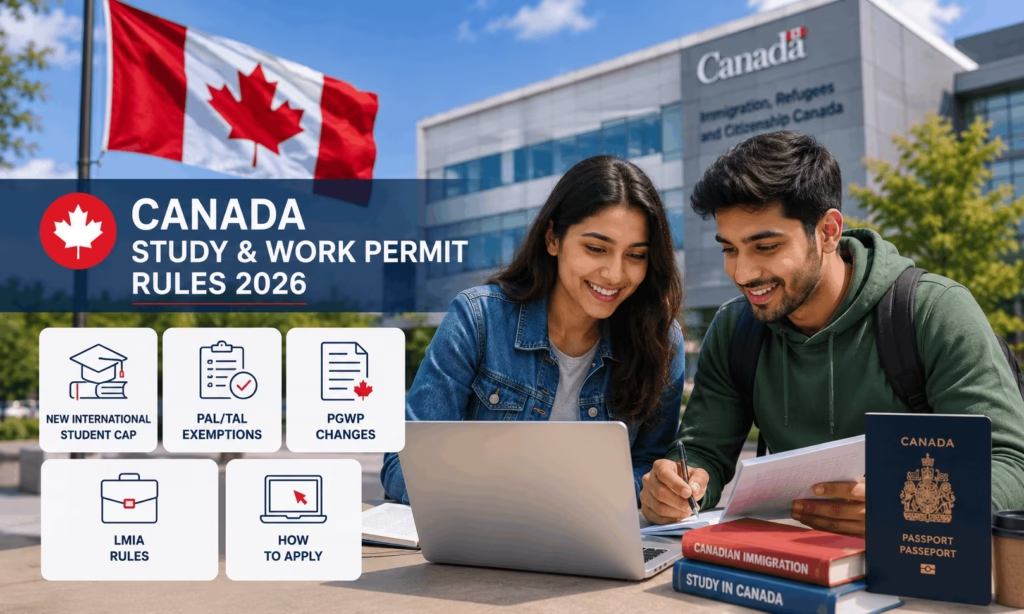
Canada Study and Work Permit Rules 2026: Canada has confirmed one of the most restrictive years yet for its international student and temporary worker programs, and the numbers released this year show exactly how far the shift has gone. Immigration, Refugees and Citizenship Canada (IRCC) will issue up to 408,000 study permits in 2026, made up of roughly 155,000 for newly arriving international students and 253,000 extensions for those already studying in the country, a figure that is nearly 50 percent lower than the new arrival numbers seen just two years ago. Alongside this, the International Mobility Program target has been set at 170,000 admissions while the Temporary Foreign Worker Program target has dropped to 60,000, a 27 percent reduction from the previous year. Together these figures confirm that Canada study and work permit rules 2026 mark a deliberate, government led effort to shrink the temporary resident population rather than a temporary adjustment.
The changes go beyond simple numbers. Starting January 1, 2026, master’s and doctoral students at public designated learning institutions no longer need a Provincial or Territorial Attestation Letter, removing them entirely from the capped allocation system that still applies to most undergraduate and college applicants. On the work permit side, Employment and Social Development Canada quietly updated how small employers calculate their low wage Temporary Foreign Worker Program cap in August 2026, while IRCC extended the concurrent processing window for certain in-Canada work permit applications from 60 to 90 days. For students, workers, employers and families planning a move to Canada, these are not minor footnotes, they directly decide who gets an application processed, who needs a provincial attestation, and who qualifies for a permit at all. We’ll be updating this article monthly so you always have the newest study permit cap, PGWP eligibility and work permit rules in one place.
Latest Update: What Changed in Canada’s Study and Work Permit System
The most consequential update this year is the confirmed 2026 international student cap, released by IRCC on November 25, 2025, and now fully in effect. IRCC expects to issue 408,000 total study permits in 2026, a 7 percent drop from 2025 and a 16 percent drop from 2024. Of that total, only 155,000 go to brand new international students, while 253,000 cover extensions for students already inside Canada. Study permit holders overall have already fallen from more than one million in January 2024 to about 725,000 by September 2025, and the government’s stated goal is to keep pushing the temporary resident share of Canada’s population below 5 percent by the end of 2027.
| Category | 2026 Figure |
|---|---|
| Total study permits expected to be issued | 408,000 |
| New international student permits | 155,000 |
| Study permit extensions for existing students | 253,000 |
| Reduction versus 2025 new arrivals | Nearly 50 percent |
| Study permit application spaces available | 309,670 |
| International Mobility Program (IMP) target | 170,000 admissions |
| Temporary Foreign Worker Program (TFWP) target | 60,000, down 27 percent from 82,000 |
| Proof of living funds required (single applicant, outside Quebec) | 22,895 Canadian dollars, plus first year tuition |
| Study permit holders in Canada (September 2025) | Approximately 725,000, down from over 1 million in January 2024 |
| Government target for temporary resident share of population | Below 5 percent by end of 2027 |
OAS Payment Increase September 2026: Confirmed Amounts, Payment Date, and the Annual GIS Reset !
Ohio SNAP Food Ban starts October 1, 2026: What’s Banned, Court Update & Rules
Canada Study Permit Rules 2026: PAL, TAL and Who Is Exempt
The Provincial or Territorial Attestation Letter, commonly called PAL or TAL, remains the single biggest gatekeeper for most study permit applicants in 2026. Most college and undergraduate applicants still need this letter from the province or territory where they plan to study before IRCC will even begin processing their study permit application. What has changed is who is exempt.
As of January 1, 2026, the following groups no longer need a PAL or TAL:
- Master’s and doctoral degree students enrolled at public designated learning institutions
- Primary and secondary school students
- Existing study permit holders extending their status at the same designated learning institution and the same level of study
- Certain government identified priority groups and vulnerable applicant cohorts
This graduate exemption is one of the most talked about pieces of Canada study and work permit rules 2026 because it takes an entire category of applicants outside the capped allocation system altogether. For a master’s or PhD applicant at a public university, this removes a major administrative barrier and effectively puts them on a separate, faster track compared to undergraduate applicants who must still compete for a limited number of provincial attestation slots. Undergraduate and college level applicants remain fully inside the cap and should expect continued competition for available spaces, particularly in larger provinces like Ontario and British Columbia.
Financial Requirements and Proof of Funds in 2026
Since September 1, 2025, applicants outside Quebec must show access to at least 22,895 Canadian dollars in living expenses for a single applicant, in addition to their first year of tuition and travel costs, a figure that carried over unchanged into 2026. For programs longer than one year, applicants must show proof that their first year’s tuition has already been paid. This financial threshold applies on top of the letter of acceptance from a designated learning institution and, where required, the PAL or TAL, and it is one of the most common reasons genuine applications get delayed when documentation is incomplete or inconsistent.
PGWP Eligibility in 2026: What Graduates Need to Know
The Post-Graduation Work Permit list of eligible fields of study has not changed for 2026 and remains stable at 1,107 eligible educational programs, following the addition of 119 new PGWP eligible fields in healthcare, trades and education back in June 2025. The field of study linked eligibility rule, which ties PGWP eligibility to programs connected with a labour market shortage, generally applies only to students who applied for their study permit on or after November 1, 2024. Bachelor’s, master’s and doctoral graduates are not affected by this restriction and continue to qualify under the standard PGWP framework, provided they meet the usual conditions around program length, full time study and graduation from an eligible designated learning institution.
Students working part time while studying can still work up to 24 hours per week off campus, a limit that has held steady through the recent rounds of policy changes and remains one of the more stable parts of the international student framework this year.
$400 Inflation Refund Checks 2026: New York’s Real Program, Fact-Checked
Stimulus Check 2026: Fact-Checking Every Viral Payment Claim (Tracker)
Social Security SSI Payment Date September 2026 Confirmed by SSA- Check Full Schedule here!
Canada Work Permit Rules 2026: LMIA and TFWP Update
While the study permit side of the system has focused on shrinking new arrivals, the work permit side has focused on tightening employer obligations and shifting the balance further toward LMIA exempt pathways. For every Temporary Foreign Worker Program spot available in 2026, there are close to three International Mobility Program spots, confirming that LMIA exempt routes are now the dominant channel for temporary work in Canada.
Several concrete rule changes have landed in 2026:
- Employment and Social Development Canada updated how employers with fewer than 10 employees calculate the low wage Labour Market Impact Assessment cap, effective August 18, 2026, now looking at staff numbers per individual work location rather than nationwide, which gives some small multi location employers more flexibility
- IRCC extended the concurrent processing period for certain in-Canada Temporary Foreign Worker Program applications from 60 days to 90 days, effective August 21, 2026, giving eligible workers an extra 30 days to submit proof of a positive or neutral LMIA
- Certain low wage LMIA applications in the Montreal and Laval economic regions will not be processed until December 31, 2026
- Eligible rural employers in participating provinces and territories may retain a higher proportion of low wage temporary foreign workers, using a 15 percent cap instead of the standard 10 percent cap, though this relief is not automatic and depends on provincial participation
- The low wage cap percentages themselves, 10 percent and 20 percent depending on employer size and sector, remain unchanged, and an LMIA is still required for most Temporary Foreign Worker Program based work permits
- Monetary penalties under the Temporary Foreign Worker Program increased significantly, reported by the government in July 2026, as compliance enforcement tightens
Canada Work Permit Changes 2026 Highlights
| Change | Effective Date | Impact |
|---|---|---|
| Small employer low wage cap calculated per location | August 18, 2026 | More flexibility for multi location small employers |
| Concurrent processing extended from 60 to 90 days | August 21, 2026 | Extra time to submit LMIA proof for in-Canada applicants |
| Montreal and Laval low wage LMIA pause | Until December 31, 2026 | Certain low wage LMIA applications not processed in these regions |
| Rural employer 15 percent cap option | Ongoing, province dependent | Higher low wage worker retention in participating rural areas |
| TFWP compliance penalties increased | Reported July 2026 | Stronger enforcement against non compliant employers |
| Unemployment rate table review | Revised quarterly, next update October 9, 2026 | Determines which regions face low wage LMIA restrictions |
Notably, IRCC’s 2026 accounting methodology now treats the Post-Graduation Work Permit as an extension or change of status rather than a new temporary resident arrival, since PGWP holders are already in Canada as students. This is why PGWP numbers no longer appear inside the International Mobility Program target, a technical change that partly explains why headline work permit numbers look sharply lower this year even though graduates transitioning from study to work are not actually being blocked by this particular shift.
How to Apply for a Canada Study or Work Permit in 2026
Applying correctly the first time matters more than ever given tighter caps and stricter document checks. Here is the general sequence for both pathways.
For a study permit:
- Secure a letter of acceptance from a designated learning institution
- Obtain a Provincial or Territorial Attestation Letter if your program and level of study require one, checking first whether you qualify for the master’s or doctoral exemption
- Gather proof of funds covering tuition and at least 22,895 Canadian dollars in living costs for a single applicant, adjusted upward for family members
- Create an account and submit your study permit application online through the official IRCC portal, along with biometrics if required
- Wait for a decision and respond promptly to any request for additional documents
For a work permit:
- Confirm which pathway applies, an LMIA based Temporary Foreign Worker Program permit or an LMIA exempt International Mobility Program category
- If LMIA based, your employer must obtain a positive or neutral Labour Market Impact Assessment from Employment and Social Development Canada before you apply
- Gather your job offer details, employment contract and any required compliance documents
- Submit your work permit application online through the official IRCC portal
- Complete biometrics and any additional verification requested, and monitor concurrent processing timelines if applicable
Study Permit and Work Permit Processing Time in 2026
Processing times continue to vary depending on permit type, application volume and document completeness, and applicants should expect longer waits in categories facing increased scrutiny under the current cap system. Work permit processing, particularly for LMIA based applications, is expected to see longer waiting periods this year due to the reduced Temporary Foreign Worker Program target and increased compliance checks on employers. The most reliable way to track processing time for any individual application is IRCC’s official processing times tool, since published averages shift regularly and do not guarantee any single case will move at the same pace.
Payment Schedule and Fees for Study and Work Permits
Government fees for both study and work permit applications are paid online at the time of submission. The general fee structure includes:
| Fee Component | Applies To |
|---|---|
| Study permit processing fee | Every study permit applicant |
| Work permit processing fee | Every work permit applicant, LMIA based or LMIA exempt |
| Labour Market Impact Assessment fee | Employer, paid before an LMIA based work permit application |
| Biometrics fee | Applicants required to give biometrics, per family member |
| Open work permit holder fee | Applicants applying for an open, unrestricted work permit |
| Restoration of status fee | Applicants who need to restore status after it lapses |
Fee amounts are updated periodically, so applicants and employers should always confirm the exact current figures on IRCC’s official fees page rather than relying on outdated third party numbers.
Trump Accounts Dell $250 Grant: Did Deposits Actually Start Monday? Here’s Who’s Actually Been Paid
2027 Social Security COLA Forecast: Latest 3.6% Estimate and How Much Retirees Could Get
$2000 Stimulus Payment September 2026 Fact-Check: Is It Really Coming?
Impact on International Students and Employers in 2026
For students, the practical effect of Canada study and work permit rules 2026 depends heavily on the intended level of study. Undergraduate and college applicants face continued competition for a capped number of provincial attestation slots, alongside stricter financial documentation requirements, and should expect refusal rates to remain a real factor in planning, since mid 2025 refusal rates reached as high as 65.4 percent before easing somewhat. Master’s and doctoral applicants at public institutions, by contrast, now face a noticeably smoother path with the PAL and TAL requirement removed entirely.
For employers, the direction is equally clear, LMIA exempt hiring through the International Mobility Program is now far easier to justify than LMIA based hiring through the Temporary Foreign Worker Program, both in terms of processing speed and cost. Employers who still need to hire through the Temporary Foreign Worker Program should expect closer scrutiny of wage levels, regional unemployment data, and low wage worker caps, along with materially higher penalties for non compliance.
Official Canada Study and Work Permit Resources and Links
Always verify caps, fees, PAL requirements and processing times directly through IRCC’s official channels rather than third party summaries.
| Resource | Purpose | Official Link |
|---|---|---|
| Apply for a study permit | Study permit application and login | canada.ca/en/immigration-refugees-citizenship/services/study-canada/study-permit.html |
| Apply for a work permit | Work permit application and login | canada.ca/en/immigration-refugees-citizenship/services/work-canada.html |
| IRCC secure account login | Manage applications and profiles | canada.ca/en/immigration-refugees-citizenship/services/application/account.html |
| Check application status | Track a submitted study or work permit application | canada.ca/en/immigration-refugees-citizenship/services/application/check-status.html |
| International student cap and PAL/TAL information | Current provincial and territorial allocations | canada.ca/en/immigration-refugees-citizenship/news/notices/2026-provincial-territorial-allocations-under-international-student-cap.html |
| Post-Graduation Work Permit eligibility | Check eligible programs and institutions | canada.ca/en/immigration-refugees-citizenship/services/study-canada/work/after-graduation/eligibility.html |
| Labour Market Impact Assessment information | Employer guidance for LMIA applications | canada.ca/en/employment-social-development/services/foreign-workers/median-wage.html |
| Processing times | Check current study and work permit processing times | canada.ca/en/immigration-refugees-citizenship/services/application/check-processing-times.html |
| Fees | Current government processing fees | canada.ca/en/immigration-refugees-citizenship/services/study-canada/study-permit/fees.html |
FAQs on Canada Study and Work Permit Rules 2026
How many study permits will Canada issue in 2026?
IRCC expects to issue up to 408,000 study permits in 2026, including 155,000 for new international students and 253,000 extensions for students already in Canada.
Do master’s and PhD students need a PAL or TAL in 2026?
No. As of January 1, 2026, master’s and doctoral students at public designated learning institutions are exempt from the Provincial or Territorial Attestation Letter requirement and fall outside the capped allocation system.
How much money do I need to show for a Canada study permit in 2026?
Single applicants outside Quebec must show at least 22,895 Canadian dollars in living funds, on top of first year tuition and travel costs.
Has the PGWP eligible program list changed for 2026?
No, the list remains stable at 1,107 eligible programs, unchanged since the addition of 119 new fields in June 2025. The labour market shortage linked eligibility rule mainly applies to students who applied for a study permit on or after November 1, 2024, and does not affect bachelor’s, master’s or doctoral graduates.
What is the Temporary Foreign Worker Program target for 2026?
The Temporary Foreign Worker Program target has been reduced to 60,000 admissions, down 27 percent from 82,000 the previous year, while the International Mobility Program target sits at 170,000.
How many hours can international students work off campus in 2026?
International students can continue to work up to 24 hours per week off campus during academic sessions.
Is an LMIA still required for most work permits in 2026?
Yes, an LMIA is still required for most Temporary Foreign Worker Program based work permits, though IRCC and Employment and Social Development Canada have introduced processing and calculation changes that affect specific groups of employers and workers.
How long does a Canada work permit take to process in 2026?
Processing time varies by permit type and category, and LMIA based applications are generally taking longer this year due to the reduced program target and increased compliance checks. Checking IRCC’s official processing times tool gives the most accurate current estimate for a specific application.
Conclusion
Canada study and work permit rules 2026 reflect a system that is being deliberately reshaped around sustainability rather than growth, with a lower overall study permit cap, a meaningful new exemption for graduate students, a shrinking Temporary Foreign Worker Program, and tighter compliance rules for employers. The practical message for anyone planning a move is that the path has not closed, it has simply become more selective, favoring master’s and doctoral applicants, LMIA exempt work permit categories, and applicants who submit complete, accurate documentation the first time. With policy details still shifting through the year, from quarterly unemployment rate updates to regional LMIA pauses, the safest approach remains checking IRCC’s official pages directly before making any final decision.
Canada 50% Tariff 2026: 700 US Goods Hit With Tariffs Up to 50% From September 8
Social Security Changes September 2026: SSA Announces Major Update for Retirees and Beneficiaries
Minimum Wage Increase in 5 Canadian Provinces: What Changes October 1, 2026