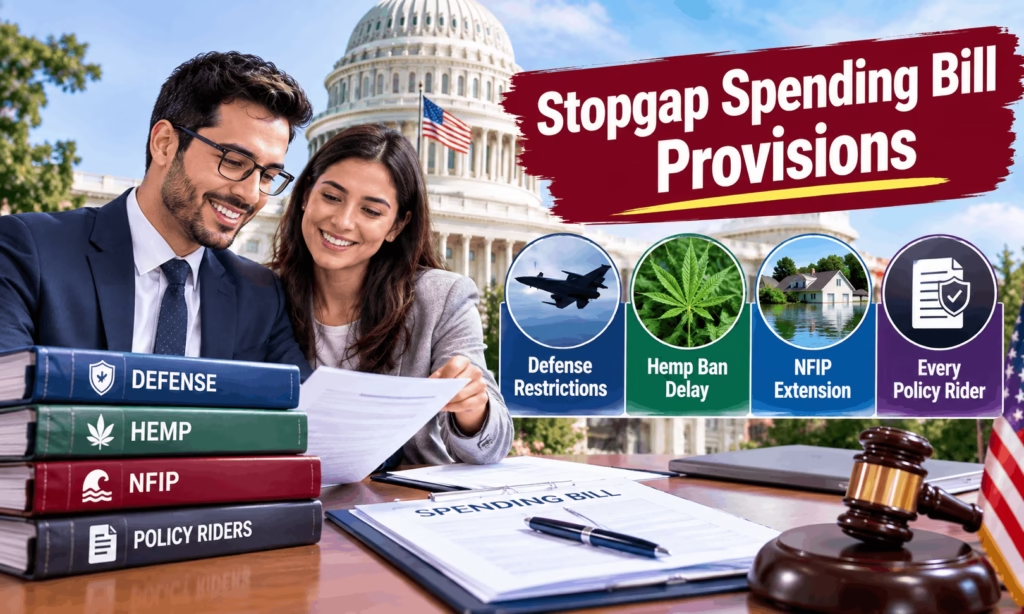
Government Shutdown Stopgap Spending Bill: The headline news that Congress avoided another government shutdown has already circulated widely, but the actual text of the Continuing Appropriations and Extensions Act, 2027 contains a long list of specific policy provisions that go well beyond simply keeping the lights on in federal agencies. Signed into law by President Trump on September 2, 2026, just 28 days before the fiscal year ended, the bill locks in fiscal year 2026 funding levels through December 11, but it also includes targeted restrictions on defense spending, a delayed ban on intoxicating hemp products, an extension of flood insurance, and a block on a controversial White House budget rule that has drawn bipartisan opposition from appropriators in both parties.
House Speaker Mike Johnson framed the bill’s passage as evidence that Republicans have made real progress restoring a committee-driven appropriations process, while House Appropriations Committee Ranking Member Rosa DeLauro used the moment to warn that any final fiscal year 2027 agreement must permanently block the disputed budget rule from ever taking effect. Both statements point to the same underlying reality: this is a temporary patch, not a resolution, and not a single one of the twelve full-year fiscal 2027 appropriations bills has passed both chambers of Congress as of this bill’s signing. We’ll be updating this article monthly as Congress works through fall negotiations ahead of the new December 11 deadline.
The Vote Count and Basic Structure
| Detail | Information |
|---|---|
| Official name | Continuing Appropriations and Extensions Act, 2027 |
| Senate vote | 90 to 6, August 8, 2026 |
| House vote | 370 to 48, September 1, 2026, under suspension of the rules |
| House opposition breakdown | 19 Republicans, largely House Freedom Caucus members, and 29 Democrats voted against |
| Presidential signature | September 2, 2026 |
| Funding level | Fiscal year 2026 levels, held flat rather than increased or cut |
| New deadline | December 11, 2026, or enactment of the applicable full-year appropriations act, whichever comes first |
Defense Spending Restrictions Inside the Bill
One of the most significant, and least publicized, provisions in this continuing resolution places firm limits on how the Department of Defense, now referred to as the War Department under current administration terminology, can spend money during the funding gap.
| Defense Provision | What It Restricts |
|---|---|
| New production starts | War Department funds cannot be used to begin new production of items not already funded for production in fiscal 2026 or earlier |
| Production rate increases | Agencies cannot raise production rates above what fiscal 2026 funding levels can sustain |
| New project or program starts | Agencies cannot initiate, resume, or continue any project, activity, or program element that lacked appropriations during fiscal 2026 |
| Multiyear procurement | The bill blocks new multiyear procurements using advance procurement funding for economic order quantity purchases, unless Congress later appropriates specifically for them |
| Navy shipbuilding exceptions | The Navy’s shipbuilding and conversion funds may be apportioned to cover prior-year cost increases across 20 specific programs |
| Largest shipbuilding ceiling | $566.5 million for the 2021 Columbia-class submarine program |
| Second-largest shipbuilding ceiling | $561.1 million for the 2019 Virginia-class submarine program |
These restrictions matter because they prevent the Pentagon from using the continuing resolution period to launch new weapons programs or expand production beyond what was already funded, effectively freezing major new defense initiatives until Congress passes full-year appropriations.
Is It Hard to Refinance Student Loan, and What Are the Pros and Cons of Doing It?
Tax Filing Season 2027: IRS Start Date, Deadlines and Refund Schedule
SNAP Maximum Benefits FY2027 Confirmed: Family of Four Gets Up to $1,023 (Effective Oct 1, 2026)
Cognizant Green Card Filings Frozen as US Labor Department Escalates Visa Fraud Crackdown
CRA Tax Season 2027: Check Here Complete T1 Filing Guide for Your 2026 Return
The Delayed Intoxicating Hemp Ban
A separate, unrelated policy matter tucked into this funding bill affects an entirely different industry, and it was specifically requested by the White House.
| Hemp Provision | Detail |
|---|---|
| What was delayed | A new nationwide ban on intoxicating hemp products, originally scheduled to take effect this fall |
| Who requested the delay | The White House |
| Partial exception | Restrictions on certain synthetic hemp-derived products originating from China still take effect in November, regardless of the broader delay |
| Future outlook | The administration has stated it will not seek another extension later this year, facing opposition from some congressional Republicans |
The Blocked OMB Grant-Making Rule
Perhaps the most politically contentious provision in the entire bill involves a proposed rule change at the Office of Management and Budget that drew opposition from appropriators across party lines.
- The continuing resolution prohibits OMB from issuing or finalizing revisions to its Uniform Guidance through December 11, 2026
- The blocked rule would give senior political appointees significantly greater influence over federal grant-making decisions at nearly every level
- The rule had originally been scheduled to take effect in October 2026, timed to coincide with the start of the new fiscal year
- Democratic appropriators, including Ranking Member Rosa DeLauro, have signaled they will push for a permanent block on the rule as part of any final fiscal year 2027 appropriations agreement, while some Republicans have indicated support for allowing the rule to eventually proceed
Program Extensions Bundled Into the Bill
Beyond the headline funding patch, this continuing resolution extends authorization for a wide range of federal programs that were otherwise set to lapse at the September 30 fiscal year deadline.
| Program | Extension Detail |
|---|---|
| National Flood Insurance Program | Authorization extended through December 11, preventing a lapse in flood insurance availability |
| Food for Peace and related foreign aid programs | Continued funding through the same deadline |
| Surface transportation and highway infrastructure programs | Major highway and infrastructure funding continues rather than expiring September 30 |
| African Growth and Opportunity Act | Trade preference program extended through December 11 |
| Defense Production Act authority | Extended, preserving the federal government’s authority to direct industry production of critical materials |
| Technology Modernization Fund | Extended through December 11 |
| Cybersecurity information-sharing authorities | Extended through the same deadline |
| Veterans’ healthcare and economic support programs | Continuity ensured through specific funding anomalies included in the bill |
Why Lawmakers Chose December 11 as the Deadline
The specific timing was a deliberate political calculation rather than an arbitrary date, and multiple lawmakers and analysts pointed to the same underlying motivation.
- Both parties faced pressure to avoid a shutdown occurring one month before the November 2026 midterm elections, a scenario that risked politically damaging either or both parties depending on how blame was assigned
- The House had initially passed its own version of a continuing resolution extending funding only to December 4, before ultimately adopting the Senate’s slightly longer December 11 date
- The House did not return to Washington until after a five-week recess specifically to take up this bill, passing it under suspension of the rules, a procedure requiring a two-thirds majority that ultimately succeeded given the bill’s broad bipartisan support
- With the House not expected to return again until after the November elections, attention has now shifted to whether the Senate will begin posting its own full-year fiscal 2027 appropriations bills for floor consideration during the fall
IRS Identity Protection PIN: How to Get One and Stop Tax Fraud
Express Entry Labour Shortage Categories 2027: What Canada May Tighten?
The State of Full-Year Fiscal 2027 Appropriations
Understanding how far Congress actually is from completing its full-year budget work explains why this stopgap was necessary and highlights the scale of work still remaining before December 11.
- As of this bill’s enactment, not a single one of the twelve full-year fiscal year 2027 appropriations bills had passed both chambers of Congress
- The House had made some earlier progress on individual fiscal year 2026 appropriations bills prior to this cycle, but fiscal year 2027 work remained essentially at the starting line when this continuing resolution was signed
- House Speaker Mike Johnson characterized recent progress as a return to a more traditional, committee-driven appropriations process, suggesting the House intends to move individual bills rather than relying solely on another broad continuing resolution
- Whether the Senate follows a similar committee-by-committee approach, or instead moves toward another omnibus-style package closer to the December 11 deadline, remains an open question heading into the fall
How to Apply for Programs Affected by the Continuing Resolution?
For individuals and organizations that rely on programs specifically extended or affected by this bill, understanding how to access them during the continuing resolution period matters directly.
- National Flood Insurance Program policyholders and applicants should continue working through their normal insurance provider or FEMA channels, since the program’s authorization gap was specifically avoided by this bill
- Veterans seeking healthcare or economic support benefits should continue using standard VA application channels, since this bill includes specific funding anomalies protecting program continuity
- Organizations receiving federal grants should watch for further guidance on the paused OMB Uniform Guidance revisions, since the underlying rule review process remains delayed rather than canceled
- Defense contractors and suppliers should consult directly with their contracting officers regarding how the production and procurement restrictions in this bill affect specific existing contracts
Processing Time: What Happens Between Now and December 11
Understanding the practical timeline for what comes next helps set expectations for federal agencies, contractors, and program participants navigating this temporary funding period.
| Step | Expected Timing |
|---|---|
| Current continuing resolution in effect | September 2, 2026 through December 11, 2026 |
| House return to session | Not expected until after the November 2026 midterm elections |
| Senate appropriations committee work | Expected to continue through the fall, with individual bills potentially advancing to the floor |
| Full fiscal year 2027 appropriations completion | Uncertain; depends on whether Congress completes individual bills or resorts to another continuing resolution or omnibus package by December 11 |
| OMB Uniform Guidance rule status | Remains paused through December 11, with its longer-term fate to be decided during year-end negotiations |
Payment Schedule: How Funding Actually Flows Under This Bill
Because this is a continuing resolution rather than new appropriations legislation, the mechanics of how money moves to agencies and programs differ from a standard budget year.
- Federal agencies continue drawing funding at their fiscal year 2026 levels throughout the continuing resolution period, without the increases or decreases that would come with new fiscal year 2027 appropriations
- Programs with specific funding anomalies, including veterans’ benefits and certain disaster relief programs, receive adjusted funding levels within the continuing resolution rather than waiting for full-year appropriations
- Defense programs subject to the production and procurement restrictions in this bill will see delayed fund disbursement for any new starts that do not qualify under the bill’s specific exceptions
- Should Congress fail to act again by December 11, 2026, funding would lapse entirely for any agency without either a signed full-year appropriations bill or a subsequent continuing resolution in place
UPS Tariff Refund: Who Is Eligible to Get One and How Can You Apply?
Ontario Minimum Wage Rises to $17.95 on Oct 1, 2026
SNAP Income Limits FY2027 Confirmed: Single Applicants Capped at $1,729, Family of Four at $3,575
Official Resources for Tracking Federal Funding Status
Given how quickly appropriations negotiations can shift, individuals, contractors, and organizations should rely on official congressional and agency sources for the latest confirmed information.
| Resource | Purpose | Official Link |
|---|---|---|
| House Appropriations Committee | Official bill text, committee news, and markup schedules | appropriations.house.gov |
| Senate Appropriations Committee | Official Senate-side appropriations bill tracking and hearings | appropriations.senate.gov |
| Congress.gov bill tracker | Full legislative text and status of the Continuing Appropriations and Extensions Act, 2027 | congress.gov |
| Office of Management and Budget | Federal budget guidance and the status of the paused Uniform Guidance rule | omb.gov |
| FEMA National Flood Insurance Program | Policyholder resources and program status | fema.gov/flood-insurance |
| Department of Veterans Affairs | Veterans benefits and healthcare program access | va.gov |
FAQs About Stopgap Spending Bill Provisions
What is in the stopgap spending bill besides basic funding?
Beyond extending fiscal year 2026 funding levels, the bill restricts new Defense Department production starts, delays a nationwide intoxicating hemp product ban, blocks a controversial OMB grant-making rule, and extends programs including the National Flood Insurance Program, surface transportation funding, and the Defense Production Act.
When does the current government funding deadline expire?
The continuing resolution funds the government through December 11, 2026, or until the applicable full-year fiscal 2027 appropriations act is enacted, whichever happens first.
Why did the bill restrict new Defense Department spending?
The restrictions prevent the Pentagon from using continuing resolution funding to launch entirely new weapons programs or increase production beyond fiscal 2026 levels, with limited exceptions for prior-year cost increases on 20 existing Navy shipbuilding programs.
What happened to the intoxicating hemp product ban?
The bill delays the ban at the White House’s request, though restrictions on certain synthetic hemp products from China still take effect in November regardless of the broader delay.
What is the OMB rule that this bill blocks?
The bill prevents the Office of Management and Budget from finalizing a proposed rule that would give political appointees significantly greater control over federal grant-making decisions, pausing implementation through December 11.
How many fiscal year 2027 appropriations bills has Congress passed?
As of this continuing resolution’s signing, not a single one of the twelve full-year fiscal year 2027 appropriations bills had passed both the House and Senate.
Does this bill increase or cut federal agency funding?
No. The bill holds most federal agency funding flat at fiscal year 2026 levels rather than implementing any new increases or cuts, deferring those decisions to later full-year appropriations.
Which infrastructure and insurance programs does this bill extend?
The bill extends the National Flood Insurance Program, surface transportation and highway infrastructure funding, and the African Growth and Opportunity Act trade program, all of which were otherwise set to lapse September 30.
How did lawmakers vote on this continuing resolution?
The Senate passed it 90 to 6 on August 8, 2026, and the House passed it 370 to 48 on September 1, 2026, with opposition split between 19 Republicans and 29 Democrats in the House.
What happens if Congress does not pass new funding by December 11?
If Congress fails to enact either full fiscal year 2027 appropriations or another continuing resolution by December 11, 2026, federal agencies without covered funding would face another shutdown.
Conclusion
The stopgap spending bill signed into law on September 2, 2026 does far more than simply avoid a government shutdown, embedding specific restrictions on defense production, a delayed hemp product ban, a paused OMB grant-making rule, and extensions for programs ranging from flood insurance to veterans’ benefits, all inside a single piece of legislation. With not one of the twelve full-year fiscal 2027 appropriations bills yet passed by both chambers, the real appropriations work Congress deferred by choosing this December 11 deadline remains almost entirely ahead of it, set against the backdrop of a House that will not return to session again until after the November midterm elections. Whether lawmakers use the coming weeks to pass individual, committee-driven bills as Speaker Johnson has suggested, or fall back on another broad continuing resolution, will determine whether December 11 becomes a formality or the site of the next real funding showdown. As appropriations work continues through the fall, check back here, since this article is reviewed and updated with the latest confirmed information each month.
SSDI Pay Chart: The Least Amount You Can Get Per Month and the Most Common Disabilities
Ohio SNAP Sugary Beverage Ban Delayed: What Happened and Why