
Green Card Rule Changes: The green card applicants had been watching for months has passed. The DHS public charge rule took effect on September 18, 2026, and every adjustment of status case is now sorted by one question: when was your Form I-485 postmarked or filed electronically? If it went in before that date, your case stays under the older, narrower 2022 framework. If it went in on or after that date, officers now apply a much broader, discretion-based standard.
This article explains what changed, which applicants are affected, what the new Form I-485 asks, where the lawsuits stand, and what you can still do to protect your application. We update it as USCIS issues more guidance and as the courts act. DHS announced the final rule on July 16, 2026, and published it in the Federal Register on July 20, 2026, with an effective date of September 18, 2026.The changes are not retroactive. The new policy applies only to I-485 applications postmarked or e-filed on or after September 18, 2026.

What Is the Public Charge Test?
The public charge ground comes from Section 212(a)(4) of the Immigration and Nationality Act. It asks whether a person applying for a visa, admission at a port of entry, or adjustment of status is likely at any time to become a public charge. An officer who answers yes can find the applicant inadmissible and deny the green card.
The law itself has not changed. What has changed is how much room officers have to measure it. Congress listed factors that officers must consider: age, health, family status, assets, resources and financial status, and education and skills. The Affidavit of Support (Form I-864) is also required in most family-based cases. The 2022 rule told officers how to weigh these factors and which benefits could count. The 2026 rule removes that structure.
Green Card Rule Changes Over 30 Years: Four Major Immigration Policy Shifts
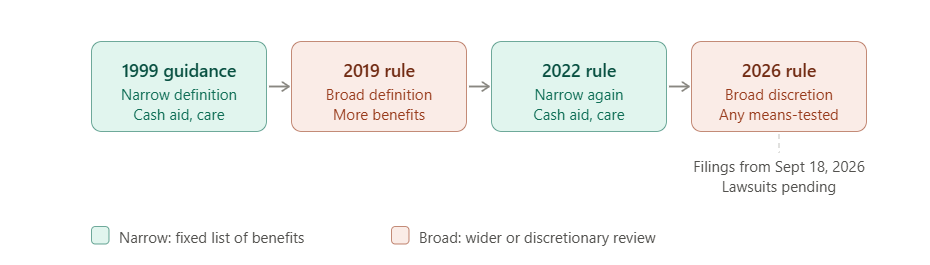
The public charge test has shifted repeatedly:
- 1999 field guidance: The definition was narrow and focused mainly on cash assistance for income maintenance and long-term institutionalization at government expense.
- 2019 rule (first Trump administration): The definition widened significantly and added more benefits to the list. A court later vacated it, and DHS discontinued it in 2021.
- 2022 rule (Biden administration): It returned to a narrow approach, limited officers to a defined set of benefits and set out detailed instructions for weighing each factor.
- 2026 rule: DHS concluded that all the earlier frameworks unduly constrained officers. The rule removes the core 2022 provisions, including the definitions of “public charge” and “receipt of public benefits,” and returns to a case-by-case approach
2027 Tax Changes: 8 IRS Limits and Rates to Know
FTC Refund 2026: Millions of Americans May Be Owed Money and Most Don’t Know It
New York Free Air Conditioner Program 2026: Eligibility, Rules, Application and Deadline
Why These Green Card Rule Changes Are Happening Now
Since 1999, three different frameworks have shaped how this test gets applied. The 1999 field guidance kept the definition narrow, counting mainly cash assistance and long-term institutional care paid for by the government. The 2019 rule under the first Trump administration widened that definition considerably. The 2022 rule under the Biden administration then narrowed it back, limiting officers to a defined list of benefits and setting out detailed terms for how each factor should be weighed.
DHS has now labeled the 2022 approach overly restrictive, arguing it prevented officers from making individualized, fact based decisions. The new rule does not replace that framework with another detailed checklist. Instead, it removes most of the 2022 regulatory language and restores officer discretion to review a case on the totality of the circumstances, guided directly by the statute rather than a fixed list of countable benefits.
The Core Factors Officers Must Weigh
Under federal law, officers are required to consider several statutory factors before making a public charge determination. These factors are not new, but with the 2022 guardrails removed, officers now have far more latitude in how heavily each one is weighed. The core factors include:
- Age of the applicant, since very young or older applicants may face different employment prospects
- Health, including any medical condition that could affect the ability to work or that would require extensive, uncompensated care
- Family status, meaning household size and the number of dependents relying on the applicant
- Assets, resources and financial condition, covering income, savings, debts and overall financial stability
- Education and skills, since stronger qualifications suggest a higher likelihood of steady employment
- The Affidavit of Support, a binding pledge from a financial sponsor that is required for most family based green card cases
Green Card Rule Changes Key Dates and Details
| Detail | Information |
|---|---|
| Rule announced | July 16, 2026 |
| Published in Federal Register | July 20, 2026 |
| Effective date | September 18, 2026 |
| What is being rescinded | 2022 public charge final rule (8 CFR 212.20 to 212.23) |
| What stays in place | The statutory public charge ground under INA Section 212(a)(4) |
| Applies to | Form I-485 adjustment of status applications postmarked or filed electronically on or after September 18, 2026, and applications for admission on or after that date |
| Benefits received before September 18, 2026 | Assessed under the older, narrower 2022 rule |
| Form I-485 requirement | Older editions of the form will be rejected once the new edition is required after the effective date |
| Public charge bonds | Bond terms revised; a bond posted on or after September 18, 2026 can be breached by receiving a means tested benefit before death, permanent departure or naturalization |
Who Is Affected by This Change
The revised standard reaches a wide group of people. It applies to family based and employment based green card applicants filing adjustment of status from within the United States, as well as people applying for admission at a port of entry or through consular processing overseas. It does not apply retroactively to benefits received before the effective date, and it does not apply to categories that are statutorily exempt from the public charge ground, such as refugees, asylees and certain other humanitarian categories.
For applicants with a green card case already pending, the filing date is the factor that decides which framework applies. An adjustment of status application properly postmarked or submitted electronically and accepted by USCIS before September 18, 2026 continues to be evaluated under the current, more limited 2022 rule, even if a decision comes after that date. Anyone who plans to file soon should factor this deadline into their timeline.
Green card rule changes calculator
Find out which public charge rule applies to your Form I-485, which benefits can count, and which form edition you need.
What Exactly Changed on September 18
1. The “primary dependence” standard is gone
Under the 2022 rule, an applicant was a public charge only if likely to become primarily dependent on the government. The new rule moves away from that standard. Officers can now weigh public benefit use even when the government is not the applicant’s main source of support.
2. More benefits can count
The change is easiest to see by comparing benefits received before and after the effective date:
- Benefits received before September 18, 2026: USCIS considers only public cash assistance for income maintenance and long-term institutionalization at the government’s expense.
- Benefits received on or after September 18, 2026: USCIS says it will consider any and all means-tested public benefits.
3. Officers get totality-of-the-circumstances discretion
Without the 2022 checklist, officers weigh the statutory factors directly. Two applicants with similar incomes can get different outcomes depending on health, employment record, household size, insurance, education and how well the sponsor’s Affidavit of Support holds up.
4. A new Form I-485 asks much more
As of September 18, 2026, USCIS requires a new edition of Form I-485, and it gave no grace period for older versions. The revised form asks for more detail about family, finances, education, skills and use of means-tested benefits. Part 9 was rewritten. Applicants subject to public charge are asked whether they have ever received a means-tested benefit, and if so, the type, dates, value and reason.
5. The Affidavit of Support gets more scrutiny
USCIS has said that an I-485 filed with an older I-864 edition after October 1 is not rejected outright. It is treated as missing initial evidence. The new edition also allows USCIS to request consumer report information about the sponsor, so a sponsor with a credit freeze should be ready to lift it.
6. Public charge bonds are stricter
A bond submitted on or after September 18, 2026 is breached if the bonded person receives any means-tested public benefit before death, permanent departure or naturalization. Under the older rule, only cash assistance for income maintenance or long-term institutionalization at government expense triggered a breach
Who Is Not Affected by New Benefit Rules:
- Applicants whose I-485 was properly filed before September 18, 2026. These cases stay under the 2022 framework even if a decision comes later.
- Categories statutorily exempt from the public charge ground, such as refugees, asylees and certain other humanitarian categories. DHS said the rule changes which public benefits are considered, not which people are exempt.
- People who received benefits before the effective date, whose benefits are assessed under the older, narrower rule
How to Strengthen a Green Card Application Under the New Standard
Immigration attorneys are advising applicants to treat documentation as the strongest defense against an unfavorable public charge finding. Steps commonly recommended include:
- Gather recent pay stubs, tax transcripts and bank statements to demonstrate steady income and savings
- Collect proof of private health insurance or employer sponsored coverage
- Include diplomas, certifications and professional licenses that support employability
- Prepare a complete and well documented Affidavit of Support from the financial sponsor
- Keep records of any public benefits received, including the dates, since benefits used before September 18, 2026 are judged under the older rule
- File a complete adjustment of status package as early as possible if the goal is to remain under the current framework
Official Resources for Green Card Applicants
| Resource | Purpose | Official Link |
|---|---|---|
| USCIS Public Charge Page | Official policy updates and guidance | Visit USCIS Public Charge |
| Form I-485 | Application to Register Permanent Residence or Adjust Status | Download Form I-485 |
| USCIS Case Status Online | Track a pending green card application | Check Case Status |
| USCIS Online Account Registration | Create an account to file and manage forms | Create USCIS Account |
| Federal Register | Access official federal rules and legal notices | Visit Federal Register |
| Form I-864 Affidavit of Support | Sponsor’s financial support document | Download Form I-864 |
FAQs About Green Card Rule Changes
Does using Medicaid or SNAP automatically make me a public charge?
No. Benefit use is one factor officers weigh, not an automatic disqualifier. But for benefits received on or after September 18, 2026, officers may now consider any means-tested benefit. Benefits received before that date are judged under the narrower 2022 rule.
Is it too late to file under the old rule?
Yes. The cutoff was September 18, 2026. Only applications properly filed before that date remain under the 2022 framework.
Will USCIS reject my Form I-485 if I use the old edition?
Yes. USCIS requires the 09/18/26 edition for anything postmarked or e-filed on or after September 18, and it gave no grace period.
Who is exempt from the public charge test?
Refugees, asylees and several other humanitarian based categories are statutorily exempt and should not be penalized for benefit use under either the old or new framework.
Does this rule change who qualifies for public benefits?
No. The rule does not change eligibility for federal, state or local benefit programs. It changes only how benefit use and other personal factors can be weighed in an immigration officer’s public charge decision.