
DHS “Hold and Review” Policy: Thousands of green card, work permit, and citizenship applicants from nearly 40 countries have spent much of 2026 in legal limbo, and the latest court ruling in their case has only partially resolved that uncertainty. The Hold and Review policy, first issued by USCIS on December 2, 2025 and expanded on January 1, 2026, froze nearly every category of immigration benefit application filed by nationals of countries covered under the Trump administration’s travel ban, including green cards, work permits, naturalization, and asylum claims, regardless of how long the applicant had lived in the United States. A federal judge in Rhode Island struck down the policy entirely on June 5, 2026, but on August 14, 2026, the First Circuit Court of Appeals partially reversed course, allowing USCIS to resume one part of the policy, the Comprehensive Re-Review Policy, while the rest remains blocked. We’ll be updating this article monthly as the appeal proceeds and USCIS issues further guidance.
For applicants and their families, the practical reality right now is genuinely mixed. Three of the four original hold policies, the Benefits Hold Policy, the Global Asylum Hold Policy, and the Country-Specific Factors Policy, remain vacated and blocked as of this writing, meaning USCIS should be adjudicating pending Form I-130, I-485, N-400, I-589, and I-765 applications normally for affected nationals. But the Comprehensive Re-Review Policy, which allows USCIS to re-examine already-approved benefits granted since January 20, 2021, is back in effect while the underlying appeal continues, and immigration attorneys report that many previously delayed cases still have not shown visible movement despite the court’s order. This article breaks down exactly what the Hold and Review policy does, which policies are currently blocked versus active, and what affected applicants should do right now.
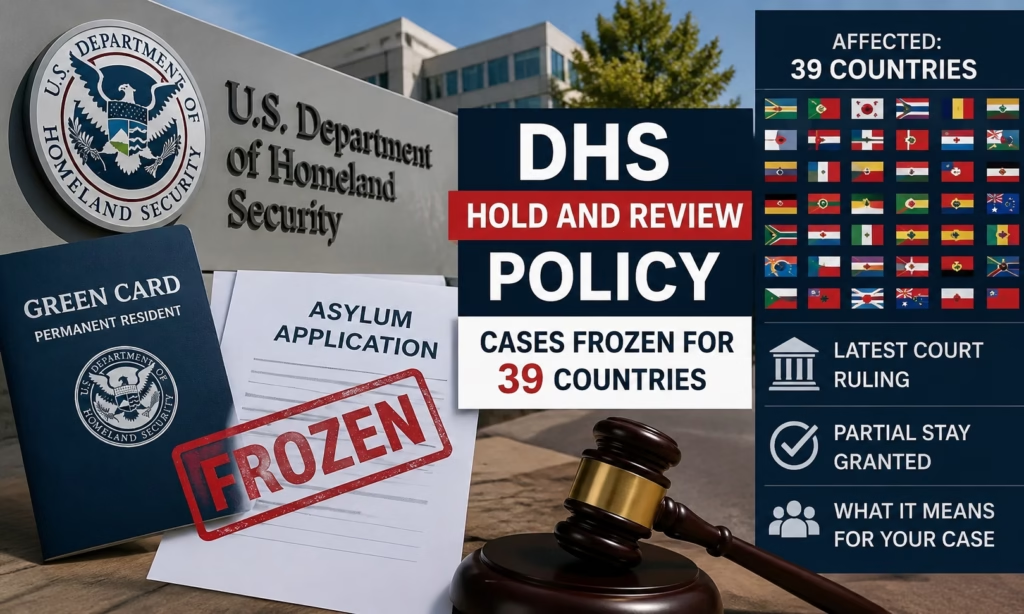
Key Highlights of the Hold and Review Policy and Its Legal Status
| Detail | Information |
|---|---|
| Original policy memo | PM-602-0192, issued December 2, 2025 |
| Original scope | 19 countries under Presidential Proclamation 10949 |
| Expanded policy memo | PM-602-0194, issued January 1, 2026 |
| Expanded scope | 39 countries under Presidential Proclamation 10998, plus Palestinian Authority document holders |
| District court ruling | June 5, 2026, U.S. District Court for the District of Rhode Island |
| Case name | Dorcas International Institute of Rhode Island v. USCIS |
| Final judgment date | June 11, 2026 |
| Government’s appeal filed | June 12, 2026, First Circuit Court of Appeals |
| First Circuit partial stay ruling | August 14, 2026 |
| Policies currently vacated (blocked) | Benefits Hold Policy, Global Asylum Hold Policy, Country-Specific Factors Policy |
| Policy currently reinstated (active) | Comprehensive Re-Review Policy |
| Appeal case number | Docket No. 26-01703, First Circuit |
What the Hold and Review Policy Actually Does
The Hold and Review policy was never a single document, it was a package of four separate USCIS directives that together paused or restricted adjudication for applicants tied to travel ban countries. Understanding the difference between these four policies matters because, as of August 2026, they are no longer treated the same way under the law.
The Benefits Hold Policy placed an indefinite adjudicative hold on pending immigration benefit requests filed by anyone born in or a citizen of a listed country, regardless of how long they had lived in the U.S. or whether they held a valid visa. This included Form I-130 family petitions, Form I-485 adjustment of status applications, Form N-400 naturalization applications, and Form I-765 work permit requests.
The Global Asylum Hold Policy froze every pending Form I-589 asylum application nationwide, regardless of the applicant’s nationality, not just those from listed countries, citing the need for a comprehensive review of screening and vetting procedures.
The Comprehensive Re-Review Policy directed USCIS to re-examine immigration benefits already approved on or after January 20, 2021, for individuals from listed countries, including potential re-interviews.
The Country-Specific Factors Policy built country-of-origin considerations directly into adjudication decisions for listed nationals.
SNAP State Cost-Share 2027: The New Rule That Could Force States to Pay Billions in Food Benefits
The 39 Countries Currently Covered Under the Travel Ban and Hold Policies
The scope of affected countries expanded significantly between the original June 2025 travel ban and the December 2025 expansion. The original travel ban, effective June 9, 2025, applied full entry suspension to citizens of Afghanistan, Myanmar, Chad, the Republic of Congo, Equatorial Guinea, Eritrea, Haiti, Iran, Libya, Somalia, Sudan, and Yemen, with partial restrictions on Burundi, Cuba, Laos, Sierra Leone, Togo, Turkmenistan, and Venezuela, totaling 19 countries. Presidential Proclamation 10998, signed December 16, 2025 and effective January 1, 2026, more than doubled that list to 39 countries plus individuals traveling on Palestinian Authority-issued documents, expanding the Hold and Review policy’s reach to match.
Timeline: How the Hold and Review Policy Reached the Courts
| Date | Event |
|---|---|
| June 4, 2025 | Presidential Proclamation 10949 signed, original 19-country travel ban |
| June 9, 2025 | Original travel ban takes effect |
| December 2, 2025 | USCIS issues PM-602-0192, “Hold and Review” policy memo for 19 countries |
| December 16, 2025 | Presidential Proclamation 10998 signed, expanding travel ban to 39 countries |
| January 1, 2026 | Expanded travel ban and PM-602-0194 take effect, covering 39 countries |
| March 5, 2026 | Dorcas International Institute of Rhode Island v. USCIS filed in district court |
| June 5, 2026 | District court vacates all four Hold and Review policies as unlawful under the APA |
| June 11, 2026 | District court issues final judgment clarifying its order |
| June 12, 2026 | USCIS files notice of appeal with the First Circuit Court of Appeals |
| August 14, 2026 | First Circuit issues partial stay, reinstating only the Comprehensive Re-Review Policy |
Why the District Court Struck Down the Hold and Review Policy
Chief Judge John J. McConnell Jr. of the U.S. District Court for the District of Rhode Island issued a 135-page decision on June 5, 2026, finding that each of the four challenged policies violated the Administrative Procedure Act and exceeded USCIS’s statutory authority. The court specifically found that the policies were arbitrary and capricious because USCIS failed to provide a reasoned explanation for enacting them, did not account for the reliance interests of applicants who had spent years and significant resources pursuing their cases, and offered what the court characterized as a pretextual justification for the sweeping freeze. The plaintiffs in the case were a coalition of nonprofit organizations and labor unions representing millions of individuals with pending immigration applications.
Following the ruling, USCIS publicly stated it strongly disagreed with the court’s order but would comply with its terms pending further judicial review. The agency confirmed it was rescinding the four freeze policies and resuming processing of previously held applications, including Form I-130, I-485, N-400, I-589, and I-765 cases.
H-1B Visa Fee 2026: DHS Proposes New $103,265 Charge After Losing in Court
N-400 Fee Increase 2026: Citizenship Application Cost Set to Jump From $760 to $1,330
What Changed on August 14: The Partial Stay Explained
The government’s compliance with the June ruling did not last unchallenged. After USCIS filed its appeal with the First Circuit Court of Appeals on June 12, 2026, it simultaneously asked the appellate court to stay, or temporarily pause, the district court’s decision while the appeal proceeded. On August 14, 2026, a three-judge First Circuit panel granted that request only in part. The court allowed USCIS to resume enforcing the Comprehensive Re-Review Policy specifically, meaning the agency can once again re-examine already-approved benefits granted to nationals of the 39 covered countries since January 20, 2021. The panel denied the government’s request to reinstate the other three policies, the Benefits Hold Policy, the Global Asylum Hold Policy, and the Country-Specific Factors Policy, which remain vacated and blocked while the underlying appeal continues.
This split outcome creates a genuinely complicated situation for affected applicants. Pending applications should, in theory, continue moving forward through normal adjudication since the Benefits Hold Policy itself remains blocked. But applicants who already received an approved green card, work permit, or other benefit since January 2021 may now face a new re-review, additional interviews, or renewed scrutiny of their case under the reinstated Comprehensive Re-Review Policy.
Current Status of Each Hold and Review Policy Component
| Policy | Status as of August 2026 | Practical effect |
|---|---|---|
| Benefits Hold Policy | Vacated, remains blocked | Pending applications should continue normal processing |
| Global Asylum Hold Policy | Vacated, remains blocked | Pending asylum cases (Form I-589) should continue processing nationwide |
| Country-Specific Factors Policy | Vacated, remains blocked | Country of origin should not be used as an independent adjudication factor |
| Comprehensive Re-Review Policy | Reinstated via partial stay | USCIS may re-review benefits approved since January 20, 2021, for listed countries |
How to Apply and Check Your Case Status During the Legal Uncertainty
- Confirm your case type and whether it falls under a currently blocked policy (pending Form I-130, I-485, N-400, I-589, or I-765) or the reinstated re-review policy (already-approved benefits granted since January 20, 2021).
- Check your case status directly through the official USCIS online case status tool using your receipt number to see whether movement has resumed on your file.
- If your case remains stalled despite the June ruling, immigration attorneys recommend documenting the delay and consulting counsel about whether a formal inquiry or mandamus action may be appropriate.
- If you previously received an approved immigration benefit and are contacted by USCIS for a re-interview or additional review, seek legal assistance immediately before responding, since re-review cases can affect your existing status.
- Monitor official USCIS policy alerts directly, since the agency has been inconsistent in publicly updating guidance even after court orders take effect.
- Applicants with upcoming international travel should consult an immigration attorney before departing the U.S., given the ongoing uncertainty around both the travel ban and the underlying hold policies.
Processing Timeline for Affected Applications
Processing timelines for previously held cases remain inconsistent even after the June 2026 court ruling. While USCIS confirmed it would resume adjudicating Form I-130, I-485, N-400, I-589, and I-765 applications for nationals of the 39 covered countries, immigration attorneys have reported that many delayed cases have not shown visible movement in USCIS systems, suggesting a gap between the agency’s official compliance statement and actual case-by-case processing. There is no official published timeline for how quickly backlogged cases will be adjudicated, and the ongoing First Circuit appeal means the legal landscape could shift again before previously stalled cases are fully resolved.
Who Is Affected by the Hold and Review Policy
The policy directly affects citizens and individuals born in any of the 39 countries listed under Presidential Proclamation 10998, along with individuals who hold Palestinian Authority-issued travel documents, regardless of their current immigration status or how long they have lived in the United States. This includes green card applicants, work permit holders, naturalization applicants, and asylum seekers, as well as individuals who already received an approved benefit any time since January 20, 2021 and could now face re-review under the reinstated policy. Lawful permanent residents are generally exempt from the underlying travel ban itself, though the Hold and Review policy’s benefits freeze and re-review provisions have applied more broadly to pending and previously approved cases.
Official USCIS and Legal Resources
| Resource | Link |
|---|---|
| USCIS official court order alert on Hold Policies | https://www.uscis.gov/newsroom/alerts/court-order-on-hold-policies |
| USCIS case status check | https://egov.uscis.gov/casestatus/landing.do |
| USCIS policy manual and memoranda | https://www.uscis.gov/policy-manual |
| myUSCIS account login | https://my.uscis.gov |
| State Department travel ban information | https://travel.state.gov |
| USCIS newsroom, alerts and policy updates | https://www.uscis.gov/newsroom |
| First Circuit Court of Appeals case information | https://www.ca1.uscourts.gov |
Conclusion
The Hold and Review policy’s legal fate remains genuinely unresolved even after a decisive district court ruling and a partial appellate stay. As of August 2026, three of the four original policies, including the sweeping benefits freeze that stalled thousands of green card, work permit, and naturalization cases, remain blocked, while the Comprehensive Re-Review Policy is back in effect for already-approved benefits granted since January 20, 2021. Applicants from the 39 affected countries should not assume their case is automatically moving forward simply because the district court ruled in their favor, since implementation gaps and the ongoing First Circuit appeal mean real uncertainty persists. Anyone with a pending or previously approved immigration benefit tied to a listed country should check their case status directly, document any unusual delays, and consult qualified immigration counsel given how quickly this legal landscape has already shifted twice in 2026. This article will continue to be updated monthly as the First Circuit appeal progresses and USCIS issues further implementation guidance.
FAQs About DHS “Hold and Review” Policy
What is the USCIS Hold and Review policy?
It is a set of four USCIS directives, first issued December 2, 2025 and expanded January 1, 2026, that froze pending immigration benefit applications and re-reviewed already-approved benefits for nationals of countries covered under the travel ban.
Is the Hold and Review policy still in effect in 2026?
Partially. Three of the four policies, the Benefits Hold Policy, Global Asylum Hold Policy, and Country-Specific Factors Policy, remain vacated and blocked following a June 2026 court ruling, while the Comprehensive Re-Review Policy was reinstated on August 14, 2026 through a partial appellate stay.
Which countries are covered under the Hold and Review policy?
The policy covers nationals of the 39 countries listed under Presidential Proclamation 10998, which took effect January 1, 2026, along with individuals holding Palestinian Authority-issued travel documents.
What did the Rhode Island court rule about the Hold and Review policy?
On June 5, 2026, the U.S. District Court for the District of Rhode Island ruled all four Hold and Review policies unlawful under the Administrative Procedure Act, finding them arbitrary and capricious, and vacated them agency-wide.
Why did the appeals court partially reinstate one of the policies?
On August 14, 2026, the First Circuit Court of Appeals granted a partial stay allowing USCIS to resume only the Comprehensive Re-Review Policy while the government’s appeal of the full ruling continues, but denied reinstatement of the other three policies.
Will my pending green card or work permit application move forward now?
If your case falls under the Benefits Hold Policy, which remains blocked, it should continue normal processing, though immigration attorneys report inconsistent implementation and some delayed cases have not yet shown visible movement.
Can USCIS re-review a green card or work permit I already received?
Yes, if you are a national of one of the 39 listed countries and received your benefit on or after January 20, 2021, the reinstated Comprehensive Re-Review Policy currently allows USCIS to re-examine your approved case.
Is asylum processing still frozen for applicants from any country?
No, the Global Asylum Hold Policy, which had frozen all pending asylum applications nationwide regardless of nationality, remains vacated and blocked as of August 2026.
How can I check the status of my USCIS case affected by this policy?
You can check your case status directly through the official USCIS case status tool using your receipt number, linked in the resources table above.
What should I do if I am contacted by USCIS for a re-review interview?
Seek legal assistance from a qualified immigration attorney immediately before attending any re-review interview or responding to additional evidence requests, since these reviews can affect your existing immigration status.
Social Security Disability Claim Status Tracker: New Online Tools Launch As SSA Turns 91
Young Child Tax Credit California: $1,189 CalEITC Bonus, Full Eligibility Rules & How to Claim It