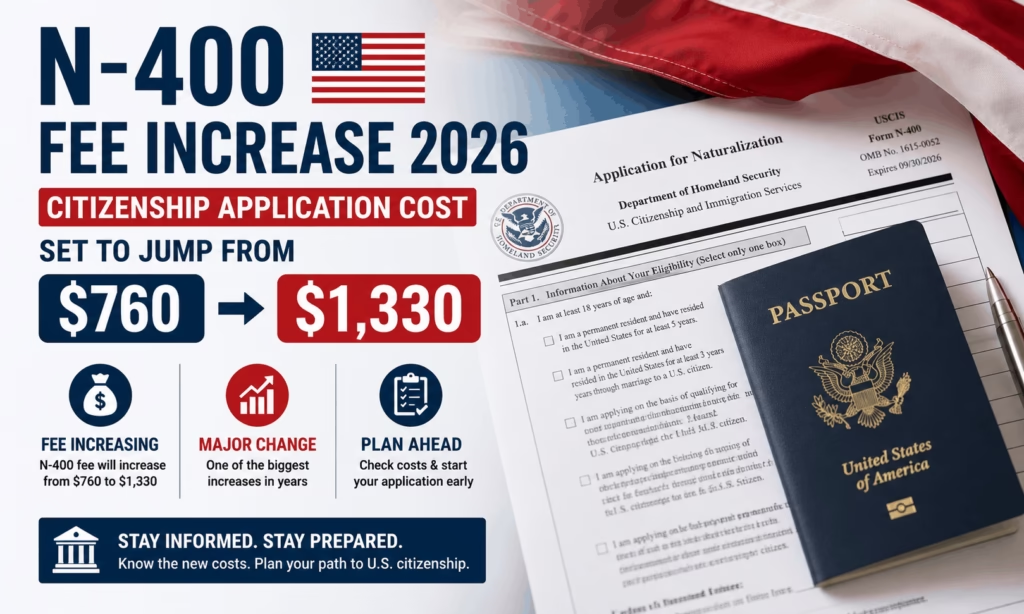
N-400 Fee Increase 2026: The public comment window on one of the steepest citizenship fee hikes in USCIS history closes today, August 24, 2026, putting the proposed N-400 fee increase 2026 back in the spotlight for the estimated 8.8 million lawful permanent residents currently eligible to naturalize. The Department of Homeland Security wants to raise the paper filing fee for Form N-400, Application for Naturalization, from $760 to $1,330, a 75 percent jump, while the online filing fee would climb from $710 to $1,280, an 80 percent increase. Alongside the fee hike, DHS has proposed eliminating the $380 reduced fee option for lower income applicants and ending fee waiver eligibility entirely for both Form N-400 and Form N-336, the form used to appeal a naturalization denial. Only current and former members of the U.S. armed forces would remain exempt from paying, as required under existing statute. We’ll be updating this article monthly as the rulemaking process moves forward.
The proposal, filed under DHS Docket No. USCIS-2026-0265 and RIN 1615-AD08, was published in the Federal Register on June 23, 2026. It is not a final rule. Current fees remain in effect while DHS reviews public comments, a process that typically takes several months before any final rule is issued and an effective date is set. For applicants who currently qualify for a fee waiver or the reduced fee, the message from immigration attorneys and advocacy groups has been consistent: filing now, while the old fee schedule still applies, may be the only way to lock in lower costs before this rule potentially takes effect. Immigrant rights organizations have already flagged that over half of naturalization applications filed through community partners currently rely on a full or partial fee waiver, meaning the proposed change could reshape who can realistically afford to become a citizen.
Key Highlights: N-400 Fee Increase 2026
| Detail | Current | Proposed |
|---|---|---|
| N-400 paper filing fee | $760 | $1,330 (75% increase) |
| N-400 online filing fee | $710 | $1,280 (80% increase) |
| N-400 reduced fee (income-based) | $380 | Eliminated |
| N-400 fee waiver (Form I-912) | Available | Eliminated |
| N-336 appeal, paper filing | $830 | $1,475 (78% increase) |
| N-336 appeal, online filing | $780 | $1,425 (83% increase) |
| Military exemption | Applies | Continues to apply |
| Proposed rule published | June 23, 2026 | — |
| Public comment deadline | August 24, 2026 | — |
| Docket number | USCIS-2026-0265 | RIN 1615-AD08 |
| Rule status | Proposed, not final | Effective date not yet set |
Why DHS Is Proposing This Fee Hike?
DHS says the current N-400 and N-336 fees do not cover what it actually costs USCIS to process each application, including background checks, biometrics coordination, interview scheduling, and the security vetting the agency says it has expanded under recent executive orders. In the notice, the agency argues that raising fees and removing fee waivers for these two forms would close a funding gap that is currently being covered by fees paid by applicants for other, unrelated immigration benefits. In plain terms, DHS is proposing a shift toward a beneficiary pays model, where naturalization applicants cover the full processing cost of their own case rather than having part of it subsidized through the broader USCIS fee structure.
This is not the first time an administration has tried to push naturalization fees sharply higher. In 2020, USCIS attempted to raise the N-400 fee by more than 80 percent to $1,170 and eliminate fee waivers for vulnerable applicants, including asylum seekers. Immigrant rights groups sued, and a federal judge blocked the rule from taking effect after finding the agency had failed to provide adequate notice and a proper opportunity for public comment. That history is part of why immigration attorneys are watching this 2026 proposal closely, since it revives many of the same elements, a large percentage increase paired with the removal of income-based relief options.
Social Security SSI Payment Date September 2026 Confirmed by SSA- Check Full Schedule here!
What Would Actually Change for Applicants
If the rule is finalized as written, three changes would hit naturalization applicants at once. First, the base filing fee itself would rise sharply, regardless of filing method. Second, the modest discount USCIS currently offers for online filing would narrow, though it would not disappear. Under the proposal, filing Form N-400 online would still cost $50 less than filing on paper, $1,280 versus $1,330, preserving a small incentive to use the digital system. Third, and most significant for lower income households, the entire safety net built around the N-400 fee would be removed. Today, applicants whose documented household income falls at or below 150 percent of the Federal Poverty Guidelines can request a full fee waiver using Form I-912, paying nothing to file. Those with income between 150 and 400 percent of the guidelines can request the $380 reduced fee using Form I-942. Under the proposed rule, both pathways disappear, meaning every civilian applicant, regardless of income, would pay the same $1,330 paper fee or $1,280 online fee.
The elimination of the reduced fee option is a particularly sharp change because it does not just raise a cost, it removes an entire tier of pricing that currently exists specifically to make citizenship attainable for working class and low income green card holders. Advocacy groups have pointed out that many applicants who currently pay $380, or nothing at all through a waiver, would see their required payment jump by well over 300 percent under the new structure.
Naturalization Fee Increase Timeline
| Date | Event |
|---|---|
| June 22, 2026 | DHS advance copy of proposed rule becomes public |
| June 23, 2026 | Official publication in the Federal Register |
| June 23 to August 24, 2026 | 60-day public comment period |
| August 24, 2026 | Public comment period closes |
| After August 24, 2026 | DHS reviews comments; may revise the proposal |
| Not yet announced | Final rule publication and effective date |
DHS has not announced an effective date, and none can be set until the comment period closes and the agency publishes a final rule. Based on how similar USCIS fee rules have moved in recent years, that process commonly takes anywhere from a few months to over a year, and the agency can revise specific numbers, timelines, or exemptions based on the comments it receives before locking in a final version.
How to Apply for Form N-400 Before the Fee Increases?
Applicants who are currently eligible and want to file under the existing fee schedule can still do so while the proposed rule remains under review. The general steps are as follows.
- Confirm eligibility. You generally need to have held a green card for at least 5 years, or 3 years if married to a U.S. citizen, along with continuous residence, physical presence in the U.S. for at least half that period, and good moral character.
- Gather supporting documents, including your green card, proof of continuous residence, marital and travel history, and any required tax records.
- Complete Form N-400 either through your myUSCIS account online or on paper.
- If you currently qualify for a fee waiver or reduced fee, file Form I-912 or Form I-942 alongside your N-400 now, since both options are proposed for elimination.
- Pay the current filing fee, $760 paper or $710 online, plus biometrics if applicable.
- Attend your biometrics appointment when scheduled.
- Complete your naturalization interview, including the English and civics tests.
- Take the Oath of Allegiance once your application is approved.
Immigration attorneys generally recommend not rushing an incomplete or poorly documented application just to beat a fee deadline, since a denied or delayed case due to missing evidence can end up costing more time and money than waiting to file correctly.
N-400 Processing Time in 2026
Processing times for Form N-400 currently range from roughly 8 to 14 months, depending on the USCIS field office handling the case. Historically, offices such as Cleveland have reported some of the shorter wait times, around 5 months, while busier offices in cities like Boston, Los Angeles, and Houston have run closer to 7 months, and Minneapolis and Kansas City have seen waits closer to 8 months in past cycles. Actual processing time depends heavily on the specific field office, current caseload, and whether an applicant’s case requires additional background review. Applicants can check their individual case status directly through the USCIS online case status tool.
Social Security Disability Claim Status Tracker: New Online Tools Launch As SSA Turns 91
Unemployment Benefits by State 2026: Full Weekly Maximum Comparison Chart
N-400 Payment Schedule and Fee Breakdown
Under the current fee schedule, most adult applicants pay the base filing fee plus, in many cases, a separate biometric services fee, which is often bundled into the total online filing cost. Applicants filing for a reduced fee currently pay $380 plus the biometrics fee, while those approved for a full fee waiver pay nothing. Under the proposed rule, that entire tiered structure collapses into a single flat fee for nearly all civilian applicants, with the only remaining exemption reserved for qualifying military service members and veterans. USCIS does not currently offer an installment or payment plan option for the N-400 fee itself; the full amount is due at the time of filing.
Who Is Most Affected by the Proposed Fee Increase
The proposed rule would affect the roughly 8.8 million green card holders nationwide who are currently eligible to apply for citizenship, but its impact is expected to fall unevenly. Lower income immigrants, including many seniors, disabled applicants, and households receiving means tested benefits such as SSI, currently rely on the fee waiver or reduced fee pathway to make naturalization financially possible. Removing both options means these applicants would face the same $1,330 or $1,280 charge as higher income filers, with no income-based alternative. Community organizations that run citizenship clinics have also raised concerns that the change could slow naturalization rates in cities with large immigrant populations, since staff at these clinics report that more than half of the applications they help prepare currently include a fee waiver or reduced fee request.
Reactions to the Proposed Rule
Supporters of the proposal within DHS argue that applicants, not the broader pool of immigration fee payers, should cover the true cost of adjudicating naturalization cases, especially as the agency says it has expanded security screening and vetting procedures. Critics, including several immigrant rights organizations and members of Congress, argue that citizenship carries broader public benefits beyond the individual applicant, including higher civic participation, expanded tax contributions, and stronger community integration, and that pricing lower income green card holders out of naturalization runs counter to those goals. Some lawmakers have already sent formal letters urging USCIS to preserve the fee waiver and reduced fee options, citing the same public benefit argument that has historically kept the N-400 fee somewhat insulated from the largest proposed increases applied to other immigration forms.
Official USCIS Resources and Links
| Resource | Link |
|---|---|
| Form N-400 official page | https://www.uscis.gov/n-400 |
| USCIS filing fees schedule | https://www.uscis.gov/forms/filing-fees |
| myUSCIS account login (online filing) | https://my.uscis.gov |
| Check your case status | https://egov.uscis.gov/casestatus/landing.do |
| Federal Register proposed rule text | https://www.federalregister.gov/documents/2026/06/23/2026-12542/naturalization-application-fee-adjustments |
| Submit a public comment (regulations.gov) | https://www.regulations.gov |
| Form I-912, Request for Fee Waiver | https://www.uscis.gov/i-912 |
| Form I-942, Request for Reduced Fee | https://www.uscis.gov/i-942 |
Conclusion
The proposed N-400 fee increase would mark one of the largest single jumps in naturalization costs in recent memory, raising the paper filing fee from $760 to $1,330 and the online fee from $710 to $1,280, while removing the reduced fee and fee waiver options that currently help lower income applicants afford citizenship. With the public comment period closing today, August 24, 2026, the rule now moves into a review phase where DHS will read submitted comments before deciding whether to finalize, revise, or adjust the proposal. No effective date has been set, and current fees remain valid for now, which means eligible applicants still have a window to file under the existing, lower fee schedule. Anyone close to eligibility, or currently relying on a fee waiver or reduced fee, should treat this as a genuine deadline pressure point and speak with a qualified immigration professional about their specific timeline. This article will continue to be updated monthly as DHS moves toward a final rule.
Canada FMCSP Study Permit: 2,970 Spots Open August 26, See Eligibility, PR Pathway & How to Apply?
$1,483.50 BC Income and Disability Assistance Payment: Full Monthly Schedule Explained
FAQs
What is the current N-400 filing fee in 2026?
The current fee is $760 for a paper filing and $710 for an online filing, plus biometrics where applicable.
How much will the N-400 fee increase to if the rule is finalized?
The proposed fee is $1,330 for paper filings and $1,280 for online filings, a 75 to 80 percent increase over current rates.
Is the N-400 fee increase final yet?
No. It is a proposed rule published on June 23, 2026. The public comment period closed on August 24, 2026, and DHS must review comments before issuing a final rule with an effective date.
Will fee waivers for citizenship applications be eliminated?
Yes, under the current proposal, fee waivers for Form N-400 and Form N-336 would be eliminated entirely, except for current and former military service members, who remain exempt by statute.
What happened to the $380 reduced fee option?
The proposal would eliminate the reduced fee option for applicants whose household income falls between 150 and 400 percent of the Federal Poverty Guidelines, requiring them to pay the full fee instead.
Should I file my N-400 now before the fee increases?
If you are already eligible, especially if you currently qualify for a fee waiver or reduced fee, filing before a final rule takes effect can help you lock in the current, lower fee. Speak with an immigration attorney to confirm your eligibility first.
How long does N-400 processing currently take?
Processing times generally range from about 8 to 14 months, depending on the USCIS field office and the complexity of the individual case.
Where can I check my N-400 application status?
You can check your case status directly through the official USCIS case status tool linked in the resources table above.
Does the fee increase affect military applicants?
No. Current and former members of the U.S. armed forces remain exempt from N-400 and N-336 fees under existing statute, and this proposal does not change that exemption.
Where can I submit a comment on the proposed fee increase?
Public comments were accepted through the Federal eRulemaking Portal at regulations.gov under Docket No. USCIS-2026-0265 through August 24, 2026.
$1750 Minnesota Child Tax Credit: No Limit on Children, Eligibility & How to Claim It