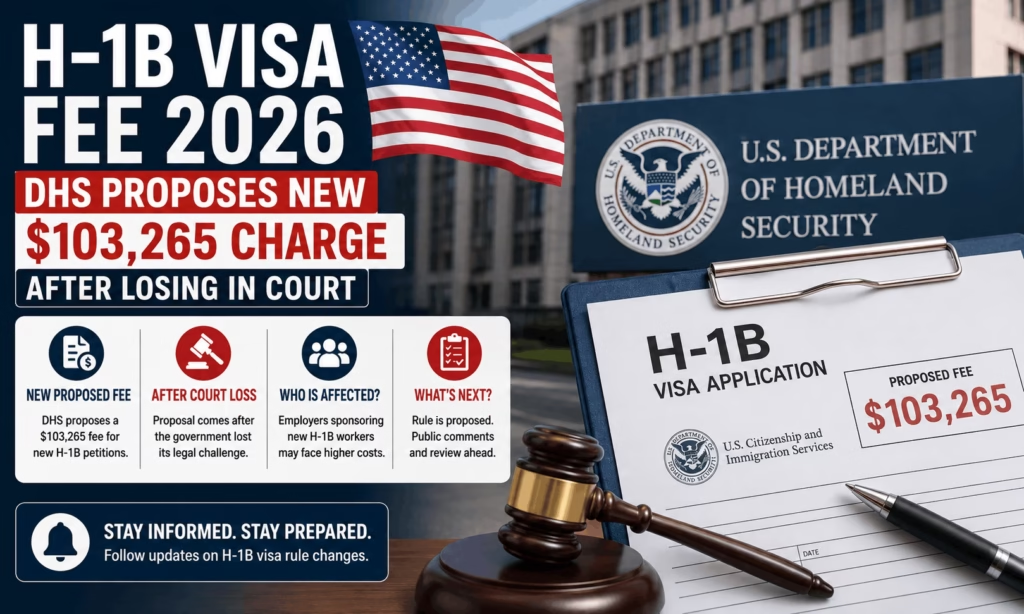
H-1B Visa Fee 2026: The Department of Homeland Security has opened a new front in its push to charge employers over $100,000 for H-1B visas, filing a formal regulatory proposal just weeks after a federal appeals court refused to save the administration’s earlier version of the fee. On Monday, DHS placed a proposed rule on public inspection setting a $103,265 fee for every H-1B petition subject to the annual visa cap, with the Federal Register set to officially publish the proposal on Tuesday, August 25, 2026, opening a 30-day public comment period. Unlike President Trump’s original September 2025 proclamation, which applied only to workers entering the country from abroad, this new H-1B visa fee 2026 proposal would apply far more broadly, covering nearly all new cap-subject petitions, including the 20,000-slot U.S. advanced-degree allocation. We’ll be updating this article monthly as the comment period, court proceedings, and final rule move forward.
The timing is not a coincidence. A federal judge in Boston ruled on June 8, 2026 that Trump’s original $100,000 H-1B fee was unlawful, finding that the administration had exceeded its authority and effectively tried to usurp Congress’s power to set immigration policy and taxes. The U.S. Court of Appeals for the First Circuit later declined to pause that ruling, handing the White House one of its most significant immigration policy defeats to date. Rather than abandon the fee, DHS is now attempting to achieve largely the same outcome through a different legal pathway, formal notice-and-comment rulemaking under the Administrative Procedure Act, which agencies typically use specifically because it is harder to challenge in court than a presidential proclamation issued unilaterally.
Key Highlights of the New H-1B Fee Proposal
| Detail | Information |
|---|---|
| Proposed fee amount | $103,265 per cap-subject H-1B petition |
| Federal Register publication date | August 25, 2026 |
| Public comment period | 30 days from publication |
| Legal mechanism | Formal DHS rulemaking, not a presidential proclamation |
| Applies to | Nearly all new cap-subject petitions, including the 20,000 advanced-degree slots |
| Excludes | Cap-exempt H-1B filings |
| Fee calculation basis | Approx. $8.78 billion in projected annual immigration costs divided by 85,000 expected fee-paying petitions |
| Projected annual federal revenue | Approximately $8.8 billion |
| White House regulatory review completed | August 19, 2026 |
| Rule classification | Economically significant and a major rule |
| Original proclamation fee | $100,000, issued September 2025 |
| Original proclamation legal status | Ruled unlawful June 8, 2026; stay denied by First Circuit |
| Original proclamation expiration | Due to expire in September 2026 |
Why DHS Is Trying Again With a New Legal Approach
According to DHS, the $103,265 figure is not an arbitrary round number chosen for headlines, it is the product of a specific cost allocation formula. The agency calculated the fee by dividing approximately $8.78 billion in projected annual immigration system costs by roughly 85,000 anticipated fee-paying H-1B petitions each year. DHS says the resulting revenue, an estimated $8.8 billion annually, would help fund U.S. Citizenship and Immigration Services along with immigration-related operations at Immigration and Customs Enforcement, Customs and Border Protection, the Department of Justice’s immigration courts, the State Department, and the Department of Labor.
Crucially, DHS is not describing the new $103,265 fee as a replacement for the original proclamation. The agency has stated the two charges rely on different legal authority and apply to different categories of petitions, meaning that, at least for now, both the original $100,000 proclamation fee and this new proposed rule exist as separate, parallel mechanisms. The White House Office of Information and Regulatory Affairs completed its review of the new proposal on August 19, 2026, and classified it as both economically significant and a major rule, a designation that typically means the regulation is expected to have an annual economic impact exceeding $100 million.
H-1B FY2027 Cap Reached: What Happens Next for Applicants?
Social Security 2100 Act 2027: Bigger COLA Increase, Higher Benefits & Latest Bill Update
IRS Business Tax Account New Features Give Small Businesses More Ways to Skip the Phone Line
How the New Fee Differs From Trump’s Original $100,000 Proclamation
The most important distinction for employers and workers to understand is scope. Trump’s original proclamation, issued in September 2025, barred new H-1B recipients from entering the United States unless their sponsoring employer had paid the $100,000 fee, and the administration clarified at the time that it applied only to new petitions filed after the proclamation’s effective date, not to existing H-1B holders or pending applications filed earlier. The new DHS rule works differently. It would apply the $103,265 charge to virtually all new cap-subject H-1B petitions going forward, not just those tied to workers entering from outside the country, which significantly broadens who would actually owe the fee.
| Feature | Original Trump Proclamation (Sept 2025) | New DHS Proposed Rule (Aug 2026) |
|---|---|---|
| Fee amount | $100,000 | $103,265 |
| Legal mechanism | Presidential proclamation | Formal agency rulemaking |
| Who it applies to | New H-1B entrants from abroad only | Nearly all new cap-subject petitions |
| Court status | Ruled unlawful, stay denied | Not yet finalized, in comment period |
| Public comment process | None | 30 days starting August 25, 2026 |
| Set to expire | September 2026 | No expiration specified |
Other H-1B Program Changes Employers Should Know About
The proposed fee is arriving alongside a broader set of changes to the H-1B program that have been rolling out through 2026. DHS has already finalized higher screening fees for some larger employers, expanded the discretion USCIS officers have to reject petitions, and signaled plans to eliminate the 60-day grace period that currently allows H-1B workers who lose their jobs to remain in the country while searching for new sponsorship or changing status. Separately, the Department of Justice has increased enforcement activity around allegations of hiring bias against U.S. workers connected to H-1B sponsorship. Together, these changes represent what immigration attorneys describe as a broad, multi-agency effort to raise costs and tighten eligibility across the H-1B system, not a single isolated fee increase.
Legal Battle Timeline: How We Got Here
| Date | Event |
|---|---|
| September 2025 | Trump issues proclamation imposing $100,000 H-1B fee |
| September 21, 2025 | Proclamation’s effective date for new petitions |
| December 2025 | California and 19 other states sue in federal court in Boston to block the fee |
| Earlier 2026 | U.S. Chamber of Commerce and other business groups file separate legal challenges |
| June 8, 2026 | Federal judge in Massachusetts rules the $100,000 fee unlawful and vacates it |
| June 12, 2026 | Same court temporarily stays its own ruling pending appeal |
| Mid-2026 | U.S. Court of Appeals for the First Circuit declines to stay the district court’s decision |
| August 19, 2026 | White House regulatory review of new $103,265 rule completed |
| August 24, 2026 | DHS places new proposed rule on public inspection |
| August 25, 2026 | Official Federal Register publication; 30-day comment period begins |
| September 2026 | Original proclamation set to expire |
How Employers Can Respond to the Proposed Rule
- Review whether your company’s pending or planned H-1B petitions fall under the cap-subject category that would be affected by the new $103,265 fee.
- Track the 30-day public comment period, which opens August 25, 2026, and consider submitting formal comments through the Federal eRulemaking Portal before it closes.
- Consult immigration counsel about whether filing a cap-subject petition now, before any final rule takes effect, makes sense for your hiring timeline.
- Monitor both the fate of the original $100,000 proclamation, which is still being litigated, and the new proposed rule separately, since DHS has said the two operate under different legal authority.
- Review internal budgeting and sponsorship policies, since the combined effect of new screening fees, potential grace period elimination, and this proposed fee could significantly raise the total cost of sponsoring a single H-1B worker.
- Stay alert for the final rule publication, since a major, economically significant rule like this one can still be revised based on public comments before taking effect.
What This Means for the Timeline and Processing of H-1B Petitions
No effective date has been set for the $103,265 fee, since the rule remains in the public comment stage. Based on standard federal rulemaking timelines, DHS would need to review comments received during the 30-day window, respond to significant concerns raised, and then publish a final rule with its own effective date, a process that has historically taken anywhere from a few months to over a year for major economically significant rules. In the meantime, some employers with workers subject to the earlier $100,000 proclamation have reportedly rushed to submit petitions while that fee’s legal status remains contested, wary of another sudden change once the appeals process concludes. Other companies, according to immigration attorneys, are holding off on major hiring plan changes for now, partly because corporate sponsorship processes take time to restructure and partly due to the ongoing uncertainty surrounding both the proclamation and the new proposed rule.
Canada Citizenship Proof Rules Updated Document Checklist, Requirements and Application Process
EB-1 India Visa Bulletin Warning: Category Could Go Unavailable Within Weeks, State Department Says
Who Is Affected by the New H-1B Fee Proposal
The proposed rule would primarily affect U.S. employers in technology, healthcare, education, engineering, and research sectors that rely heavily on H-1B sponsorship to fill specialized roles. It would also directly affect prospective H-1B workers, many from India and China, who make up the largest share of H-1B recipients each year. Current H-1B holders with previously approved petitions are not the direct target of the new fee, but the broader climate of program changes, including potential grace period elimination and expanded USCIS discretion to reject petitions, means even existing visa holders have reason to stay informed about how the rule evolves.
Official Resources and Where to Track This Rule
| Resource | Link |
|---|---|
| Federal Register, proposed and final rules | https://www.federalregister.gov |
| USCIS H-1B program information | https://www.uscis.gov/working-in-the-united-states/h-1b-specialty-occupations |
| Submit a public comment (Federal eRulemaking Portal) | https://www.regulations.gov |
| USCIS case status check | https://egov.uscis.gov/casestatus/landing.do |
| Department of Homeland Security newsroom | https://www.dhs.gov/news |
| Department of Labor, H-1B wage and labor condition rules | https://www.dol.gov/agencies/eta/foreign-labor/programs/h-1b |
Conclusion
The Trump administration’s new $103,265 H-1B fee proposal shows that a court loss on the original $100,000 proclamation has not ended the push to sharply raise the cost of sponsoring skilled foreign workers, it has simply shifted the strategy to formal federal rulemaking, a process generally seen as more legally durable than a presidential proclamation. With the Federal Register publication landing August 25, 2026 and a 30-day comment period following immediately after, employers, immigration attorneys, and prospective H-1B workers now have a defined window to respond before DHS can move toward a final rule. Because the original proclamation remains separately tied up in litigation and is set to expire in September 2026, the H-1B landscape for the rest of 2026 is likely to stay unsettled, with two different legal fights unfolding at once. Employers currently planning H-1B sponsorship should treat this as an active, evolving situation and consult qualified immigration counsel before making hiring or budget decisions. This article will continue to be updated monthly as the comment period closes and the rulemaking process advances.
FAQs About H-1B Visa Fee 2026
What is the new proposed H-1B visa fee for 2026?
DHS has proposed a $103,265 fee for every H-1B petition subject to the annual visa cap, published in the Federal Register on August 25, 2026.
Is the $103,265 H-1B fee the same as Trump’s $100,000 proclamation?
No. DHS says the two fees rely on different legal authority and apply to different categories of petitions. The original $100,000 proclamation applies to new entrants from abroad, while the new proposed rule would apply to nearly all new cap-subject petitions.
Has the $103,265 H-1B fee been finalized yet?
No. It is currently a proposed rule open for a 30-day public comment period starting August 25, 2026. DHS must review comments before any final rule with an effective date can be issued.
What happened to Trump’s original $100,000 H-1B fee in court?
A federal judge in Massachusetts ruled the fee unlawful on June 8, 2026, and the U.S. Court of Appeals for the First Circuit later declined to stay that ruling, though litigation is still ongoing in multiple courts.
Will current H-1B visa holders have to pay the new fee?
The proposed rule targets new cap-subject petitions rather than existing approved H-1B status, but employers and workers should watch for further clarification as the rule develops.
Why is DHS using a proposed rule instead of a presidential proclamation this time?
Formal rulemaking under the Administrative Procedure Act generally involves a public comment process and is considered more difficult to challenge successfully in court than a fee imposed unilaterally by proclamation.
How was the $103,265 fee amount calculated?
DHS divided approximately $8.78 billion in projected annual immigration system costs by an estimated 85,000 fee-paying petitions per year to arrive at the figure.
Where can I submit a comment on the proposed H-1B fee rule?
Public comments can be submitted through the Federal eRulemaking Portal at regulations.gov once the proposal is officially published in the Federal Register.
Does the new fee apply to the H-1B advanced-degree cap category?
Yes, the proposed fee would apply to petitions in the 20,000-slot U.S. advanced-degree allocation, in addition to the regular cap-subject category.
What other H-1B changes are happening alongside this fee proposal?
DHS has also finalized higher screening fees for some employers, expanded USCIS officer discretion to reject petitions, and proposed eliminating the 60-day job loss grace period for H-1B workers.