
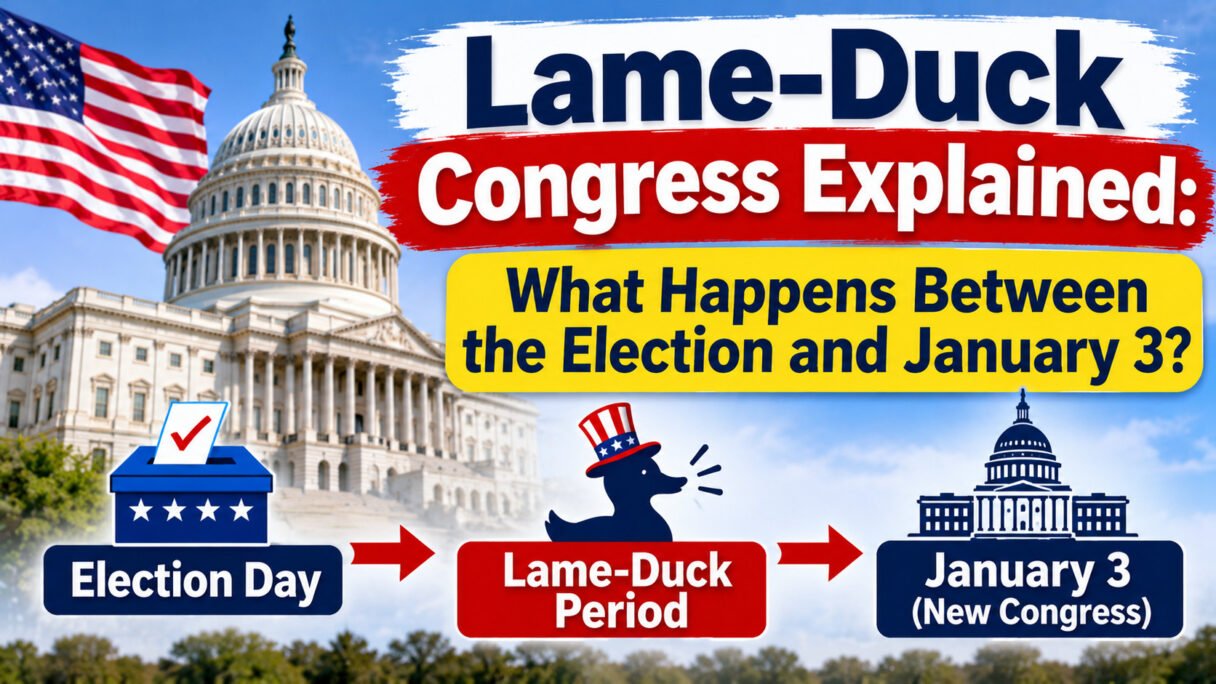
Lame-Duck Congress Explained: The lame-duck Congress period is the time between the November midterm elections and January 3, when newly elected members of Congress officially begin their terms. During this period, outgoing lawmakers continue their responsibilities and can still pass important legislation, approve government funding, confirm appointments and address pending national issues. Although the election results may change the balance of power in Congress, the current members remain in office until the new Congress takes over. Here’s what happens during the lame-duck session, what decisions lawmakers can make and why January 3 is an important date.
Voters chose a new Congress on November 3, but it cannot start work until January 3, 2027. Until then, the old Congress stays in charge, including members who lost or are leaving. This year that matters more than usual because Democrats are projected to win both chambers while Republicans still hold the gavels and the December 11 funding deadline.
What “Lame-Duck” means?
A Lame-Duck session is the stretch between Election Day and the new Congress taking office in January, when members who lost or are retiring still vote. The 20th Amendment ends current terms at noon on January 3. Republicans run Congress until noon on January 3, 2027, and Democrats get the gavels and subpoenas after that.
The election result that frames everything
CBS News projects Democrats won both chambers, with at least 54 Senate seats and between 251 and 268 House seats once counting finishes. Two Senate races were still unresolved. Treat the final numbers as provisional.
Leadership will change shape. Chuck Schumer is expected to be elected majority leader when Senate Democrats hold leadership elections in early December, and Thune is expected to become minority leader after Republicans hold theirs next week. Hakeem Jeffries would become Speaker if his colleagues elect him when the new Congress begins in January. A Democratic House flip could trigger a cascade of GOP leadership elections, and Speaker Johnson has given mixed signals about his future.
The calendar
Both chambers return November 9 for two weeks, recess for Thanksgiving week, then return for two or three weeks, for a maximum of about five legislative weeks. Akin Gump counts 19 session days for the House and 22 for the Senate. The session is expected to run until Christmas.
| Date | What happens? |
| Mon, Nov 9 | Congress returns; Senate holds first vote on permitting bill |
| Thu, Nov 26 | Thanksgiving; Congress typically recesses that week |
| Fri, Dec 11 | Stopgap funding, surface transportation and flood insurance authorities expire |
| Sat, Dec 12 | A funding gap would begin if nothing passes |
| Thu, Dec 31 | Health center and other program authorities expire |
| Sun, Jan 3, 2027 (noon) | New Congress sworn in |
GOV.HOUSE reports that surface transportation authority and National Flood Insurance Program authority also expire December 11. Holland & Knight notes the Community Health Center Fund expires December 31.
The to-do list
1. Government funding (the main event). Public Law 119-103 funds agencies through December 11, and Congress must enact FY2027 bills or another stopgap to avoid a gap starting December 12. Akin Gump lays out three scenarios: full-year FY2027 appropriations, another short-term extension into early 2027, or a hybrid. The Washington Sun reported that the expectation among Republicans was a CR running until mid-March, dulling talk of a yearlong stopgap. Harbinger Strategies likewise sees another CR as likely but cannot rule out a December shutdown. As of late October, none of the 12 bills had become law and Collins and Murray had no topline agreement.
2. Defense bill (NDAA). Akin Gump calls appropriations and the NDAA the two principal must-pass items. Senator Rounds predicted in August that the NDAA would come together after the election. The Trump administration wants a record $1.5 trillion for defense, which Senate Democrats reject.
3. FISA Section 702. The surveillance authority has been lapsed since June. Harbinger calls it a high priority of the administration, national security hawks and the intelligence community.
4. Farm bill. The farm bill extension expired September 30. The Senate Agriculture Committee advanced a bill September 16, but it needs 60 votes on the floor and a fight over SNAP cost sharing is unresolved.
5. Permitting reform. The Senate holds an initial cloture vote on H.R. 2347, the vehicle for permitting reform, on November 9. Senate Democrats must decide whether to advance the bipartisan bill or wait until next year.
6. College sports bill. The Senate passed it 77-22. Speaker Johnson must decide how to handle it, since his members want changes.
7. Nominations. Thune must choose between confirming as many Trump nominees as possible or spending weeks on a defense reconciliation package. Judicial confirmations are a top priority for Thune and Judiciary Chair Grassley.
8. Other expiring items. The American Subcontractors Association lists BLM oil and gas permitting fees, which expired October 1, and surface transportation reauthorization among the unfinished business. LIHEAP is also on the table, per a congressional tracker.
When Will You Learn Your Exact 2027 Social Security Amount? Dates and Steps
Trump Midterm Losses: “I Wasn’t on the Ballot” and What Happens Next in Congress
Reconciliation 3.0 and the debt ceiling
Some Republicans want one last party-line bill. The House passed a $95 billion budget blueprint this summer for a third package centered on military and Iran war funding, farm relief and election security. Senator Ron Johnson says he secured a commitment from Thune to seek a reconciliation bill in the lame duck.
The obstacles are real. Thune has questioned whether Republicans have 50 votes to advance it and to protect it from Democratic amendments. A Senate Republican aide said reconciliation is more unlikely than not. Members who just lost their seats have little incentive to grind out a final win, if they come back at all.
The debt ceiling is tied in. Including a debt ceiling hike in reconciliation would let Republicans avoid negotiating it with Democrats; the limit could be reached between late winter and mid-summer. If it is not handled now, it would likely need a bipartisan vote in the first half of 2027.
Why Lame-Duck are hard?
- Attendance and discipline. A historically large group of departing members and a narrow House GOP majority could make it hard to pass closely divided measures.
- Shifted incentives. Democrats may prefer to wait for January leverage. Republicans want to lock in what they can. That is analysis, not a reported fact.
- A short clock. Once a topline deal exists, appropriators generally need about four weeks to draft and vote on final bills.
What history suggests?
Lame-Duck have ended both ways. After Democrats won the House in 2018, the outgoing Congress failed to agree on funding, and a 35-day shutdown began December 22, 2018 and ran until January 25, 2019. In 2020, Congress passed the Consolidated Appropriations Act, 2021 on December 21, and it was signed December 27. That deal came after a one-week stopgap on December 11. Precedent is a guide, not a prediction.
What it means for your money?
Most Lame-Duck news has no direct effect on household payments. Three things do matter:
- Social Security and SSI. SSA’s December schedule is: SSI on December 1; pre-May 1997 and dual beneficiaries on December 3; birthdays 1st-10th on December 9; 11th-20th on December 16; and 21st-31st on December 23; with SSI for January 2027 paid early on December 31. SSA stated during the earlier 2026 shutdown that payments continue with no change in dates.
- Congressional pay. P.L. 119-103 bars any member pay adjustment through December 11, holding salaries at $174,000.
- Programs expiring December 11 and 31. These could affect transportation funding, flood insurance, health centers and TANF if Congress does not extend them.
Official Sources
| Source | Type | Link |
| CRS: Continuing Appropriations for FY2027 | Official (Congress) | congress.gov |
| SSA: 2026 Payment Schedule (PDF) | Official | ssa.gov |
| SSA: How a shutdown affects payments | Official | ssa.gov |
| Senate Approps (Dem.): CR statement | Official | appropriations.senate.gov |
| CBS News: Midterm results | News | cbsnews.com |
| AP via WSLS: Democrats sweep | News | wsls.com |
| Semafor: Lame-duck to-do list | News | semafor.com |
| The Hill: Senate majority and leadership | News | thehill.com |
| MS NOW: GOP reconciliation push | News | ms.now |
| Akin Gump: Midterm takeaways | Law firm analysis | akingump.com |
| Holland & Knight: Year-end deadlines | Law firm analysis | hklaw.com |
| Harbinger Strategies: Lame-duck preview | Analysis | harbingerdc.com |
| No Labels: Lame-duck explainer | Nonprofit | nolabels.org |
Lame-Duck Congress Explained – FAQ’s
When does the Lame-Duck session start?
November 9, 2026, six days after Election Day.
When does it end?
It is expected to run until about Christmas. The old Congress’s terms end at noon on January 3, 2027.
Who controls Congress during the lame duck?
Republicans. Democrats take over on January 3.
Can members who lost still vote?
Yes, until their terms end.
What is the most important deadline?
December 11, when the stopgap funding law expires. A lapse would start December 12.
Will there be a shutdown?
Not certain. Harbinger sees another CR as likely but cannot rule a shutdown out.
Who will lead the Senate next year?
Schumer is expected to be elected majority leader in early December, per The Hill.
Who will be Speaker?
The House elects the Speaker when the new Congress convenes. Jeffries is the presumptive Democratic choice.
What is reconciliation?
A procedure that lets the Senate pass certain budget bills with a simple majority, avoiding the filibuster.
Will my Social Security check change in December?
No change to payment timing. See the SSA schedule above.
What is the debt ceiling issue?
The borrowing limit could be reached between late winter and mid-summer 2027, per MS NOW.
Also Read :-
How to Check Your $90 Medicare Rebate Payment Status (Phone Numbers and Steps)
$90 Rebate vs 2027 Part B Increase Calculator: Does the Medicare Rebate Cover Your Premium Hike?
Medicare $90 Rebate for Couples: Does Each Spouse Get Paid for $180 ?