Canada’s western province of British Columbia has unveiled some of the most significant immigration reforms seen in recent years. The British Columbia Provincial Nominee Program (BC PNP) has undergone a major restructuring in 2026, introducing a new targeted immigration stream while eliminating several existing pathways. The changes are designed to address labour shortages in critical sectors, support regional economic growth, and ensure that limited immigration allocations are directed toward occupations that are most needed across the province.
For international students, skilled workers, healthcare professionals, construction workers, and employers, these reforms represent a major shift in how provincial immigration will operate moving forward.
Why British Columbia Changed Its Immigration Program
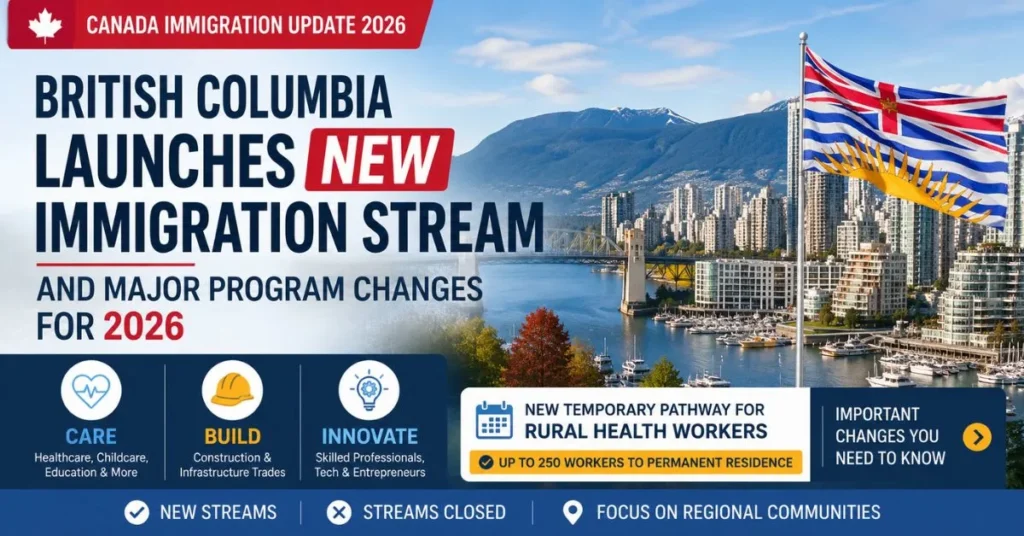
British Columbia received a reduced allocation of provincial nominations for 2026 compared to previous expectations. With fewer nomination spaces available, provincial authorities decided to focus immigration efforts on sectors facing the most severe labour shortages. As a result, the BC PNP has been redesigned around three key priorities:
- Care
- Build
- Innovate
These priorities form the foundation of British Columbia’s updated immigration strategy and influence who will receive invitations for provincial nomination in 2026 and beyond.
The New Immigration Framework: Care, Build and Innovate
The province has replaced many of its previous pathways with a simplified structure focused on critical workforce needs.
1. Care Stream
The Care category targets workers in healthcare, childcare, education, and veterinary occupations. British Columbia continues to face shortages of nurses, healthcare aides, physicians, early childhood educators, and other care-related professionals. Under the new framework, these occupations receive priority consideration for provincial nomination.
Eligible occupations may include:
- Registered nurses
- Licensed practical nurses
- Physicians
- Healthcare assistants
- Early childhood educators
- Veterinarians
- Veterinary technicians
- Certain education professionals
The province has indicated that healthcare and care-related occupations will remain one of its highest immigration priorities throughout 2026.
2. Build Stream
The Build category focuses on construction and infrastructure occupations. British Columbia is experiencing rapid population growth and major housing development projects. To address ongoing labour shortages in construction, the province is prioritizing workers in skilled trades.
Priority occupations include:
- Electricians
- Carpenters
- Plumbers
- Welders
- HVAC technicians
- Construction supervisors
- Heavy equipment operators
- Other designated construction trades
The province hopes these measures will help accelerate housing construction and major infrastructure projects across British Columbia.
3. Innovate Stream
The Innovate category is aimed at highly skilled professionals and entrepreneurs who can contribute significantly to British Columbia’s economy.
Candidates may include:
- Senior technology professionals
- Engineers
- Scientists
- Business executives
- High-income skilled workers
- Entrepreneurs launching or expanding businesses
Unlike previous tech-focused programs, the Innovate category evaluates candidates based on their overall economic impact rather than occupation-specific technology lists.
New Temporary Immigration Stream for Rural and Remote Health Workers
One of the most notable additions in 2026 is a new temporary immigration pathway designed specifically for workers employed in rural and remote healthcare settings. The initiative aims to help up to 250 workers transition to permanent residence. It targets support staff working for British Columbia health authorities in rural communities.
Eligible occupations include certain cleaning, maintenance, and security-related roles that are critical to healthcare operations but often receive less attention in immigration programs. Registrations for the stream open from June 15 through August 31, 2026.
Purpose of the New Stream
The provincial government created this pathway because many rural healthcare facilities struggle to attract and retain workers. Healthcare support workers often play an essential role in maintaining hospitals, clinics, and long-term care facilities. By offering a pathway to permanent residence, British Columbia hopes to improve worker retention and strengthen healthcare services in smaller communities.
Major Immigration Pathways Being Eliminated
While the province introduced new opportunities, it also removed several previously available immigration options.
End of Dedicated Tech Draws
For years, British Columbia’s Tech Program was considered one of Canada’s most popular provincial immigration pathways.
Under the 2026 reforms:
- Dedicated tech draws have been eliminated.
- Technology workers will now compete under broader categories.
- Tech occupations no longer receive separate invitations.
This marks a significant change for software developers, IT professionals, and technology specialists seeking provincial nomination.
Cancellation of New Graduate Streams
British Columbia had previously planned specialized pathways for:
- Bachelor’s graduates
- Master’s graduates
- Doctoral graduates
However, the province has officially cancelled these planned streams before they were fully launched. International students can still pursue permanent residence through other immigration pathways, but these dedicated graduate streams will no longer be available.
Closure of Entry-Level and Semi-Skilled Stream
The Entry-Level and Semi-Skilled (ELSS) pathway has also been permanently closed. This stream had allowed workers in certain lower-skilled occupations to apply for provincial nomination after gaining qualifying work experience. Its closure means many workers will need to explore alternative immigration options or qualify through different BC PNP categories.
Greater Focus on Regional Communities
Another major aspect of the 2026 reforms is the province’s emphasis on regional economic development. British Columbia has announced that a significant portion of provincial nominations will be directed toward candidates working outside the Greater Vancouver area.
The objective is to:
- Address labour shortages in smaller communities.
- Support economic growth in regional areas.
- Reduce immigration concentration in major urban centres.
This could create new opportunities for immigrants willing to live and work in smaller cities and rural communities throughout the province.
Impact on International Students
The changes may be particularly significant for international students. Previously, many graduates relied on anticipated graduate-specific streams or tech-focused pathways. With those options no longer available, students may need to align their career choices more closely with provincial priorities.
Graduates entering healthcare, education, childcare, construction, or high-demand skilled occupations may have stronger opportunities under the new framework. Meanwhile, graduates in non-priority sectors could face increased competition for provincial nominations.
Impact on Employers
British Columbia employers are expected to play an even greater role in immigration applications under the revised system.
Employers in priority sectors may benefit from:
- Faster access to skilled workers.
- Increased nomination opportunities.
- Improved employee retention.
Healthcare organizations, construction companies, and businesses operating in regional communities could see the greatest advantages from the reforms.
Early Results Show Strong Demand
The first draws conducted under the new framework have already demonstrated strong interest among applicants.
Recent BC PNP invitation rounds have focused heavily on:
- Healthcare occupations
- Construction trades
- Entrepreneur categories
Hundreds of invitations have been issued to candidates aligned with the province’s updated priorities, indicating that British Columbia is actively implementing its new immigration strategy.
What Prospective Immigrants Should Do Next
Individuals considering immigration to British Columbia should carefully review how their occupation aligns with the province’s new priorities.
Strong candidates in 2026 are likely to include:
- Healthcare professionals
- Childcare workers
- Construction tradespeople
- Regional community workers
- Entrepreneurs
- High-skilled professionals with significant economic impact
Those who previously planned to immigrate through tech-specific draws, graduate pathways, or semi-skilled programs may need to reassess their immigration strategy.
Fact Check:
The information in this article is based on British Columbia’s 2026 BC Provincial Nominee Program announcements, updated Skills Immigration Program guidance, and reports from Canadian immigration news sources published between April and June 2026. Details regarding eligibility requirements, occupation lists, nomination allocations, and temporary immigration initiatives may be updated by provincial or federal authorities. Readers should verify current requirements through official government immigration resources before making application decisions.
Disclaimer:
This article is intended for informational and educational purposes only and does not constitute immigration, legal, or professional advice. Immigration policies and eligibility requirements may change without notice. Individuals seeking guidance regarding their specific immigration situation should consult an authorized immigration consultant, lawyer, or official government source before submitting any application.