
IRS Tax Brackets 2026: The seven federal tax rates stay the same for 2026, but the dollar ranges, deductions, and several new worker-focused breaks have changed. The 2026 brackets, set by the IRS last October, are the current official figures and apply to returns filed in 2027. The 2027 update is still pending, so every 2027 number below is a projection.
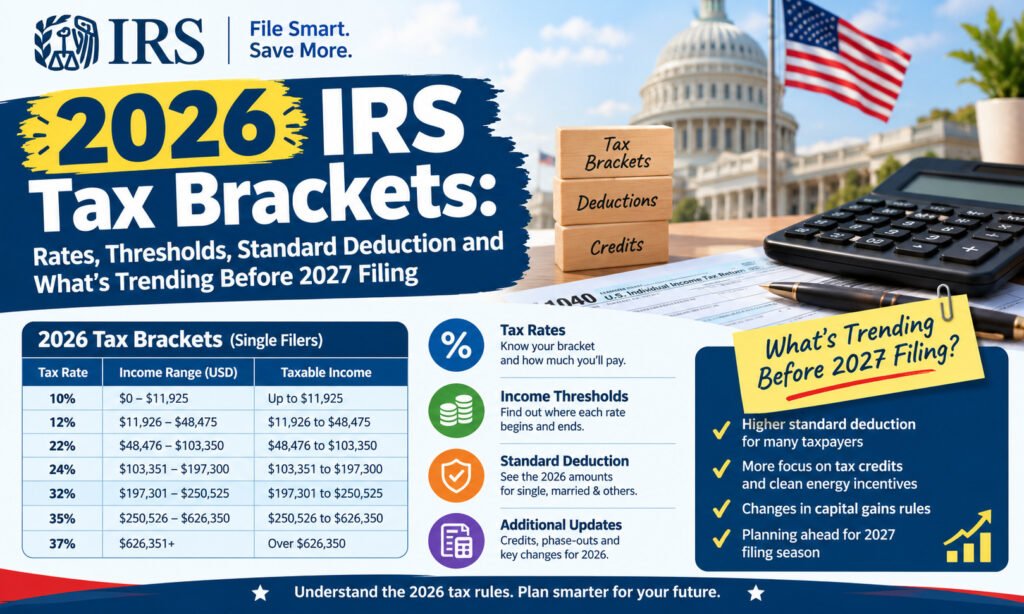
2026 tax brackets (current official figures)
The IRS released Rev. Proc. 2025-32 with inflation adjustments for more than 60 provisions, to be used on 2026 returns generally filed in 2027. The rates remain 10%, 12%, 22%, 24%, 32%, 35%, and 37%.
Single filers
| Rate | Taxable income up to |
| 10% | $12,400 |
| 12% | $50,400 |
| 22% | $105,700 |
| 24% | $201,775 |
| 32% | $256,225 |
| 35% | $640,600 |
| 37% | Above $640,600 |
Married filing jointly
| Rate | Taxable income up to |
| 10% | $24,800 |
| 12% | $100,800 |
| 22% | $211,400 |
| 24% | $403,550 |
| 32% | $512,450 |
| 35% | $768,700 |
| 37% | Above $768,700 |
Head of household
| Rate | Taxable income up to |
| 10% | $17,700 |
| 12% | $67,450 |
| 22% | $105,700 |
| 24% | $201,750 |
| 32% | $256,200 |
| 35% | $640,600 |
| 37% | Above $640,600 |
2026 standard deduction
| Filing status | 2025 | 2026 |
| Single / married filing separately | $15,750 | $16,100 |
| Married filing jointly | $31,500 | $32,200 |
| Head of household | $23,625 | $24,150 |
Other 2026 numbers worth knowing
- Child Tax Credit: The 2026 maximum is $2,200, with $1,700 refundable. It did not rise from 2025, because inflation adjustments are rounded to $100 steps and the threshold wasn’t reached. The full credit becomes inflation-indexed starting in 2027.
- SALT cap: Rises from $10,000 to $40,400 ($20,200 if married filing separately). It phases down for higher earners starting at $505,000 MAGI.
- Senior deduction: $6,000 for age 65+, for 2025 through 2028, phasing out at $75,000 AGI ($150,000 for MFJ).
- Car loan interest: Up to $10,000, for tax years 2025–2028.
- Charitable giving: Non-itemizers can deduct up to $1,000 ($2,000 joint) in cash donations starting in 2026.
The new tips and overtime rules
No tax on tips
Qualified tips are voluntary cash or charged tips, including shared tips. The maximum deduction is $25,000, and self-employed workers cannot exceed their net income from the business where tips were earned. The deduction phases out above $150,000 MAGI ($300,000 joint). It applies only to IRS-listed occupations. On the 2026 W-2, tips are reported in Box 12 code TP, plus an occupation code in Box 14b.
No tax on overtime
Only the premium counts, generally the “half” in time-and-a-half. The maximum is $12,500 ($25,000 joint), a valid Social Security number is required, married filers must file jointly, and it works whether you itemize or not. The joint cap is per return, not per spouse.
New W-2 reporting
For 2025, employers weren’t required to report overtime separately. From 2026, overtime goes in Box 12 using Code TT. If the employer understates it, you need a corrected W-2c, and Form 4852 cannot increase the amount. The IRS issued updated overtime FAQs on August 6, 2026 (IR-2026-88, Fact Sheet 2026-13).
Common misunderstanding: these are deductions, not tax-free paychecks. Overtime wages still count for payroll tax and withholding. To see the benefit in your paycheck, file a new 2026 Form W-4 using the step 4(b) worksheet, or use the IRS Tax Withholding Estimator.
What comes next: 2027 ?
The official update is still pending
The IRS announces new brackets each fall in a revenue procedure. As of October 19, it had not released its official 2027 figures. Wolters Kluwer expects the release in late October or early November 2026.
Projected 2027 figures
Bloomberg Tax projects thresholds rising 3.2%, compared with 2.7% for 2026. Projected standard deductions are $16,600 for single filers and $33,200 for joint filers. Head of household is projected near $24,900, though Bloomberg’s literal figure of $24,925 could round to $24,950. The rates themselves stay: the seven-bracket structure continues barring new legislation.
Single filers:
| Rate | 2026 (official) | 2027 (projected) |
| 10% | $12,400 | ~$12,800 |
| 12% | $50,400 | ~$52,025 |
| 22% | $105,700 | ~$109,125 |
| 24% | $201,775 | ~$208,300 |
| 32% | $256,225 | ~$264,525 |
| 35% | $640,600 | ~$661,350 |
Practical checklist
- Use the 2026 brackets to plan the return you file in 2027.
- Check your January W-2 for Box 12 codes TT and TP.
- Update your W-4 if you want the new deductions reflected in paychecks.
- Don’t present 2027 brackets as official until the IRS revenue procedure appears.
- Speak to a tax professional for your own case. I’m not a tax advisor.
Key dates
| When | Event | Status |
| October 2025 | IRS releases 2026 figures (Rev. Proc. 2025-32) | Done, current official |
| Aug 6, 2026 | IRS updated overtime FAQs (IR-2026-88) | Done |
| Late Oct–Nov 2026 | Official 2027 inflation adjustments | Pending |
| Jan 2027 | 2026 W-2s with codes TT and TP | Upcoming |
| 2028 | Last year of tips, overtime, senior, car-loan deductions | Scheduled |
| 2030 | SALT cap reverts to $10,000 | Scheduled |
Official and data sources
FAQ’s : IRS Tax Brackets 2026
What are the 2026 IRS Tax rates?
10%, 12%, 22%, 24%, 32%, 35%, and 37%.
What is the 2026 standard deduction?
$16,100 single, $32,200 married filing jointly, $24,150 head of household.
Are the 2026 brackets final?
Yes. The IRS set them last October, and they apply to returns filed in 2027.
Have the 2027 brackets been announced?
Not as of October 19. Projections point to about a 3.2% increase.
How much of my tips can I deduct?
Up to $25,000, subject to phase-out, in IRS-listed occupations.
How much overtime is deductible?
Up to $12,500 ($25,000 joint), covering only the premium portion.
Do I still pay payroll tax on tips and overtime?
Yes. The break is an income tax deduction.
Where do I find these on my W-2?
Overtime in Box 12 code TT, tips in Box 12 code TP.
What if my employer under-reports overtime?
Ask for a corrected W-2c. Form 4852 cannot raise the amount.