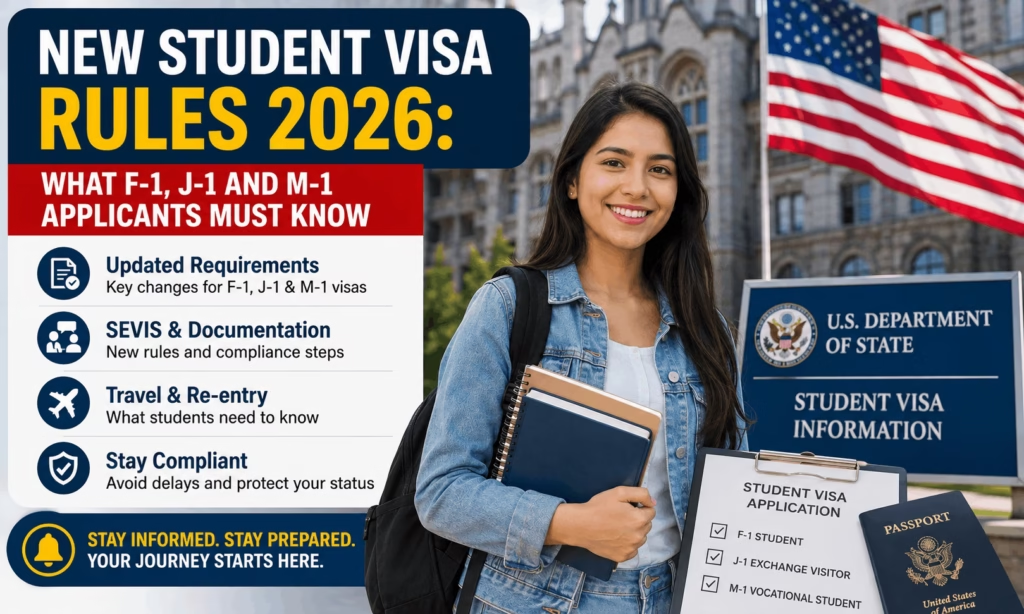
New Student Visa Rules 2026: The Department of Homeland Security (DHS) published a final rule on July 17, 2026 that eliminates “Duration of Status” (D/S) for F-1 students and J-1 exchange visitors, replacing it with a fixed period of admission capped at four years. The change, described by immigration attorneys and DHS itself as the biggest shift to the U.S. student visa system in roughly 50 years, takes effect September 15, 2026, and affects an estimated 1.2 million international students currently studying in the United States. DHS Secretary Markwayne Mullin said the outdated D/S system had “compromised national security and created an environment ripe for immigration fraud” by allowing indefinite enrollment without direct federal oversight.
Here’s the detail that trips up a lot of students searching this topic: the rule applies specifically to F, J, and I visa categories student, exchange visitor, and foreign media, respectively. M-1 vocational students are not part of this new rule, because M-1 status has never used D/S in the first place; M-1 students have always been admitted for a fixed period tied to their program length. That distinction matters for anyone comparing notes with classmates on different visa types. We’ll be updating this article monthly as USCIS and DHS release further implementation guidance ahead of the September deadline.
New Student Visa Rules 2026 Highlights
| Rule Published | July 17, 2026 (Federal Register) |
| Effective Date | September 15, 2026 |
| Visa Categories Affected | F (student), J (exchange visitor), I (foreign media) |
| M-1 Status | Not affected — already used fixed admission, not D/S |
| New Admission Structure | Fixed period tied to Form I-20 program length |
| Maximum Admission Period (F-1/J-1) | 4 years |
| Maximum Admission Period (I visa) | 240 days |
| F-1 Grace Period After Program Completion | Reduced from 60 to 30 days (for new admissions) |
| J-1 Grace Period | Remains 30 days (unchanged) |
| Extension Mechanism | Form I-539 Extension of Stay (EOS) via USCIS |
| Estimated Students Affected | Approximately 1.2 million |
| Status of Rule | Subject to congressional review and possible litigation — date could shift |
What “Duration of Status” Actually Was, and Why It’s Ending?
For decades, F-1 and J-1 visa holders were admitted to the U.S. under “Duration of Status,” meaning their I-94 record simply read “D/S” instead of listing an expiration date. As long as a student’s designated school official (DSO) kept their SEVIS record active full-time enrollment, good academic standing they could remain in the country indefinitely, extend programs, or even start new ones without ever filing paperwork with USCIS. DHS’s final rule ends that open-ended structure. Beginning September 15, 2026, F-1 and J-1 holders will instead receive an “Admit Until Date” (AUD) printed on their I-94, based on their program length as listed on Form I-20 or DS-2019, capped at a hard four-year maximum regardless of how long the underlying academic program actually runs.
Who Needs to Take Action Right Now?
If you’re a current F-1 or J-1 student already in the United States on September 15, 2026, the rule includes transition provisions, and in most cases, you don’t need to do anything immediately. Students who remain continuously in the U.S. without international travel generally continue under their existing D/S admission until the later of their program’s natural end date or the point at which they either travel internationally or file for an Extension of Stay. In practical terms, many PhD students several years from finishing will keep studying under the old rules for a while longer without taking any immediate action.
That changes the moment you travel internationally and re-enter the U.S. on or after September 15, 2026. Re-entry after that date means you’ll be issued a new I-94 with a fixed Admit Until Date, immediately placing you under the new framework including the reduced 30-day grace period rather than the original 60 days.
Max Social Security Benefit at Age 67 in 2026: How to Get It?
Canada Ranked Second Most Trustworthy Country for Investment 2026
The New Grace Period: 60 Days Is Becoming 30
One of the most consequential changes for students finishing their programs is the shortened grace period the window after your program ends during which you must depart the U.S., transfer schools, change status, or begin authorized practical training. For decades, F-1 students had 60 days to sort out their next step. Under the new rule, that shrinks to 30 days for anyone admitted under the new fixed-period system, aligning F-1 with the J-1 grace period, which has always been 30 days and remains unchanged. Current F-1 students who stay continuously in the U.S. keep their original 60-day grace period until they either travel internationally or receive a new I-94 through an approved Extension of Stay.
How the Extension of Stay (EOS) Process Works
Anyone whose program runs longer than their fixed admission period or who needs more time to finish coursework, complete OPT, or pursue STEM OPT must now file a formal Extension of Stay application (Form I-539) directly with USCIS, rather than relying on a DSO to simply extend their SEVIS record. The EOS process requires:
- An updated Form I-20 or DS-2019 reflecting the extended program timeline
- Biometric data submission and background/fraud screening
- Evidence of sufficient funds to cover the extended period
- The applicable USCIS filing fee
- A qualifying reason — DHS lists compelling academic reasons, documented illness or medical condition, or exceptional circumstances beyond the student’s control as acceptable grounds; academic probation, suspension, or repeated failure to complete coursework generally will not qualify
Filing on time matters significantly. Students who submit their EOS application before their current admission period expires can generally continue on-campus employment, CPT, and severe-economic-hardship employment for up to 240 days while USCIS processes the request. Students who wait until the 30-day departure grace period to file must stop all employment immediately and cannot resume working until the extension is actually approved.
Impact on OPT, STEM OPT and CPT
The rule does not eliminate Optional Practical Training, STEM OPT, or Curricular Practical Training, but it does change how they interact with your immigration timeline. CPT must now fit entirely within your fixed admission period — if your program runs past your I-94 expiration date, you’ll need an approved EOS first. For post-completion OPT and STEM OPT, DHS has built in a transition cushion: F-1 students admitted under D/S who timely file Form I-765 for OPT or STEM OPT on or before March 18, 2027, are not required to file a separate EOS application for that specific OPT period. Employers of F-1 workers on OPT or STEM OPT are being advised to monitor I-94 expiration dates closely and coordinate extension filings well in advance to avoid gaps in employment authorization. The existing 180-day automatic extension for timely filed STEM OPT extensions and H-1B cap-gap protections remain unchanged under the new rule.
New Restrictions on Changing Programs and Degree Levels
The final rule also tightens what F-1 students can do academically after finishing a degree. Students who complete a degree program after September 15, 2026 are generally prohibited from enrolling in another F-1 program at the same or a lower degree level. For example, a student who completes a U.S. master’s degree cannot pursue a new bachelor’s or a second master’s program under F-1 status. Immigration attorneys have flagged this as a direct hit to so-called “day-one CPT” master’s programs, a popular pathway for students who already hold one U.S. master’s degree and wanted to pursue a second for work-authorization purposes. School transfers and changes to field of study now also generally require formal approval, shifting oversight from individual DSOs back to federal authorities.
What Happens to Dependents (F-2, J-2)
Spouses and children under 21 holding F-2 or J-2 dependent status are directly affected as well. Dependents will now receive a fixed period of admission that cannot exceed the principal F-1 or J-1 student’s own authorized period. If a family wants a dependent to remain in the U.S. beyond that date, the dependent must separately file for an Extension of Stay, mirroring the process required of the primary visa holder.
Where M-1 Students Actually Stand
Because the current news cycle frequently lumps F-1, J-1, and M-1 together, it’s worth stating clearly: this specific July 2026 DHS rule does not change how M-1 vocational students are admitted. M-1 status has never used Duration of Status — vocational and technical students have always been admitted for a fixed period tied to their program length, generally up to one year initially, with the ability to request additional one-year extensions up to a total of three years from the original start date, plus the standard 30-day grace period. M-1 students already navigate a federal extension process similar in spirit to what F-1 and J-1 students are now being required to adopt for the first time.
Visa Waiver Program (VWP) 2026: ESTA Fee, Eligible Countries & Entry Rules
EB-5 Visa Cap India: Why New Green Card Approvals Stay Blocked Until October
Legal Status: Is This Rule Guaranteed to Take Effect?
Not entirely settled. Multiple legal and higher-education organizations have noted that the rule’s September 15, 2026 effective date remains subject to Congressional Review Act scrutiny and likely court challenges, meaning the timeline could still shift before it takes full effect. A similar Duration-of-Status elimination effort was proposed during the first Trump administration in 2020 but was ultimately withdrawn before taking effect. Universities and immigration attorneys are advising students to plan around the September 15 date while continuing to monitor official guidance for any changes.
Official Resources
| Resource | Purpose | Official Link |
|---|---|---|
| Study in the States (DHS) | Official rule FAQ and updates | studyinthestates.dhs.gov |
| USCIS Extension of Stay (Form I-539) | File for an Extension of Stay | uscis.gov/i-539 |
| SEVP / SEVIS Portal | Student and school record system | studyinthestates.dhs.gov/sevis |
| DHS News Release on the Final Rule | Official DHS announcement | dhs.gov/news |
| USCIS Form I-765 (OPT/STEM OPT) | Apply for practical training work authorization | uscis.gov/i-765 |
FAQs
When do the new F-1 and J-1 visa rules take effect?
The final DHS rule takes effect on September 15, 2026, though the date remains subject to congressional review and possible litigation.
Does the new rule apply to M-1 students?
No. M-1 vocational students already use a fixed period of admission rather than Duration of Status, so this specific rule does not change how M-1 status works.
Do current F-1 students need to do anything right now?
Generally, no — if you remain continuously in the U.S. without international travel, you keep your existing D/S admission under transition provisions until your program ends, or until you travel internationally or file for an Extension of Stay.
How long is the new F-1 grace period after finishing a program?
It drops from 60 days to 30 days for students admitted under the new fixed-period system, matching the J-1 grace period, which stays at 30 days.
Can I still pursue a second master’s degree on F-1 status?
Generally, no, if you complete a degree after September 15, 2026 — the rule prohibits enrolling in a new F-1 program at the same or a lower degree level than one you’ve already completed.
What is the maximum period of admission under the new rule?
Up to 4 years for F-1 and J-1 students, matched to program length, and up to 240 days for I (foreign media) visa holders. Anyone needing more time must file a Form I-539 Extension of Stay.
People Also Ask
What is the difference between F-1, J-1, and M-1 visas? F-1 is for academic study, J-1 is for exchange visitor and scholar programs, and M-1 is for vocational or non-academic technical training — each has different work authorization rules and, as of 2026, different admission structures.
Will this rule affect my OPT or STEM OPT application? It changes the process rather than eliminating these programs — CPT must now fit within your fixed admission period, and OPT/STEM OPT applicants may need to coordinate Extension of Stay filings depending on their timing.
What happens if my Extension of Stay application is denied? If an EOS application is denied, there is generally no grace period, and the applicant must depart the United States immediately.
Is Duration of Status completely gone after September 15, 2026? For new admissions and re-entries after that date, yes. Current students already in D/S status keep it temporarily under transition provisions until they travel internationally or receive a new fixed-date I-94 through an approved extension.
Conclusion
The end of Duration of Status for F-1 and J-1 visa holders marks the most significant change to the U.S. international student system in decades, replacing an open-ended framework with fixed admission dates, mandatory federal extension filings, and tighter restrictions on switching programs or degree levels. M-1 vocational students, by contrast, continue operating under the fixed-period system they’ve always used. With the rule’s effective date still subject to legal and congressional review, students on F-1, J-1, or M-1 status should track official guidance closely, avoid unnecessary international travel before confirming their own timeline, and file any required extensions well ahead of their program’s end date. We’ll be updating this article monthly as DHS and USCIS release further implementation details.
Form I-551 Confirmed Green Card Holders Enter US Without a Visa