New York’s STAR Check 2026: New York’s STAR program has entered its second payment wave, with Governor Kathy Hochul confirming that homeowners in communities with August and September school tax deadlines are now receiving their checks, following the completion of phase one payments in cities including New York City, Buffalo, Rochester, and Syracuse. Alongside this rollout, a wave of income verification letters has also started landing in mailboxes, and the state has already published the income limit that will apply next year, giving homeowners a preview of where Enhanced STAR eligibility is headed before the 2026 benefit season even wraps up.
Nearly three million New York homeowners qualify for a STAR benefit each year, and the 2026 program is delivering more than two billion dollars in combined relief statewide. But qualifying depends on a specific set of income limits, ownership rules, and registration steps that change slightly each year, and 2026 brought several real updates, including automatic Enhanced STAR upgrades, a rule that now excludes non-resident co-owners from your income calculation, and a new round of Form RP-5300 verification letters that some recipients need to respond to before their payment is released. This article breaks down exactly who qualifies, how much you could receive, how to check your payment status once you have registered, and what to do if your check is delayed or flagged. We’ll be updating this article monthly as new phases of the STAR payment schedule are confirmed.
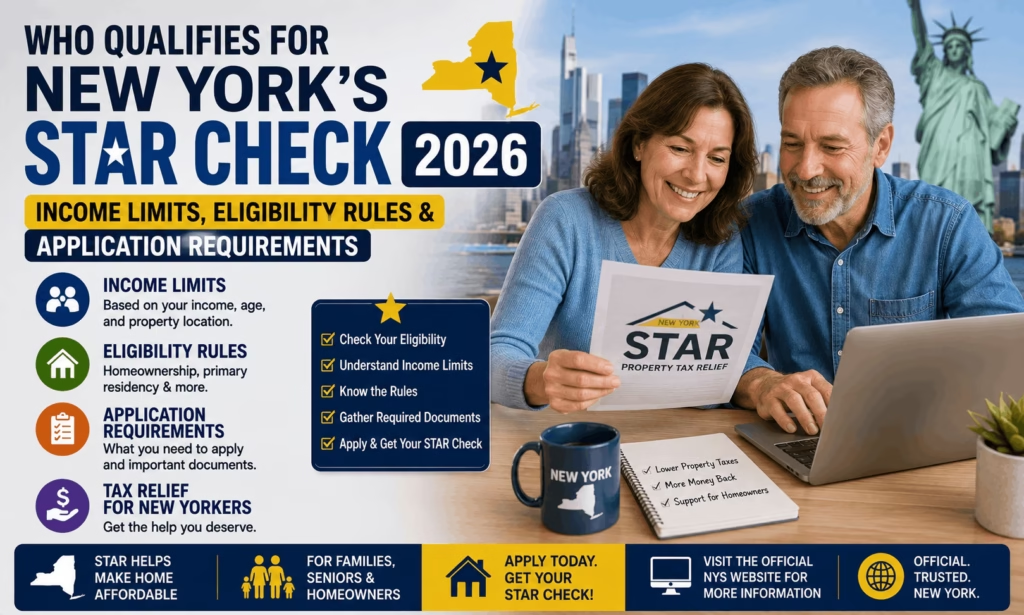
Latest Update: Phase Two Payments and the 2027 Income Limit
As of early August 2026, the New York State Tax Department confirmed that phase two of the STAR benefit season is underway, covering homeowners in areas with school tax due dates in August and September. Homeowners eligible for the standard STAR credit in this phase are receiving checks ranging from $350 to $600, while seniors eligible for Enhanced STAR are receiving between $700 and $1,500, depending on their school district’s tax rate. The overall 2026 benefit season, covering all payment phases statewide, runs from June through November.
Looking ahead, the state has already confirmed the income limit that will apply for the 2027 benefit year. Enhanced STAR eligibility will require resident owner income of $113,550 or less, up from the $110,750 threshold that applies for 2026. This means homeowners who are close to this year’s limit, or who expect a modest income increase, may still qualify next year even if their income rises slightly in 2026.
Since late June 2026, the state has also been mailing Form RP-5300 to certain STAR recipients, asking them to confirm their income directly. Homeowners who ignore it risk having their benefit paused even if their check would otherwise have already gone out. More on exactly what this letter means and how to respond to it further down.
What Is the STAR Program?
STAR stands for School Tax Relief, and it is New York’s largest property tax relief program. It does not reduce your county or municipal taxes, it specifically offsets your school district tax bill, either through a check or direct deposit, known as the STAR credit, or as a direct reduction on your tax bill, known as the STAR exemption, which is only available to long-time recipients.
There are two tiers. Basic STAR is open to nearly all primary-residence homeowners, regardless of age, as long as they meet the income threshold. Enhanced STAR is a larger benefit reserved for senior homeowners who meet a stricter, lower income limit.
PSLF Payment Reversal: The New “On-Time Only” Rule Now Required to Get Your Student Debt Erased
Basic STAR Eligibility Rules and Income Limits
To qualify for Basic STAR, you need to meet three core conditions. You must own the home, and it must be your primary residence. The combined income of all owners and any spouses who reside at the property must be $500,000 or less for the STAR credit. You must also not be disqualified by ownership structure, covered in more detail below.
There is an important wrinkle. If you have been receiving the older STAR exemption, a direct reduction on your bill, since 2015 or earlier, your income limit is actually lower, at $250,000 or less. If your income rises above $250,000 but stays under $500,000, you will not lose the benefit entirely, you will simply be switched from the exemption to a STAR credit check instead. The STAR exemption itself is no longer available to new homeowners, so anyone buying a home today can only register for the STAR credit going forward.
One subtle but important point is that the STAR credit’s savings can grow by up to roughly 2 percent per year, while the older exemption’s value is frozen. That means many longtime exemption recipients are now financially better off voluntarily switching to the credit.
Enhanced STAR Eligibility: Age and Income Limits for 2026
Enhanced STAR is built for senior homeowners and pays out a noticeably larger benefit, typically in the $700 to $1,500 range, depending on your school district. To qualify in 2026, you need to meet both an age test and a tighter income limit.
At least one owner of the property must be 65 years of age or older by December 31, 2026. For married couples or co-owners who are not related, only one owner needs to meet the age threshold, and the relationship between co-owners no longer matters under the current rules. The combined adjusted gross income of all resident owners and their resident spouses must be $110,750 or less, based on your 2024 tax year return, rising to $113,550 for the 2027 benefit year.
This is a meaningful increase over prior years’ Enhanced STAR thresholds, so some seniors who were previously phased out by income may now qualify again.
STAR Credit Payment Amounts by Category
| Recipient Type | Income Limit | Typical Payment Range |
|---|---|---|
| Basic STAR credit | $500,000 or less (combined owner and spouse income) | $350 to $600 |
| Enhanced STAR credit (seniors) | $110,750 or less for the 2026-2027 school year | $700 to $1,500 |
| Basic STAR exemption (legacy, pre-2015 registrants) | $250,000 or less | Applied directly as a line-item reduction on the school tax bill |
The exact figure a homeowner receives depends on their local school tax rate and assessed home value, which is why two neighbors in different school districts can receive noticeably different amounts even with similar incomes.
How New York Calculates Your STAR Income
STAR eligibility for the 2026 benefit year is based on your 2024 income tax return, not your current income, since the state always looks back two tax years. To calculate your qualifying income, take your federal adjusted gross income from your 2024 Form 1040 and subtract the taxable portion of IRA distributions. On the New York State Form IT-201, this means taking your federal AGI figure and subtracting your taxable IRA distributions line.
If you were not required to file a tax return for 2024, the Tax Department may send you a letter, sometimes labeled Form RP-5300, asking you to verify your income directly, often through the Homeowner Benefit Portal or an income worksheet. Some counties have also held in-person income reporting seminars to help affected homeowners complete this verification. Once you have proven your eligibility for three consecutive years as a non-filer, you may no longer need to resubmit that proof annually.
What the RP-5300 Income Verification Letter Actually Means
This is where a lot of avoidable panic happens each year. Form RP-5300 is not a rejection notice, and receiving one does not mean a homeowner has lost their STAR benefit. It means the Tax Department could not confirm income eligibility using the tax return data it already has on file, often because a return was filed late, filed jointly in a way that complicates the household income calculation, or simply was not filed at all for the relevant tax year.
Homeowners who receive this letter are asked to confirm their income within 30 days, either through the state’s online STAR Income Worksheet tool or by mailing in a paper version described directly in the letter. The Tax Department has also been running in-person income reporting sessions at local libraries and community centers across the state through the summer, specifically to help homeowners who receive this letter complete the process without navigating it entirely online. Ignoring the letter, rather than disputing or completing it, is what actually puts a payment at risk, since the state will not release a credit it cannot verify.
A separate letter, Form RP-5310-DLI, goes out to homeowners whose income has been confirmed to exceed the STAR credit limit. Unlike RP-5300, this letter does not require a response unless the homeowner disagrees with the state’s income determination, in which case they can contact the Tax Department directly to dispute it.
Young Child Tax Credit California: $1,189 CalEITC Bonus, Full Eligibility Rules & How to Claim It
$1750 Minnesota Child Tax Credit: No Limit on Children, Eligibility & How to Claim It
Big 2026 Changes Every Homeowner Should Know
New York simplified several parts of the STAR program for the 2026 benefit year, and these changes directly affect who qualifies. Only resident owners now count toward income, meaning if you co-own a property with someone who does not actually live there, that non-resident owner’s income is excluded from the eligibility calculation entirely, a change from previous years when all owners’ incomes counted regardless of residency.
Automatic Enhanced STAR upgrades are now in place, so you no longer need to file a separate application with your local assessor when you turn 65. The state now automatically tracks your age and income through tax records and upgrades you from Basic to Enhanced STAR, as long as you remain otherwise eligible. Relationship rules between co-owners have also loosened, so regardless of how the owners are related, just one resident owner needs to hit the age 65 mark. Ownership changes are now reported through the Homeowner Benefit Portal rather than filed as separate local paperwork with your assessor.
Who Is Not Eligible for STAR
Several categories of property and ownership are automatically excluded, regardless of income. Corporations, partnerships, and LLCs generally cannot receive STAR, with one exception for a farm dwelling owned by a qualifying agricultural entity. Second homes, vacation properties, and rentals do not qualify, since the home must be your primary residence. Married couples can only claim one STAR benefit total, even if they jointly or separately own multiple properties in New York, unless they are legally separated. Properties where someone other than a co-owner or spouse resides may also affect eligibility, since the program is built around owner-occupants.
STAR Credit vs. STAR Exemption: Which Applies to You?
If you bought your home after 2015, you are automatically on the STAR credit system, and there is no exemption option available to you. You register once through the state and receive a check or direct deposit each year that you can apply toward your school tax bill. If you have held the STAR exemption continuously since 2015 or earlier, you can keep it as long as you remain eligible, but it is worth comparing your current exemption savings against what the STAR credit would pay, since many longtime recipients are leaving money on the table by not switching.
Two Ways to Check Your STAR Credit Status
New York offers two separate official tools for tracking a STAR payment, and homeowners often only know about one of them.
The Property Tax Credit Lookup tool is the most direct option. Entering your SWIS code, which identifies your specific school district and municipality, along with your parcel ID, returns the exact date your credit was issued and the amount, once it has actually been processed. This tool only shows a result after your payment has been issued, so an empty result does not necessarily mean something is wrong, particularly if your district’s tax due date has not yet arrived.
The STAR Credit Delivery Schedule works differently. Rather than looking up an individual payment, it shows the general mailing window for every school district statewide, letting a homeowner see roughly when their area’s payments are expected to begin, even before an individual check has been issued. Checking this tool first, before jumping to the individual lookup, helps homeowners understand whether a missing payment is simply early or genuinely delayed.
Direct Deposit vs Mailed Check
Homeowners who enroll in STAR Credit Direct Deposit at least seven days before their credit is scheduled to be processed generally receive payment electronically rather than by mail, which typically arrives faster and avoids the risk of a lost or delayed paper check. Enrollment is done directly through the homeowner’s STAR account on the Tax Department’s website, and once set up, it carries forward automatically in future years without needing to be re-entered.
$1,150 a Week: Rhode Island TDI Benefit Rises Again as State Delivers Second Increase in 2026
Interest on Late STAR Payments
Homeowners who register for the STAR credit by July 1 may be entitled to interest if the state issues their check after their local school tax due date. This interest is calculated automatically based on when the local school district files its tax roll, the master list of assessed property taxes, so eligible homeowners generally do not need to request it separately. That said, even if your STAR credit is delayed, you are still required to pay your local school taxes by your local deadline, or you may face local interest and penalties on the school tax bill itself.
How to Apply for Your STAR Check in 2026
STAR is not automatic, and you must register at least once. You can register online through the New York State Homeowner Benefit Portal at tax.ny.gov/star, available at any time. If you do not have computer access, you can register by phone through the Tax Department’s STAR line during weekday business hours. For the Enhanced STAR exemption specifically, relevant only if you are not already receiving Basic STAR exemption and being auto-upgraded, you will need to file Form RP-425-E along with the supplemental Form RP-425-IVP, including Social Security numbers for all resident owners and spouses.
Once registered, the state reviews your eligibility annually and renews your benefit automatically, with no annual reapplication needed unless your situation changes. To be eligible for a STAR credit in any given year, you must own the home as your primary residence on July 1 of that year, so timing your registration around a home purchase matters.
STAR Payment Schedule by Phase
| Phase | School Tax Due Date Window | Areas Covered | Status as of Late August 2026 |
|---|---|---|---|
| Phase One | Late June to July | New York City, Yonkers, Buffalo, Rochester, Syracuse | Completed |
| Phase Two | August to September | Communities with August and September deadlines, including much of the Capital Region | Underway |
| Nassau County | First-half tax due October 1 | Nassau County districts | Checks typically mail mid-August through mid-September |
| Suffolk County | First-half tax due January | Suffolk County districts | Checks typically mail October through early November |
| Remaining Phases | Through November | Remaining school districts statewide | Rolling through fall |
First-time STAR registrants should expect an additional delay in their first year, since new registrations take longer to process than renewals, meaning a payment can sometimes arrive after the local school tax bill is already due. The state recommends registering as early in the year as possible for exactly this reason.
Common Mistakes That Delay or Disqualify a STAR Benefit
Forgetting to register at all is the most common mistake, since STAR is opt-in and no registration means no check, regardless of how clearly you qualify. Reporting the wrong income figure, using gross income instead of AGI minus IRA distributions, is another frequent error that can trigger a correction letter. Assuming exemption and credit limits are the same causes confusion too, since the exemption’s $250,000 cap is stricter than the credit’s $500,000 cap. Missing the direct deposit enrollment deadline, which is 15 business days before your school tax due date, means you will get a slower paper check instead. Finally, not updating ownership changes promptly through the Homeowner Benefit Portal can delay or interrupt your benefit the following year.
How to Resolve a Delayed or Flagged STAR Payment
- Check the STAR Credit Delivery Schedule first to confirm whether your district’s payments have started mailing yet.
- If your district’s window has passed and you still have no result, use the Property Tax Credit Lookup tool with your SWIS code and parcel ID to check for an issue date.
- If you received Form RP-5300, complete the income verification within 30 days using the online STAR Income Worksheet or the paper option described in your letter.
- If you are unsure how to complete the online worksheet, look up whether an in-person income reporting session is scheduled near you.
- If you believe an income determination letter, such as RP-5310-DLI, is incorrect, contact the Tax Department directly to dispute it rather than assuming the decision is final.
- If you have not registered for STAR at all, register through the Homeowner Benefit Portal as early as possible, since new registrations take longer to process than renewals.
- Enroll in STAR Credit Direct Deposit if you have not already, to reduce future delivery delays and avoid lost mail.
Scam Warning: Protect Yourself During STAR Season
New York state officials have repeatedly warned that STAR season is a common target for scam texts, calls, and emails designed to look official. The New York State Tax Department will never call or text you asking for personal or banking information in connection with your STAR benefit. If you receive a message asking you to click a link or provide payment details to receive your STAR check, treat it as fraudulent and report it, since legitimate STAR communication comes through the Homeowner Benefit Portal, official mail, or a verified phone line, not unsolicited texts or emails.
Official Resources and Application Links
| Resource | Purpose | Link |
|---|---|---|
| STAR Homeowner Benefit Portal | Register, check status, and update ownership details | tax.ny.gov/star |
| STAR Credit Delivery Schedule | Check general mailing windows by school district | tax.ny.gov/pit/property/star/star-check-delivery-schedule.htm |
| Property Tax Credit Lookup | Check the status of an individual issued payment | tax.ny.gov/pit/property/star/star-credit-lookup.htm |
| STAR Income Worksheet | Complete income verification after receiving RP-5300 | tax.ny.gov/pit/property/star/star-income-worksheet.htm |
| Enhanced STAR Application (Form RP-425-E) | Apply for the Enhanced STAR exemption directly | tax.ny.gov (Form RP-425-E) |
| NYS Tax Department STAR phone line | Register, ask questions, or resolve a flagged payment by phone | 518-457-2036 |
| Report a scam | Report suspicious STAR-related texts, calls, or emails | tax.ny.gov (report fraud) |
$145.83 BC Family Benefit First Child Payment Confirmed as Income Phase-Out Shifts to $96,562
FAQs
What is the income limit for the STAR credit in 2026?
$500,000 or less in combined income for all owners and resident spouses. Homeowners still on the older STAR exemption face a lower limit of $250,000.
What is the Enhanced STAR income limit for 2026, and what will it be in 2027?
$110,750 or less based on your 2024 tax return for 2026 benefits. The state has already confirmed the 2027 threshold will rise to $113,550.
Do I need to reapply for Enhanced STAR every year once I turn 65?
No. As of 2026, the state automatically tracks your age and income through tax records and upgrades eligible homeowners from Basic to Enhanced STAR without a separate application.
When will my STAR check arrive in 2026?
It depends on your local school tax due date. Areas with June and July deadlines have already received phase one payments, while areas with August and September deadlines are currently receiving phase two payments. Nassau County typically sees checks mid-August through mid-September, and Suffolk County from October through early November. The full statewide season runs through November.
How do I check if my STAR credit check has been mailed?
Use the Property Tax Credit Lookup tool on the Tax Department’s website with your SWIS code and parcel ID. If no result appears yet, check the STAR Credit Delivery Schedule to see whether your district’s payments have started.
What happens if I don’t respond to the RP-5300 letter?
Your STAR credit can be paused or delayed if the Tax Department cannot verify your income within the 30-day response window, so completing the online worksheet or paper form promptly is important even if you believe you clearly qualify.
Is the RP-5300 letter a scam?
No, it is a legitimate letter from the Tax Department, but homeowners should still verify it by checking their own STAR account online or calling the official program line directly rather than clicking any link in an unexpected email or text claiming to be related to it.
Is STAR automatic, or do I have to apply?
You must register at least once through the Homeowner Benefit Portal. After that, your eligibility is reviewed and renewed automatically each year unless your situation changes.
Can I get interest if my STAR payment is late?
Yes, if you registered by July 1 and the state issues your check after your local school tax due date, interest is generally added automatically based on when your school district files its tax roll.
Are STAR scam texts and calls a real concern?
Yes. New York officials have confirmed scammers actively target STAR recipients with fake texts and calls asking for personal or banking information. The Tax Department will never request this information by text or unsolicited call.
Conclusion
Qualifying for a STAR check in 2026 comes down to three things: owning and living in the home as your primary residence, staying under the applicable income limit for either Basic or Enhanced STAR, and making sure you are properly registered through the state’s Homeowner Benefit Portal. With phase two payments now rolling out to homeowners in August and September deadline areas, the 2027 Enhanced STAR income limit already confirmed, and stronger protections like automatic senior upgrades and resident-only income counting, more New York homeowners may qualify than in past years. For anyone still waiting on a check, the Delivery Schedule and Property Tax Credit Lookup tools are the fastest way to confirm timing, and anyone who receives a Form RP-5300 income verification letter should respond within 30 days rather than assuming the payment will arrive regardless, since a missed response window is one of the most common reasons a STAR credit gets delayed year over year. Stay alert to scam attempts that tend to spike during payment season, since legitimate STAR communication never asks for personal or banking details by text or unsolicited call.