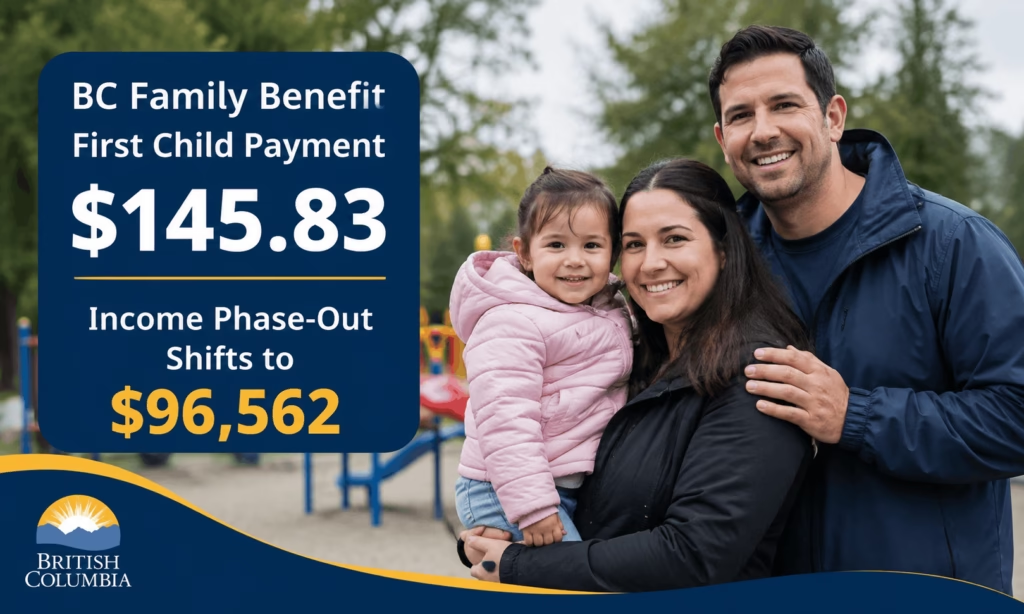
$145.83 BC Family Benefit First Child Payment: British Columbia families are now receiving up to $145.83 a month for their first child under the BC Family Benefit, after the temporary bonus payment that boosted amounts through the 2024-25 benefit year expired and monthly payments reset to their standard 2023-24 levels starting July 2025. At the same time, the income level at which the benefit begins phasing out has moved higher for the second half of the 2026 calendar year, climbing from $94,483 to $96,562, meaning more middle-income households in the province will keep at least a partial payment even as their earnings rise. We’ll be updating this article monthly, so check back for the latest payment amounts, income thresholds, and payment dates as the Canada Revenue Agency updates its figures.
For a working parent in British Columbia trying to plan a monthly budget, the difference between $145.83 and $182.33 a month, the amount paid during the temporary bonus period that just ended, is not trivial once you multiply it across a full year and add in payments for additional children. The BC Family Benefit is delivered automatically alongside the federal Canada Child Benefit, so most families never fill out a separate application, but the amount they actually receive depends entirely on their adjusted family net income and how many eligible children they have, both of which are recalculated every July based on the previous year’s tax return. Understanding exactly where the current maximum payment stands, and exactly where the phase-out begins and ends, is essential for any BC family trying to anticipate their deposit for the months ahead.
What the BC Family Benefit 2026?
The BC Family Benefit is a tax-free monthly payment issued to eligible British Columbia families with children under 18, designed to help offset the cost of raising kids in one of Canada’s more expensive provinces to live in. It is administered by the Canada Revenue Agency on behalf of the Government of British Columbia and is paid on the same monthly schedule as the federal Canada Child Benefit, arriving in the same direct deposit rather than as a separate payment.
Because the benefit rides inside the CCB deposit, families do not need to submit a distinct application form specifically for the BC Family Benefit. Eligibility and payment amounts are calculated automatically once a family files their income tax return and registers their child for the Canada Child Benefit, with the Canada Revenue Agency using that filed return to determine both the family’s adjusted family net income and how much BC Family Benefit they qualify for.
$145.83 BC Family Benefit First Child Payment Highlights
| Detail | Information |
|---|---|
| Program name | BC Family Benefit |
| Administered by | Canada Revenue Agency, on behalf of the Government of British Columbia |
| Maximum monthly amount, first child | $145.83 |
| Maximum annual amount, first child | $1,750 |
| Maximum annual amount, second child | $1,100 |
| Maximum annual amount, third and each additional child | $900 |
| Income threshold for full benefit | $29,526 (rising to $30,176 from July 2026) |
| Income phase-out start, January to June 2026 | $94,483 |
| Income phase-out start, July to December 2026 | $96,562 |
| Phase-out rate above the upper threshold | 4% of income above the threshold |
| Guaranteed minimum amounts (between thresholds) | $775 first child, $750 second child, $725 additional children |
| Payment frequency | Monthly, combined with the Canada Child Benefit deposit |
| Separate application required | No, automatic through tax filing and CCB registration |
| Previous temporary bonus amount, first child | $2,188 annually (ended June 30, 2025) |
Employment Insurance (EI) 2026 Rule Changes: What Every Canadian Worker Needs to Know
Empire State Child Credit 2026: $1,000 Per Child Under 4, Full Eligibility & Payment Guide
Oregon Kicker Tax Credit 2026: How To Claim Your Share Of The $1.41 Billion Surplus
California Climate Credit 2026: Payment Timing Just Changed, Here Is What to Expect on Your Bill
Why the Payment Amount Dropped From Its Bonus-Period High
Families who received BC Family Benefit deposits during the 2024-25 benefit year may notice a real difference in their current payments compared to a year ago, and this is not a mistake or a processing error. The provincial government had introduced a temporary 25% bonus increase to the BC Family Benefit that ran from July 2024 through June 2025, temporarily pushing the maximum annual amount for a first child up to $2,188, compared to the standard $1,750 that applies now.
That bonus period also temporarily raised the income threshold for receiving the full benefit, from $27,354 up to $35,902, and extended partial benefit eligibility to a wider band of household incomes than the standard rules allow. When the bonus program expired as scheduled on June 30, 2025, both the payment amounts and the income thresholds reverted to their pre-bonus levels starting with the July 2025 payment, which is why the current maximum of $145.83 a month for a first child reflects the standard 2023-24 benefit structure rather than the higher bonus-era amount some families had grown used to.
Advocacy organizations focused on child poverty in the province, including groups that track the benefit’s real-world impact through annual reporting, have publicly criticized the decision to let the bonus expire rather than making the higher amount permanent, arguing that the reversion effectively took income away from lower and middle-income families at a time when the overall cost of living in British Columbia continued climbing.
How the Payment Amount Is Calculated by Income Level
The BC Family Benefit is structured in three income bands, and where a family’s adjusted family net income falls determines which calculation applies to their payment.
Families with adjusted family net income at or below $29,526 for the January to June 2026 payment period, rising to $30,176 for the July to December 2026 period, receive the full maximum benefit amount for every eligible child, meaning $1,750 annually, or $145.83 monthly, for a first child, plus $1,100 annually for a second child and $900 annually for each additional child.
Families with income above that lower threshold but below the upper phase-out threshold, currently $94,483 through June 2026 and rising to $96,562 from July 2026 onward, receive a reduced amount but are guaranteed a minimum payment regardless of exactly where their income falls within that range. That guaranteed minimum sits at $775 annually for a first child, $750 for a second child, and $725 for each additional child.
Families with income above the upper threshold receive a further reduced amount, calculated as their guaranteed minimum reduced by 4% of the amount their income exceeds that upper threshold, continuing until the benefit phases out entirely to zero. This structure means that even solidly middle-income BC households, well above the $30,000 range typically associated with income-tested benefits, can still receive a meaningful partial payment as long as their income has not climbed past the upper phase-out point.
Who Is Eligible for the BC Family Benefit?
Eligibility for the BC Family Benefit is tied directly to Canada Child Benefit eligibility and BC residency. To qualify, a family must be a resident of British Columbia, have at least one child under the age of 18 living with them, and be registered for the Canada Child Benefit, which itself requires being primarily responsible for the child’s care and being a Canadian resident for tax purposes.
Both parents in a two-parent household need to file an income tax return every year, even if they had no income to report, since the Canada Revenue Agency relies on those filed returns to calculate adjusted family net income and determine the correct benefit amount. Newcomers to Canada or to British Columbia specifically may need to complete additional forms when first registering for the Canada Child Benefit, since the CRA needs to establish their residency and income history before payments can begin.
Shared custody arrangements affect how much a parent receives. If a child lives with a parent only part of the time under a recognized shared custody arrangement, that parent generally receives half of what they would receive if they had full custody of the child, with the other half going to the other parent under their own separate calculation.
Payment Dates and How the Deposit Works
The BC Family Benefit does not arrive as a separate cheque or deposit. It is combined directly with a family’s monthly Canada Child Benefit payment, meaning families see one consolidated deposit that already includes both the federal and provincial amounts added together. Payments follow the same twelve monthly dates used for the Canada Child Benefit throughout the year, generally landing around the 20th of each month, with adjustments made when that date falls on a weekend, and a notably earlier December payment date to account for the holiday period.
Families not registered for direct deposit receive their payment by mailed cheque instead, which can take up to ten business days to arrive after the scheduled payment date. In cases where a family’s combined annual BC Family Benefit and CCB entitlement is very small, specifically under $240 for the year, the Canada Revenue Agency issues that amount as a single lump sum payment in July rather than spreading it across twelve monthly instalments.
Trump Halts 50 Percent Tariffs Canada: What the Last Minute Deal With Ottawa Means
Green Card Rule Changes: New Public Charge Test to Assess Age, Health, Family Status and Finances
Georgia Flat Income Tax Rate Cut to 4.99%: What the New Law Actually Means for Your Paycheck
An Important Change Coming for Families With a Child With a Disability
Looking beyond the current standard payment structure, British Columbia has confirmed that a new disability supplement will be added to the BC Family Benefit starting in July 2027, specifically for families with a child who qualifies for the federal Disability Tax Credit. Under the announced structure, families will receive the full disability supplement amount when their adjusted family net income is at or below $50,000, with the supplement reduced by 4% of income above that threshold. The supplement fully phases out once adjusted family net income reaches $200,000 for one eligible child, with that phase-out threshold increasing by $150,000 for each additional child with a qualifying disability.
While this supplement does not affect payments for the current 2025-26 and 2026 benefit periods discussed in this article, families with a child who may qualify for the Disability Tax Credit should begin the DTC application process well ahead of the 2027 rollout, since a valid, approved DTC certificate will be a prerequisite for receiving the new supplement once it becomes available. The province has also published an online estimator tool that lets families project their expected monthly and annual disability supplement payments in advance based on projected income.
How the BC Family Benefit Compares to Other Provincial Child Benefits?
Every Canadian province and territory layers its own child benefit on top of the federal Canada Child Benefit, and the specific amounts and thresholds vary considerably from one jurisdiction to another. This means two families with identical household incomes and an identical number of children can receive noticeably different combined federal-provincial totals depending on which province they live in, since each province sets its own maximum amounts, income thresholds, and phase-out rates independently.
For BC families specifically, this means the provincial portion of their overall child benefit deposit, the $145.83 monthly maximum for a first child in the standard benefit structure, is calculated entirely separately from the federal Canada Child Benefit portion of the same deposit, even though both amounts land in a family’s bank account together. Families trying to understand their total monthly child benefit income should account for both components separately when budgeting, since the federal and provincial thresholds and phase-out rates do not move in lockstep with each other.
How to Apply?
Because there is no standalone BC Family Benefit application, the practical steps for a family to start or continue receiving payments center entirely on federal tax and benefit administration. New parents apply for the Canada Child Benefit as soon as possible after a child is born or begins living with them, typically through the birth registration process in the hospital or directly through CRA My Account, and BC Family Benefit eligibility is assessed automatically as part of that same application.
Every family receiving the benefit needs to file an annual income tax return, even with no income to report, since missing a tax filing interrupts the CRA’s ability to recalculate the family’s adjusted family net income and can pause payments until the return is filed and processed. Keeping a current mailing address and banking information on file with the CRA, along with promptly reporting any change in marital status or custody arrangement, helps avoid payment delays or incorrect amounts, since these are the details the CRA uses to determine both eligibility and the correct payment amount each July.
Chapter 33 VA Benefits Housing Allowance: How Much Can You Get Per Month
State Farm Dividend: Who Qualifies to Receive Part of the $5 Billion Payout
H-1B Visa Ban Texas Schools: Abbott Wants Exactly Zero Foreign Workers, What Indians Should Know
Official Resources and Links
FAQs About $145.83 BC Family Benefit First Child Payment
How much is the BC Family Benefit for one child right now?
The current maximum is $145.83 per month, or $1,750 annually, for a first child, for families with adjusted family net income at or below the lower threshold. This reflects the standard benefit level after a temporary bonus payment expired at the end of June 2025.
What is the income limit for the BC Family Benefit?
Families with income at or below roughly $29,526 to $30,176, depending on the payment period, receive the full amount. The benefit then phases out gradually, with the payment reaching zero once income surpasses the upper threshold, which moved from $94,483 to $96,562 starting with the July 2026 payment period.
Do I need to apply separately for the BC Family Benefit?
No. There is no distinct application. The Canada Revenue Agency calculates your eligibility and payment amount automatically once you file your income tax return and register your child for the Canada Child Benefit.
Why did my BC Family Benefit payment go down this year?
A temporary 25% bonus that increased BC Family Benefit payments and income thresholds ran from July 2024 to June 2025. That bonus expired as scheduled, and payments reverted to the standard, lower amounts starting with the July 2025 payment, which is why current deposits are smaller than they were during the bonus period.
When is the BC Family Benefit paid?
It is paid monthly, combined with your Canada Child Benefit deposit, generally around the 20th of each month, with adjustments for weekends and an earlier December payment date.
Is the BC Family Benefit taxable?
No, the BC Family Benefit is a tax-free payment, like the federal Canada Child Benefit it is delivered alongside, and does not need to be reported as income on your tax return.
People Also Ask
How much is the Canada Child Benefit in BC? The federal Canada Child Benefit is calculated separately from the BC Family Benefit and provides up to a set maximum per child under 6 and a lower maximum per child aged 6 to 17, phasing out as family net income rises above a federal threshold, with the BC Family Benefit added on top of that federal amount for BC residents.
What is adjusted family net income for child benefits? Adjusted family net income, often abbreviated AFNI, is generally your family’s net income from your tax return with certain adjustments, such as excluding Universal Child Care Benefit and Registered Disability Savings Plan amounts, and it is the figure the CRA uses to calculate both your Canada Child Benefit and your BC Family Benefit.
Why is my BC Family Benefit different from my neighbor’s? Payment amounts depend on each family’s own adjusted family net income and number of eligible children, so two families in the same city can receive very different amounts even with a similar number of kids if their household incomes differ.
Does the BC Family Benefit continue if I share custody? Yes, in a recognized shared custody arrangement, each parent generally receives half of the amount they would otherwise receive if they had full custody of the child, calculated separately for each parent’s own income situation.
Will the BC Family Benefit increase again in the future? Advocacy groups have continued to call on the provincial government to reintroduce or make permanent a higher benefit level similar to the 2024-25 bonus period, though as of now the standard 2023-24 level remains in effect, with the confirmed disability supplement being the next scheduled enhancement, arriving in July 2027.
Conclusion
The BC Family Benefit remains one of the more consistent sources of monthly support for British Columbia families, delivering up to $145.83 a month for a first child automatically alongside the federal Canada Child Benefit, with no separate application needed beyond staying current on annual tax filing. With the income phase-out threshold moving from $94,483 to $96,562 starting in the second half of 2026, more middle-income families are likely to retain at least a partial payment even as their earnings grow, though the overall maximum amount remains lower than the temporary bonus level some families received during the 2024-25 benefit year. As advocacy groups continue pushing for a permanent increase and the province prepares to roll out its new disability supplement in 2027, this article will be updated every month with the latest payment figures and threshold changes.
Premium Tax Credit Expiration Hits Millions of Taxpayers as Filing Season Rules Change
My Safe Florida Home Grant Program 2026: Current Status, $10,000 Funding, and How to Apply
Colorado TABOR Refund and PTC Rebate 2026: Who Qualifies and How Much You Can Get
USCIS E-Filing Mandate: New DHS Rule Gives Agency Power To Retire Paper Immigration Forms
Denaturalization Cases Surge As DOJ Files Record 25 Complaints In Just Two Weeks