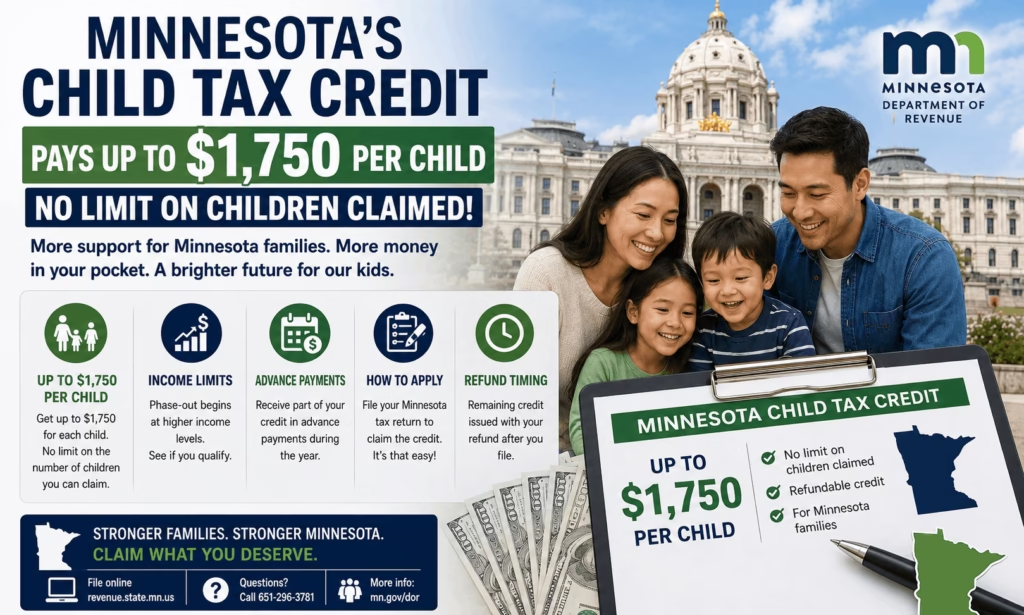
$1,750 Minnesota Child Tax Credit: More than 220,000 Minnesota families claimed the Minnesota Child Tax Credit in 2025, and the state is now pushing a second wave of outreach as lawmakers debate raising the credit even higher. Right now, eligible families can receive up to $1,750 per qualifying child, with no cap on the number of children a household can claim, making Minnesota’s version one of the most generous state-level child credits in the country. The Department of Revenue confirms the credit phases out gradually for single filers earning above $31,950 and joint filers above $37,910, and because it is fully refundable, families who owe zero state tax still receive the full payment as part of their refund.
The bigger news this season is the arrival of advance payments for the first time. Starting with tax year 2025 returns, families can now elect to receive part of their upcoming 2026 Child Tax Credit early, split into three installments arriving in the second half of the year rather than waiting for a single lump sum at tax time. Roughly 17,231 taxpayers received about $22.7 million through these early payments in the program’s first run, according to Minnesota House Research figures. Meanwhile, a legislative proposal now moving through the Capitol would push the maximum credit from $1,750 to $2,000 starting with taxable years after December 31, 2025, then tie future amounts to inflation beginning in 2027. We’ll be updating this article monthly as the Department of Revenue and the legislature finalize these changes, so check back for the latest confirmed figures.
What Is the Minnesota Child Tax Credit?
The Minnesota Child Tax Credit (CTC) is a state-level, fully refundable tax credit created for tax year 2023 and expanded in the years since. It was designed to directly cut child poverty by putting cash back into the hands of working families, and unlike many federal benefits, it comes with no limit on the number of qualifying children a household can claim. A family with four young children under the income threshold can claim the full $1,750 for each one, with no reduction simply for having a larger family.
The credit stacks alongside Minnesota’s companion benefit, the Working Family Credit (WFC), which functions similarly to the federal Earned Income Tax Credit but with state-specific rules. Together, these two credits are sometimes filed and referenced as a combined package, since both appear on the same state schedule.
Because the credit is refundable, it works differently from an ordinary deduction. It first offsets any Minnesota income tax owed, and any amount left over is paid out directly as a refund. A family that owes no state tax at all still receives the full credit value in cash. State officials have emphasized this repeatedly in outreach materials aimed at lower-income households who might otherwise assume filing a return is pointless if they do not owe tax.
Minnesota Child Tax Credit Key Highlights for the 2026 Filing Season
| Detail | Current Confirmed Figure |
|---|---|
| Maximum credit amount | Up to $1,750 per qualifying child |
| Limit on number of children | None, every qualifying child counts |
| Qualifying child age | 17 or younger at the end of the tax year |
| Refundable? | Yes, fully refundable |
| SSN required? | No, an ITIN also qualifies |
| Income phase-out begins (single filers) | Above $31,950 |
| Income phase-out begins (married filing jointly) | Above $37,910 |
| Phase-out rate | Credit reduced by 12% of income above the threshold |
| Claim form | Schedule M1CWFC, filed with Form M1 |
| Advance payments available | Yes, starting with tax year 2025 returns |
| Families who claimed the credit in 2025 | Over 220,000 |
| Legislative proposal pending | Raise maximum to $2,000 for taxable years after Dec. 31, 2025 |
| Page last updated by Department of Revenue | December 12, 2025 |
Who Qualifies for the Minnesota Child Tax Credit?
Eligibility for the Minnesota Child Tax Credit hinges on residency, a qualifying child, and income falling within the published thresholds.
You must not be a full-year nonresident. Full-year and part-year Minnesota residents are eligible, but a taxpayer who lived outside Minnesota the entire year cannot claim the credit. Part-year residents can still qualify, though their credit is adjusted based on the percentage of income taxable to Minnesota.
Your child must be 17 or younger at the end of the tax year. Any dependent child who is 17 or under generally counts as a qualifying child for this credit. Children who are 18 to 23 do not qualify for the standard Child Tax Credit, but many families with an older dependent can instead claim the separate Credit for Qualifying Older Children, which pays a smaller amount.
You cannot be claimed as another person’s dependent or qualifying child. If you can be claimed on someone else’s return, you are not eligible to claim the Child Tax Credit yourself.
You must not have an active IRS ban on claiming the federal EITC. If the IRS has barred you from the federal Earned Income Tax Credit due to a prior violation, that same restriction disqualifies you from Minnesota’s credit as well.
Your income must fall within the published limits for your family size. Unlike credits with a single flat income cutoff, Minnesota’s thresholds rise with each additional qualifying child, which is one of the more important and frequently searched details about this credit.
One feature that stands out compared with many other states is that Minnesota does not require a Social Security Number. A taxpayer, spouse, or qualifying child with only an Individual Taxpayer Identification Number can still be included, and military members whose home of record is Minnesota may include nontaxable combat zone pay as earned income when calculating the credit.
$1250 New Jersey Child Tax Credit: State Budget Delivers 25% Boost for Families With Young Children
Trump Halts 50 Percent Tariffs Canada: What the Last Minute Deal With Ottawa Means
Green Card Rule Changes: New Public Charge Test to Assess Age, Health, Family Status and Finances
Minnesota Child Tax Credit Income Limits by Family Size
Because the phase-out point rises with each additional child, larger families can earn considerably more and still qualify for at least a partial credit. These figures assume earned income of at least $9,480; households earning less have a slightly lower threshold.
| Number of Qualifying Children | Married Filing Jointly | Non-Married Filers |
|---|---|---|
| 1 | $55,649 | $49,689 |
| 2 | $70,232 | $64,272 |
| 3 | $84,815 | $78,855 |
| 4 | $99,399 | $93,439 |
| 5 | $113,982 | $108,022 |
| 6 | $128,565 | $122,605 |
| 7 | $143,148 | $137,188 |
| 8 | $157,732 | $151,772 |
| 9 or more | Add $14,583 per additional child | Add $14,583 per additional child |
These are the income levels at which most families can generally still expect to receive the credit. Below the lower thresholds of $31,950 for single filers and $37,910 for joint filers, families typically receive the full $1,750 per child; income above that starts reducing the credit at a rate of 12% of the excess income, until it phases out entirely near the figures shown in the table above.
How Much Can a Minnesota Family Actually Receive?
Because there is no cap on the number of qualifying children, families with several young kids can see this credit add up quickly if their income stays under the relevant threshold.
| Number of qualifying children | Maximum combined Child Tax Credit |
|---|---|
| 1 child | $1,750 |
| 2 children | $3,500 |
| 3 children | $5,250 |
| 4 children | $7,000 |
Minnesota House Research data shows that for tax year 2024, roughly 240,100 returns with a younger or older qualifying child claimed a combined $665.9 million in child and working family credits, for an average credit of about $2,773 per return, reflecting how many households claim more than one child or stack the credit with the Working Family Credit.
How to Apply for the Minnesota Child Tax Credit (Step by Step)
There is no separate application outside your tax return. You claim the credit by filing your Minnesota state income tax return correctly. Here is the practical process:
- Determine your qualifying children. Complete Schedule M1DQC, Dependents and Qualifying Children, to confirm which dependents count for the Child Tax Credit.
- Gather your documents. You will need each qualifying child’s name and Social Security Number or ITIN, along with your own income records such as W-2s and 1099s.
- Complete Schedule M1CWFC, Minnesota Child and Working Family Credits. This is the schedule that calculates your actual Child Tax Credit and Working Family Credit amounts based on your income and number of qualifying children.
- File Form M1, Individual Income Tax Return, attaching Schedule M1CWFC and Schedule M1DQC.
- Decide whether you want advance payments. If you want part of next year’s credit paid early, check the advance payment box on the first page of your return and complete section two of Schedule M1CWFC.
- Choose your filing method. You can file electronically, use a paid tax preparer, or print and mail your forms. Depending on income, you may also qualify for free electronic filing or free tax preparation help through VITA and TCE sites across the state.
- Submit by the standard Minnesota filing deadline, which generally lines up with the federal deadline of April 15 each year unless the state announces an extension.
Families who were eligible in a prior year but never claimed the credit can generally file a claim for refund to collect it retroactively, subject to Minnesota’s standard refund statute of limitations.
Advance Payments: How the New Option Works
For the first time, Minnesota families can receive part of next year’s Child Tax Credit early rather than waiting until they file their full return. Here is how it works if you elect advance payments on your 2025 return:
- You receive part of your estimated 2026 Child Tax Credit split into three equal payments during the second half of 2026, generally arriving at the end of July, September, and November.
- The remaining portion of your 2026 credit is paid when you actually file your 2026 income tax return the following year.
- If you choose not to receive advance payments, you simply claim your full 2026 Child Tax Credit in one payment when you file that year’s return, as in previous years.
- If your 2026 income tax return shows you remain eligible for at least the amount already advanced, no repayment is required. Overpayments can occur if your qualifying children or income change enough to reduce your credit below what was advanced.
- Any changes to your advance payment election must generally be submitted through e-Services well ahead of the first scheduled payment to take effect for that round.
- If you owe other Minnesota tax debts or certain government debts, the state may apply your advance payments to that balance instead of sending it to you directly.
Financial counselors have specifically flagged that households receiving federal SNAP benefits should think carefully before opting into advance payments, since a change in expected income could affect other benefit calculations.
Minnesota Child Tax Credit Processing Time: When Will You Get Paid?
Processing time depends heavily on how you file and whether your return needs additional review.
- Electronically filed returns with direct deposit are processed fastest and are the method the Department of Revenue actively recommends for quicker refunds.
- Paper returns filed by mail take noticeably longer due to manual data entry and verification.
- Returns flagged for additional review, including cases involving qualifying-child documentation or income verification, will take longer than the standard timeline.
- Advance payment elections follow their own fixed schedule of end-of-July, end-of-September, and end-of-November disbursements rather than the standard refund timeline, since they are not tied to when you filed your return.
There is no separate tracking number for the Child Tax Credit itself; it is included in your total Minnesota refund amount, so tracking your refund status also tracks your credit payment.
Payment Schedule: Minnesota State Refund vs Federal Refund Timing
Your Minnesota state refund, which includes the Child Tax Credit, and any federal refund you are due come from two separate agencies on two separate schedules, so a delay in one does not necessarily mean a problem with the other.
| Return type | Typical processing window | Where to check status |
|---|---|---|
| Minnesota e-filed return with direct deposit | Fastest option, generally within a few weeks | “Where’s My Refund?” on revenue.state.mn.us |
| Minnesota paper-filed return | Slower, often several weeks longer | “Where’s My Refund?” on revenue.state.mn.us |
| Advance Child Tax Credit payments | Fixed schedule: late July, late September, late November | e-Services account |
| Federal refund (IRS, separate from state credit) | Generally within 21 days for error-free e-filed returns | IRS “Where’s My Refund?” tool |
Documents You Need Before You File
- Social Security cards or ITIN letters for yourself, your spouse, and every qualifying child
- W-2 forms from all employers for the year
- 1099 forms for any self-employment, gig, or freelance income
- Prior-year Minnesota return, useful for reference and for claiming a refund from a missed year
- Records confirming residency status if you were a part-year resident
- Bank account and routing number for direct deposit, which speeds up both regular refunds and advance payments
Common Mistakes That Delay or Reduce the Minnesota Child Tax Credit
- Assuming a large family disqualifies you. Since there is no cap on qualifying children, families sometimes wrongly assume the credit shrinks per child as family size grows; instead, the income threshold rises to accommodate more children.
- Forgetting to complete Schedule M1DQC first. Missing this step can lead to confusion about which dependents actually qualify before you calculate the credit on Schedule M1CWFC.
- Not filing because of zero tax owed. Since the credit is fully refundable, non-filers with low income still need to submit a return to receive the payment.
- Opting into advance payments without checking eligibility for the following year. Families expecting a income increase in the coming year should confirm they will still qualify, to avoid a smaller-than-expected credit when they file.
- Missing the e-Services deadline to change an advance payment election. Changes submitted late do not apply to the next scheduled payment.
$1,636 ODSP and Canada Disability Benefit Now Stack Fully in Ontario, No Clawback on Either Payment
$4427 EITC Payment: How to Know If You Qualify and When Will You Get It?
Minnesota Child Tax Credit vs Federal Child Tax Credit: What Is the Difference?
| Feature | Minnesota Child Tax Credit | Federal Child Tax Credit |
|---|---|---|
| Administered by | Minnesota Department of Revenue | IRS |
| Filed on | Schedule M1CWFC with Form M1 | Form 1040 and Schedule 8812 |
| Age requirement | 17 or younger | Under 17 |
| Maximum amount | $1,750 per child, no limit on children | Up to $2,200 per child |
| SSN required | No, ITIN accepted | Yes, for the child in most cases |
| Fully refundable | Yes | Partially, through the Additional Child Tax Credit |
| Advance payment option | Yes, starting tax year 2025 | No |
Both credits can be claimed for the same child in the same year, since one is a state benefit and the other is federal, and claiming one does not reduce your eligibility for the other.
Official Resources and Direct Links
| Resource | Purpose | Official Link |
|---|---|---|
| Minnesota Child Tax Credit overview | Eligibility rules, income thresholds, and current amount | revenue.state.mn.us Child Tax Credit page |
| Advance Payments of the Child Tax Credit | Details on the new early-payment option | revenue.state.mn.us Advance Payments page |
| Schedule M1CWFC | The form used to calculate your Child Tax Credit and Working Family Credit | revenue.state.mn.us Find a Form |
| Schedule M1DQC | Determines which dependents qualify | revenue.state.mn.us Find a Form |
| e-Services login | Manage your account, change advance payment elections | mndor.state.mn.us e-Services |
| Where’s My Refund? | Check your Minnesota refund and Child Tax Credit status | revenue.state.mn.us Where’s My Refund page |
| Free electronic filing | File your Minnesota return for free if income-eligible | revenue.state.mn.us Free Electronic Filing page |
| Free tax preparation sites | Locate VITA and TCE free filing help near you | revenue.state.mn.us Free Tax Preparation Sites page |
FAQs
How much is the Minnesota Child Tax Credit worth per child?
The credit is worth up to $1,750 per qualifying child, with no limit on the number of children a household can claim.
Is there an age limit for the Minnesota Child Tax Credit?
Yes. Your child must be 17 or younger at the end of the tax year. Dependents who are 18 to 23 may instead qualify for the separate Credit for Qualifying Older Children.
Do I need a Social Security Number to claim this credit?
No. Minnesota allows taxpayers, spouses, and qualifying children with only an Individual Taxpayer Identification Number to claim the credit.
What is the income limit for the Minnesota Child Tax Credit?
The credit begins phasing out above $31,950 for single filers and $37,910 for married joint filers, with the exact cutoff rising for each additional qualifying child.
Can I get part of my Child Tax Credit early?
Yes. Starting with tax year 2025 returns, families can elect advance payments and receive part of their estimated 2026 credit in three installments during the second half of the year.
What form do I use to claim the Minnesota Child Tax Credit?
Schedule M1CWFC, Minnesota Child and Working Family Credits, filed together with Form M1, your Minnesota Individual Income Tax Return.
Will the Minnesota Child Tax Credit increase soon?
A legislative proposal would raise the maximum from $1,750 to $2,000 for taxable years beginning after December 31, 2025, with future amounts indexed to inflation starting in 2027, though this had not yet been finalized as law at publication time.
How do I check my Minnesota Child Tax Credit refund status?
Use the “Where’s My Refund?” tool on the Department of Revenue’s website, since the credit is included in your overall state refund rather than tracked separately.
People Also Ask
Is the Minnesota Child Tax Credit the same as the federal Child Tax Credit? No. Minnesota’s credit is a separate state benefit worth up to $1,750 per child with no limit on the number of children, while the federal Child Tax Credit covers children under 17 and is worth up to $2,200 per child.
Who is eligible for Minnesota’s Child Tax Credit income phase-out? Any filer, single or joint, with income above $31,950 or $37,910 respectively sees the credit reduced by 12% of the excess income, with the exact phase-out point rising as family size increases.
How many families claim the Minnesota Child Tax Credit? More than 220,000 Minnesota families claimed the credit in 2025 alone, according to the Department of Revenue.
What is the Minnesota Working Family Credit and how does it relate to the Child Tax Credit? The Working Family Credit is a companion refundable credit similar to the federal EITC, calculated on the same Schedule M1CWFC as the Child Tax Credit, and many families claim both together.
Conclusion
The Minnesota Child Tax Credit has quickly become one of the most consequential family benefits offered by any state, largely because of its unusually generous structure: up to $1,750 per child with no cap on how many children a household can claim. The arrival of advance payments this year gives families a new option to receive part of next year’s credit sooner rather than waiting for a single refund at tax time, though it comes with real trade-offs worth thinking through first. With a legislative proposal already moving to raise the maximum to $2,000, this credit is likely to keep growing in value for Minnesota families. Filing costs nothing through the state’s free electronic filing option or a local VITA site, and households who missed claiming it in a past eligible year can generally still file a claim for refund. Watch for updated guidance from the Department of Revenue and the legislature later this year, and check back here since we will update this article as soon as new figures are confirmed.
Hawaii TDI 2026: New Weekly Benefit Rate, Eligibility & Payment Rules