IRS Digital Asset Compliance Portal Scam: The Internal Revenue Service has issued a direct public warning that a program called the Digital Asset Compliance Portal does not exist, after fraudsters began mailing counterfeit letters instructing cryptocurrency holders to register through it before a fake deadline. IRS Criminal Investigation confirmed the scam involves letters printed to look like official Treasury Department correspondence, complete with a QR code that routes victims to a fraudulent website built to imitate IRS.gov, in what the agency’s own criminal investigation chief called a professionalized international fraud operation. We’ll be updating this article monthly as the IRS, cybersecurity researchers, and crypto exchanges report new details about this scam.
For anyone who owns cryptocurrency and has grown used to receiving genuine IRS correspondence about digital asset reporting requirements, this scam is designed to feel disturbingly plausible. The letters arrive in a plain, unmarked envelope, reference a real-looking notice number, and cite a broad multi-year tax range that makes the document appear as though it could apply to almost anyone who has ever bought, sold, or held crypto. Because the IRS has genuinely tightened digital asset reporting rules over the past several years, official-looking mail referencing cryptocurrency no longer strikes most taxpayers as unusual, which is precisely the trust gap this scam is engineered to exploit.
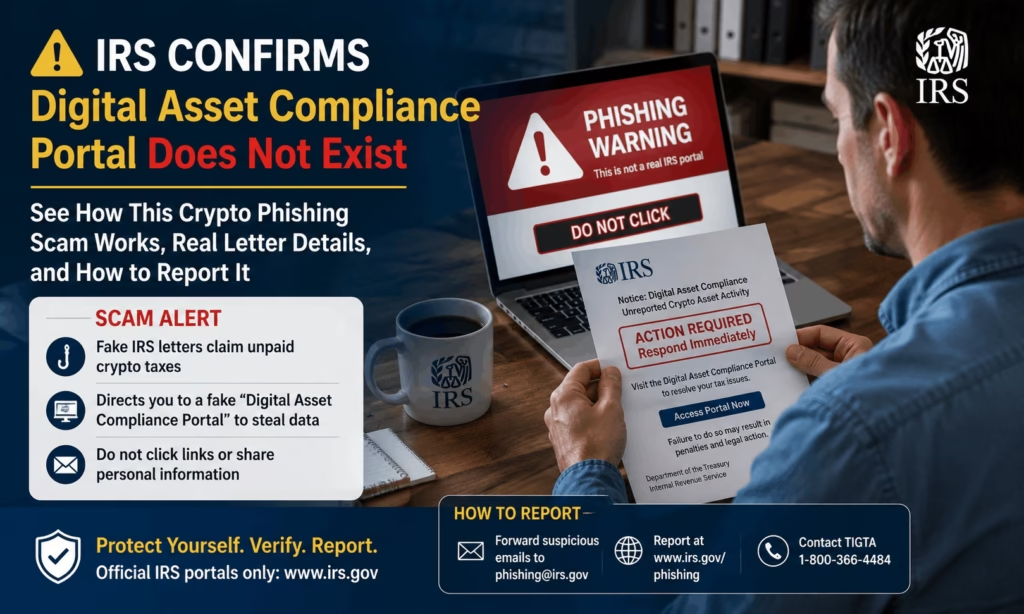
What the IRS Digital Asset Compliance Portal Scam?
According to the IRS’s own public statement, the scam centers on a physical letter mailed directly to a taxpayer’s home address, a notable shift from the email-based phishing campaigns most people have learned to recognize and distrust. The letter claims to come from the Department of the Treasury, Internal Revenue Service, with a return address referencing Austin, Texas, and it instructs the recipient to enroll in something called the Digital Asset Compliance Portal before a specified deadline.
The IRS has been unambiguous in its response. In its public warning, the agency stated plainly that it does not operate a program by that name and that any letter referencing it should be treated as fraudulent. IRS Criminal Investigation Chief Jarod Koopman described the operation as a professionalized international scam, noting that criminals are systematically exploiting public trust in government agencies to extract sensitive financial information and cryptocurrency holdings from unsuspecting taxpayers.
Key Facts and Latest Warning Highlights
| Detail | Information |
|---|---|
| Scam name | Digital Asset Compliance Portal letter scam |
| Confirmed by | Internal Revenue Service and IRS Criminal Investigation (IRS-CI) |
| Delivery method | Physical letter mailed to taxpayer’s home address |
| Fake notice number observed | CP14-432RA |
| Fake return address referenced | Department of the Treasury, IRS, Austin, TX |
| Tax year range cited in fake letters | 2017 to 2026 |
| Attack mechanism | QR code linking to a fraudulent IRS.gov look-alike site |
| Domain registration location | Registered through a Hong Kong-based registrar |
| Hosting location | Romanian server infrastructure |
| Prior use of hosting infrastructure | Previously linked to bank and delivery-service phishing pages |
| Timing of domain setup | Registered only days before letters were mailed |
| Second-stage tactic | Follow-up phone call requesting 2FA codes or seed phrases |
| Official IRS confirmation | No Digital Asset Compliance Portal exists |
How the IRS Digital Asset Compliance Portal Scam Actually Unfold?
Security researchers who examined the scheme, including threat intelligence firm DarkTower working alongside Coinbase’s security team, traced the full mechanics of the operation after a customer reported receiving one of the fraudulent letters. Understanding each stage helps explain why the scam has managed to fool even relatively sophisticated crypto holders.
The letter itself is the first point of contact, styled to closely resemble genuine IRS correspondence and arriving in an unmarked envelope rather than an official-looking government mailer, which researchers suggest may actually help it evade initial suspicion since it does not trigger the visual red flags some people associate with obvious scam mail. The letter references a fabricated notice number and an unusually wide tax year range spanning nearly a decade, a detail designed to make the letter feel applicable to almost any recipient regardless of when they actually acquired or traded digital assets. A prominent QR code sits within the letter, accompanied by instructions to scan it and complete registration before an artificial deadline meant to pressure recipients into acting quickly without pausing to verify the letter’s legitimacy.
Scanning the QR code redirects the victim to a website engineered to closely mimic the appearance of IRS.gov, including a banner falsely claiming to be an official website of the United States government. On this fraudulent site, victims are prompted to enter sensitive information, including which cryptocurrency exchange or wallet type they use, ranging from hardware wallets to major exchange platforms, along with other personal and financial details. Researchers noted the site is deliberately structured to collect enough information for scammers to appear credible in a subsequent step of the scheme.
That subsequent step is a phone call. Armed with the victim’s name, address, and details about which crypto platform they use gathered from the fake website, a scammer posing as a support representative contacts the victim directly. This technique, known as vishing, or voice phishing, is considered one of the most effective account-takeover methods currently used against cryptocurrency holders, since a confident-sounding caller who already seems to know accurate personal details can be highly convincing. During this call, the scammer attempts to talk the victim into revealing a two-factor authentication code, a account password, or most damagingly, a recovery or seed phrase, the string of words that provides complete access to a cryptocurrency wallet. In some observed variations, scammers instead convince victims to voluntarily move their funds to a so-called safe wallet that is, in reality, controlled entirely by the criminals.
Employment Insurance (EI) 2026 Rule Changes: What Every Canadian Worker Needs to Know
Empire State Child Credit 2026: $1,000 Per Child Under 4, Full Eligibility & Payment Guide
Oregon Kicker Tax Credit 2026: How To Claim Your Share Of The $1.41 Billion Surplus
California Climate Credit 2026: Payment Timing Just Changed, Here Is What to Expect on Your Bill
$145.83 BC Family Benefit First Child Payment Confirmed as Income Phase-Out Shifts to $96,562
Why This Scam Is Especially Convincing Right Now
Cybersecurity researchers and the IRS itself have both pointed to a specific reason this particular scam is proving unusually effective compared to typical phishing attempts. Over the past several years, the IRS has substantially tightened cryptocurrency reporting requirements, meaning genuine written communication between the agency and digital asset holders has become considerably more common than it once was. A letter referencing crypto reporting obligations simply does not sound as far-fetched to the average taxpayer today as it might have several years ago, before digital asset questions became a routine part of standard tax filings.
This shift in the broader compliance environment gives the fake letters a layer of built-in believability that older, more generic IRS impersonation scams typically lacked. Combined with the use of physical mail rather than email, which bypasses many of the spam filters and phishing warnings people have come to rely on for digital communication, the scam represents what researchers describe as a deliberate evolution in tactics designed specifically to exploit this moment of heightened, and legitimate, IRS attention to cryptocurrency.
The Infrastructure Behind the Scam Operation
The technical investigation conducted by DarkTower, working in partnership with Coinbase, uncovered details suggesting a well-organized and international criminal operation rather than an amateur or opportunistic attempt. The look-alike domain used to host the fraudulent website was registered through a domain registrar based in Hong Kong, and researchers found it was set up only a matter of days before the fraudulent letters actually began arriving in mailboxes, suggesting a coordinated and deliberately timed rollout.
The fraudulent website itself was hosted on server infrastructure located in Romania, and notably, that same hosting network had previously been linked to earlier phishing campaigns impersonating other well-known brands, including fraudulent pages designed to imitate FedEx and various banking institutions. This reuse of established criminal infrastructure led investigators to characterize the operation as a professionalized scheme rather than an isolated incident, consistent with the assessment IRS Criminal Investigation itself offered publicly.
What the IRS Says You Should Do If You Receive This Letter
The IRS has issued clear, direct guidance for anyone who receives a letter referencing the Digital Asset Compliance Portal or any similarly named program. The agency’s core message is unambiguous: do not scan any QR code included in the letter, do not click on any related links, and do not respond to any phone call requesting payment or personal information tied to the letter.
For taxpayers who have already scanned the code, visited the fraudulent website, or provided any information, the IRS and cybersecurity experts recommend taking immediate action. Anyone who shared login credentials, a password, or wallet access information should contact their cryptocurrency exchange or financial institution immediately to secure their accounts, since rapid action can sometimes prevent or limit unauthorized transfers. Changing passwords and enabling or resetting two-factor authentication on any affected accounts is an important follow-up step, along with closely monitoring account activity for any unauthorized transactions in the days and weeks following exposure.
Reporting the fraud is also a key part of the IRS’s recommended response. Taxpayers who receive one of these letters, whether or not they engaged with it further, are encouraged to report the suspected fraud to appropriate authorities rather than simply discarding the letter, since reporting helps law enforcement track the scale and evolution of the operation.
How to Verify Whether Any IRS Communication Is Legitimate
Given how convincingly this scam mimics genuine government correspondence, understanding a few reliable verification habits matters more than ever for anyone who owns or trades cryptocurrency. The single most important fact to remember is the one the IRS has stated outright: there is no such thing as a Digital Asset Compliance Portal, and any letter referencing that name should be treated as fraudulent regardless of how official it appears.
Beyond that specific detail, taxpayers should be broadly skeptical of any unexpected communication, whether by mail, email, or phone, that creates a sense of urgency around a deadline, requests immediate action through a QR code or embedded link, or asks for sensitive information like passwords, two-factor codes, or wallet recovery phrases. Genuine IRS communication generally does not request this kind of sensitive credential information through a link or QR code embedded in a letter. When in doubt, the safest step is to independently navigate directly to IRS.gov by typing the address manually into a browser, rather than following any link or scanning any code provided in a suspicious letter, and to contact the IRS or a tax professional directly to verify whether any notice referencing a specific notice number is genuine.
Trump Halts 50 Percent Tariffs Canada: What the Last Minute Deal With Ottawa Means
Green Card Rule Changes: New Public Charge Test to Assess Age, Health, Family Status and Finances
Georgia Flat Income Tax Rate Cut to 4.99%: What the New Law Actually Means for Your Paycheck
Why Cryptocurrency Holders Specifically Are Being Targeted
This scam did not emerge in a vacuum. It reflects a broader pattern of scammers increasingly focusing on cryptocurrency holders as digital assets have moved further into mainstream financial adoption. Unlike traditional bank fraud, where financial institutions often have fraud detection systems and reversal mechanisms in place, cryptocurrency transactions are generally irreversible once completed, making successful crypto theft particularly damaging and difficult to recover from.
The scam’s design specifically probes for information about which exchange or wallet type a victim uses, giving scammers the ability to tailor their follow-up phone call to sound more credible by referencing platform-specific details or terminology the victim would recognize. This targeted approach, combined with the psychological pressure created by an artificial compliance deadline, is part of why cybersecurity researchers have flagged this particular scheme as notably more sophisticated than typical mass-market phishing attempts.
What Legitimate IRS Cryptocurrency Correspondence Actually Looks Like
Because the IRS has genuinely increased its scrutiny of digital asset reporting in recent years, it is worth understanding what real IRS communication about cryptocurrency typically involves, so taxpayers can better distinguish it from fraudulent letters. Legitimate IRS notices reference specific, verifiable notice numbers that can be checked against official IRS notice explanations, and they do not direct taxpayers to scan a QR code to complete an urgent registration process tied to an unfamiliar portal name.
The IRS also generally does not initiate contact demanding immediate payment or account credentials through unsolicited letters combined with follow-up phone calls, particularly not calls requesting sensitive access information like two-factor codes or wallet seed phrases. Any taxpayer uncertain about the legitimacy of a letter referencing cryptocurrency compliance should independently verify it by contacting the IRS directly through official channels rather than using any contact information or QR code printed on the letter itself.
Official Resources and Links
| Resource | Purpose | Link |
|---|---|---|
| IRS official scam and phishing alerts page | Verify current tax scams and report fraud | https://www.irs.gov/newsroom/tax-scams-consumer-alerts |
| Report phishing to the IRS | Forward suspicious IRS-related communications | https://www.irs.gov/privacy-disclosure/report-phishing |
| IRS digital assets guidance | Understand actual cryptocurrency reporting requirements | https://www.irs.gov/filing/digital-assets |
| Federal Trade Commission fraud reporting | File a formal consumer fraud report | https://reportfraud.ftc.gov |
| IRS identity theft central | Steps to take if your information was compromised | https://www.irs.gov/identity-theft-central |
| Verify official IRS contact | Confirm legitimacy of any IRS notice or letter | https://www.irs.gov/help/telephone-assistance |
Chapter 33 VA Benefits Housing Allowance: How Much Can You Get Per Month
State Farm Dividend: Who Qualifies to Receive Part of the $5 Billion Payout
H-1B Visa Ban Texas Schools: Abbott Wants Exactly Zero Foreign Workers, What Indians Should Know
FAQs
Is the IRS Digital Asset Compliance Portal real?
No. The IRS has explicitly confirmed it does not operate any program called the Digital Asset Compliance Portal. Any letter referencing this name is part of a phishing scam designed to steal personal and financial information from cryptocurrency holders.
What should I do if I received a letter about the Digital Asset Compliance Portal?
Do not scan the QR code, click any links, or respond to any related phone calls. The IRS recommends reporting the letter as suspected fraud and, if you already engaged with the fraudulent site, securing your crypto exchange and financial accounts immediately.
How does the Digital Asset Compliance Portal scam actually work?
Victims receive a fraudulent letter with a QR code that leads to a fake website mimicking IRS.gov, which collects personal and crypto exchange information. Scammers then use that information in a follow-up phone call to try to extract passwords, two-factor codes, or wallet seed phrases.
Why do these fake letters look so convincing?
The letters use a real-looking notice number, reference a broad multi-year tax range, and arrive in a plain unmarked envelope. Because the IRS has genuinely increased cryptocurrency reporting requirements in recent years, official-looking mail about crypto no longer seems unusual to most recipients.
What information were the scammers trying to steal?
The fraudulent website asked victims to share which cryptocurrency exchange or wallet type they use, along with other personal and financial details, which scammers then used to make a follow-up phone call sound more credible when requesting access credentials.
How can I verify if an IRS letter is genuine?
Never use contact information, links, or QR codes printed on a suspicious letter. Instead, navigate directly to IRS.gov by typing the address yourself, or contact the IRS through its official phone channels to confirm whether a specific notice number is legitimate.
People Also Ask
Does the IRS send letters about cryptocurrency? Yes, the IRS does send legitimate correspondence related to digital asset tax reporting as part of its increased compliance efforts, which is part of what makes this particular scam more convincing than earlier, more generic IRS impersonation attempts.
Can scammers steal cryptocurrency through a QR code? A QR code itself does not directly steal cryptocurrency, but scanning one in this scam leads to a fraudulent website designed to collect personal information, which is then used in a follow-up phone call to trick victims into revealing wallet access credentials or moving funds voluntarily.
What is vishing in the context of crypto scams? Vishing, or voice phishing, refers to scam phone calls where a fraudster poses as a legitimate representative, often using personal details already gathered from an earlier phishing step, to convince a victim to reveal sensitive information like passwords or wallet recovery phrases.
Is cryptocurrency theft reversible if I fall for a scam? Generally no. Unlike many traditional bank transactions, cryptocurrency transfers are typically irreversible once completed, which is part of why crypto-focused scams are considered especially damaging and why acting immediately upon suspecting fraud is so important.
Where can I report an IRS impersonation scam? Suspected IRS impersonation scams, including fraudulent letters referencing programs like the Digital Asset Compliance Portal, can be reported directly to the IRS through its official phishing reporting page, as well as to the Federal Trade Commission.
Conclusion
The Digital Asset Compliance Portal scam represents a notable escalation in how fraudsters are targeting cryptocurrency holders, combining convincing physical mail, a professionally built fake website, and a coordinated follow-up phone call into a single, well-orchestrated scheme. The single most important fact for any taxpayer to remember is the one the IRS has stated directly: no such portal exists, and any letter referencing it, regardless of how official it looks, should be treated as fraudulent and reported rather than acted upon. As cybersecurity researchers and the IRS continue tracking this operation and potentially uncover new variations of the scheme, this article will be updated every month with the latest confirmed details and protective guidance.
Premium Tax Credit Expiration Hits Millions of Taxpayers as Filing Season Rules Change
My Safe Florida Home Grant Program 2026: Current Status, $10,000 Funding, and How to Apply
Colorado TABOR Refund and PTC Rebate 2026: Who Qualifies and How Much You Can Get
USCIS E-Filing Mandate: New DHS Rule Gives Agency Power To Retire Paper Immigration Forms
Denaturalization Cases Surge As DOJ Files Record 25 Complaints In Just Two Weeks