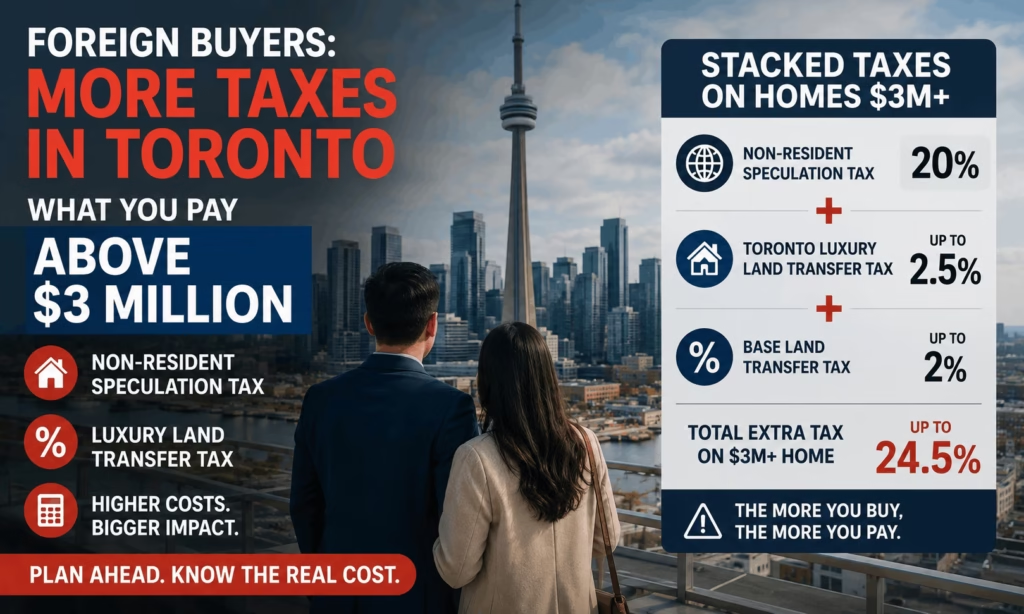
Non-Resident Speculation Tax Toronto: Foreign buyers eyeing a high-value home in Toronto are now facing a closing cost bill that has quietly grown steeper on two fronts at once. The Non-Resident Speculation Tax has applied at 25 percent of the purchase price in Ontario since October 2022, and Toronto’s own Municipal Non-Resident Speculation Tax has added another 10 percent since January 2025. What changed recently is a separate piece of the puzzle sitting right next to those speculation taxes, the City of Toronto’s Municipal Land Transfer Tax itself, which now carries a new set of graduated luxury brackets that took effect April 1, 2026 and push the tax rate as high as 8.6 percent on the priciest homes in the city.
For a non-resident buyer purchasing anything above 3 million dollars in Toronto, these two separate tax systems no longer just sit side by side, they compound. The Non-Resident Speculation Tax and its municipal counterpart apply to the full purchase price regardless of value, while the newly revised land transfer tax brackets apply their steeper rates specifically to the portion of a high-value purchase above 3 million dollars. Put together, a foreign buyer closing on an 8 million dollar Toronto home this year is now looking at a combined tax bill that did not exist in this exact form even a few months ago. We’ll be updating this article monthly as Toronto and Ontario release further guidance on these overlapping tax structures.
What Is the Non-Resident Speculation Tax?
The Non-Resident Speculation Tax, often shortened to NRST, is a provincial land transfer surtax that applies when a foreign national, foreign corporation, or taxable trustee purchases residential property anywhere in Ontario. It sits on top of Ontario’s standard Land Transfer Tax rather than replacing it, and in Toronto specifically, buyers face a third layer, the Municipal Non-Resident Speculation Tax, bringing the combined foreign buyer surtax in the city to 35 percent of the purchase price before land transfer tax is even factored in.
| Tax | Rate | Applies To |
|---|---|---|
| Provincial NRST | 25% | Foreign buyers, anywhere in Ontario |
| Toronto MNRST | 10% | Foreign buyers, City of Toronto only, in addition to NRST |
| Combined NRST plus MNRST in Toronto | 35% | Foreign buyers purchasing residential property in Toronto |
What Just Changed: Toronto’s New Luxury Land Transfer Tax Brackets
Separately from the speculation taxes, Toronto City Council passed an amendment on December 17, 2025 introducing new graduated Municipal Land Transfer Tax rates specifically for high-value residential properties containing one or two single family residences. Those revised rates took effect April 1, 2026 and represent a meaningful jump from the previous luxury tax structure.
| Value of Consideration | Municipal Land Transfer Tax Rate |
|---|---|
| $3,000,000 to $4,000,000 | 4.40 percent |
| $4,000,000 to $5,000,000 | 5.45 percent |
| $5,000,000 to $10,000,000 | 6.50 percent |
| $10,000,000 to $20,000,000 | 7.55 percent |
| Above $20,000,000 | 8.60 percent |
These are marginal rates, meaning each bracket only applies to the portion of the purchase price falling within that specific range, similar to how income tax brackets work. A buyer purchasing an 8 million dollar home does not pay 6.5 percent on the full amount, only on the slice between 5 million and 8 million dollars, with lower rates applying to the portions below that.
How the NRST and the New MLTT Brackets Stack Together
This is where the picture becomes genuinely more expensive for non-resident buyers than it was before April 2026. Because the NRST and MNRST apply as a flat percentage of the entire purchase price while the new luxury MLTT brackets apply marginally to the value above 3 million dollars, a foreign buyer purchasing a high-value Toronto home is now paying both systems simultaneously, with no offset between them.
Consider a non-resident buyer purchasing a 4,000,000 dollar single-family home in Toronto after April 1, 2026. The NRST alone comes to 1,000,000 dollars, calculated as 25 percent of the full purchase price. The MNRST adds another 400,000 dollars, calculated as 10 percent of the full purchase price. That is 1,400,000 dollars in speculation taxes before land transfer tax is even calculated. On top of that, the municipal land transfer tax on the portion of the price above 3 million dollars is now taxed at 4.4 percent rather than the older, lower luxury rate, adding thousands more in municipal tax alone, on top of the standard provincial land transfer tax that also applies to the full purchase price.
Student Loans and FAFSA 2026: Urgent changes every student needs to know
ACA Subsidy Cliff 2026: What Is It, Who Is Affected and Why Health Insurance Costs Are Rising
2027 HSA Contribution Limits Announced: IRS Confirms $4,500 and $9,000 Caps
Worked Example: Combined Costs on a High-Value Toronto Purchase
| Cost Component | Amount on a $4,000,000 Non-Resident Purchase in Toronto |
|---|---|
| Provincial NRST (25%) | $1,000,000 |
| Toronto MNRST (10%) | $400,000 |
| Ontario Land Transfer Tax (standard marginal rates) | Approximately $70,475 |
| Toronto Municipal Land Transfer Tax (standard plus new luxury bracket on the portion above $3M) | Approximately $79,475 |
| Approximate total closing tax burden | Over $1,549,950 |
These figures illustrate the scale of the combined burden and can shift slightly depending on exact property classification and any applicable rebates or exemptions. The core point for foreign buyers is that the speculation tax layer and the land transfer tax layer are now both meaningfully higher in Toronto’s luxury market than they were before this spring.
Why Toronto Introduced Higher Luxury Land Transfer Tax Brackets
The City of Toronto’s stated rationale for the December 2025 amendment centers on revenue generation from the high end of the housing market rather than a direct extension of the foreign buyer speculation framework. Toronto has faced ongoing budget pressure, and council views the graduated luxury brackets as a way to draw additional revenue from transactions least likely to affect affordability at the entry-level end of the housing market, since buyers purchasing homes above 3 million dollars are, by definition, operating well above the price range most residents compete in.
Unlike the NRST and MNRST, the new luxury MLTT brackets are not limited to foreign buyers. Canadian citizens and permanent residents purchasing a qualifying high-value property in Toronto pay the same graduated municipal rates. What makes the combined burden so much steeper for non-resident buyers specifically is that they are the only group also paying the 35 percent NRST and MNRST surtax layer on top of these land transfer tax brackets.
Who Is Considered a Foreign Buyer Under NRST Rules
The NRST and MNRST apply to three categories of purchasers under Ontario’s Land Transfer Tax Act. A foreign national is any individual who is not a Canadian citizen and not a permanent resident of Canada. A foreign corporation is one incorporated outside Canada, or in some cases a Canadian-incorporated company that is controlled by a foreign entity. A taxable trustee refers to a trust where at least one trustee or beneficiary is a foreign entity. These definitions apply identically whether a purchase falls under the standard provincial land transfer tax brackets or the new high-value municipal brackets introduced this year.
FTC Refund 2026: Millions of Americans May Be Owed Money and Most Don’t Know It
Exemptions and Rebates Still Apply on Top of the New Brackets
The introduction of higher luxury MLTT brackets does not change the existing exemption and rebate framework for NRST and MNRST. Buyers who become permanent residents of Canada within the required timeframe after purchase, certain nominees under Ontario’s provincial nominee program, and protected persons under Canada’s immigration framework may still qualify for a full or partial NRST and MNRST rebate, regardless of whether their purchase also falls into the new high-value land transfer tax brackets. However, these rebates apply specifically to the speculation tax portion, not to the land transfer tax itself, meaning a buyer who successfully obtains an NRST rebate would still owe the standard and, where applicable, the new luxury land transfer tax rates in full.
Official Ontario and Toronto Resources
| Resource | Purpose | Link |
|---|---|---|
| Ontario Non-Resident Speculation Tax | Official provincial NRST rules, rates, and rebate information | https://www.ontario.ca/document/non-resident-speculation-tax |
| City of Toronto MLTT and MNRST Page | Official municipal land transfer tax and speculation tax rates | https://www.toronto.ca/services-payments/property-taxes-utilities/municipal-land-transfer-tax-mltt |
| Toronto MLTT and MNRST Calculator | Estimate combined municipal tax owing on a purchase | https://www.toronto.ca/services-payments/property-taxes-utilities/municipal-land-transfer-tax-mltt |
| Ontario Land Transfer Tax Refund Affidavit | Provincial forms for NRST rebate applications | https://www.ontario.ca/document/land-transfer-tax |
FAQs
Does the Non-Resident Speculation Tax apply on top of Toronto’s new luxury land transfer tax brackets?
Yes. The 25 percent provincial NRST and 10 percent Toronto MNRST apply to the full purchase price regardless of value, while the new graduated municipal land transfer tax brackets apply separately and marginally to the portion of a purchase price above 3 million dollars. A non-resident buyer purchasing a high-value Toronto property pays both layers simultaneously.
When did Toronto’s new luxury land transfer tax brackets take effect?
Toronto City Council passed the amendment introducing graduated Municipal Land Transfer Tax rates for high-value residential properties on December 17, 2025, and the new rates took effect on April 1, 2026.
What is the highest Municipal Land Transfer Tax rate in Toronto right now?
The highest bracket applies an 8.6 percent municipal rate to the portion of a residential purchase price above 20 million dollars. Rates step down through 7.55 percent, 6.5 percent, 5.45 percent, and 4.4 percent for lower luxury brackets starting at 3 million dollars.
Do the new luxury land transfer tax brackets only apply to foreign buyers?
No. The graduated luxury Municipal Land Transfer Tax brackets apply to any qualifying high-value single or two-family residential purchase in Toronto, regardless of the buyer’s citizenship or residency status. Only the separate NRST and MNRST speculation taxes are specific to foreign buyers.
Can a foreign buyer get a rebate on the Non-Resident Speculation Tax?
Yes, in certain circumstances. Buyers who obtain Canadian permanent residency within the required timeframe after purchase, along with certain nominees and protected persons, may qualify for a full or partial NRST and MNRST rebate. This rebate applies only to the speculation tax portion and does not reduce the standard or luxury land transfer tax owed.
How much would a non-resident buyer pay in total taxes on a $4 million home in Toronto?
Combining the 25 percent NRST, the 10 percent MNRST, and both the provincial and municipal land transfer tax including the new luxury bracket, a non-resident buyer purchasing a 4 million dollar single-family home in Toronto after April 1, 2026 would face a combined tax burden well above 1.5 million dollars before any applicable rebate.
Is the Non-Resident Speculation Tax the same across all of Ontario?
The 25 percent provincial NRST rate applies province-wide. Toronto is currently the only municipality that layers an additional Municipal Non-Resident Speculation Tax on top of the provincial rate, making the City of Toronto the most expensive jurisdiction in Ontario for non-resident buyers.
Conclusion
Foreign buyers considering a high-value purchase in Toronto now face a tax picture that is considerably more expensive than it was before this spring, not because the Non-Resident Speculation Tax rate itself changed, but because a separate municipal tax structure sitting right alongside it just got steeper. With the 35 percent combined NRST and MNRST surtax now compounding against graduated luxury land transfer tax brackets reaching as high as 8.6 percent, buyers and their legal advisors need to run the full combined math well before signing an agreement of purchase and sale, since the two systems no longer operate as independently as they once did in practice. We’ll be updating this article monthly as Ontario and the City of Toronto issue further guidance on how these overlapping tax structures apply to non-resident buyers.
Canada 50% Tariff 2026: Full List of Products That Could See Price Hikes
Why Is SNAP Enrollment Falling in 2026? Key Reasons Behind the Decline in SNAP Participation
Social Security Compassionate Allowances List: 14 Conditions Added