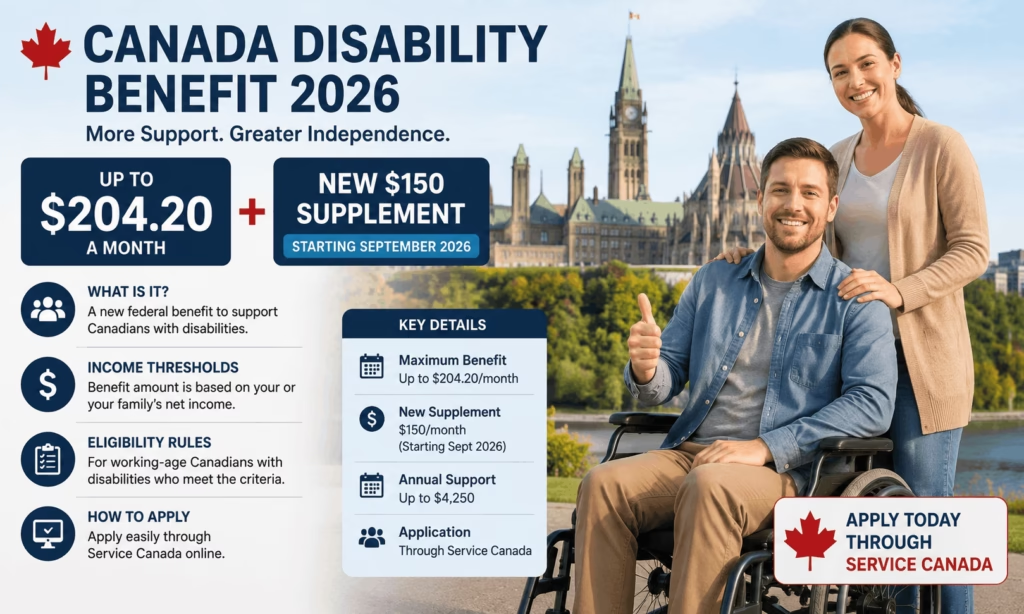
$204 Canada Disability Benefit September 2026: More than 600,000 low-income Canadians with disabilities are about to see extra money land in their accounts for reasons that have nothing to do with their regular monthly deposit. Starting in September 2026, Service Canada will begin issuing a one-time 150 dollar supplemental payment to every current and past Canada Disability Benefit recipient, on top of the regular monthly payment that already rose to 204.20 dollars in July under the program’s first-ever inflation adjustment. The supplement, authorized through regulatory changes published in the Canada Gazette on July 1, 2026, is meant to offset the cost of obtaining the Disability Tax Credit certificate that every applicant needs before they can receive the benefit at all. We’ll be updating this article monthly as Service Canada confirms exact supplement payment dates and any further changes to income thresholds.
For many recipients, September brings two separate deposits rather than one, and understanding which payment is which matters because the rules around them are different. The regular monthly Canada Disability Benefit continues on its usual third-Thursday schedule and is calculated against income thresholds that were also indexed upward this year. The new supplemental payment, by contrast, requires no separate application, arrives as a single lump sum, and goes out automatically to anyone who received even one Canada Disability Benefit payment before September 2026, whether or not they are still actively receiving the monthly amount. This article breaks down exactly how much you can get, the income thresholds that determine your payment, how the working income exemption protects part-time earnings, and the full step-by-step process for applying through Service Canada if you have not yet done so.
Latest Update: The $150 September Supplement
The federal government confirmed on July 1, 2026 that amendments to the Canada Disability Benefit Regulations would authorize a new one-time supplemental payment, funded through 115.7 million dollars committed in Budget 2025 over four years. The changes take legal effect on September 1, 2026.
| Detail | Information |
|---|---|
| Supplement amount | 150 dollars, fixed, tax-free lump sum |
| Who qualifies | Anyone who received at least one Canada Disability Benefit payment before September 2026, including past recipients no longer receiving monthly payments |
| Application required | No, the supplement is issued automatically |
| Multiple certificates | A separate 150 dollar payment is issued for each approved Disability Tax Credit certification that results in benefit entitlement |
| Purpose | To offset costs, often charged by medical practitioners, for completing the Disability Tax Credit certificate |
| Payment phases | Most recipients paid September 2026, two smaller groups delayed to February 2027, full alignment by March 2027 |
Two specific groups will see their supplement arrive later than September. People who receive their first Canada Disability Benefit payment between July 1, 2026 and January 31, 2027, and people who are re-certified for the Disability Tax Credit during that same window while already receiving the benefit, will both be paid in February 2027 instead. Starting in March 2027, the supplement will simply arrive the same month as a recipient’s first regular payment, closing that gap for future applicants.
What Is the Canada Disability Benefit?
The Canada Disability Benefit is a federal, tax-free, income-tested monthly payment for low-income Canadians with disabilities between the ages of 18 and 64. It was created under the Canada Disability Benefit Act, which came into force on June 22, 2024, with the first eligible month set at June 2025 and the first payments issued in July 2025. Unlike Canada Pension Plan disability benefits, which depend on your contribution history while working, the Canada Disability Benefit requires no prior work history or contributions. It is designed to sit alongside existing provincial and territorial disability supports rather than replace them, and most provinces have confirmed the federal payment does not reduce provincial disability assistance.
Social Security Disability Claim Status Tracker: New Online Tools Launch As SSA Turns 91
Young Child Tax Credit California: $1,189 CalEITC Bonus, Full Eligibility Rules & How to Claim It
$1750 Minnesota Child Tax Credit: No Limit on Children, Eligibility & How to Claim It
September 2026 Payment Amounts
The 2026-27 benefit year, which runs from July 2026 through June 2027, brought the program’s first annual inflation adjustment since it launched.
| Benefit Year | Maximum Monthly Amount | Maximum Annual Amount |
|---|---|---|
| July 2025 to June 2026 | 200 dollars | 2,400 dollars |
| July 2026 to June 2027 | 204.20 dollars | 2,450.40 dollars |
That 204.20 dollar figure reflects a 2.1 percent cost-of-living adjustment applied for the first time this July, and it is the amount that continues through the September payment and the remainder of the current benefit year. Recipients whose income falls below the applicable threshold receive this full amount every month, paid on the third Thursday, which in September 2026 falls on September 17.
Income Thresholds for the 2026-27 Benefit Year
Your payment amount depends entirely on your adjusted family net income from the previous tax year, measured against income thresholds that were also indexed upward alongside the maximum benefit amount.
| Household Type | Income Threshold | Reduction Rate Above Threshold |
|---|---|---|
| Single individual | 23,460 dollars | 20 cents per dollar over the threshold |
| Couple, only one partner eligible | 33,150 dollars combined | 20 cents per dollar over the threshold |
| Couple, both partners eligible | 33,150 dollars combined | 10 cents per dollar over the threshold, applied to each partner separately |
If your adjusted family net income falls at or below your applicable threshold, you receive the full 204.20 dollar monthly payment. Above that threshold, your annual benefit is reduced gradually rather than cut off entirely, which means many Canadians with modest incomes above the threshold still receive a partial payment rather than nothing at all.
The Working Income Exemption Explained
One of the most misunderstood parts of the program is how working income is treated. The Canada Disability Benefit specifically shields a portion of employment earnings from the income calculation, so that taking a part-time or full-time job does not immediately eliminate your benefit.
| Household Type | Working Income Exempted |
|---|---|
| Single individual | Up to 10,210 dollars per year |
| Couple, combined | Up to 14,294 dollars per year |
Working income includes earnings from employment, self-employment, or taxable scholarships. It does not include investment income, pension income, or other social assistance payments, which are counted in full against the threshold. In practice, this means a single applicant can earn up to 10,210 dollars from a job with zero impact on their benefit calculation, effectively raising their real-world income ceiling well above the stated 23,460 dollar threshold once working income is involved.
To see how the math plays out, consider a single recipient earning 20,000 dollars entirely from part-time work in 2025. After subtracting the full 10,210 dollar working income exemption, their calculation income is 9,790 dollars, which sits well below the 23,460 dollar threshold, so they receive the full 204.20 dollar monthly payment despite their actual earnings being nearly 20,000 dollars. Compare that to a recipient with 25,000 dollars in pension or investment income and no employment earnings at all. None of that income qualifies for the working exemption, so the full 25,000 dollars counts against the 23,460 dollar threshold, triggering a reduction of 20 cents for every dollar over the limit, roughly 308 dollars off the annual benefit.
Who Qualifies for the Canada Disability Benefit
Eligibility depends on meeting every one of the following conditions at the time of application, not just having a disability in a general sense.
You must be between 18 and 64 years old, though applicants can now submit their application up to six months before turning 18 so payments start seamlessly the month they reach adulthood. You must hold a valid, approved Disability Tax Credit certificate on file with the Canada Revenue Agency. You and your spouse or common-law partner, if applicable, must have filed your most recent federal income tax return, since the benefit calculation relies entirely on that data. You must be a Canadian citizen, a permanent resident, a person registered or entitled to be registered under the Indian Act, a protected person, or a temporary resident who has lived in Canada throughout the previous 18 months. You must not be incarcerated in a federal penitentiary for two years or more, except during the first and last month of that sentence.
If your spouse or common-law partner cannot file taxes due to exceptional circumstances, such as not residing in Canada for tax purposes or living apart from you for reasons outside your control, Service Canada can grant a waiver and calculate your benefit as a single applicant instead of using combined income.
PSLF Payment Reversal: The New “On-Time Only” Rule Now Required to Get Your Student Debt Erased
$1,636 ODSP and Canada Disability Benefit Now Stack Fully in Ontario, No Clawback on Either Payment
$4427 EITC Payment: How to Know If You Qualify and When Will You Get It?
How to Apply for the Canada Disability Benefit Through Service Canada
Applications are open now, and the process is designed to move quickly once you have the Disability Tax Credit in hand.
- Confirm you have an approved Disability Tax Credit certificate through the Canada Revenue Agency. If you do not yet have one, complete Form T2201 and have it certified by a medical practitioner before applying for the Canada Disability Benefit.
- Ensure your 2025 federal income tax return has been filed, along with your spouse or common-law partner’s return if applicable, since an unfiled return will stop payments from being calculated correctly.
- Apply online through the official Canada Disability Benefit page on Canada.ca, or apply by phone, mail, or in person at a Service Canada Centre if you prefer not to apply online.
- If you already hold an approved Disability Tax Credit certificate, check for a letter from Service Canada containing a unique application code, which can speed up the process considerably.
- Provide your net income figure from your notice of assessment, which is optional but recommended, and your direct deposit information if you want faster payment delivery.
- If applying on behalf of someone else as a legal representative, include proof of legal authority, such as a court order or power of attorney.
- Wait for a decision letter, which will confirm the date and amount of your first payment.
Approved applicants begin receiving payments the month after their application is received and approved, and can receive back payments for up to 24 months from when Service Canada receives the application, though not for any month before June 2025, the program’s first eligible month. The first payment always arrives on the third Thursday of the month following approval and will include any applicable back payments in that same deposit.
Processing Time and What to Expect After You Apply
Processing time depends heavily on whether an applicant already holds an approved Disability Tax Credit certificate at the time they apply for the Canada Disability Benefit, since the certificate itself is a prerequisite rather than something Service Canada can approve as part of the disability benefit application. Applicants who already have DTC approval and a straightforward income situation tend to see faster decisions, since the primary remaining step is confirming income data against a filed tax return.
Once an application is approved, the first payment is issued the month following approval, on the third Thursday, with retroactive amounts included automatically rather than requiring a separate retroactive claim. Applicants should expect that incomplete applications, particularly ones missing a spouse’s tax filing or a valid Disability Tax Credit certificate, will take longer, since Service Canada cannot calculate a payment amount without complete income data for the household.
As of September 8, 2026, the Canada Revenue Agency will stop accepting older versions of Form T2201 printed before 2023, so anyone still relying on an outdated paper form should switch to the current version to avoid a processing delay at the Disability Tax Credit stage, which would in turn delay the disability benefit application itself.
September 2026 Payment Schedule
The Canada Disability Benefit follows a fixed monthly schedule, issued on the third Thursday of each month, regardless of the September supplement arriving separately.
| Month | 2026 Payment Date |
|---|---|
| July | July 16 |
| August | August 20 |
| September | September 17 |
| October | October 15 |
| November | November 19 |
| December | December 17 |
The 150 dollar supplemental payment is separate from this monthly schedule and does not follow the same third-Thursday pattern. Service Canada has indicated more specific information on the exact supplement payment date within September will be released on the official Canada Disability Benefit website closer to the rollout.
Canada Disability Benefit vs CPP Disability: Key Differences
Many Canadians receive both programs simultaneously, but they are structured very differently, and confusing the two leads to unnecessary confusion about eligibility.
| Feature | Canada Disability Benefit | CPP Disability |
|---|---|---|
| Basis for eligibility | Income-tested, no work history required | Based on past contributions to the Canada Pension Plan |
| Maximum monthly amount | 204.20 dollars | 1,741.20 dollars (2026) |
| Requires Disability Tax Credit | Yes | No |
| Can be received alongside the other program | Yes | Yes |
| Counted as income for the other program’s calculation | CPP Disability income counts toward the CDB income test | Not applicable |
A recipient collecting the maximum CPP Disability amount of 1,741.20 dollars monthly receives 20,894.40 dollars annually from that program alone, which still falls below the 23,460 dollar single-person Canada Disability Benefit threshold. That means someone receiving the maximum CPP Disability payment with no other income would still qualify for the full Canada Disability Benefit amount on top of it.
Provincial Disability Support and the Canada Disability Benefit
A common concern among applicants is whether receiving this federal payment will reduce provincial disability assistance, such as Ontario’s ODSP or Alberta’s AISH. The federal government has worked with most provinces and territories to ensure the Canada Disability Benefit functions as a genuine top-up rather than a clawback trigger. Ontario has confirmed it will exempt Canada Disability Benefit income from ODSP payment calculations entirely, and similar exemptions have been confirmed or are in progress in most other provinces. Because the benefit is now formally defined as not being treated as income under the Income Tax Act, following the July 2026 regulatory changes, it also does not reduce eligibility for other federal supports like the Canada Child Benefit.
Official Canada Disability Benefit Resources
| Resource | Purpose | Official Link |
|---|---|---|
| Apply for the Canada Disability Benefit | Start a new application online | canada.ca/en/services/benefits/disability/canada-disability-benefit |
| Disability Tax Credit application | Complete Form T2201, required before applying for the CDB | canada.ca (Disability Tax Credit) |
| Canada Disability Benefit calculator | Estimate your monthly payment amount | canadadisabilitybenefit.ca/calculations |
| Benefits payment calendar | Confirm exact monthly payment dates | canada.ca/en/services/benefits/calendar.html |
| Service Canada contact | Ask questions or check application status | Contact Service Canada through Canada.ca |
FAQs About the Canada Disability Benefit
How much is the Canada Disability Benefit in September 2026?
The maximum monthly payment is 204.20 dollars for the July 2026 to June 2027 benefit year, paid on September 17, with a separate 150 dollar one-time supplement also beginning that month for eligible recipients.
Do I need to apply separately for the $150 supplement?
No. The supplement is issued automatically to anyone who received at least one Canada Disability Benefit payment before September 2026, including people who are no longer currently receiving monthly payments.
What is the income threshold to get the full Canada Disability Benefit?
23,460 dollars for a single individual and 33,150 dollars combined for a couple, using adjusted family net income from your most recent filed tax return.
Can I work and still receive the Canada Disability Benefit?
Yes. Up to 10,210 dollars in annual working income is exempt for single applicants, and up to 14,294 dollars combined for couples, before that income counts against your threshold.
Do I need the Disability Tax Credit to qualify?
Yes. An approved Disability Tax Credit certificate from the Canada Revenue Agency is mandatory. Without it, you cannot receive the Canada Disability Benefit regardless of your age or income.
Will the Canada Disability Benefit reduce my provincial disability payments?
In most provinces, no. Ontario and several other provinces have confirmed the benefit is exempt from provincial disability assistance calculations, so it functions as additional income rather than a replacement.
Can I receive the Canada Disability Benefit and CPP Disability at the same time?
Yes, both programs can be received together. Your CPP Disability income does count toward the income test that determines your Canada Disability Benefit amount, but the two programs otherwise operate independently.
How far back can retroactive payments go?
You can receive back payments for up to 24 months from when Service Canada receives your application, but not for any month before June 2025, the program’s first eligible month.
What happens if my spouse cannot file a tax return?
If your spouse or common-law partner cannot file due to exceptional circumstances, such as living outside Canada or being separated for reasons outside your control, you can request a waiver so Service Canada calculates your benefit using only your individual income.
People Also Ask
Is the Canada Disability Benefit taxable? No. It is entirely tax-free and does not need to be reported as income on your annual tax return.
When did the Canada Disability Benefit start? The first eligible month was June 2025, with the first payments issued in July 2025 under the Canada Disability Benefit Act.
Who administers the Canada Disability Benefit? Service Canada administers the program, while the Canada Revenue Agency handles Disability Tax Credit approvals that are required before applying.
Does the Canada Disability Benefit replace provincial disability programs? No. It is designed to supplement existing provincial and territorial disability supports, not replace them.
Conclusion
September 2026 marks the first month where Canada Disability Benefit recipients could see two separate federal deposits rather than one, the regular 204.20 dollar monthly payment on September 17 and a new automatic 150 dollar supplement tied to Disability Tax Credit costs. Together with the indexed income thresholds and working income exemptions that took effect in July, the program now offers meaningfully more room for recipients with modest earnings to keep more of their benefit than it did in its first year. Anyone who has not yet applied, particularly those who already hold an approved Disability Tax Credit certificate, should not wait, since payments only begin the month after an application is approved and retroactive coverage does not extend before June 2025. For current recipients, the most important action right now is simple: make sure your 2025 tax return, and your spouse’s if applicable, is filed, since that single step determines whether your September payment and supplement process without delay.
Hawaii TDI 2026: New Weekly Benefit Rate, Eligibility & Payment Rules