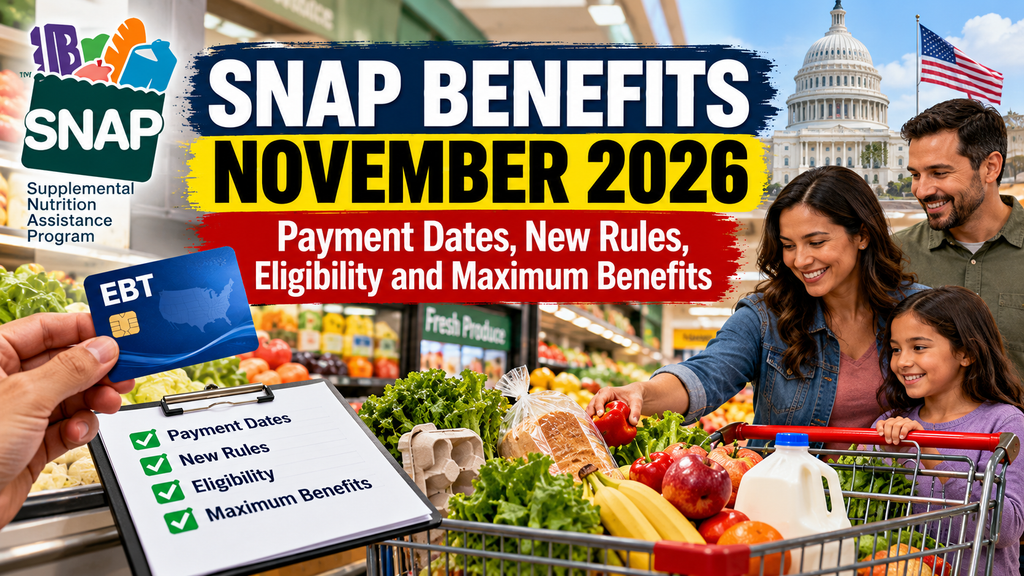
SNAP Benefits November 2026: Millions of Americans rely on the Supplemental Nutrition Assistance Program (SNAP) to help pay for groceries each month. As November 2026 approaches, recipients are looking for answers about their next EBT deposit, possible benefit changes, income eligibility, and whether new federal rules could affect their assistance.
The most important thing to understand is that SNAP benefits are not deposited on one nationwide payment date. Each state and participating jurisdiction administers its own payment schedule, so the date money reaches an EBT card depends on where the household lives and the rules used by its state agency. The U.S. Department of Agriculture’s Food and Nutrition Service (USDA FNS) oversees SNAP at the federal level. State agencies handle applications, eligibility decisions, benefit calculations, and the distribution of monthly assistance.
For November 2026, recipients should check their state’s official SNAP website for the exact deposit date and any notices affecting their case. They should also review renewal deadlines, reporting requirements, and messages from their local benefits agency. This guide explains how November SNAP payments work, how benefits are calculated, who may qualify, what recipients should know about federal rule changes, and where to find verified information.
SNAP Benefits November 2026: What Recipients Need to Know
SNAP is a federally funded nutrition assistance program designed to help eligible households purchase food. Benefits are generally delivered electronically through an Electronic Benefits Transfer (EBT) card.
The following table summarizes the main points recipients should check before their November payment arrives.
| SNAP question | What recipients should know |
|---|---|
| November payment date | Depends on the state or participating jurisdiction |
| Payment method | Generally deposited electronically to an EBT account |
| Benefit amount | Based on household circumstances and applicable program rules |
| Eligibility | Depends on financial and nonfinancial requirements |
| Benefit increases | Do not assume an increase without an official notice |
| Recertification | Households must follow their assigned renewal deadline |
| Where to verify | USDA FNS and the official state SNAP agency |
USDA’s official SNAP recipient information explains the program’s eligibility and benefit rules. Recipients can start with the USDA SNAP website.
Trump Accounts Dell $250 Grant: Did Deposits Actually Start Monday? Here’s Who’s Actually Been Paid
$1776 Warrior Dividend 2026: Payment Status, Eligibility & Tax-Free Confirmation
When Will SNAP Benefits Be Deposited in November 2026?
There is no single November 2026 SNAP payment date for every American household. States distribute benefits on different schedules. Some use a recipient’s case number, while others use details such as a household member’s name, the last digit of an identification number, or another state-defined schedule.
As a result, two eligible households living in different states may receive their November benefits on different days. Recipients should check the official payment calendar published by their state agency. If the state provides a personalized benefits portal, the recipient may also be able to view the scheduled deposit or case status online.
Why SNAP Payment Dates Differ by State
Although SNAP is federally funded, states administer the program under federal requirements. This arrangement allows state agencies to manage applications, eligibility reviews, payment distribution, and customer service. Consequently, a payment calendar published for one state should not be used to predict the deposit date in another state.
For example, a recipient in California should consult California’s official CalFresh information, while a recipient in Texas should use the Texas Health and Human Services website. The same principle applies to Florida, New York, Pennsylvania, Ohio, Illinois, Georgia, and other states.
How to Find Your November SNAP Payment Date
Follow these steps to find the correct schedule:
- Visit the official website of your state’s SNAP agency.
- Look for the EBT, benefits, or payment schedule section.
- Check whether the agency has published a November 2026 calendar.
- Confirm the date using your account or official notice if one is available.
- Contact the agency if your expected deposit does not appear.
The USDA provides a directory of state agencies through its SNAP State Directory.
Important: Do not rely on a social media post claiming that all SNAP recipients will receive their benefits on the same date. Verify your schedule with the agency responsible for your case.
Will SNAP Benefits Increase in November 2026?
Recipients should be cautious about claims that SNAP benefits will automatically increase in November. SNAP benefit amounts are determined under federal rules, including household size, income, deductions, and applicable maximum allotments. Annual adjustments may affect program limits, but an adjustment does not mean every household will receive a larger payment.
The federal fiscal year begins on October 1. For that reason, annual program adjustments, when officially announced and applicable, can affect benefit calculations during the fiscal year. However, a recipient’s individual payment may remain unchanged or decrease depending on the household’s circumstances and the rules that apply. Before publishing or relying on a specific November benefit increase, recipients should verify the applicable fiscal-year limits and effective dates through USDA FNS or their state agency.
Why Your SNAP Payment May Be Different
A household’s payment can change for several reasons, including:
- A change in earned or unearned income.
- A change in household size.
- A change in allowable deductions.
- A change in housing or utility expenses that qualify under applicable rules.
- A new eligibility determination.
- A change in the household’s reporting or certification status.
- A change in the applicable federal or state program rules.
A lower deposit does not necessarily mean the state has made an error, but recipients should ask their agency for an explanation if the amount differs from their notice. Likewise, a higher payment should not be assumed to be permanent until the agency confirms the household’s benefit amount.
2027 COLA Estimate Changed Again: What Moved and 3 Smart Moves to Make Before October 14
CRA GST/HST Credit 2026: October 5 Payment, New $679 and $890 Maximums, and Who Still Gets Paid
Social Security Changes October 2026: SSA Announces Major Update for Retirees and Beneficiaries
What Is the Maximum SNAP Benefit for November 2026?
The maximum SNAP benefit is not the same for every household. It varies according to household size and the applicable program rules. The maximum allotment represents the highest benefit available for a household of a particular size under the relevant rules. It does not mean every household receives that amount. Actual assistance is calculated using the household’s circumstances and applicable deductions.
For an accurate November 2026 figure, check the official USDA allotment information applicable to the household’s state and household size. Do not use an older maximum-benefit chart without confirming its effective date.
Does Household Size Matters
A household with more eligible members generally has a higher maximum allotment than a smaller household. However, household size alone does not determine the final payment. Income, deductions, and other eligibility rules also affect the amount. For this reason, a family of four should not assume that it will receive the maximum benefit for four people. Its actual amount depends on its individual circumstances. Recipients can find federal program information through USDA SNAP eligibility resources.
Who Qualifies for SNAP Benefits in November 2026?
SNAP is intended to help eligible households with limited resources purchase food. Applicants must meet the applicable financial and nonfinancial eligibility requirements. State agencies review household information to determine whether an applicant qualifies and, if so, how much assistance the household may receive.
Eligibility is not determined by income alone in every case. Factors such as household composition, expenses, age, disability status, student status, immigration-related eligibility rules, and work requirements may be relevant.
Income Requirements
SNAP uses income tests established under federal rules, subject to applicable state options and exceptions. The agency may examine earned income, such as wages, as well as unearned income, such as certain benefits or other payments. Allowable deductions can affect the amount of income used to calculate SNAP benefits.
Depending on the household, applicable deductions may include certain earned-income expenses, dependent care costs, medical expenses for eligible elderly or disabled members, and qualifying shelter expenses. Because rules and thresholds can change, applicants should consult the official information for the relevant fiscal year rather than relying on an old income chart.
Household Size Criteria
Household composition is important when applying for SNAP. The agency considers who lives together and how the program’s household rules apply. People living at the same address do not necessarily all count as one SNAP household in every situation. Applicants should provide accurate information about the people included in the application and follow the state agency’s instructions.
Senior Citizen and People With Disabilities
Special rules may apply to households that include older adults or people with disabilities. Certain deductions and eligibility procedures may differ from those used for other households. Applicants should review USDA’s guidance and ask their state agency how the rules apply to their circumstances.
Students and Other Special Categories
Some college students face additional eligibility restrictions. Exceptions may apply depending on circumstances recognized under SNAP rules. Other categories of applicants may also be subject to special provisions. Applicants should not assume that they qualify or are disqualified based only on a general summary. The official USDA guidance on SNAP eligibility is the appropriate starting point.
How to Apply for SNAP Benefits
People who are not currently receiving SNAP can apply through the agency that administers the program in their state. Most states provide an online application process, while other application methods may be available depending on local procedures.
The general process includes the following steps:
Step 1: Find your state SNAP agency. Use the USDA’s official state directory to identify the correct agency.
Step 2: Complete the application. Provide the information requested about household members, income, expenses, and other relevant circumstances.
Step 3: Submit supporting documents. The agency may request proof of identity, income, residency, expenses, or other details needed to evaluate eligibility.
Step 4: Complete an interview if required. The state agency will explain whether an interview is needed and how to complete it.
Step 5: Watch for the eligibility decision. The agency will notify you about approval, denial, benefit amount, and any additional requirements.
Step 6: Follow the instructions for receiving benefits. Approved households generally receive benefits electronically through an EBT card. Applying does not guarantee approval. The state agency must determine whether the household meets the applicable eligibility rules.
$90 Medicare Part B Payment: Who Qualifies, When It Arrives and Who Gets Nothing
Social Security COLA Increase for 2027: Estimates Point to 3.5% as the October 14 Announcement Nears
Social Security 2027 COLA: Latest Estimate, Official Date and Calculator
What Is an EBT Card, and How Does It Work?
An Electronic Benefits Transfer card is the usual way SNAP benefits are provided to eligible households. The card is used at authorized retailers to purchase eligible food items. The available balance reflects the benefits credited to the account, along with any relevant transactions. Recipients should protect their card and personal identification number, monitor transactions, and report suspected unauthorized activity to the appropriate agency or EBT customer-service provider.
What Can You Buy With SNAP?
SNAP benefits are generally used to purchase eligible food for home consumption.
Examples of commonly eligible purchases include:
- Fruits and vegetables.
- Meat, poultry, and fish.
- Bread, cereals, and other staple foods.
- Milk and other qualifying dairy products.
- Seeds and plants that produce food for household consumption.
Federal rules also restrict certain purchases. SNAP generally cannot be used to buy alcoholic beverages, tobacco, vitamins, medicines, or hot foods prepared for immediate consumption, subject to specific program exceptions. Retailers and state agencies can provide information about eligible purchases and any applicable exceptions. For the federal overview, see USDA’s SNAP eligible food items guidance.
What Should You Do If Your November SNAP Benefits Are Late?
A missing deposit can be stressful, particularly for households that depend on SNAP to purchase groceries. Before assuming that benefits have been stopped, check whether your state uses a different deposit date or whether your case requires additional action.
Consider the following steps:
- Check your payment schedule. Confirm the November date for your state and case.
- Review your EBT balance. Use the official balance-checking method provided by your EBT service.
- Check your case status. Look for notices requesting documents, an interview, or a renewal.
- Confirm your contact information. Make sure the agency can reach you if additional information is required.
- Contact the state agency. Ask whether the deposit is scheduled, delayed, or affected by an eligibility issue.
- Keep records. Save notices and confirmation numbers related to your case.
A late or missing payment can have several explanations. Only the agency handling your case can confirm the reason for your specific situation.
SNAP Recertification: Do Not Miss Your Deadline
SNAP approval is not necessarily permanent. Households must complete periodic reviews and provide information requested by the agency to continue receiving benefits. The process is commonly called recertification. The deadline depends on the household’s certification period and state procedures. If your renewal date falls near November 2026, read your notice carefully and submit the required information on time.
Failing to complete the process may interrupt benefits or result in the case closing, depending on the circumstances and applicable procedures. Recipients should not assume that benefits will continue indefinitely without a review. If you are unsure about your renewal date, contact your state agency.
Are There New SNAP Rules in 2026?
Federal SNAP rules can change through legislation, regulations, and official agency guidance. States also administer the program and communicate how applicable requirements affect recipients. Some federal changes may affect work requirements, eligibility categories, or administrative procedures. The effect on a particular household depends on the final rules, effective dates, applicable exceptions, and state implementation.
For this reason, recipients should not rely on broad claims that every SNAP household must meet the same new requirement or that all beneficiaries are affected in the same way. If a new rule applies to your case, your state agency is the appropriate source for instructions about what you must do and when. Before acting on a report about a 2026 policy change, verify the information through USDA FNS, the relevant federal regulation, or an official state notice.
Where to Find Official SNAP Updates
The following government resources are useful for checking payment information, eligibility, and program rules.
| Official resource | What it helps you verify |
|---|---|
| USDA Food and Nutrition Service | Federal SNAP program information |
| USDA SNAP State Directory | The correct state agency and official contact information |
| USDA SNAP Eligibility | Eligibility requirements and related guidance |
| USDA Eligible Food Items | Federal rules for food purchases |
| Your state’s official benefits portal | State-specific payment schedules, case status, renewal notices, and application information |
These resources should be used before relying on unofficial websites, social media posts, or claims about a nationwide payment date.
FAQ’s About SNAP Benefits November 2026
1. When will SNAP benefits arrive in November 2026?
The exact date depends on the state or participating jurisdiction. Check the official payment calendar or your state benefits account for the date that applies to your household.
2. Will everyone receive SNAP benefits on November 1, 2026?
No nationwide rule establishes November 1 as the payment date for all recipients. States use different distribution schedules, and a household’s deposit date depends on its state’s procedures.
3. Will SNAP benefits increase in November 2026?
Do not assume there will be an increase. Benefit amounts depend on the applicable maximum allotments, household size, income, deductions, and program rules. Verify any announced adjustment through USDA FNS or your state agency.
4. How can I check my SNAP balance?
Use the official EBT balance-checking method provided by your state or EBT service. Keep your card details and PIN private, and report suspicious transactions promptly.
5. Can I receive SNAP if I work?
Working does not automatically disqualify someone from SNAP. Eligibility depends on the applicable financial and nonfinancial requirements, including relevant income calculations and any work-related rules.
6. What happens if I miss my SNAP recertification deadline?
Missing a renewal deadline can interrupt benefits or lead to case closure, depending on the circumstances and state procedures. Contact your state agency as soon as possible if you miss a deadline or receive a notice you do not understand.
7. Where can I apply for SNAP?
You can find your state’s application portal through the USDA SNAP State Directory. Follow the application instructions published by the agency responsible for your location.
8. Can SNAP be used to buy household supplies?
SNAP is intended for eligible food purchases and certain food-producing seeds and plants. Ordinary household supplies, toiletries, and nonfood items generally are not SNAP-eligible purchases.
9. What should I do if my November payment does not arrive?
Confirm your state’s payment schedule, check your EBT balance and case status, review agency notices, and contact the state SNAP office if the payment is still missing.
10. Is information on social media enough to confirm a SNAP change?
No. Use official USDA and state agency information to verify payment dates, benefit amounts, eligibility rules, and deadlines before making decisions.
Check Your State’s Official November SNAP Schedule
SNAP benefits remain an important source of grocery assistance for eligible households across the United States. However, November 2026 payment dates and individual benefit amounts cannot be confirmed using one nationwide calendar. Recipients should check their state’s official schedule, monitor their EBT account, complete any required renewal, and review notices from the agency managing their case.
The most reliable way to avoid confusion is to verify information directly through USDA FNS and your state benefits agency. Do not assume that a reported payment increase, new deadline, or nationwide deposit date applies to your household unless an official source confirms it.
Editorial note: This article distinguishes general federal SNAP rules from state-specific payment procedures. Benefit amounts, payment dates, and rule changes should be confirmed against the official guidance in effect for November 2026.
Also Read:
$200 Extra Social Security Payment: When Is It Being Approved, and Who Can Get It?
Trump $5000 Dividend Check: Latest Update on Cost, Eligibility and Payment Date
New York POWER Rebate Checks: $100 to $200 Payments Begin Landing in Mailboxes This Fall