Top Ranked Canadian Universities 2026: If you have been searching for Canadian universities QS World Rankings 2027, here is the update you need before relying on older data: the rankings referenced in earlier headlines about “2026” placements are now a full edition out of date. QS (Quacquarelli Symonds) released its newest edition, the QS World University Rankings 2027, on June 17, 2026, evaluating more than 1,500 institutions worldwide from a pool of over 8,000. The good news for Canada is that the headline result has not changed: four Canadian universities remain in the global top 100, though three of them slipped slightly compared to the previous edition. McGill University holds onto its position as Canada’s top-ranked university at 30th globally, followed by the University of Toronto at 32nd, the University of British Columbia at 45th, and the University of Alberta at 96th, marking the University of Alberta’s third consecutive year inside the world’s top 100. We’ll be updating this article monthly as new ranking data and methodology changes are released.
This article breaks down exactly how each of Canada’s top four universities performed in the QS World Rankings 2027, what changed compared to the previous edition, how the ranking methodology actually works, where other well-known Canadian universities like Waterloo, McMaster, and Université de Montréal landed outside the top 100, and how these standings connect to subject-specific QS rankings released earlier in 2026. Every figure below reflects the officially published QS 2027 results and cross-checked reporting from Canadian universities’ own newsrooms.
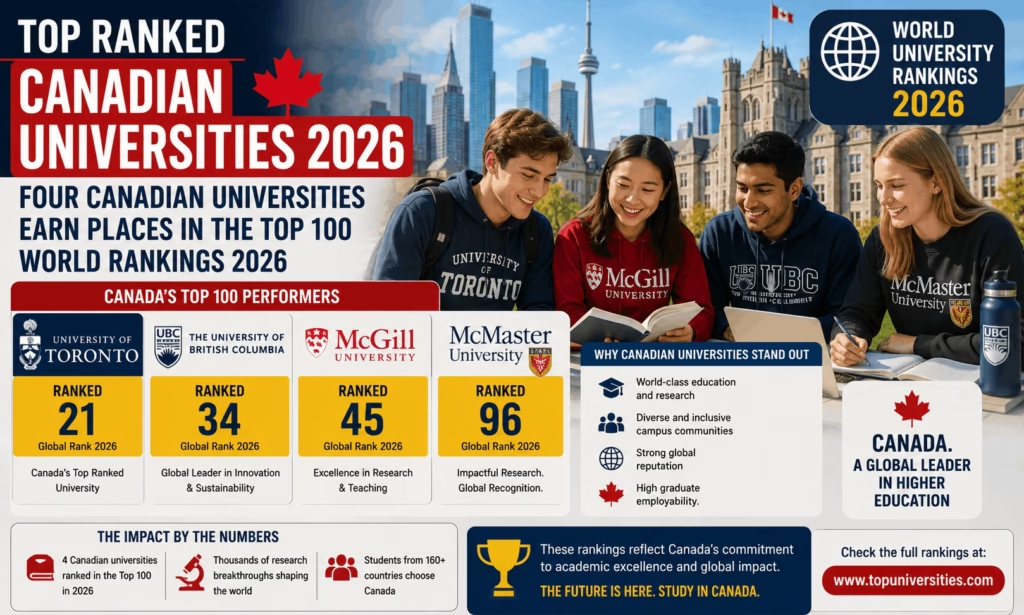
Top Ranked Canadian Universities 2026 Key Highlights
| Ranking edition | QS World University Rankings 2027 |
| Publication date | June 17, 2026 |
| Institutions evaluated | Over 8,000, narrowed to more than 1,500 ranked |
| Canadian universities included overall | 30 |
| Canadian universities in the global top 100 | 4 (unchanged from the previous edition) |
| Canada’s top-ranked university | McGill University, ranked 30th globally |
| University of Toronto | Ranked 32nd globally |
| University of British Columbia | Ranked 45th globally |
| University of Alberta | Ranked 96th globally, third consecutive year in the top 100 |
| World’s top 5 universities (2027) | MIT, Imperial College London, Stanford, Oxford, Harvard (unchanged from 2026) |
| McGill’s global sustainability rank | 9th, up from 15th the previous year |
Why This Article Updates the Previous “2026 Rankings” Data
If you previously read that McGill ranked 27th and the University of Toronto ranked 29th, that information reflected the QS World University Rankings 2026 edition, published in June 2025. QS releases a new edition every June, and each edition is named for the following year, which means the 2027 edition, published on June 17, 2026, is now the current and active ranking. Under the newer results, McGill has fallen three spots to 30th, Toronto has dropped three spots to 32nd, and UBC has fallen five spots to 45th. The University of Alberta is the one exception moving in the opposite direction, edging up slightly to 96th from its earlier 94th position, while still comfortably inside the global top 100 for a third straight year.
The practical takeaway is that Canada’s four-university presence in the world’s top 100 has held steady across both editions, even though individual rankings shifted. Anyone comparing older “2026 rankings” coverage against this article should treat the numbers here, from the 2027 edition, as the current benchmark.
Adult Child Sponsorship in Canada 2026: Immigration Pathways, Requirements and Alternatives
CRA My Account Breach Claims 2026: How Eligible Canadians Could Seek Up to $5,280 in Compensation
Canada’s Four Top 100 Universities in the QS 2027 Rankings
McGill University, based in Montreal, remains Canada’s highest-ranked institution for a fourth consecutive year, placing 30th globally with a strong overall score. McGill posted a perfect academic reputation score among Canadian institutions and now ranks among the world’s top 100 in five of the nine indicators QS measures, up from four the previous year. Its standout result came in sustainability, where it climbed to 9th globally from 15th the year before, placing it among the world’s leading institutions on environmental, social, and governance priorities.
The University of Toronto, Canada’s largest university with more than 97,000 students across three campuses, sits at 32nd globally in the 2027 edition, a three-spot drop from the prior year. Toronto continues to perform strongly in academic reputation, employment outcomes, employer reputation, and international student diversity, and has ranked consistently within or near the QS global top 30 across recent years.
The University of British Columbia ranks 45th globally in the 2027 edition, down five spots from the previous year. UBC recorded particularly strong results in citations per faculty among Canada’s top institutions, and its strengths in computer science, international economics, biology, and mathematics continue to draw international applicants, especially given its proximity to both the Pacific Northwest technology sector and Asia-Pacific markets.
The University of Alberta climbed to 96th globally, marking its third consecutive year inside the QS world top 100. University of Alberta president Bill Flanagan highlighted this consistency as a reflection of ongoing research and academic performance, with the university noting the achievement among the more than 1,500 institutions included in the current ranking.
How the QS Ranking Methodology Works
The QS World University Rankings evaluate institutions across several core categories, with recent editions organizing these into five broad indicator groups: research and discovery, employability outcomes, learning experience, global engagement, and sustainability. These broad categories are built from nine specific indicators, including academic reputation, employer reputation, faculty-student ratio, citations per faculty, international faculty ratio, international student ratio, international research network, employment outcomes, and sustainability.
This weighted, multi-indicator approach is why individual universities can rise in one area, such as McGill’s improved sustainability score, while their overall global rank still declines slightly if other institutions worldwide improved faster across the full indicator set. It is also why comparing a single year-over-year rank change in isolation can be misleading without looking at the underlying indicator scores.
Quiet IRS Rule Shift 2026: How the SALT Cap Increase Could Mean an Extra $800 for Some Americans
State-by-State Social Security Payments 2026: Where Benefits Are Highest?
Other Canadian Universities in the Global Rankings
Beyond the top 100, Canada continues to place a substantial number of universities within the broader QS World Rankings 2027, with 30 Canadian institutions included in total. The University of Waterloo is tied for 113th globally, followed by Western University tied for 142nd, Université de Montréal tied for 162nd, McMaster University tied for 174th, Queen’s University tied for 179th, and the University of Ottawa tied for 228th.
Further down the rankings, additional Canadian institutions recognized in the 2027 edition include Memorial University of Newfoundland, Carleton University, Université de Sherbrooke, Université du Québec, the University of Regina, Brock University, and the University of Northern British Columbia, reflecting the depth of Canada’s presence across the full global ranking rather than only at the very top.
Canadian Universities in QS Subject Rankings 2026
Separate from the overall world rankings, QS also publishes subject-specific rankings, and its most recent 16th edition, released in March 2026, placed six Canadian universities somewhere within the global top 100 across various subject areas, matching the same total as the previous year. The University of Toronto and the University of British Columbia both ranked within the top 30 globally across all five broad subject areas QS evaluates, with Toronto maintaining its position as Canada’s highest-ranked institution in every subject category, ranging as high as 12th place in certain disciplines.
The University of Alberta expanded its subject-level presence in the 2026 edition, appearing in the global top 100 for two subject areas rather than one, reaching 98th place in natural sciences, although its life sciences and medicine ranking slipped from 86th to 93rd. McMaster University held its position in the top 100 for life sciences and medicine specifically, improving to 56th place from 59th the year before. Canada’s top-ranking institutions by subject area this year were spread across Ontario, British Columbia, Alberta, and Quebec.
What These Rankings Mean for International Students
For prospective international students, these rankings often factor into study permit planning, since institution reputation can influence perceptions around post-graduation work permit eligibility and long-term career prospects tied to a designated learning institution. All four of Canada’s top 100 universities, McGill, Toronto, UBC, and Alberta, continue to offer strong post-graduation pathways and maintain broad international research networks, even as individual rank positions shift year to year.
It is worth noting that Canada’s overall higher education sector has faced budget pressures tied to recent federal caps on international student intake, a factor some analysts point to when explaining why several Canadian institutions saw modest rank declines in the 2027 edition even as their underlying academic performance remained strong.
Official Resources and Useful Links
| Resource | Purpose | Link |
|---|---|---|
| QS World University Rankings, Official Site | Full 2027 rankings, methodology, and subject rankings | topuniversities.com |
| McGill University, Admissions | Application information for Canada’s top-ranked university | mcgill.ca (Admissions) |
| University of Toronto, Admissions | Application and program information | utoronto.ca (Admissions) |
| University of British Columbia, Admissions | Application and program information | ubc.ca (Admissions) |
| University of Alberta, Admissions | Application and program information | ualberta.ca (Admissions) |
| IRCC, Study Permit Information | Official study permit eligibility and application details | canada.ca (Study permit: how to apply) |
People Also Ask
Which Canadian university is ranked highest in the world in 2026? Based on the most recent QS World University Rankings 2027, published June 17, 2026, McGill University is Canada’s highest-ranked institution at 30th globally, ahead of the University of Toronto at 32nd.
How many Canadian universities are in the global top 100? Four Canadian universities currently rank in the QS World Rankings top 100: McGill (30th), University of Toronto (32nd), University of British Columbia (45th), and University of Alberta (96th).
Did Canadian university rankings drop in 2026? Three of Canada’s four top 100 universities, McGill, Toronto, and UBC, dropped a few spots compared to the previous edition, while the University of Alberta improved slightly, moving up to 96th from 94th.
Is the University of Toronto still Canada’s top university? No, McGill University has now held the top Canadian spot for a fourth consecutive year in the QS World Rankings, having overtaken the University of Toronto in an earlier edition.
What subjects is Canada strongest in globally? The University of Toronto and University of British Columbia both rank within the global top 30 across all five broad QS subject areas, while the University of Alberta and McMaster University hold top 100 subject rankings in natural sciences and life sciences and medicine respectively.
FAQs
What is the latest QS World University Rankings edition for Canadian universities?
The current edition is the QS World University Rankings 2027, published on June 17, 2026. It replaces the earlier 2026 edition, which was published in June 2025 and is now out of date.
Which four Canadian universities are ranked in the global top 100?
McGill University (30th), University of Toronto (32nd), University of British Columbia (45th), and University of Alberta (96th) are the four Canadian institutions currently inside the QS World Rankings top 100.
Why did McGill, Toronto, and UBC drop in rank this year?
All three slipped a few spots compared to the previous edition even though their underlying academic performance remained strong, a pattern some analysts connect to increasingly competitive gains among universities in the Middle East and East Asia, alongside domestic budget pressures tied to Canada’s international student intake caps.
How many total Canadian universities are included in the QS World Rankings?
The QS World University Rankings 2027 includes 30 Canadian universities in total, ranging from McGill at 30th globally down through institutions ranked in the 900-plus range.
Does QS also rank Canadian universities by subject?
Yes, QS publishes separate subject rankings. Its most recent edition, released in March 2026, placed six Canadian universities in the global top 100 across various subject areas, with Toronto and UBC both ranking in the top 30 across all five broad subject categories.
Do these global rankings affect study permit or immigration outcomes?
Rankings themselves do not directly determine study permit eligibility, but attending a well-regarded, designated learning institution can influence post-graduation work permit planning and long-term career prospects, which is why many international students weigh these rankings heavily when choosing where to apply.
Conclusion
Canada’s presence among the world’s top universities remains strong heading into the 2027 QS ranking cycle, with McGill, the University of Toronto, the University of British Columbia, and the University of Alberta all holding firm inside the global top 100, even as three of the four saw modest rank declines compared to the previous edition. The most important update for anyone still relying on older “2026 rankings” coverage is that a newer edition, released June 17, 2026, is now the current benchmark, and McGill’s position as Canada’s top-ranked university has now held for a fourth consecutive year. This article will be updated monthly as new QS data, subject rankings, or methodology changes are released.
Also Read
OAS Payment Increase July 2026: Confirmed Amounts, Payment Date, and the Annual GIS Reset !