Trump’s New Student Visa Rules 2026 [F-1, J-1 & M-1]: The U.S. Department of Homeland Security has officially finalized the new student visa rule that ends “Duration of Status” for F-1, J-1, and I visa holders. This is no longer a proposal or a rumor — DHS published the final rule on July 17, 2026, and it takes effect on September 15, 2026. This guide explains exactly what has changed, who is affected, and what international students need to do before the deadline.
With more than a million international students studying in the United States and contributing through tuition, research output, and cross-cultural exchange, the U.S. remains the world’s most sought-after study destination. Indian students, who make up the largest international cohort on U.S. campuses, are among the most affected by this shift. For decades, F-1 and J-1 students were admitted for “Duration of Status” (D/S), letting them remain in the country for as long as they maintained their academic program and a valid SEVIS record. That system ends on September 15, 2026, replaced by fixed admission periods and mandatory federal extensions.
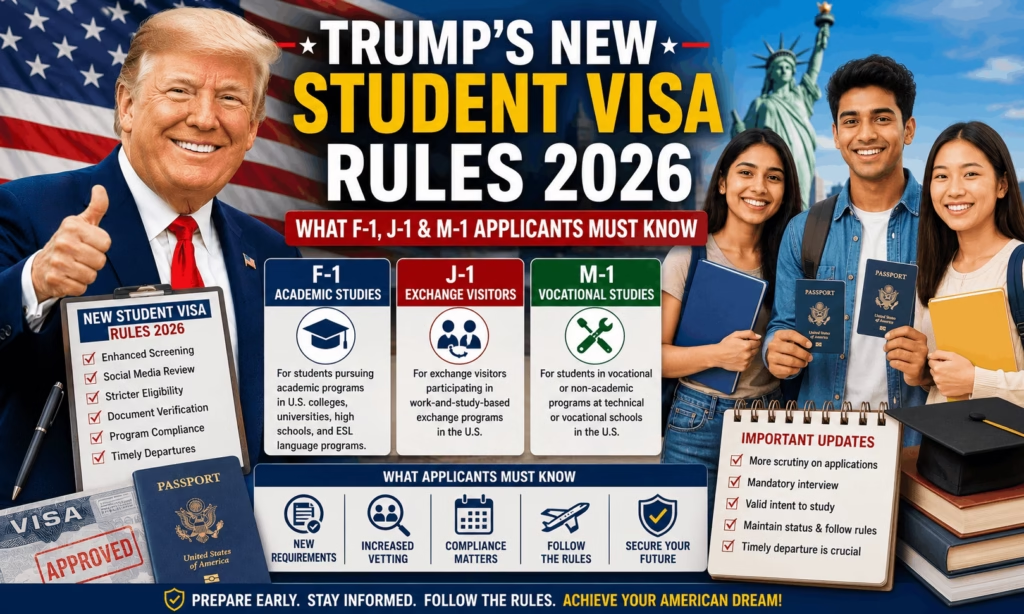
Trump’s New Student Visa Rules 2026 Key Highlights
| Particulars | Details |
|---|---|
| Rule Name | Final Rule Establishing a Fixed Time Period of Admission and Extension of Stay Procedure |
| Issuing Authority | U.S. Department of Homeland Security (DHS) |
| Final Rule Published | July 17, 2026 |
| Effective Date | September 15, 2026 |
| Visa Categories Affected | F-1 (academic), J-1 (exchange visitor), I (foreign media) |
| Old System | Duration of Status (D/S) — indefinite stay while maintaining status |
| New System | Fixed period of admission, up to 4 years (240 days for I visa) |
| Extension Process | Mandatory Extension of Stay (EOS) application with USCIS |
| F-1 Grace Period | Reduced from 60 days to 30 days |
| Who Announced It | DHS Secretary Markwayne Mullin |
DHS Finalizes the Student Visa Rule: From Proposal to Law
Earlier in 2025 and into early 2026, reports of Trump’s planned student visa overhaul were treated largely as a proposed regulation — first floated in an August 2025 Notice of Proposed Rulemaking (NPRM). Many news outlets and blogs described “major changes” to F-1 visa regulations, J-1 exchange visitor rules, and M-1 vocational visas as pending speculation. That changed on July 17, 2026, when DHS published the final rule in the Federal Register, converting the proposal into binding law with a confirmed effective date of September 15, 2026.
DHS Secretary Markwayne Mullin framed the change as a national security and integrity measure, stating that the decades-old D/S system had left the door open to abuse, citing cases of foreign nationals remaining enrolled in F-1 status for well over a decade without genuine academic progress. According to DHS, at least 2,134 individuals who entered on F-1 visas between 2000 and 2010 remained in active F-1 status as of April 2026 — a pattern the agency says the new rule is designed to close.
Fixed 4-Year Limit on Student Visas Explained
Under the new framework, F-1 and J-1 nonimmigrants will be admitted for the length of their specific academic or exchange program, capped at a maximum of four years. I visa holders (representatives of foreign information media) face a separate, shorter cap of 240 days. This is a sharp departure from the open-ended D/S model, under which students could remain enrolled indefinitely as long as they stayed in compliance.
Students in longer programs — engineering, medicine, PhD research, or any course of study that regularly runs past four years — will need to apply for a formal Extension of Stay (EOS) through USCIS before their authorized period expires. This shifts oversight away from university Designated School Officials (DSOs) and places it directly with federal immigration authorities, who will conduct biometric vetting, background checks, and fraud screening as part of every extension request.
F-1, J-1, and I Visa: Fixed Period Comparison
| Visa Type | Old System | New System (Effective Sept 15, 2026) |
|---|---|---|
| F-1 (Academic) | Duration of Status | Fixed period matching program length, max 4 years |
| J-1 (Exchange Visitor) | Program-based flexibility | Fixed period, max 4 years, regular assessments |
| I (Foreign Media) | Duration of Status | Fixed period, max 240 days |
Grace Period Cut from 60 Days to 30 Days
One of the most consequential changes for graduating students is the reduction of the post-completion grace period from 60 days to 30 days. This window has traditionally given F-1 students time to apply for Optional Practical Training (OPT), search for a job offer, change their visa status, or prepare to depart the U.S. Under the new rule, students have half the time to complete these steps, which immigration advisors expect will add pressure on those still waiting for OPT approval, an H-1B sponsor, or a change-of-status decision.
Students who are the beneficiary of a timely filed cap-subject H-1B petition do get one exception: they can remain in F-1 status under a “cap-gap” extension until their H-1B is approved or April 1 of the relevant fiscal year, whichever comes first.
Transition Rules for Students Already in the U.S.
DHS has built in transition provisions for F-1 and J-1 nonimmigrants who are already inside the United States and properly maintaining D/S status when the rule takes effect on September 15, 2026. These students will be authorized to remain until the program end date listed on their Form I-20 or DS-2019 that is valid on that date — but not beyond four years from the effective date — plus the applicable 30-day departure grace period.
Anyone currently outside the U.S. or planning international travel should note that re-entry after September 15, 2026, will automatically convert their admission to the new fixed-date system, with a new Form I-94 reflecting a specific “admit until” date rather than “D/S.”
Restrictions on School Transfers and Program Changes
The final rule also tightens the rules around switching schools or academic programs. Graduate students in particular will face new restrictions: those enrolled in graduate education programs may be prohibited from changing programs at any point during their studies, and any change to a lower or equivalent education level while in F-1 status is expected to be barred. Transfers will need to be backed by documented academic or compelling medical reasons rather than discretionary judgment calls by school officials — a shift aimed at closing the “serial transfer” pattern DHS says some students have used to prolong their U.S. stay.
M-1 Vocational Visa Holders Face the Tightest Restrictions
M-1 vocational and technical training visa holders are expected to feel the impact most acutely. Extensions will be harder to obtain, school transfers will face stricter scrutiny, and practical training authorizations tied to vocational programs will come under closer review. This affects fields where hands-on training is central to the credential — aviation maintenance, culinary and hospitality training, and other technical certificate programs. Critics argue this could push prospective vocational students toward countries like Canada, Germany, or Australia, where vocational training remains more closely tied to direct employment pathways.
What This Means for Indian Students
Indian nationals form the largest group of international students in the U.S., and immigration consultants say the practical impact will depend heavily on how “prepared” an applicant’s paperwork already is. Pune-based education counselor Ananya Kulkarni notes that students with strong academic continuity, clear career plans, and well-documented funding are unlikely to see much disruption — but applications with inconsistent financial documentation, vague statements of purpose, or unclear program justification are more likely to face scrutiny or delay under the new, stricter vetting standards tied to every EOS filing.
O-1 Visa: An Alternative Path Worth Considering
With F-1 rules tightening and H-1B competition already intense, immigration advisors are pointing more international graduates toward the O-1 visa, reserved for individuals with extraordinary ability in the sciences, arts, education, business, or athletics. The O-1 is not subject to the new fixed-period student visa limits in the same way. STEM students and those in creative fields are advised to start building a strong portfolio early — research publications, leadership roles, awards, and recognitions — to strengthen a future O-1 case.
How to Prepare Before September 15, 2026
- Check your current Form I-20 or DS-2019 program end date and confirm whether it falls within or beyond the 4-year cap from the effective date
- If your program runs longer than four years, start preparing your Extension of Stay (EOS) documentation well in advance of your authorized period ending
- Avoid non-essential international travel close to September 15, 2026, since re-entry after that date immediately converts your status to the fixed-date system
- Keep detailed academic and financial documentation ready, since USCIS extension reviews will include biometric vetting and background checks
- Speak with your school’s Designated School Official (DSO) and a qualified immigration attorney if your program involves a graduate-level transfer or major change
- Track official updates only through DHS.gov, USCIS.gov, or Study in the States rather than social media, since implementation details are still rolling out via SEVIS system updates
FAQs
Is Trump’s new student visa rule for 2026 final, or is it still a proposal?
It is final. DHS published the final rule in the Federal Register on July 17, 2026, and it takes effect on September 15, 2026.
What is the maximum period international students can now stay in the U.S. on an F-1 or J-1 visa?
F-1 and J-1 nonimmigrants can be admitted for a fixed period matching their program length, up to a maximum of four years. I visa (foreign media) holders are capped at 240 days.
What happens if my academic program takes longer than four years to complete?
You must file a formal Extension of Stay (EOS) application with USCIS before your authorized period expires, which includes biometric vetting and background checks.
How much has the F-1 post-completion grace period changed?
It has been reduced from 60 days to 30 days for F-1 students to prepare for OPT, a job search, a status change, or departure.
Will students already studying in the U.S. be affected immediately?
Students properly maintaining D/S status on September 15, 2026, can remain until their current I-20/DS-2019 program end date, capped at four years from the effective date, plus the applicable grace period.
How much has the F-1 post-completion grace period changed?
It has been reduced from 60 days to 30 days for F-1 students to prepare for OPT, a job search, a status change, or departure.
Will students already studying in the U.S. be affected immediately?
Students properly maintaining D/S status on September 15, 2026, can remain until their current I-20/DS-2019 program end date, capped at four years from the effective date, plus the applicable grace period.
Does this rule end all school and program transfers for F-1 students?
No, but it tightens them significantly. Graduate students may be barred from changing programs mid-study, and transfers generally require documented academic or compelling medical reasons.
Are M-1 vocational visa holders affected differently than F-1 students?
Yes. M-1 students face the tightest restrictions on extensions, school transfers, and practical training authorization compared to F-1 and J-1 categories.
What should students currently traveling abroad know?
Re-entry to the U.S. after September 15, 2026, will automatically convert admission to the new fixed-date system with a new Form I-94 reflecting a specific end date.
Is the O-1 visa a good alternative to F-1 restrictions?
For individuals with extraordinary ability in their field, the O-1 visa is not bound by the new student visa caps and is increasingly recommended by immigration advisors as an alternative path.
Where can students verify official updates on this rule?
Official updates are available at DHS.gov, USCIS.gov, and Study in the States (studyinthestates.dhs.gov) — not social media or unverified blogs.
Official Sources
| Source | Link |
|---|---|
| U.S. Department of Homeland Security | dhs.gov |
| Study in the States (DHS) | studyinthestates.dhs.gov |
| Federal Register Final Rule | federalregister.gov |
| U.S. Department of State | travel.state.gov |