Deceased Person’s Credit Card Debt: Families dealing with a loved one’s death are increasingly getting collection calls within weeks, sometimes days, of the funeral, and consumer advocates say confusion over who pays a deceased person’s credit card debt is now one of the most common financial fears reported to debt-help hotlines. The short answer under federal law is straightforward: a deceased person’s credit card debt is paid from their estate, not from the personal bank accounts of their children, siblings, or, in most states, their surviving spouse. Yet that simple rule gets misunderstood constantly, partly because debt collectors sometimes pressure grieving relatives who have no legal obligation to pay a single dollar.
This confusion is getting worse just as federal oversight of debt collectors is shrinking. The Consumer Financial Protection Bureau (CFPB), the agency that has historically enforced the rules protecting families from being misled about deceased relatives’ debt, is operating in 2026 with a fraction of its former staff after workforce cuts tied to a funding dispute, pushing more enforcement responsibility onto state attorneys general. That shift matters directly for anyone who just lost a parent or spouse and is now facing a stack of collection letters. We’ll be updating this article monthly as CFPB guidance, state probate rules, and collection practices continue to change.
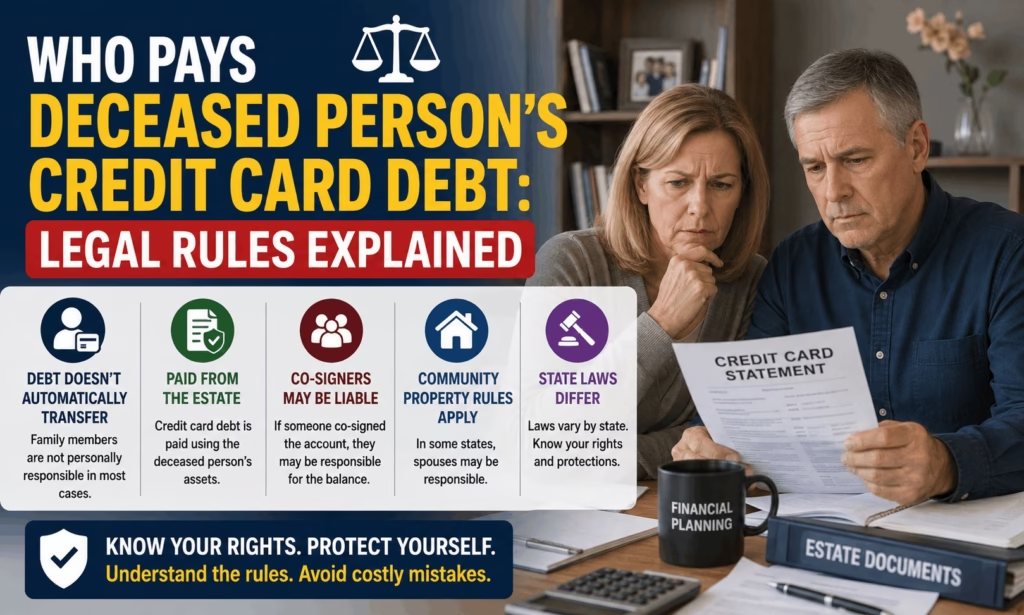
Deceased Person’s Credit Card Debt Key Highlights
| Detail | Information |
|---|---|
| Who legally owes the debt | The deceased person’s estate, not family members, in most cases |
| Exceptions where a person may owe the debt | Co-signers, joint account holders, community property spouses, “necessaries” doctrine states |
| Authorized users | Not liable for the balance, per CFPB guidance |
| Community property states | 9 states: Arizona, California, Idaho, Louisiana, Nevada, New Mexico, Texas, Washington, Wisconsin (Alaska allows opt-in) |
| Debt priority in an insolvent estate | Secured debts (mortgage) and taxes paid before unsecured debts (credit cards) |
| Who collectors may legally contact | Spouse, executor, administrator, or authorized estate representative only |
| Federal law governing collector conduct | Fair Debt Collection Practices Act (FDCPA) / Regulation F |
| CFPB workforce in 2026 | Reduced to roughly 556 employees, down from about 1,700 at peak |
| CFPB funding status | Secured $145 million in emergency funding through March 2026 amid ongoing legal disputes |
| Federal student loans after death | Discharged, not passed to family or estate |
The General Rule: Debt Dies With the Estate, Not the Family
The core principle, confirmed directly by both the CFPB and the Federal Trade Commission (FTC), is that when someone dies, their debts do not transfer to their children or other relatives simply because they are family. According to the CFPB, “family members usually don’t have to pay the debts of a deceased relative from their own money.” The FTC states the same thing in its consumer guidance: generally, no one else has to pay back debts for a person who has died, with only limited exceptions.
What actually happens is that the deceased person’s outstanding credit card balance becomes a claim against their estate. If someone died with $14,000 in credit card debt and $30,000 sitting in a bank account, the credit card company can file a claim against the estate for that $14,000 before any remaining money is distributed to heirs. That reduces what heirs eventually receive, but it does not create personal liability for any relative who never signed onto the account.
Who Is Actually Responsible: The Four Exceptions
While the general rule protects most family members, there are four specific situations where someone can become personally responsible for a deceased relative’s credit card debt:
- You co-signed the debt. If you co-signed a credit card application or loan, you agreed to pay if the primary borrower couldn’t. That obligation does not disappear when the borrower dies.
- You are a joint account holder, not merely an authorized user. Joint credit card accounts make both parties equally liable for the balance, regardless of who made the charges.
- You live in a community property state. In these states, debts incurred during a marriage can be treated as jointly owned, meaning a surviving spouse may owe the balance even without ever signing the account agreement.
- Your state enforces a “necessaries” or “doctrine of necessities” law. Some states require spouses to cover each other’s essential expenses, such as medical care or housing costs, regardless of whose name appears on the bill.
Community Property States: The Big Exception for Spouses
This is the exception that trips up the most people, particularly surviving spouses who assume they are automatically protected. Nine states follow community property law: Arizona, California, Idaho, Louisiana, Nevada, New Mexico, Texas, Washington, and Wisconsin. In these states, debts incurred during the marriage, including credit card balances run up by one spouse alone, may be considered jointly owned by both spouses. That means a surviving spouse in one of these nine states could be responsible for paying a deceased spouse’s credit card debt even if their name was never on the account. Alaska offers an optional community property system that couples can elect into through a written agreement, which can create similar exposure if that election was made.
Because the rules vary significantly by state and by the specific type of debt, surviving spouses living in a community property state should talk with a local estate or probate attorney before paying, or refusing to pay, any collector who contacts them.
Canada Disability Benefit: New $150 Payment Coming, Here’s the Update
Quebec Family Sponsorship Program Reopens With a New 15,700 Application Cap
Canadian Citizenship Certificate Wait Time Hits 19 Months as Backlog Nears 100,000
Authorized Users vs Joint Account Holders
This distinction causes enormous confusion, and getting it wrong can mean paying money you never actually owed. Being an authorized user on someone else’s credit card, common for adult children added to a parent’s card for convenience or credit-building purposes, does not make that person liable for the balance when the primary cardholder dies. The CFPB is explicit on this point: authorized users don’t owe the debt.
A joint account holder is a completely different legal status. Joint accounts make both named parties equally responsible for the full balance, whether or not the surviving holder made any of the charges. Some joint accounts also carry a “right of survivorship,” meaning any positive balance in shared financial accounts passes directly to the surviving owner, but for credit card debt specifically, joint status simply means shared liability for what’s owed.
How the Executor Handles Credit Card Claims
The person named as executor (or appointed as administrator if there’s no will) is responsible for managing the estate through probate, which includes notifying creditors, reviewing claims, and paying valid debts from estate assets before distributing anything to heirs. Executors typically need to:
- Notify major credit card issuers of the death, often by sending a copy of the death certificate
- Open an estate account to handle incoming claims and outgoing payments
- Review each creditor’s claim for accuracy before paying it
- Pay debts in the legally required order of priority under state probate law
- Keep records of every payment made from estate funds
Executors should never pay a deceased person’s credit card debt from their own personal funds. Once someone voluntarily pays a debt they don’t legally owe, recovering that money later is extremely difficult.
What Happens if the Estate Has No Money
Not all debts are treated equally when an estate goes through probate. Secured debts, such as a mortgage or car loan, and priority obligations like taxes and funeral expenses, are generally paid before unsecured debts like credit cards. That means credit card companies wait behind secured lenders and government claims before collecting anything from the estate.
If the estate’s assets run out before reaching the credit card balance, the credit card company typically absorbs the loss. According to legal guidance from Nolo, if the estate doesn’t have sufficient assets to pay the debt, the credit card company is usually simply out of luck, and the family is not asked to cover the gap. This scenario, known as an insolvent estate, means the debt may go permanently unpaid with no legal consequence to surviving relatives who had no ownership interest in the account.
Debt Collector Rules: What They Can and Can’t Say
Federal law places strict limits on who a debt collector may contact about a deceased person’s account and what they’re allowed to say. Under the FTC’s guidance and the Fair Debt Collection Practices Act (FDCPA), collectors may only discuss a deceased person’s debt with the surviving spouse, the estate’s executor or administrator, or another legally authorized representative. An adult child who is neither the executor nor a joint account holder is not legally obligated to respond to a collector’s calls about a parent’s credit card bill at all.
Collectors are also restricted on timing and conduct: under CFPB rules implementing the FDCPA, they cannot contact anyone before 8 a.m. or after 9 p.m., and they are barred from misleading any family member into believing they are personally responsible for the debt when they legally are not. Family members can also send a written request demanding all contact stop, after which repeated collector contact can itself become a legal violation.
CFPB Oversight in 2026: What’s Changed
The regulatory backdrop for all of this has shifted meaningfully in 2026. The CFPB, historically the primary federal agency enforcing debt collector conduct rules, has faced what one industry analysis calls the most consequential restructuring in its history. Court filings show the bureau’s workforce has been cut to roughly 556 employees, down from an authorized level of about 1,700 during the prior administration, following a court-approved downsizing plan tied to a statutory funding cap under recent budget legislation. The agency did secure $145 million in emergency funding to remain operational through March 2026 after a federal judge rejected arguments that Federal Reserve operating losses made its usual funding mechanism unavailable, but its longer-term funding remains legally contested.
Regulation F, the rule implementing the FDCPA that governs communication limits, validation notices, and prohibitions on collecting time-barred debt, remains fully in effect regardless of the bureau’s staffing levels. However, reduced federal supervisory capacity means enforcement responsibility is increasingly shifting to state attorneys general, and families dealing with aggressive or misleading collectors may need to rely more heavily on state-level consumer protection offices in 2026 than in past years.
Federal Student Loans and Other Debt Types After Death
Credit card debt is not the only balance families worry about after a death. Federal student loans are discharged entirely upon the borrower’s death and do not pass to a spouse, parent, or co-signer, though private student loans may work differently depending on the lender and whether a co-signer was involved. Mortgages generally must continue to be paid by whoever inherits the property or the loan is called due, and medical debt follows the same estate-claim process as credit card debt in most states.
What Families Should Do When a Collector Calls
If a debt collector contacts a family member who is not the executor, not a joint account holder, and not a co-signer, the safest response is to confirm there is an estate being handled, provide the executor’s contact information if appropriate, and decline to discuss any further account details. Family members should also request a validation notice, which collectors are legally required to provide either during the first communication or within five days of it. If a collector refuses to provide basic information about the debt, even to a surviving spouse, parent, or personal representative of the estate, that refusal itself can be a red flag for a scam, and it can be reported directly to the CFPB or a state attorney general’s consumer protection office.
COVID Tax Refunds: Who Might Still Qualify, What The Kwong Ruling Means, And Your Options Now
Canada Asylum Rules 2026: What Changed, What’s Next?
Canada’s High-Wage Occupation Proposal: Who Could Benefit Most
Latest Updates
- CFPB funding secured through March 2026: A federal judge rejected the administration’s argument that Federal Reserve losses blocked the bureau’s statutory funding, allowing continued operations, though a longer-term funding fix remains unresolved.
- Workforce reduced to roughly 556 employees: Court filings in April 2026 confirmed the CFPB’s ongoing restructuring, with the Supervision division cut from about 487 staff to roughly 73.
- State enforcement rising: With reduced federal supervisory capacity, state attorneys general are increasingly taking on debt collection enforcement that the CFPB previously handled directly.
- Regulation F unchanged: Despite the funding turmoil, the core federal debt collection communication rules under Regulation F remain fully enforceable and unaffected by the CFPB’s staffing reductions.
- State-level commercial debt rules expanding: States like California have extended consumer-style collection protections to certain smaller commercial debts, signaling a broader trend of state governments filling federal oversight gaps.
Official Resources
| Resource | Purpose | Official Link |
|---|---|---|
| CFPB: Debt After Death Guidance | Federal guidance on deceased relatives’ debt | consumerfinance.gov |
| CFPB Complaint Portal | File a complaint against a collector | consumerfinance.gov/complaint |
| FTC: Debts and Deceased Relatives | Consumer protection guidance | ftc.gov/consumer-advice |
| FDCPA Full Text | Federal debt collection law | ftc.gov |
| Regulation F Summary | Debt collector communication rules | consumerfinance.gov |
| State Attorney General Directory | File complaints against local collectors | naag.org |
FAQs
Do I have to pay my parent’s credit card debt if I never co-signed?
No. Adult children are not personally responsible for a parent’s credit card debt unless they co-signed the account or were a joint account holder.
Is a surviving spouse always responsible for a deceased spouse’s credit card debt?
Not always. It depends on whether they live in a community property state, whether the account was joint, or whether they co-signed. In most non-community-property states, a surviving spouse is not automatically liable.
Does being an authorized user make me responsible for the balance?
No. The CFPB confirms authorized users are not liable for a deceased cardholder’s balance, unlike joint account holders.
What happens if the estate doesn’t have enough money to pay the credit card debt?
The estate is considered insolvent, and the credit card company typically absorbs the unpaid balance. Family members are not required to cover the shortfall from personal funds.
Can a debt collector call me if I’m not the executor?
Generally, collectors are only permitted to discuss the debt with the spouse, executor, administrator, or an authorized representative, not any relative they can locate.
Are federal student loans forgiven when someone dies?
Yes. Federal student loans are discharged upon the borrower’s death and are not transferred to family members or the estate.
People Also Ask
Who is responsible for credit card debt after death? The deceased person’s estate is responsible first. Family members are generally not liable unless they co-signed, held a joint account, or live in a community property state.
Can credit card companies come after family for debt? Not directly, in most cases. Collectors can pursue the estate through probate, but they cannot legally demand payment from family members who have no ownership interest in the account.
What debts are forgiven when you die? Federal student loans are automatically discharged. Other unsecured debts, including credit cards, are only forgiven if the estate lacks sufficient assets to pay them.
Do you inherit debt from a deceased parent? No. Debt is not inherited the way assets are. It is paid from the estate before any inheritance is distributed to heirs.
How long do creditors have to file a claim against an estate? Deadlines vary by state, but most states require creditors to file claims within a set window, often a few months, after the executor provides formal notice to creditors during probate.
Conclusion
For most families, the answer to who pays a deceased person’s credit card debt is simple: the estate pays it, not the surviving relatives. The exceptions, co-signers, joint account holders, community property state spouses, and “necessaries” doctrine obligations, are narrow and specific, and they should never be assumed just because a collector calls and asks for payment. With the CFPB operating under significant staffing and funding pressure in 2026, families need to be more proactive than ever about knowing their rights, requesting validation notices, and pushing back on collectors who misrepresent who legally owes a debt. When in doubt, especially for surviving spouses in one of the nine community property states, a conversation with a local probate or estate attorney is worth far more than paying a collector out of fear or grief.
Missouri SNAP Food Ban Delayed: What’s Banned & Latest Status
Hawaii SNAP Soda Ban Delayed to 2027: What Will Be Banned & Status
Florida SNAP Junk Food Ban 2026: What’s Banned, Court Update, EBT Rules & Latest Status
Nevada SNAP Food Ban: What’s Banned & Start Date Explained