$760 U-Save Rebate Fact Check: Social media posts claiming a fresh $760 U-Save Rebate is landing in Singapore right now are only half correct, and the confusion is sending thousands of HDB households to check accounts that already received the money months ago. The Ministry of Finance confirmed that the full $760 U-Save payout belongs to Financial Year 2025, a support cycle that ran from April 2025 through January 2026 and officially closed with its final tranche in January 2026. What is actually landing in HDB utilities accounts right now, in Financial Year 2026, is a different and lower figure, and mixing the two years up is exactly why the $760 number keeps resurfacing out of context. We’ll be updating this article monthly as the Ministry of Finance releases new U-Save and S&CC rebate figures.
Here is the fact check in one line: the $760 U-Save Rebate was real, it was fully disbursed, and it is now finished. More than 950,000 Singaporean HDB households received it across four quarterly credits in April 2025, July 2025, October 2025, and January 2026, automatically through their SP Services utilities accounts. The current cycle, Financial Year 2026, was confirmed by MOF to total up to $570 per eligible household, still credited automatically with no application needed. Anyone seeing “$760” attached to a 2026 date should treat it as an old figure being recirculated, not a new payment.
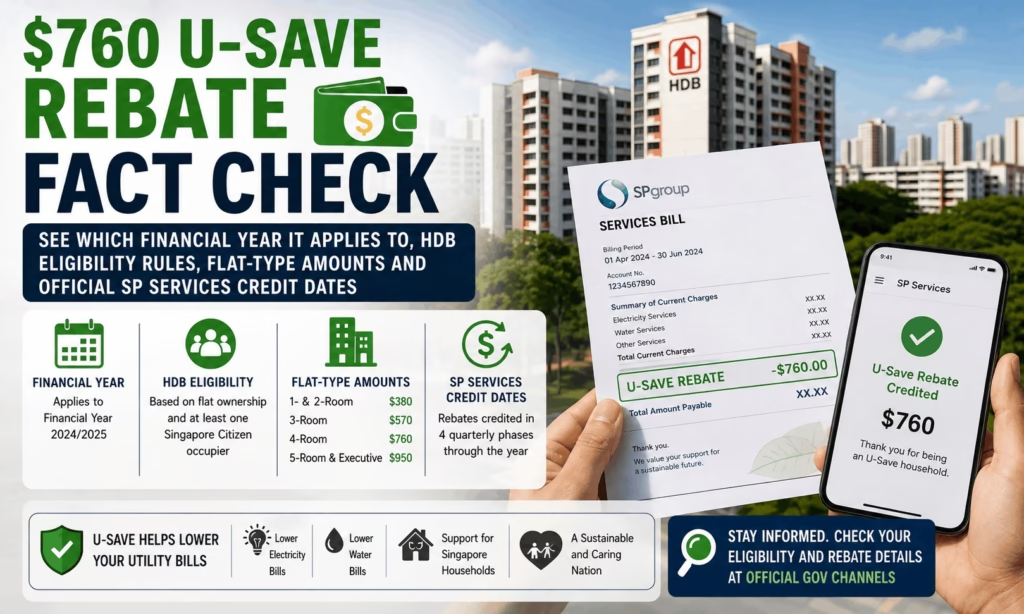
What the $760 U-Save Rebate?
The U-Save rebate is part of Singapore’s permanent GST Voucher scheme, first introduced in Budget 2012 to help lower and middle income households manage the cost of living. For Financial Year 2025, the government doubled the usual GST Voucher U-Save amount through a combination of the regular GSTV U-Save, an Assurance Package U-Save top-up, and a one-off Budget 2025 Cost-of-Living U-Save enhancement. Combined, these three components brought the maximum annual payout for the smallest flat types up to $760, disbursed across four quarters rather than as a single lump sum.
MOF’s official record confirms that more than 950,000 HDB households benefited from this enhanced FY2025 support, with the final $190 quarterly tranche credited in January 2026, closing out the cycle. That January 2026 credit is very likely the source of the viral “$760 U-Save Rebate 2026” headlines, since the payment date fell inside 2026 even though it belonged to the FY2025 budget cycle.
$760 U-Save Rebate Fact Check Key Highlights
| Detail | Information |
|---|---|
| Programme name | GST Voucher (GSTV) U-Save Rebate |
| Financial year the $760 figure applies to | FY2025 (April 2025 to January 2026) |
| Total maximum payout, FY2025 | Up to $760 per eligible household |
| Disbursement quarters, FY2025 | April 2025, July 2025, October 2025, January 2026 |
| Current cycle | FY2026 (April 2026 to January 2027) |
| Total maximum payout, FY2026 | Up to $570 per eligible household |
| FY2026 disbursement quarters | April 2026, July 2026, October 2026, January 2027 |
| Households benefiting | More than 950,000 in FY2025; over 1 million in FY2026 |
| Application required | No, rebate is credited automatically |
| Credited to | SP Services utilities account |
| Administering body | Ministry of Finance (MOF) and GST Voucher Secretariat |
Why FY2026 Rebates Are Lower Than the $760 Figure
The drop from $760 to $570 is not a cut in support, it reflects the end of a temporary enhancement. The FY2025 total included a one-off Budget 2025 Cost-of-Living U-Save component specifically designed to help households absorb carbon tax and water price increases during 2024 and 2025. That one-off top-up was never meant to continue indefinitely.
For FY2026, MOF confirmed a different structure. Households still receive the regular quarterly GSTV U-Save, but Budget 2026 added extra U-Save disbursed specifically in April 2026 and July 2026, bringing the July 2026 quarterly amount to double the usual rate. Combined across all four quarters, this brings the FY2026 total to up to $570 for eligible households, lower than FY2025’s enhanced $760 figure but still above the baseline GST Voucher U-Save rate from before 2023.
Federal Fuel Excise Tax Suspension: Ford Pushes Carney to Extend Relief Past Labour Day
USCIS Restored Power To Deny Without RFE: Here Is What Policy Alert PA-2026-05 Actually Changes
Direct Express Card Transition to Fifth Third Bank: What 3.6 Million Cardholders Need to Know
Maryland SNAP Cost-Sharing Rules: Why the State Faces a $300 Million Bill Starting 2027
Canada 50% Tariff 2026: Full List of Products That Could See Price Hikes
HDB Flat Type and Rebate Amount
Both the $760 FY2025 rebate and the current $570 FY2026 rebate follow the same principle: smaller flats receive larger rebates. This reflects the scheme’s original design, since households in smaller HDB flats are more likely to fall into lower income brackets.
- 1-room and 2-room flats received the maximum $760 in FY2025 and are receiving the highest tier under the FY2026 structure as well
- 3-room flats receive a moderately lower rebate than 1- and 2-room flats in both financial years
- 4-room flats sit in the middle tier of the rebate structure
- 5-room flats receive a reduced rebate compared with smaller flat types
- Executive and multi-generation flats receive the lowest rebate tier under both FY2025 and FY2026 rules
For an exact dollar figure by flat type, households should check the official MOF or GovBenefits breakdown table published with each quarterly announcement, since amounts are adjusted at every Budget.
Eligibility Criteria for the U-Save Rebate
Not every HDB household automatically qualifies. To receive the U-Save rebate, a household generally must meet these conditions:
- At least one Singapore Citizen must be an owner or occupier of the flat, or a tenant if the entire flat is rented out
- The household, including the flat owner and any essential occupiers, must not own more than one property in Singapore or overseas
- The flat must be a Housing and Development Board (HDB) unit, since private property residents are not eligible under this scheme
- Households that have rented out their entire flat still qualify, provided at least one Singaporean tenant resides there
Permanent residents and non-citizens living alone in a flat, without a Singapore Citizen owner, occupier, or tenant, generally do not qualify for the U-Save rebate under current rules.
U-Save Credit Dates and How the Rebate Works
Both the FY2025 and FY2026 U-Save rebates follow the same quarterly disbursement schedule, credited automatically without any application:
- April disbursement, the first quarterly tranche of the financial year
- July disbursement, the second quarterly tranche
- October disbursement, the third quarterly tranche
- January disbursement, the fourth and final quarterly tranche of the financial year
Every credit is applied directly to the household’s utilities account with SP Services, offsetting electricity, water, gas, and refuse collection charges. If the rebate exceeds the current bill, the surplus rolls over automatically to offset future utility charges and does not expire unless the utilities account itself is closed. No cash withdrawal option exists, and households do not need to submit any form, bank detail, or Singpass verification to receive it.
Alongside U-Save, eligible households also receive Service and Conservancy Charges (S&CC) rebates, credited separately through their respective Town Councils rather than SP Services. In FY2025, eligible households received up to 3.5 months of S&CC rebates across the year, and a comparable structure of up to 3.5 months applies again in FY2026.
IEEPA Tariff Refund Process: How Businesses Are Claiming Their Share of $166 Billion
$5000 CRA Data Breach Settlement 2026: Who Qualifies and How to Claim
$2000 Tariff Dividend August 2026: Is It Still Coming? Full Fact-Check Update
New $20,000 Visa Bond Program: What It Means for Travelers Entering the U.S.
Maryland SNAP Cost-Sharing Rules: Why the State Faces a $300 Million Bill Starting 2027
How to Avoid U-Save Rebate Scams?
Because the rebate is automatic, MOF has repeatedly warned that any message asking a household to “activate,” “claim,” or “verify” their U-Save rebate by submitting bank account numbers, card details, or Singpass credentials is a scam. Genuine U-Save rebates never require a claim form, a phone verification call, or a linked bank transfer. Households unsure whether a message is genuine should go directly to the official government portal rather than clicking a forwarded link, and can independently verify their household’s rebate status using their SP Services account or MyHDB portal login.
Official Resources for U-Save and S&CC Rebates
| Resource | Purpose |
|---|---|
| GovBenefits official portal | Check eligibility, rebate amounts and Assurance Package details |
| SP Services online account login | View utilities account balance and confirm U-Save credit |
| MyHDB portal (Singpass login) | Check S&CC rebate status under My Flat, Purchased or Rental Flat |
| Ministry of Finance newsroom | Official press releases confirming each quarterly disbursement |
| SP Group customer service | Contact for queries on missing or delayed U-Save credit |
Always verify current rebate amounts directly through the official Ministry of Finance or GovBenefits website, since figures are reviewed and updated at every national Budget.
FAQs About $760 U-Save Rebate Fact Check
Is the $760 U-Save Rebate still being paid in 2026?
No. The $760 total belonged to Financial Year 2025, which ran from April 2025 to January 2026 and has already been fully disbursed. The current Financial Year 2026 cycle totals up to $570.
How much U-Save rebate will I get in FY2026?
Eligible HDB households can receive up to $570 in U-Save rebates across Financial Year 2026, with the exact amount depending on flat type, disbursed quarterly in April, July, October, and January.
Do I need to apply for the U-Save rebate?
No. The U-Save rebate is credited automatically to eligible households’ SP Services utilities accounts. No application, claim form, or bank detail submission is required.
Why did my U-Save rebate amount change from previous quarters?
Rebate amounts can change between financial years because temporary enhancements, like the FY2025 Cost-of-Living top-up, are added or removed at each national Budget announcement.
Who is not eligible for the U-Save rebate?
Households where no member is a Singapore Citizen owner, occupier, or tenant, or where a flat owner or essential occupier owns more than one property, are not eligible for U-Save.
Is the U-Save rebate the same as the S&CC rebate?
No. U-Save offsets utility bills through SP Services, while the S&CC rebate offsets Service and Conservancy Charges through the household’s Town Council. Both are credited automatically but through separate accounts.
How can I check if I received my U-Save rebate?
Log into your SP Services online account to view your utilities statement, where the U-Save credit will appear directly, or check your S&CC rebate status through the MyHDB portal using Singpass.
Conclusion
The $760 U-Save Rebate was a genuine, fully confirmed programme, but it belongs to Financial Year 2025 and has already run its course, with the final credit issued in January 2026. Households seeing this figure attached to current 2026 dates are looking at outdated or recycled information. The rebate currently active, Financial Year 2026, totals up to $570 per eligible household, still credited automatically each quarter with no application required. The safest way to confirm exactly what a household is entitled to receive, and when, remains checking the official Ministry of Finance and GovBenefits announcements directly, rather than relying on forwarded messages or social media posts that may be citing last year’s numbers.
2027 VA Disability COLA Increase: How Much Could Benefits Rise Under the Latest Projection
50% US Tariffs on Canadian Goods: Full List and What Changes
Borrower Defense Student Loans: How to Apply for a Full Discharge?