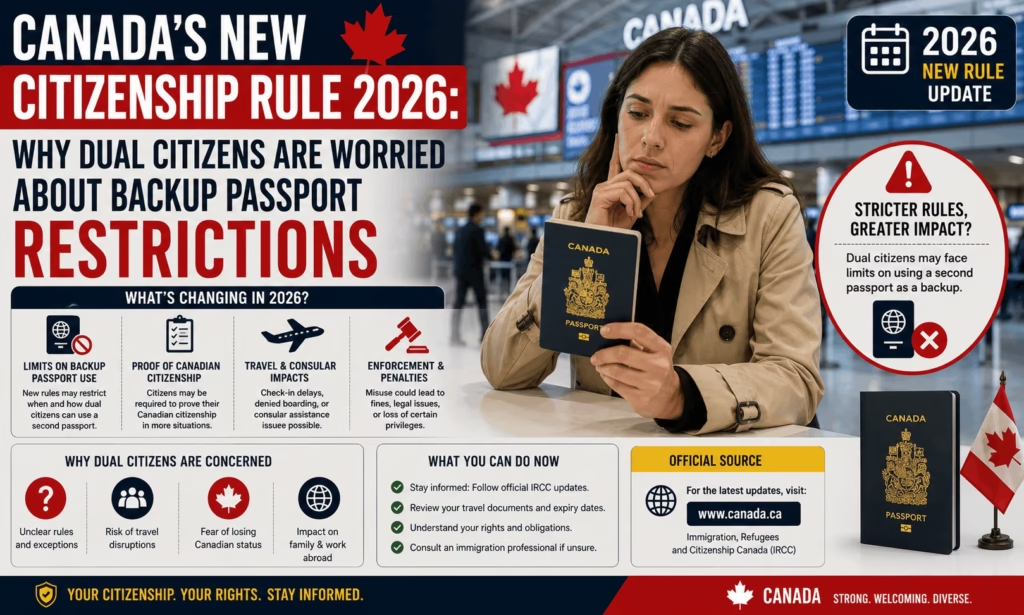
Canada’s New Citizenship Rule 2026: The concerns behind Bill C-3 citizenship by descent 2026 stopped being theoretical in June 2026. On June 13 to 15, Immigration, Refugees and Citizenship Canada’s Registrar of Canadian Citizenship, Peggy Sun, emailed a batch of recently approved Bill C-3 certificate holders, most of them born in the United States, informing them that she had information suggesting they “may not be entitled to hold a Canadian certificate of citizenship” and directing them to surrender it for review. IRCC later said the letters went to only “a few dozen” people, while immigration lawyers estimated the number affected ran into the hundreds, out of roughly 4,075 descent-based certificates issued in the law’s first three and a half months. Within days, on June 19, the department began sending reversal letters to many recipients confirming their certificates remained valid and “shall not be cancelled.” That fast reversal did not end the underlying pressure. As of IRCC’s own data published July 21, 2026, 82,020 proof of citizenship applications remain unfinalized, and average processing time has climbed from 9 months before Bill C-3 to 19 months today. We’ll be updating this article monthly as new IRCC processing data and any policy changes are confirmed.
This article walks through exactly what Bill C-3 changed when it took effect on December 15, 2025, what happened during the June 2026 certificate surrender episode and why it was reversed so quickly, the current backlog and processing time figures as of IRCC’s latest published data, the substantial connection test that already applies to future generations, and how Canada’s approach compares with countries like Ireland and Italy that have tightened similar rules. Every figure below is sourced from IRCC’s own published data, CBC News reporting, and official Senate committee transcripts.
Canada’s New Citizenship Rule 2026 Key Highlights
| Bill C-3 in force since | December 15, 2025 |
| Certificates issued under new descent rules (Dec 2025 to Mar 2026) | 4,075, with 48% (1,955) to U.S.-born applicants |
| Total proof of citizenship certificates issued (Jan 1 to May 31, 2026) | 28,940 |
| Proof of citizenship applications still pending (as of May 31, 2026) | 82,020 |
| Processing time, pre-Bill C-3 (November 2025) | Approximately 9 months |
| Processing time, current (July 2026) | Approximately 19 months |
| Separate citizenship grant backlog (PR to citizen) | 326,365 applications pending |
| Certificate surrender letters sent | Reported “a few dozen” per IRCC; several hundred per immigration lawyers |
| Surrender letters sent | June 13 to 15, 2026 |
| Reversal (revalidation) letters sent | June 19, 2026 |
| Legal basis cited for surrender | Citizenship Regulations, subsection 26(1) and 26(4) |
| Substantial connection test (post-Dec 15, 2025 births) | 1,095 cumulative days of parental physical presence in Canada |
| Citizenship certificate filing fee | CAD $75 |
What Bill C-3 Actually Changed
Before December 2025, Canada’s Citizenship Act imposed a strict first-generation limit on citizenship by descent: if you were born abroad to a Canadian parent who was also born abroad, you were generally locked out of Canadian citizenship regardless of how directly your family traced back to Canada. That limit was struck down as unconstitutional in the 2023 Bjorkquist decision, and Parliament responded with Bill C-3, which received Royal Assent on November 20, 2025 and came fully into force on December 15, 2025.
For anyone born before that date, Bill C-3 removes the generational cap entirely. If you can document an unbroken chain of descent from a Canadian citizen ancestor, there is no limit on how many generations back that connection can go, no physical presence requirement, and no requirement to have ever visited Canada. For children born on or after December 15, 2025, the law introduces a new safeguard instead: the Canadian parent must demonstrate a substantial connection to Canada, discussed further below.
Adult Child Sponsorship in Canada 2026: Immigration Pathways, Requirements and Alternatives
The June 2026 Certificate Surrender Episode
The most significant new development since this story first broke is the brief but high-profile certificate review IRCC launched in mid-June 2026. Over the weekend of June 13 to 15, Registrar Peggy Sun emailed a group of recent Bill C-3 certificate holders, mostly Americans, stating she had information indicating they might not be entitled to hold their certificates and directing them to surrender them pending further review. According to reporting reviewed by immigration outlets, the core concern was that some applicants had relied on informal genealogy records, such as screenshots or photocopies from platforms like Ancestry.ca and FamilySearch, rather than certified copies obtained directly from the original source authority, such as a provincial vital statistics office or archive.
The response was swift on both sides. NDP MP Jenny Kwan sent an open letter on June 16, 2026 demanding answers and calling for a halt to any adverse action until the reviews concluded, while Lost Canadians advocates, including longtime campaigner Don Chapman, called the move unprecedented. Just days later, on June 19, 2026, IRCC began sending a second wave of letters, again signed by Registrar Sun, informing many of the same recipients that their file review was complete, that the evidence on record was sufficient, and that their certificate “shall not be cancelled” under subsection 26(4) of the Citizenship Regulations. IRCC’s system now shows those certificates as active, and the department has characterized the entire episode as a routine administrative review rather than a revocation or a policy reversal on Bill C-3 itself.
Whether this was a one-time correction for a specific batch of under-documented files or the first sign of a broader tightening of documentary standards remains an open question that immigration lawyers are actively watching heading into the second half of 2026.
Why the Backlog Keeps Growing
Separate from the certificate review episode, the underlying processing backlog has continued to build steadily. IRCC published new finalization data on July 21, 2026 showing that between January 1 and May 31, 2026, the department issued 28,940 proof of citizenship certificates, while 82,020 applications remained unfinalized as of the end of May, meaning nearly three applications were waiting in queue for every one completed.
This is a distinct category from the much larger citizenship grant backlog, which covers permanent residents naturalizing for the first time and currently sits at 326,365 pending applications. Proof of citizenship, the category driven directly by Bill C-3, covers people who are already citizens by birth, descent, or a prior grant and need a certificate confirming that status. Processing times for this category have more than doubled, from roughly 9 months in November 2025, the month before Bill C-3 took effect, to approximately 19 months as of July 2026. Provincial archives responsible for issuing the certified vital records applicants need, including Quebec’s Bibliothèque et Archives nationales du Québec, have also reported being overwhelmed, with BAnQ certified record requests jumping from 32 in January 2025 to more than 1,000 in January 2026.
The Substantial Connection Test for Future Generations
Bill C-3 does include one built-in safeguard, though it only applies going forward. For a child born or adopted abroad on or after December 15, 2025, the Canadian parent, if that parent was also born abroad, must demonstrate a substantial connection to Canada by proving at least 1,095 cumulative days, or three years, of physical presence in the country before the child’s birth or adoption. These days do not need to be consecutive and can come from any point in the parent’s life, including time spent living, working, or studying in Canada.
The critical limitation is that this test does not apply retroactively. Anyone born before December 15, 2025 is fully exempt, meaning an adult in their 40s or 50s whose grandparent left Quebec generations ago can still claim citizenship today without ever having set foot in Canada, provided the documentary chain of descent holds up. During Senate committee review in November 2025, the government considered and rejected imposing a similar physical presence window on people born before the cutoff, with officials arguing that citizenship by descent is a matter of verifying an existing connection rather than granting a new one.
CRA My Account Breach Claims 2026: How Eligible Canadians Could Seek Up to $5,280 in Compensation
New York HEAP Program 2026: Current Status, Who Qualifies & When to Apply
Why Some Canadians Are Worried About a “Backup Passport”
The core worry driving public debate is less about eligibility and more about scale and intent. Canada’s passport currently ranks 8th globally with visa-free access to 181 destinations, and a descent-based Canadian citizen gains the unconditional right to enter, live, and work in Canada at any time, along with eventual eligibility for provincial healthcare and the ability to sponsor a spouse or common-law partner for permanent residence. Because Canada generally taxes based on residency rather than citizenship, a dual citizen who never relocates to Canada is not required to file a Canadian tax return or contribute to Canadian programs, which critics argue creates a one-directional benefit with no reciprocal obligation.
Immigration consultants quoted by CBC News have described clients pursuing this pathway explicitly as a contingency plan, seeking citizenship “in case the situation becomes worse” wherever they currently live, rather than out of any intention to relocate. Analysts have also pointed to the overlapping timing with Canada’s tightened immigration levels: the 2026 to 2028 Immigration Levels Plan targets 380,000 permanent residents annually, specifically to ease pressure on housing and healthcare, yet descent-based citizens are not counted against that target at all because they are not classified as immigrants.
How Other Countries Handle Citizenship by Descent
Canada’s current approach for anyone born before December 15, 2025, no generational limit, no residency requirement, and no language or civic test, is notably more permissive than several comparable countries.
| Country | Generational Limit | Residency Required | Language or Civic Test |
|---|---|---|---|
| Canada (pre-Dec 2025 births) | None | None | None |
| Ireland | Grandparent, via foreign births register | None for grandchild; great-grandchild must register parent first | None |
| Italy | None (jure sanguinis) | None historically, though recent reforms have tightened parts of the framework | Yes, language test required |
| United Kingdom | One generation only | None | None |
| Germany | No strict limit, but requires an unbroken documentary chain | None for Article 116 claims | None for descent; B1 German required for naturalization |
Italy is the most instructive comparison, since it moved in the opposite direction from Canada after facing a similar surge in American applicants, introducing language proficiency requirements to ensure new citizens maintain a meaningful connection to the country.
What Comes Next for Canada’s Citizenship Framework
The federal government’s 2027 to 2029 Immigration Levels consultations closed on June 14, 2026, and represent the next realistic policy window where Ottawa could address Bill C-3’s scale. IRCC’s 2026 to 2027 Departmental Plan sets a target of finalizing at least 80 percent of citizenship applications within 12 months, a target the current 19-month proof of citizenship processing time makes increasingly difficult to meet. Options under discussion among immigration policy observers include introducing language or civic knowledge requirements similar to Italy’s, applying a physical presence requirement retroactively for adult applicants, or building a formal tracking mechanism to estimate how many descent-based citizens eventually exercise their right to relocate to Canada, so that housing and service planning can account for that demand.
Official Resources and Useful Links
| Resource | Purpose | Link |
|---|---|---|
| IRCC Secure Account (Login and Application Status) | Track a submitted citizenship certificate application | canada.ca (IRCC Secure Account sign-in) |
| IRCC, Proof of Canadian Citizenship | Official eligibility rules and application guide | canada.ca/en/immigration-refugees-citizenship/services/canadian-citizenship/proof-canadian-citizenship |
| IRCC Processing Times Tool | Check current processing time estimates | canada.ca (Check IRCC processing times) |
| Citizenship Act and Regulations, Justice Laws Website | Full legal text of the Citizenship Act and Regulations | laws-lois.justice.gc.ca/eng/acts/c-29 |
| Senate Social Affairs Committee, Bill C-3 Transcripts | Official committee review and ministerial statements | canada.ca (Senate committee transparency, SOCI) |
People Also Ask
Did Canada actually cancel citizenship certificates in 2026? No. IRCC’s mid-June 2026 letters asked a limited group of certificate holders to temporarily surrender their certificates for a documentation review, and within days the department reversed most of these requests, confirming the certificates remained valid.
How long does a Canadian citizenship certificate take in 2026? As of IRCC’s July 21, 2026 data, proof of citizenship applications are taking approximately 19 months, more than double the roughly 9-month wait recorded in November 2025, before Bill C-3 took effect.
Why are people calling Bill C-3 a “backup passport” law? Because it lets people born before December 15, 2025 claim Canadian citizenship through distant ancestry with no residency, language, or physical presence requirement, some applicants and immigration consultants describe pursuing it purely as a contingency option rather than with any plan to relocate.
Is there a new test for people who want to pass on citizenship to their children? Yes, but only for children born on or after December 15, 2025. Their Canadian parent must show at least 1,095 cumulative days of physical presence in Canada before the child’s birth, a rule that does not apply to anyone born before that date.
Will Canada tighten Bill C-3 further? It is possible but not confirmed. The 2027 to 2029 Immigration Levels consultations closed June 14, 2026, and options like language testing or a retroactive residency requirement have been discussed, though no formal legislative change has been announced.
FAQs
What is Bill C-3 and when did it take effect?
Bill C-3 is the Act to Amend the Citizenship Act, which received Royal Assent on November 20, 2025 and came fully into force on December 15, 2025. It removed the first-generation limit on citizenship by descent for anyone born before that date, restoring citizenship to many so-called Lost Canadians.
What happened with the citizenship certificate surrender letters in June 2026?
Between June 13 and 15, 2026, IRCC’s Registrar of Canadian Citizenship sent letters to a group of recent Bill C-3 certificate holders asking them to surrender their certificates for review over documentation concerns. By June 19, 2026, the department had reversed most of these orders, confirming the certificates remained valid under subsection 26(4) of the Citizenship Regulations.
How big is the current citizenship certificate backlog?
As of May 31, 2026, IRCC reported 82,020 proof of citizenship applications still awaiting finalization, against 28,940 finalized since the start of the year, according to data the department published on July 21, 2026.
Does the substantial connection test apply to everyone applying under Bill C-3?
No. It only applies to children born or adopted abroad on or after December 15, 2025. People born before that date can claim citizenship through an unbroken documentary chain of descent with no physical presence requirement at all.
Do dual citizens under Bill C-3 have to pay Canadian taxes?
No, unless they establish Canadian tax residency. Canada taxes based on residency rather than citizenship, so someone who obtains citizenship through descent but continues living abroad generally has no Canadian tax filing obligation.
Can someone who gets citizenship through Bill C-3 sponsor family members?
Yes. Once a person holds a valid Canadian citizenship certificate, they gain the legal right to sponsor a spouse or common-law partner for permanent residence under Canada’s family class rules, a separate application process from the citizenship certificate itself.
Conclusion
Bill C-3 delivered a genuine and overdue correction for Lost Canadians who were unfairly cut off from citizenship by an unconstitutional generational limit, but its scale has created real strain on Canada’s processing system and real questions about how far a no-residency, no-language citizenship pathway should extend. The June 2026 certificate surrender episode showed just how quickly a documentation concern can escalate into public alarm, and how quickly it can be walked back once files are reviewed, but it did not resolve the deeper issue of a 19-month processing wait and an 82,020-application queue that keeps growing. For anyone currently in this pipeline, or considering applying, the practical takeaway is to use only certified records from official source authorities, expect a long wait, and watch the 2027 to 2029 Immigration Levels consultations for any signal of formal policy change. This article will be updated monthly as new IRCC data and policy developments are confirmed.
Also Read
Fact Check: Is There Really a $500 Cash Alert in 2026?
STIIIZY $2.9M Data Breach Settlement 2026: How to Claim Up to $7,500 Before the September Deadline