
Social Security Disability Benefits 2026: SSDI eligibility in 2026 depends on two separate tests that every applicant must pass: a work credit test proving you paid enough into Social Security, and a medical test proving your condition prevents substantial work. In 2026, workers earn one credit for every $1,890 in wages, and most adults need 40 total credits, including 20 earned in the last 10 years, to qualify for Social Security Disability Insurance (SSDI). The average monthly SSDI payment in 2026 is approximately $1,630, with a maximum of $4,152, and roughly 60 to 67% of initial applications are denied, most often due to missing medical evidence or incomplete work history documentation rather than the underlying disability itself.
This guide walks through exactly who qualifies for SSDI in 2026, the current work credit and earnings thresholds, the five-step medical evaluation SSA uses to determine disability, and the complete list of documents needed to apply, from identity records to detailed medical evidence. We’ll be updating this article monthly to reflect COLA adjustments, SGA threshold changes, and any updates to the SSDI application process. Whether you’re applying for the first time, gathering documentation, or trying to understand why a similar claim was denied, the sections below cover exactly what SSA looks for and how to prepare a complete application.
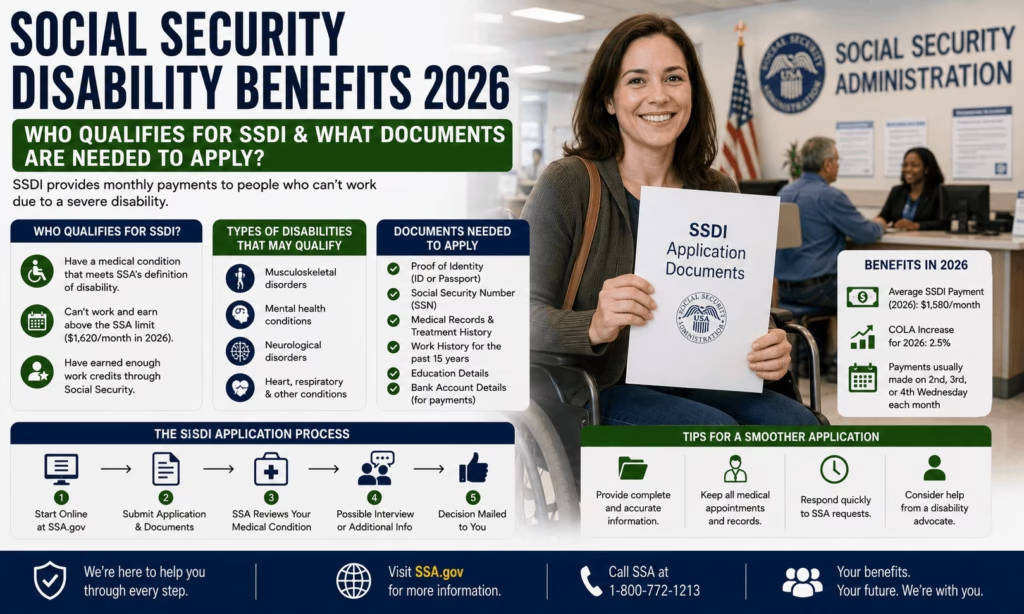
Social Security Disability Benefits 2026 Key Highlights
| Key Data Point | 2026 Figure |
|---|---|
| Work credit value | $1,890 in earnings per credit |
| Work credits typically required | 40 total, 20 earned in last 10 years |
| SGA limit (non-blind) | $1,690/month |
| SGA limit (blind) | $2,830/month |
| Trial Work Period earnings threshold | $1,210/month |
| Average monthly SSDI benefit | ~$1,630 |
| Maximum monthly SSDI benefit | $4,152 |
| 2026 COLA increase applied | 2.8% |
| Waiting period before first payment | 5 full calendar months from onset date |
| Initial application approval rate | Roughly 30–40% |
| Time to initial decision | 3 to 6 months |
| Appeal window after denial | 60 days |
| Medicare eligibility after SSDI approval | 24 months after benefit entitlement begins |
| Compassionate Allowances qualifying conditions | ~250 conditions, approved in weeks |
What Is SSDI and How It Differs from SSI
Social Security Disability Insurance (SSDI) is a federal insurance program funded through payroll taxes that pays monthly benefits to workers who have a medically determinable disability preventing them from performing substantial work, expected to last at least 12 months or result in death. Unlike Supplemental Security Income (SSI), which is a means-tested program based on income and resource limits regardless of work history, SSDI eligibility is based entirely on your work record and the Social Security taxes you paid, not your current income or assets. A person with substantial personal wealth can still qualify for SSDI as long as they meet the work credit and medical requirements, whereas SSI is reserved specifically for individuals with limited income and resources. Some applicants qualify for both programs simultaneously, known as concurrent benefits.
Who Qualifies for SSDI: The Two-Part Eligibility Test
To qualify for SSDI in 2026, an applicant must clear two separate and independent tests:
- The insured status test (work credits): You must have worked long enough, and recently enough, in jobs that paid Social Security taxes
- The medical/disability test: Your condition must meet SSA’s definition of disability, meaning it prevents you from engaging in substantial gainful activity and is expected to last at least 12 months or result in death
Failing either test independently disqualifies an applicant, regardless of how severe the medical condition is or how strong the work history looks. This is why SSA reviews work credits before conducting a full medical evaluation, since insufficient work history can end a claim before any medical evidence is even reviewed in depth.
State-by-State Social Security Payments 2026: Where Benefits Are Highest?
[Fact Check] $3,250 SSDI and Social Security Payments 2026: Is This Real or Viral Misinformation?
Work Credits Explained: How Many You Need
In 2026, a worker earns one Social Security credit for every $1,890 in covered wages or self-employment income, up to a maximum of four credits per year, meaning it now takes $7,560 in annual earnings to earn the maximum four credits for the year. Most adults need a total of 40 credits to qualify for SSDI, at least 20 of which must have been earned within the 10 years immediately before the disability began. Younger workers can qualify with fewer total credits, since SSA applies a sliding scale based on the age at which the disability started; for example, someone disabled before age 24 may need as few as 6 credits earned in the 3 years before disability onset. Applicants can check their exact credit total by creating a my Social Security account at ssa.gov, which displays a full, verified earnings and credit history.
The Five-Step Medical Evaluation Process
Once insured status is confirmed, SSA applies a standardized five-step sequential evaluation to determine medical disability:
- Are you currently working above the SGA limit? If yes, you generally cannot be found disabled, regardless of your medical condition
- Is your condition “severe”? It must significantly limit your ability to perform basic work activities
- Does your condition meet or equal a “Listed Impairment”? SSA maintains a detailed list of conditions and specific medical criteria, known informally as the “Blue Book”; if your condition matches a listing, you are automatically found disabled
- Can you perform your past relevant work? SSA reviews your work history from the last 15 years to determine if your condition prevents you from returning to any prior job
- Can you perform any other type of work? SSA considers your age, education, work experience, and residual functional capacity to determine if any other job in the national economy is realistically available to you
A claim can be approved at any of these steps once the relevant criteria are clearly met, though most denials occur at steps three through five, where medical evidence and vocational factors become more heavily weighted.
Substantial Gainful Activity (SGA) Limits in 2026
Substantial Gainful Activity (SGA) is the monthly earnings threshold SSA uses to determine whether a claimant is working at a level considered inconsistent with disability. For 2026:
- Non-blind individuals: $1,690 per month (up from $1,620 in 2025)
- Statutorily blind individuals: $2,830 per month (up from $2,700 in 2025)
- Trial Work Period (TWP) threshold: $1,210 per month, used only after SSDI approval, not during the initial application
SSA evaluates gross monthly earnings, not take-home pay, though certain deductions such as impairment-related work expenses and employer subsidies can reduce the countable amount. Self-employed applicants face a more complex evaluation, since SSA also considers hours worked, the value of duties performed, and any assistance received from others, not just net income.
Documents Needed to Apply for SSDI
A complete and well-documented application significantly reduces delays and denials. The core categories of documents needed for an SSDI application include:
Identity and Basic Information:
- Social Security number
- Birth certificate or other proof of age
- Proof of U.S. citizenship or lawful immigration status, if not a U.S.-born citizen
- Military discharge papers (Form DD-214), if applicable
Work History:
- A detailed list of jobs held over the past 15 years, including job titles, dates, and duties performed
- W-2 forms or self-employment tax returns for the most recent year worked
Medical Evidence:
- Names, addresses, and phone numbers of all doctors, hospitals, and clinics that treated the condition
- Dates of treatment for each medical provider
- Names of all prescribed medications
- Laboratory and test results, medical imaging, and treatment notes, where available
- A summary of how the condition limits daily activities and work capacity
Financial and Banking Information:
- Direct deposit bank account and routing information for payment
- Workers’ compensation or other public disability benefit information, if applicable, since these can offset SSDI payments
SSA can help track down missing medical records once an application is filed, so applicants are generally advised not to delay filing simply because some records are incomplete; providing SSA with provider names and approximate treatment dates is often sufficient to begin the process.
SNAP Maximum Monthly Benefits 2026 by State: Full Payment Chart, Eligibility & Calculator Guide
How to Apply: Online, Phone, or In-Person
Applicants have three official ways to submit an SSDI application:
- Online: Through the official ssa.gov disability application portal, available in most cases and generally the fastest method
- By phone: Calling SSA’s toll-free line to complete the application with a representative or schedule an appointment
- In person: Visiting a local Social Security office, typically by appointment
After submission, the application is forwarded to a state Disability Determination Services (DDS) office, which reviews medical evidence, may request additional records from treating providers, and can schedule a consultative examination with an independent doctor if existing medical evidence is insufficient to make a determination.
The Five-Month Waiting Period and Back Pay
Even after approval, SSDI includes a mandatory five-month waiting period measured from the date SSA determines the disability began, known as the Established Onset Date (EOD). Benefit entitlement begins in the sixth full calendar month after that date. For example, if SSA determines a disability began on January 15, 2026, the first payment would cover July 2026. There is one exception: applicants diagnosed with amyotrophic lateral sclerosis (ALS) are not subject to any waiting period. If the application process takes longer than five months, as is common, approved applicants receive retroactive back pay covering the gap between the end of the waiting period and the approval date.
Compassionate Allowances: Fast-Track Approval
SSA maintains a Compassionate Allowances (CAL) program that identifies claims involving roughly 250 severe conditions, including certain aggressive cancers, ALS, and early-onset Alzheimer’s disease, for expedited processing, sometimes resulting in approval within a matter of weeks rather than months. A related program, Quick Disability Determination (QDD), uses a predictive screening model to flag other clearly severe cases for expedited handling even if the specific condition isn’t on the CAL list. Applicants with a qualifying condition should clearly indicate this on their application and provide diagnostic confirmation as early as possible to help trigger expedited review.
What Happens If Your Application Is Denied
Denial at the initial stage is common: national data suggests 60 to 67% of first-time SSDI applications are denied, most frequently due to insufficient medical evidence rather than the absence of a genuine disability. Denied applicants have 60 days from the date of the denial notice to begin the appeals process, which includes up to four stages:
- Reconsideration: A fresh review of the file, often including new medical evidence
- Hearing before an Administrative Law Judge (ALJ): An in-person or virtual hearing where the applicant can testify and present additional evidence
- Appeals Council review: A review of whether the ALJ’s decision was legally and factually sound
- Federal court review: A final option if all administrative appeals are exhausted
A meaningful share of initially denied claims are ultimately approved during the appeals process, particularly at the ALJ hearing stage, where updated medical records and vocational testimony often carry significant weight. Total appeal timelines can range from one to three years or more, depending on regional hearing office backlogs.
How Much Will You Receive: 2026 Benefit Amounts
SSDI payments are calculated using your Average Indexed Monthly Earnings (AIME), based on your highest 35 years of earnings adjusted for wage growth, converted into a Primary Insurance Amount (PIA) using a formula with fixed “bend points.” For workers newly disabled in 2026, the formula applies 90% of the first $1,286 of AIME, plus 32% of AIME between $1,286 and $7,749, plus 15% of AIME above $7,749. Because the benefit amount is tied entirely to lifetime earnings rather than the severity of the disability, two people with the same diagnosis can receive very different monthly payments. Following the 2.8% COLA increase applied in January 2026:
- Average monthly SSDI benefit: Approximately $1,630
- Maximum monthly SSDI benefit: $4,152 (available only to very high, long-term earners)
- Approximately two-thirds of recipients receive less than the national average
Official Resources and Links
| Resource | Purpose | Official Link |
|---|---|---|
| Social Security Administration – Disability | Official SSDI eligibility rules and program overview | ssa.gov/disability |
| SSA Online Disability Application | File an SSDI application online | ssa.gov/apply/disability |
| my Social Security Account | Check work credits, earnings record, and benefit estimates | ssa.gov/myaccount |
| SSA Compassionate Allowances | Full list of qualifying fast-track conditions | ssa.gov/compassionateallowances |
| SSA Disability Starter Kit | Preparation checklist before applying | ssa.gov/disability/disability_starter_kits.htm |
| SSA Appeals Process | File a reconsideration or hearing request | ssa.gov/appeals |
Maximum Social Security Benefit 2026: How to Actually Get $5,181/Month
FAQs
How many work credits do I need for SSDI in 2026?
Most adults need 40 total credits, with 20 earned in the last 10 years before the disability began. Younger workers may qualify with fewer credits under a sliding age-based scale.
What is the maximum I can earn while applying for SSDI?
In 2026, you must earn under $1,690 per month (non-blind) or $2,830 per month (blind) to be considered not engaged in Substantial Gainful Activity during the application process.
What documents do I need to apply for SSDI?
Identity documents, your work history for the past 15 years, detailed medical provider information and records, medication lists, and direct deposit banking information.
How long does it take to get approved for SSDI?
Initial decisions typically take 3 to 6 months. If your claim requires an appeal, the total process can take 1 to 3 years or more.
What is the five-month waiting period?
SSDI benefits do not begin until the sixth full calendar month after your established disability onset date, with the sole exception of ALS diagnoses, which have no waiting period.
Can I work while applying for or receiving SSDI?
Yes, as long as your earnings stay below the SGA limit. Once approved, you can also test working through a 9-month Trial Work Period without immediately losing benefits.
What if my SSDI application gets denied?
You have 60 days to file for reconsideration, followed by a hearing before an Administrative Law Judge if needed. Many initially denied claims are approved later in the appeals process.
People Also Ask
What conditions automatically qualify for SSDI? Conditions listed under SSA’s Compassionate Allowances program, roughly 250 severe illnesses including certain cancers and ALS, can qualify for expedited approval, though most conditions still require detailed medical evidence review under the standard five-step process.
How much does SSDI pay per month in 2026? The average monthly SSDI benefit in 2026 is approximately $1,630, with a maximum of $4,152 for workers with very high lifetime earnings.
Can I get SSDI and SSI at the same time? Yes, this is called concurrent benefits, available to applicants who qualify for SSDI but whose payment amount is low enough to also meet SSI’s income and resource limits.
Do I need a lawyer to apply for SSDI? No, applying does not require legal representation, though many applicants hire disability attorneys, typically working on contingency, especially when navigating an appeal after an initial denial.
Conclusion
SSDI eligibility in 2026 rests on clearing both a work credit threshold and a strict medical disability standard, and understanding exactly what documentation SSA requires upfront can meaningfully reduce delays and denials. With work credits now valued at $1,890 each, SGA limits raised to $1,690 and $2,830, and the average benefit reaching approximately $1,630 per month following the 2.8% COLA, applicants should gather complete medical and work history records before filing rather than waiting for a “complete” file, since SSA can help fill in gaps during the review process. Given that a majority of initial applications are denied, often due to documentation issues rather than the underlying condition, understanding the five-step evaluation process and the appeals timeline in advance can make a meaningful difference in the outcome. This guide will continue to be updated monthly as SSA adjusts benefit and eligibility figures.
Also Read
How to Increase Your Social Security Benefits in 2026?
Social Security Changes 2026: New Rules, COLA Increase & What Changed This Year