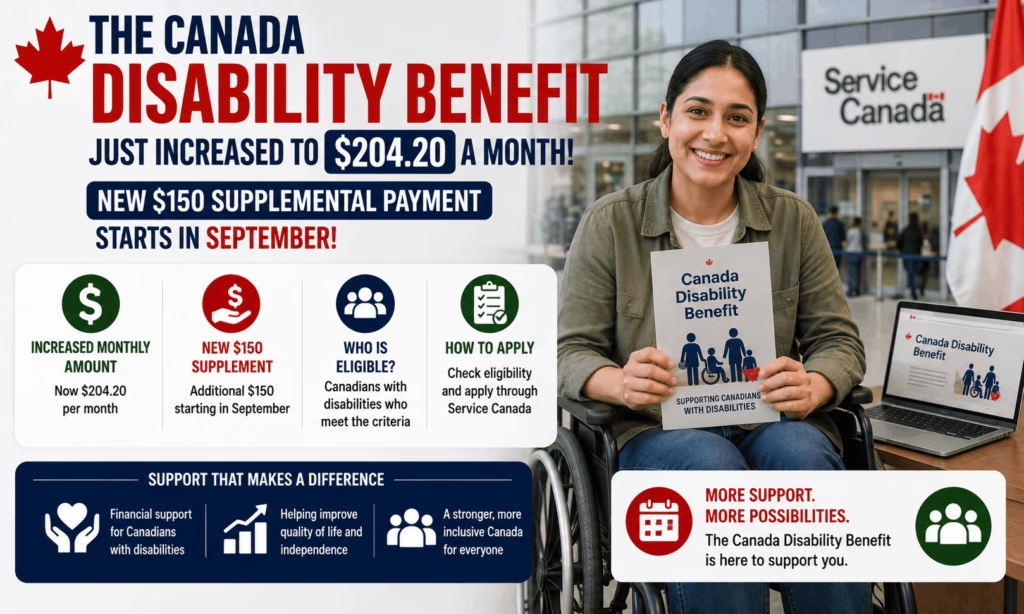
Canadians receiving the Canada Disability Benefit (CDB) got a quiet but meaningful raise this month, and there’s a second, bigger change already locked in for the fall. As of the new July 2026 to June 2027 benefit year, the maximum monthly CDB payment rose from $200 to $204.20, adjusted for inflation as required by law. That’s the update most people already expected. What’s newer, and hasn’t gotten nearly as much attention yet, is that the federal government finalized regulations on July 1, 2026, creating an entirely new $150 supplemental payment that will go out as a one-time lump sum starting September 1, 2026.
For a program that only launched its first payments in July 2025, this is the first real structural change to how much money actually lands in recipients’ accounts. If you’re one of the roughly hundreds of thousands of Canadians with an approved Disability Tax Credit already receiving the CDB, or you’re still trying to figure out if you qualify, here’s what’s actually changing, what stayed the same, and exactly when your next payment is coming.
Canada Disability Benefit Key Numbers and Dates
| Detail | Latest Figure |
|---|---|
| Maximum monthly amount (July 2025 to June 2026) | $200 |
| Maximum monthly amount (July 2026 to June 2027) | $204.20 |
| Maximum annual amount, new benefit year | $2,450.40 |
| New supplemental payment | $150 lump sum, per approved DTC certificate |
| Supplemental payment effective date | September 1, 2026 |
| August 2026 payment date | August 20, 2026 |
| Payment schedule | Third Thursday of every month |
| Program start date | June 2025 (first payments issued July 2025) |
| Age requirement | 18 to 64 |
| Income threshold (single) | $23,000 (working income exemption up to $10,000) |
| Income threshold (couple) | $32,500 (working income exemption up to $14,000) |
| Retroactive payments available | Up to 24 months, never before June 2025 |
The Latest Update: A New $150 Payment Nobody Had to Apply For
This is the part of the story worth leading with. On July 1, 2026, amendments to the Canada Disability Benefit Regulations were published in the Canada Gazette, and buried inside the technical language was a real, concrete change: starting September 1, 2026, the government will begin paying a supplemental Canada Disability Benefit payment of $150 to program recipients, delivered as a single lump sum rather than added to the monthly amount.
Here’s the detail that matters most for households with more than one eligible member: the $150 is paid per approved Disability Tax Credit certificate, not per household. That means a person with more than one qualifying DTC certificate could receive the supplemental amount more than once, and it’s structured so that even recipients whose regular monthly CDB payment is small enough to be paid as a lump sum, generally those receiving $20 or less a month, still qualify for the full $150 supplement. There’s no separate application required for this payment if you’re already an approved CDB recipient.
Missouri SNAP Food Ban Delayed: What’s Banned & Latest Status
Hawaii SNAP Soda Ban Delayed to 2027: What Will Be Banned & Status
Florida SNAP Junk Food Ban 2026: What’s Banned, Court Update, EBT Rules & Latest Status
Nevada SNAP Food Ban: What’s Banned & Start Date Explained
Why the Monthly Amount Went Up to $204.20
Separately from the new supplement, the CDB’s base monthly amount is legally required to be reviewed and adjusted for inflation once a year. For the new benefit year running from July 2026 through June 2027, that adjustment pushed the maximum monthly payment from $200 up to $204.20, based on your 2025 income tax return. Over a full year, that works out to a maximum of $2,450.40, compared to $2,400 under the previous benefit year’s rate.
It’s worth being clear that $204.20 is a ceiling, not a guarantee. Your actual monthly amount depends on your adjusted family net income, and the benefit is gradually reduced once income passes a set threshold, similar to how other income-tested federal benefits work.
Your August 2026 Canada Disability Benefit Payment Date
If you’re already receiving the CDB, your August payment lands on August 20, 2026, following the program’s standard schedule of paying out on the third Thursday of every month. The full 2026 payment calendar runs: January 15, February 19, March 19, April 16, May 21, June 18, July 16, August 20, September 17, October 15, November 19, and December 17. Recipients who receive payment by direct deposit typically see funds that same day, while those receiving a mailed cheque should allow additional time for postal delivery.
Who Actually Qualifies for the Canada Disability Benefit
The CDB is built around five main eligibility conditions, and missing any one of them means an application won’t be approved, regardless of income level or disability severity.
You generally need to be between 18 and 64 years old. Someone still 17 can submit an application once they turn 17½, though it won’t actually be processed until they reach 18, and once a recipient turns 65, ongoing CDB payments stop, though retroactive payments covering the period before their 65th birthday may still apply.
You must be a resident of Canada for tax purposes, and hold status as a Canadian citizen, permanent resident, protected person, or certain other recognized residency categories.
You must have a valid, approved Disability Tax Credit (DTC) certificate. This is the single non-negotiable gateway requirement, without an approved DTC, no level of income or disability documentation on its own will qualify someone for the CDB. Applicants who don’t already have a DTC certificate need to apply separately using Form T2201 before they can be considered for the CDB.
You need to have filed an income tax return, since your adjusted family net income, based on your most recent Notice of Assessment, is what determines your actual payment amount.
And your household income needs to fall within the program’s income test thresholds: broadly $23,000 for a single applicant and $32,500 for a couple, with working income exemptions of up to $10,000 for individuals and $14,000 for couples before the benefit starts to be reduced.
How the Income Test Actually Reduces Your Payment
This is the part that trips up a lot of applicants, especially those with other disability-related income. Once your adjusted family net income passes the relevant threshold, your CDB payment is reduced, generally by 20% of the excess amount for single applicants and 10% each for couples where both partners are eligible. Employment income up to the working income exemption doesn’t count against you, but other income sources, including employer-paid long-term disability insurance and CPP disability payments, are counted in full toward your adjusted family net income with no equivalent exemption.
For example, someone drawing both employer-paid long-term disability benefits and CPP disability payments could find themselves well over the relevant threshold before any other income is even factored in, which can significantly shrink their monthly CDB amount even if they have no other earnings at all.
How to Apply for the Canada Disability Benefit
Applications have been open since June 20, 2025, and there’s no deadline pressure to apply immediately, since approved applicants can receive retroactive payments going back up to 24 months, though never further back than June 2025, the program’s actual start date. The fastest route is applying online through a My Service Canada Account (MSCA), where having your net income figure from line 23600 of your 2024 Notice of Assessment on hand can help speed up processing. Applicants can also apply by phone or in person at a Service Canada location.
Once submitted, Service Canada generally aims to issue an eligibility decision within 28 calendar days, or 49 calendar days if a legal representative is applying on someone’s behalf. If approved, your first payment arrives the month after approval, including any retroactive amounts owed.
Is the Canada Disability Benefit Taxable, or Does It Affect Other Benefits?
The CDB was designed from the outset to be non-taxable, and the Canada Disability Benefit Regulations specifically exclude CDB payments from the income calculation used to determine future CDB amounts, meaning this year’s payment doesn’t reduce next year’s benefit. It also generally doesn’t count as income for purposes of the GST/HST credit or other federal income-tested benefits. Provinces have separately committed not to claw back their own provincial disability supports dollar-for-dollar in response to CDB payments, though the exact treatment can vary by province, so checking with your specific provincial disability program is still worthwhile.
Canada Grocery Rebate 2026 Full Schedule: Confirmed Payment Dates, Amounts & Status Check!
How to Check Your Application or Payment Status
If you’ve already applied and want to check where things stand, the most direct route is contacting Service Canada directly, since there isn’t yet a fully self-serve online status tracker specific to CDB applications the way there is for some other federal benefits. For payment or banking updates, changes can be made through your My Service Canada Account, though it’s worth noting that updating your banking details with Service Canada does not automatically update them with the Canada Revenue Agency, so both may need to be updated separately if you’re changing accounts.
Official Canada Disability Benefit Resources
| Purpose | Official Link |
|---|---|
| About the Canada Disability Benefit Program | canada.ca/en/employment-social-development/programs/disability-benefit.html |
| Apply for the CDB (via My Service Canada Account) | canada.ca/en/services/benefits/disability/canada-disability-benefit.html |
| What Happens After You Apply | canada.ca/en/services/benefits/disability/canada-disability-benefit/after-apply.html |
| Apply for the Disability Tax Credit (Form T2201) | canada.ca/en/revenue-agency/services/tax/individuals/segments/tax-credits-deductions-persons-disabilities/disability-tax-credit.html |
| Official CDB Program Overview | canadadisabilitybenefit.ca |
| Service Canada General Enquiries | 1-800-O-Canada (1-800-622-6232) |
FAQs
How much is the Canada Disability Benefit in 2026?
The maximum is now $204.20 a month, or $2,450.40 a year, for the July 2026 to June 2027 benefit year. A separate one-time $150 supplemental payment also begins in September 2026 for approved recipients.
Do I need to apply separately for the new $150 payment?
No. If you’re already an approved CDB recipient with a valid Disability Tax Credit certificate, the $150 supplemental payment is expected to be issued automatically starting September 1, 2026, with no additional application required.
What is the Canada Disability Benefit payment date for August 2026?
August 20, 2026, following the program’s standard schedule of the third Thursday of each month.
Do I need a Disability Tax Credit to get the Canada Disability Benefit?
Yes. An approved DTC certificate is mandatory. Without one, you cannot receive the CDB regardless of your income level or the severity of your disability.
Is the Canada Disability Benefit taxable?
No. It’s designed as a non-taxable benefit and generally doesn’t count as income for other federal income-tested benefits like the GST/HST credit.
Can I still get retroactive payments if I apply late?
Yes. Approved applicants can receive retroactive payments for up to 24 months from the date Service Canada received their application, though payments can’t go back further than June 2025, when the program officially began.
Conclusion
The Canada Disability Benefit has quietly gotten more generous this year in two separate ways: the annual inflation adjustment lifted the maximum monthly payment to $204.20 starting in July, and a newly finalized $150 lump-sum supplemental payment is set to arrive for eligible recipients starting September 1, 2026, with no extra paperwork required.
For anyone not yet receiving the benefit, the core eligibility requirements haven’t changed, you’ll still need an approved Disability Tax Credit, to be between 18 and 64, a Canadian resident for tax purposes, and to fall within the program’s income thresholds, but the door remains open, with up to 24 months of retroactive payments available for those who apply now. This article will continue to be reviewed and updated monthly as new payment amounts, dates, and program changes are confirmed.
No SSI Payment in August 2026: SSI August 2026 “no payment” confusion Fact-Checked
State-by-State SNAP Food Ban 2026: What’s Banned, Status Update
Arkansas SNAP Junk Food Ban 2026: What’s Banned, Court Update, EBT Rules & Latest Status
Canada Immigration Absorption Index 2026: What the Numbers Show