Canada Bail and Sentencing Laws 2026: Canada’s justice system underwent its most significant overhaul in years when the Bail and Sentencing Reform Act (Bill C-14) received Royal Assent on June 15, 2026, delivering on the federal government’s promise to make bail laws stricter and sentencing tougher for repeat and violent offenders. With more than 80 targeted changes to the Criminal Code, the Youth Criminal Justice Act, and the National Defence Act, this reform touches nearly every part of how Canadian courts assess pre-trial release and punishment. The core bail and sentencing provisions came into force on July 15, 2026, exactly 30 days after Royal Assent, meaning these rules are now fully active across the country. Justice Minister Sean Fraser called the legislation “a major step forward,” noting it was shaped through extensive consultations with provinces, territories, mayors, police chiefs, and victim advocates. We’ll be updating this article monthly as courts begin applying these new provisions and as remaining Youth Criminal Justice Act amendments come into force by order in council.
At the heart of the Canada bail and sentencing laws 2026 overhaul is an expanded set of reverse onus provisions, which shift the burden of proof at a bail hearing so that the accused rather than the Crown must demonstrate why they should be released rather than detained. The reforms also give police clearer authority to detain an accused pending a bail hearing when necessary to protect victims, witnesses, and the public, require courts to weigh a wider range of factors including outstanding charges and weapons involvement, and tighten who can act as a surety. These changes were driven largely by public concern over rising extortion, auto theft, and organized crime, and were notably backed by an unusually broad national consensus across political and law-enforcement lines. Below, we break down exactly what changed, who it affects, the full timeline, official Department of Justice resources, and the questions Canadians are asking most about this reform.
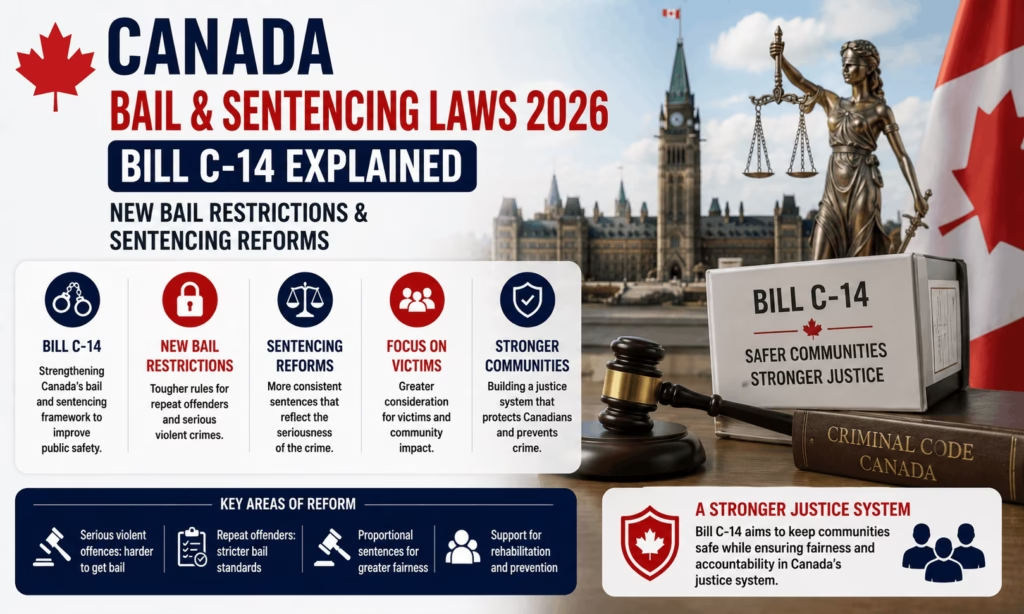
Canada Bail and Sentencing Laws 2026: Quick Overview Table
| Key Detail | Information |
|---|---|
| Legislation Name | Bail and Sentencing Reform Act (Bill C-14) |
| Statute Citation | S.C. 2026, c. 11 |
| Royal Assent Date | June 15, 2026 |
| In-Force Date (Bail & Sentencing Provisions) | July 15, 2026 |
| Youth Criminal Justice Act Amendments | Later, by order in council |
| Total Criminal Code Changes | Over 80 targeted changes |
| Laws Amended | Criminal Code, Youth Criminal Justice Act, National Defence Act |
| Sponsoring Minister | Sean Fraser, Minister of Justice and Attorney General of Canada |
| Key Focus Areas | Extortion, auto theft, organized crime, copper theft/infrastructure crime, violent repeat offending |
| Federal Funding for Bail Data | $250,000 per jurisdiction for national bail data collection and reporting |
| Political Support | Backed by premiers of every province and territory, mayors, and police chiefs |
What Is the Reverse Onus Rule Under Bill C-14?
The single most talked-about change in this reform is the expansion of reverse onus provisions. Under Canada’s standard bail framework, the Crown carries the burden of proving why an accused person should be detained rather than released. Under a reverse onus, that burden flips: the accused must instead demonstrate why they should be released on bail, or they will be detained by default. This is not a finding of guilt — it simply changes who has to prove what at a bail hearing.
Bill C-14 significantly expands the categories of charges where reverse onus applies. Notably, the new law puts a reverse bail onus on anyone charged with a violent offence involving a weapon who has a prior conviction for a similar offence within the last 10 years. This targets repeat violent offenders specifically, rather than applying broadly to all accused persons, and reflects the government’s stated goal of making it “harder to get” bail for those accused of repeat and violent offending.
New Factors Courts Must Consider at Bail Hearings
Beyond reverse onus, the reform requires judges to weigh a broader set of factors when deciding whether to grant bail, including:
- Whether the alleged violence was random or unprovoked
- Whether the accused has numerous or serious outstanding charges
- Whether weapons bans should apply, including in extortion and organized crime cases
- Whether specific release conditions are appropriate for extortion, organized crime, auto theft, and break-and-enter offences
For these targeted offence categories, courts can now impose conditions such as geographic limitations, curfews, non-communication orders with victims or witnesses, and bans on possessing break-in devices. The legislation also clarifies the long-standing “principle of restraint,” which previously encouraged courts to favour release at the earliest opportunity with the least restrictive conditions. Bill C-14 confirms this principle does not mandate release, and that detention is justified whenever it is necessary to protect the public, including victims and witnesses.
Missouri SNAP Food Ban Delayed: What’s Banned & Latest Status
Hawaii SNAP Soda Ban Delayed to 2027: What Will Be Banned & Status
Florida SNAP Junk Food Ban 2026: What’s Banned, Court Update, EBT Rules & Latest Status
Nevada SNAP Food Ban: What’s Banned & Start Date Explained
Police Authority to Detain Before a Bail Hearing
One of the most operationally significant changes directs police to detain an accused for a bail hearing when doing so is necessary to protect the public, victims, or witnesses. This gives frontline officers clearer legal authority to hold someone in custody until a judge or justice of the peace can properly assess the bail decision, rather than releasing an accused person on the spot in situations where officers have genuine public safety concerns.
Sentencing Reforms for Repeat and Violent Offenders
While bail changes have attracted the most attention, Bill C-14 also toughens sentencing for repeat and violent offenders as part of the same package. The reforms aim to ensure that individuals with a demonstrated pattern of serious or violent offending face more severe consequences upon conviction, aligning sentencing outcomes with the same public-safety priorities driving the bail changes. This dual approach — stricter bail combined with tougher sentencing — reflects the government’s stated intent to address the full lifecycle of a criminal case, from arrest through to sentencing, rather than focusing on pre-trial detention alone.
New Restrictions on Who Can Act as a Surety
A surety is a person who agrees to supervise an accused person released on bail and can be held financially responsible if that person breaches their conditions. Under the new rules, a person who has been convicted of an indictable offence within the previous 10 years is barred from being named a surety, unless no other suitable surety is available and the court determines it is in the interest of justice to allow it. Importantly, having a criminal record does not automatically disqualify someone — the restriction applies specifically to those with an indictable offence conviction within the defined 10-year window, and courts retain discretion in genuinely limited circumstances.
Why the Government Introduced These Reforms
The Bail and Sentencing Reform Act was introduced in response to what the government described as “grave concern” from communities across Canada about rising extortion, car theft, and organized crime. Separate Department of Justice announcements highlighted how the reforms specifically target escalating copper theft and crimes against essential infrastructure, alongside auto theft and extortion schemes affecting communities nationwide. According to Minister Sean Fraser, “Canada’s new government promised stricter bail laws and tougher sentencing laws. That promise is now law.” The bill’s swift passage reflected what officials called an unusually unified national consensus, with premiers from every province and territory, along with mayors and police leadership, publicly backing the legislation ahead of its passage.
Bail and Sentencing Reform Timeline: Key Dates at a Glance
| Date | Milestone |
|---|---|
| Fall 2025 | Federal government begins introducing related public safety legislation |
| Early 2026 | Bill C-14, the Bail and Sentencing Reform Act, is introduced in Parliament |
| June 15, 2026 | Bill C-14 receives Royal Assent |
| June 16–24, 2026 | Department of Justice issues a series of announcements detailing how the reforms target extortion, auto theft, organized crime, and copper theft |
| July 15, 2026 | Bail and sentencing provisions come into force nationwide |
| To be determined | Certain Youth Criminal Justice Act amendments take effect later, by order in council |
How This Affects Permanent Residents, Immigrants, and International Students
Because a reverse onus provision changes who must prove what at a bail hearing, immigration lawyers have flagged that permanent residents, international students, and work permit holders facing criminal charges should pay particularly close attention to these changes. A criminal charge — and especially a conviction — can carry immigration consequences separate from the criminal case itself, and the expanded reverse onus categories mean some accused individuals in this group may face a more difficult path to release than under the previous framework. Anyone in this situation is strongly encouraged to seek both criminal defence and immigration legal advice as early as possible, since the two processes can affect each other in ways that are easy to overlook.
National Bail Data Collection: A New $250,000-Per-Jurisdiction Investment
Alongside the legal changes, the federal government is investing $250,000 per jurisdiction to standardize national bail data collection, reporting, and analysis. This is intended to give policymakers, courts, and law enforcement a clearer, more consistent national picture of how bail decisions are being made and their outcomes, addressing long-standing criticism that Canada lacked reliable, comparable bail data across provinces and territories. Over time, this data investment could shape further refinements to bail policy as officials assess whether the July 2026 changes are achieving their intended public safety goals.
Canada Grocery Rebate 2026 Full Schedule: Confirmed Payment Dates, Amounts & Status Check!
What Defence Counsel and Accused Persons Need to Know Now
With the reformed bail system now in force, defence lawyers are adapting their approach to bail plans, since courts are required to scrutinize release proposals more closely under the new law. Practical strategies now emphasized include:
- Building detailed, watertight release plans with robust supervision arrangements
- Proposing specific, credible sureties well ahead of a bail hearing, particularly given new surety eligibility restrictions
- Addressing weapons bans and substance restrictions proactively within proposed release conditions
- Preparing to directly rebut a reverse onus where it applies, since the accused must now affirmatively demonstrate why release is appropriate
Anyone facing a bail hearing under the new framework — especially where a reverse onus provision may apply — should seek qualified legal representation as early in the process as possible, since preparation time before a first appearance can significantly affect the outcome.
Reactions and Ongoing Debate
While the reforms passed with an unusually broad coalition of support from premiers, mayors, and police leadership, discussion continues around how courts will apply the expanded reverse onus and detention provisions in practice. Advocates for the changes point to rising public concern over repeat violent offending and organized crime as justification for a firmer approach. Critics and some legal commentators, meanwhile, continue to watch closely for how the reforms affect overall bail rates, provincial correctional capacity, and outcomes for accused persons who may be detained longer while awaiting trial. As courts begin applying these provisions in the months following the July 15, 2026 in-force date, more data — including the newly funded national bail statistics — should help clarify these effects.
Official Canada Bail and Sentencing Reform Resources
| Purpose | Resource |
|---|---|
| Department of Justice Canada — Bail and Sentencing Reform Announcement | canada.ca/en/department-justice/news |
| Full Text of Bill C-14 | parl.ca (LEGISinfo — Bill C-14, 45th Parliament) |
| Criminal Code of Canada (Consolidated Text) | laws-lois.justice.gc.ca/eng/acts/C-46 |
| Youth Criminal Justice Act (Consolidated Text) | laws-lois.justice.gc.ca/eng/acts/Y-1.5 |
| Department of Justice Media Contact | media@justice.gc.ca |
| Find a Legal Aid Office by Province/Territory | justice.gc.ca/eng/fund-fina/gov-gouv/aid-aide.html |
Always confirm the latest details directly through the official Department of Justice Canada and Parliament of Canada resources listed above, since courts, provinces, and territories are still adapting procedures in response to this reform, and further Youth Criminal Justice Act changes are still pending by order in council.
FAQs
When did Canada’s new bail and sentencing laws take effect?
The core bail and sentencing provisions of Bill C-14 came into force on July 15, 2026, exactly 30 days after the legislation received Royal Assent on June 15, 2026.
What is a reverse onus in Canada’s new bail law?
A reverse onus shifts the burden of proof at a bail hearing so that the accused, rather than the Crown, must demonstrate why they should be released rather than detained. Bill C-14 expands the offences to which this applies, notably violent offences involving a weapon where the accused has a similar prior conviction within the last 10 years.
Can someone with a criminal record still act as a surety?
Generally, no — if that person was convicted of an indictable offence within the previous 10 years — unless no other suitable surety is available and the court finds it is in the interest of justice to allow it. A criminal record alone does not automatically disqualify someone outside that specific window.
Does the new bail law apply to youth offenders?
Some Youth Criminal Justice Act amendments are part of Bill C-14, but these specific provisions take effect later, by order in council, rather than on the July 15, 2026 date that applies to adult bail and sentencing provisions.
Why did the government introduce the Bail and Sentencing Reform Act?
The reforms were introduced in response to public concern over rising extortion, auto theft, organized crime, and copper theft affecting communities across Canada, and were supported by premiers, mayors, and police leadership nationwide.
Does this law make sentencing harsher for all offenders?
The sentencing reforms specifically target repeat and violent offenders, aligning tougher sentencing outcomes with the same public safety goals behind the expanded bail restrictions, rather than broadly increasing sentences for all offence types.
How does this law affect permanent residents or immigrants facing criminal charges?
Because reverse onus provisions can make bail harder to obtain in certain cases, immigration status holders facing applicable charges should seek both criminal defence and immigration legal advice promptly, since a conviction can carry separate immigration consequences.
What is the $250,000 bail data funding for?
The federal government is providing $250,000 per jurisdiction to standardize national bail data collection, reporting, and analysis, aimed at giving a clearer national picture of bail decisions and outcomes over time.
Conclusion
The Canada bail and sentencing laws 2026 reform, delivered through Bill C-14’s over 80 targeted Criminal Code changes, represents one of the most consequential shifts in Canadian criminal justice policy in recent memory. With expanded reverse onus rules, new police detention authority, tighter surety eligibility, and tougher sentencing for repeat and violent offenders now fully in force as of July 15, 2026, courts, defence counsel, and accused persons across the country are adjusting to a stricter bail landscape shaped by broad political and law-enforcement consensus. Some elements, including certain Youth Criminal Justice Act changes, are still pending, and the new national bail data initiative may inform further adjustments down the line. Anyone directly affected by these changes — particularly where a reverse onus provision may apply — should seek qualified legal advice promptly rather than relying on general information alone. We’ll be updating this article monthly to reflect further implementation details, court interpretations, and any additional order-in-council changes under this reform.
No SSI Payment in August 2026: SSI August 2026 “no payment” confusion Fact-Checked
State-by-State SNAP Food Ban 2026: What’s Banned, Status Update
Arkansas SNAP Junk Food Ban 2026: What’s Banned, Court Update, EBT Rules & Latest Status
Canada Immigration Absorption Index 2026: What the Numbers Show