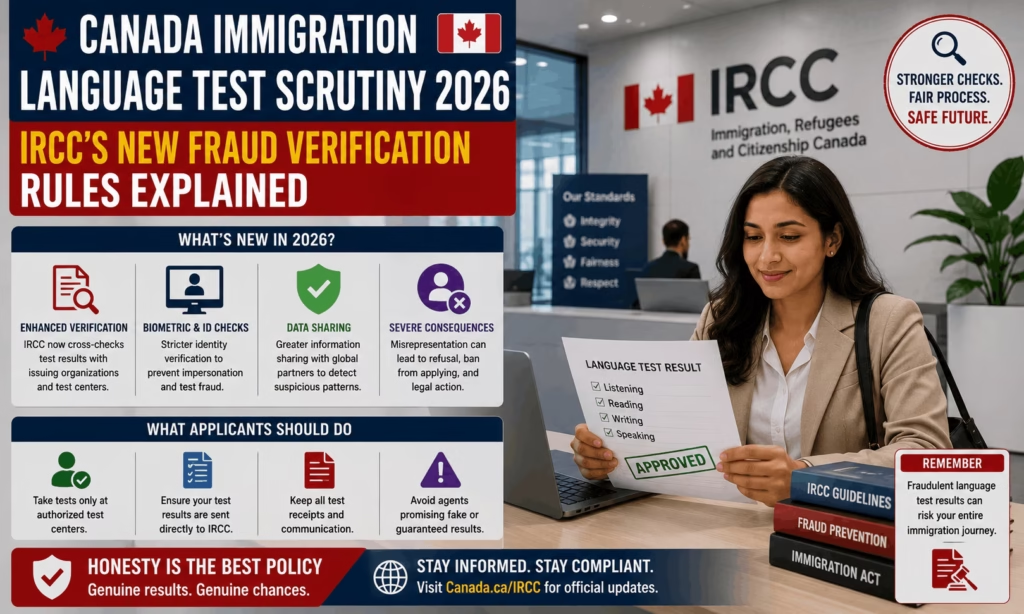
Canada Immigration Language Test Scrutiny 2026 reached a new level on June 23, 2026, when Immigration, Refugees and Citizenship Canada (IRCC) published updated operational instructions requiring officers to actively cross-reference applicant photographs against language test records and dig deeper into fraud-alert systems before approving an application. This isn’t a proposal working through consultation, it took effect immediately, and it applies across all five IRCC-approved language tests: IELTS General Training, CELPIP-General, PTE Core for English, and TEF Canada, TCF Canada for French. For the thousands of Express Entry candidates, skilled workers, and international students relying on these test results every year, understanding exactly what changed, and what didn’t, matters, since language scores directly affect Comprehensive Ranking System (CRS) points, program eligibility, and now, fraud-review risk. We’ll be updating this article monthly as IRCC issues further guidance or as this verification process affects real applications.
This guide breaks down precisely what the new instructions require officers to do, why IRCC introduced them now, what counts as a red flag under the new system, what happens if fraud is suspected or confirmed, and what genuine applicants should do to protect themselves from delays or refusals tied to this heightened scrutiny. Every detail here is sourced directly from IRCC’s own updated instructions and CIC News’s original reporting, not secondhand summaries.
Canada Immigration Language Test Scrutiny 2026 Key Highlights
| Item | Details |
|---|---|
| Updated instructions published | June 23, 2026 |
| Effective date | Immediately |
| Source | IRCC operational instructions to processing officers |
| Applies to | All 5 approved language tests: IELTS General Training, CELPIP-General, PTE Core, TEF Canada, TCF Canada |
| Core new requirement | Officers must cross-reference applicant photographs with language test records where available |
| Additional requirement | Search case notes and Info-Alerts under the applicant’s Unique Client Identifier (UCI) |
| Fraud referral unit | Tips and Reports Management Unit (TMRU) |
| When verification occurs | At every stage of processing, not just before a final decision |
| Consequence of confirmed fraud | Application may be refused for misrepresentation |
| Does this change test scores or pass/fail rules? | No — officers cannot assess proficiency or adjust scores through an interview alone |
| Test validity period | 2 years from test date for all immigration purposes |
| Related upcoming change | Language testing may extend to more International Mobility Program work permit categories by 2027 |
What Exactly Changed on June 23, 2026?
IRCC’s updated instructions to processing officers introduced several specific, concrete verification steps that didn’t previously exist in this combined form:
- Photograph cross-referencing: where a photograph of the test-taker is available in the language testing organization’s verification portal, officers must now compare that image directly against the photograph submitted with the applicant’s immigration application
- Documented discrepancies: any mismatch between these photographs must be recorded in the Global Case Management System (GCMS), IRCC’s internal case-tracking database
- UCI-based case review: officers must review all information associated with an applicant’s Unique Client Identifier (UCI) and check existing GCMS case notes for prior concerns
- Info-Alert searches: officers must run integrated searches in GCMS specifically to check whether a testing organization has issued an Info-Alert, a flag indicating that a specific applicant’s results may not be genuine or may have been fraudulently obtained
- Continuous verification: this checking process must happen at every stage of processing, not simply as a final check before a decision is issued
Free TSA PreCheck 2026: Who Actually Qualifies for No-Cost or Reimbursed Enrollment
NZ Pension 2026 New Rates, Eligibility, Payment Schedule & Fact Check!
Why Is IRCC Doing This Now?
Language test scores are not a minor formality in Canadian immigration, they directly determine Express Entry CRS points, program eligibility thresholds, and in many cases, whether an Invitation to Apply ultimately results in approval or refusal. As competition for permanent residence spots has intensified, authorities have grown increasingly concerned that fraudulent or manipulated language test results could give some applicants an unfair advantage over genuine candidates, undermining the integrity of the entire selection system. Multiple outlets covering the June 2026 update, including CIC News and Business Standard, note that IRCC has been “tightening scrutiny across different parts of its immigration system” more broadly, with this language test measure representing one specific, targeted piece of that wider integrity push.
What Happens If an Officer Suspects Fraud?
Once an officer identifies a potential concern, whether through a photograph mismatch, an Info-Alert, or another red flag, they must document the issue and forward it to IRCC’s Tips and Reports Management Unit (TMRU), a dedicated fraud investigation team, for further review. If that review ultimately confirms fraud, the consequence is serious: the application may be refused on grounds of misrepresentation, a finding that, under Canadian immigration law, can carry consequences well beyond a single application, including a multi-year bar on future applications.
Can an Immigration Officer Just Decide My Language Score Is Wrong Based on an Interview?
No. This is an important clarification that’s easy to misunderstand. An officer cannot assess your language proficiency through an interview alone, and cannot use an interview to adjust your test score or make an independent pass/fail determination about your language ability. However, there’s a specific exception worth understanding: if an interview held for an entirely different reason happens to reveal a major, obvious gap between your claimed test-based proficiency and your actual demonstrated ability, that discrepancy can trigger a fraud review under IRCC’s integrity rules, it just can’t be used on its own to override your official test score.
Does This Change Which Language Tests Are Accepted?
No, the June 2026 update is about verification procedure, not test eligibility. IRCC continues to accept the same five designated tests in 2026:
| Language | Accepted Tests |
|---|---|
| English | CELPIP-General, IELTS General Training, PTE Core |
| French | TEF Canada, TCF Canada |
TOEFL Essentials was announced in August 2025 as a future designated test, but IRCC’s own June 2026 instructions confirm it is still not currently accepted. It’s also worth noting that PTE Core and PTE Academic are different tests, only PTE Core is accepted for immigration purposes, while PTE Academic is used for study permits and university admissions and is rejected for Express Entry, Provincial Nominee Programs, and citizenship applications.
What Are the Current CLB Score Requirements?
Language test results are converted to the Canadian Language Benchmark (CLB) scale regardless of which approved test you take. Current minimum requirements include:
- Express Entry (Canadian Experience Class TEER 0/1, Federal Skilled Worker): CLB 7 across all four skill areas (reading, writing, listening, speaking)
- Express Entry (Canadian Experience Class TEER 2/3): CLB 5 across all four skill areas
- Federal Skilled Trades: CLB 5 in speaking/listening, CLB 4 in reading/writing
- Post-Graduation Work Permit (PGWP), since November 1, 2024: applicants must submit test results meeting CLB 5 or CLB 7, depending on their level of study
Is Language Testing Expanding to More Programs?
Yes, potentially. On April 7, 2026, IRCC opened a forward regulatory plan seeking the authority to require language test results from designated third-party organizations for additional International Mobility Program (IMP) open work permit categories, beyond where testing is currently required. This proposed expansion is expected to be published in the Canada Gazette, Part I, sometime in spring or summer 2026, with actual implementation anticipated by 2027. This is a separate, forward-looking regulatory process from the June 23 verification update, but it signals that language test scrutiny in Canada’s immigration system is likely to expand further, not just tighten procedurally.
Social Security Changes 2026: New Rules, COLA Increase & What Changed This Year
Stimulus Check 2026: Fact-Checking Every Viral Payment Claim (Tracker)
How Long Are Language Test Results Valid?
Regardless of which approved test you take, results are generally valid for two years from the test date for immigration purposes. Your results must typically still be valid both when you create your Express Entry profile and when you submit your permanent residence application. If your results expire in between, you may need to retake the test, since submitting an application with expired language results can lead to refusal.
What Should Genuine Applicants Do to Avoid Getting Caught Up in This Scrutiny?
- Only use IRCC-approved testing organizations, and confirm your specific test type matches immigration requirements, not just university admission requirements (a common point of confusion, especially between PTE Core vs. PTE Academic, or IELTS General Training vs. IELTS Academic)
- Ensure your application photo and any test-provider photo submissions are consistent and current, since photograph cross-referencing is now a standard verification step
- Double-check your test result validity dates before submitting your Express Entry profile or permanent residence application
- Keep your original test score reports and confirmation documents in case any verification questions arise
- Treat your language test as a core immigration document, not a formality, entering accurate test details and ensuring consistency across your entire application
- Consult a Regulated Canadian Immigration Consultant (RCIC) or licensed Canadian immigration lawyer if you have any concerns about your specific test result or documentation before submitting
Official Resources & Status Check Links
| Resource | Purpose | Official Link |
|---|---|---|
| IRCC – Language Requirements | Official list of accepted tests and current CLB requirements | canada.ca (Immigration, Refugees and Citizenship Canada) |
| IRCC – Express Entry | Check your profile, CRS score, and application status | canada.ca/en/immigration-refugees-citizenship/services/immigrate-canada/express-entry.html |
| CELPIP Official Site | Book or verify CELPIP test results | celpip.ca |
| IELTS Official Site | Book or verify IELTS General Training results | ielts.org |
| TEF Canada / TCF Canada | Book or verify French language test results | Official test provider sites (Alliance Française / France Éducation international) |
FAQs Canada Immigration Language Test Scrutiny 2026
What changed with Canada’s language test rules in 2026?
IRCC updated its internal instructions on June 23, 2026, requiring officers to cross-reference applicant photographs and search fraud-alert systems more thoroughly before approving applications involving language test results.
Does this mean genuine applicants will face more delays?
Reporting on this update suggests it’s designed to strengthen screening rather than change eligibility rules, so applicants with authentic test results are not expected to be significantly impacted, though cases requiring further review could see increased processing time.
Which language tests does this scrutiny apply to?
All five IRCC-approved tests: IELTS General Training, CELPIP-General, PTE Core, TEF Canada, and TCF Canada.
What happens if IRCC confirms my language test result was fraudulent?
Your application may be refused on grounds of misrepresentation, which can carry serious, longer-term consequences for future applications.
Can an immigration officer fail me based on an interview instead of my test score?
No, officers cannot assess proficiency or adjust your score through an interview alone, though a major gap revealed during an unrelated interview can trigger a fraud review.
Is TOEFL Essentials now accepted for Canadian immigration?
No, despite being announced as a future designated test in August 2025, IRCC’s June 2026 instructions confirm it is still not currently accepted.
How long are language test results valid for immigration purposes?
Generally two years from the test date, and your results must still be valid when you create your Express Entry profile and when you submit your permanent residence application.
Will language testing expand to more immigration programs?
Possibly, IRCC opened a forward regulatory plan in April 2026 to potentially extend language testing requirements to additional International Mobility Program work permit categories, with implementation expected by 2027.
What is the Tips and Reports Management Unit (TMRU)?
It’s IRCC’s dedicated fraud investigation team responsible for reviewing potential language test fraud concerns forwarded by processing officers.
What should I do if I’m worried about my own language test documentation?
Confirm your test type and validity dates against current IRCC requirements, keep your original documentation, and consult a Regulated Canadian Immigration Consultant or immigration lawyer if you have specific concerns.
Conclusion
Canada’s increased language test scrutiny in 2026 reflects a real, dated, and already-active policy shift, IRCC’s June 23, 2026 instructions require officers to cross-reference photographs, dig into fraud-alert systems, and refer suspected cases to a dedicated investigation unit, with confirmed fraud risking outright refusal for misrepresentation. Importantly, this is a verification and integrity measure, not a change to which tests are accepted or how CLB scores are calculated, and multiple independent reports agree that applicants with genuine, consistent, and properly documented test results are unlikely to be meaningfully affected. Given that IRCC is also exploring expanding language testing requirements to additional work permit categories by 2027, this is an area of Canadian immigration policy worth continuing to monitor closely rather than treating as a one-time update.
Also Read
2027 Social Security COLA Forecast: Latest Estimate, Medicare Offset & What Retirees Can Expect
$2000 Stimulus Payment July 2026: Full Fact-Check on Trump’s Tariff Dividend Plan!
Fact Check: Is the Facebook Privacy Settlement Checks 2026 Real?