TANF cash assistance does not follow a single national payment date the way federal programs like Social Security do, since Temporary Assistance for Needy Families is a state-administered block grant and every state sets its own monthly deposit calendar. California’s CalWORKs program deposits cash aid between the 1st and 3rd of the month for every recipient, New York uses the next-to-last digit of your case number to assign a date between the 1st and the 9th, and Texas spreads deposits across the entire month based on your EDG number, while Oklahoma and Virginia issue every single case on a flat 1st-of-the-month date regardless of case number. Roughly one million families and close to 1.9 million children rely on this benefit every month, and we’ll be updating this article monthly so families can confirm their state’s exact deposit pattern in one place, alongside the latest federal funding and eligibility updates.
This guide brings together everything a TANF cash assistance household needs in one place: the state-by-state deposit schedule, current benefit amounts, who qualifies under 2026 rules, the documents required for a new application, what to do if a payment does not arrive on time, and a major federal funding deadline approaching at the end of 2026 that every TANF household should understand now rather than in December. Whether you are a current recipient trying to plan around rent and grocery costs, or applying for the first time, this breakdown answers the questions that matter most: when your payment lands, whether you qualify, and what could change before the year is out.
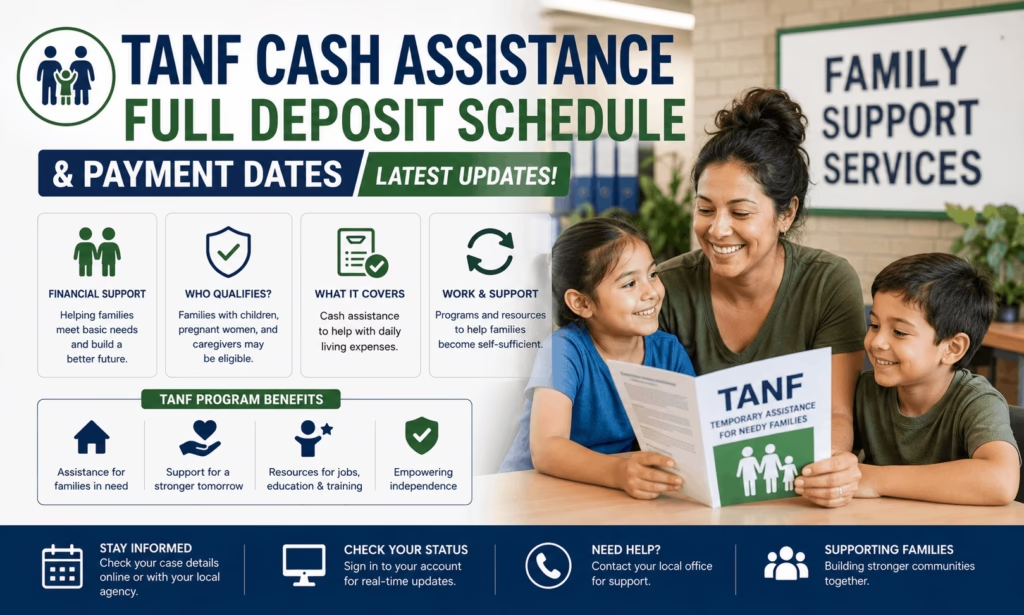
TANF Cash Assistance Highlights
| Detail | Information |
|---|---|
| Program name | Temporary Assistance for Needy Families (TANF) |
| Administered by | U.S. Department of Health and Human Services (HHS), Administration for Children and Families (ACF); benefit design set state-by-state |
| Program created | 1996, under the Personal Responsibility and Work Opportunity Reconciliation Act, replacing AFDC |
| Current federal funding authorization | Through December 31, 2026, under the Consolidated Appropriations Act, 2026 (Public Law 119-75) |
| Annual federal block grant total | $16.5 billion, unchanged since 1996 |
| Monthly recipients (approx.) | 1 million families, about 1.9 million children |
| Federal lifetime limit | 60 months per family (states may exempt up to 20% of caseload for hardship) |
| Minimum weekly work requirement | 30 hours for most single-parent families |
| Payment mode | State-issued EBT card (cash benefit) |
| California (CalWORKs) deposit window | 1st through 3rd of the month, same for all recipients |
| New York deposit window | 1st through 9th, based on case number “toe digit” |
| Texas deposit window | Spread across 1st through 28th, based on EDG number |
| Florida deposit window | First nine days, based on last digit of case number |
| Oklahoma and Virginia deposit window | 1st of the month, flat date for every case |
What TANF Cash Assistance Actually Covers
Temporary Assistance for Needy Families provides monthly cash assistance payments to low-income families with children under 18, along with a broader set of state-run services funded through the same federal block grant. The U.S. Department of Health and Human Services, through the Administration for Children and Families, oversees the program at the national level, while individual states design their own benefit amounts, income limits, and work requirements, which is why a family in California receives a very different monthly amount than a household of the same size in Alabama or Mississippi.
Beyond the direct cash payment families use for rent, utilities, diapers, and transportation, TANF funding also supports child care subsidies, job training and education programs, and, in some states, tuition assistance for recipients pursuing further education or job certifications. Unlike SNAP, which is available to eligible households without children, TANF cash assistance is generally restricted to families with a dependent child physically living in the home, along with pregnant women in their final trimester in most states. Roughly a quarter of total TANF and state matching funds nationally goes toward this direct basic assistance payment, while the rest funds work supports, child care, and related family services, which is one reason the size of the monthly cash payment itself can look modest compared to the program’s overall funding.
TANF Deposit Schedule by State
Because TANF is administered separately by each state’s human services agency, there is no single confirmed date that applies nationwide. The table below shows the current deposit pattern for the states that receive the most search interest.
| State | TANF Program Name | Deposit Window | How Your Date Is Assigned |
|---|---|---|---|
| California | CalWORKs | 1st-3rd | Same window for all recipients |
| New York (upstate) | Family Assistance / Safety Net Assistance | 1st-9th | Next-to-last digit of case number |
| New York City | Cash Assistance | ~2 weeks after SNAP deposit | Separate NYC cycle |
| Texas | TANF | 1st-28th | Last digits of EDG number |
| Florida | Temporary Cash Assistance | 1st-9th | Last digit of case number |
| Pennsylvania | Cash Assistance | 2nd-27th | Case number |
| North Carolina | Work First Family Assistance | Spread through the month | Last digits of Social Security number |
| Oklahoma | TANF | 1st of the month | Flat date, no case number variation |
| Virginia | TANF | 1st of the month | Flat date, no case number variation |
| Oregon | TANF | 1st (or 3rd if the 1st falls on a weekend) | Flat monthly date for all recipients |
If your scheduled deposit date falls on a weekend or state holiday, most states move the payment to the prior business day, though a few states issue it on the following business day instead, so it is worth confirming this detail with your specific state agency. If your state is not listed above, your local Department of Social Services or Department of Human Services website will confirm your exact deposit date for the month.
$145.83 BC Family Benefit First Child Payment Confirmed as Income Phase-Out Shifts to $96,562
TANF Cash Assistance Payment Amounts
TANF benefit amounts vary dramatically by state, since each state sets its own payment levels using its share of the federal block grant along with required state matching funds. The examples below illustrate just how wide that range is for a family of three.
| State | Approximate Monthly TANF Amount (Family of Three) |
|---|---|
| Alabama | Around $215 |
| Florida | Roughly $300 to $400 |
| California (CalWORKs) | Several hundred dollars higher, among the more generous state maximums |
| New York | Varies by region, higher in New York City than upstate |
Because the federal block grant has remained fixed at $16.5 billion annually since TANF’s creation in 1996, without any adjustment for inflation, the real value of cash assistance has eroded significantly over the past three decades even in states that have raised their nominal benefit levels in recent years. Because these figures are adjusted periodically at the state level, applicants should always confirm the current benefit amount through their state caseworker rather than relying on outdated national averages.
Who Qualifies for TANF Cash Assistance
To qualify for TANF cash assistance, your household generally needs to meet the following conditions, though exact thresholds vary by state:
- At least one dependent child under 18 living in the home, or being pregnant in the final trimester with no other children
- Meeting the state’s specific income and, in many states, resource limits, which vary considerably since each state designs its own thresholds within federal guidelines
- U.S. citizenship or qualified immigration status for household members applying for benefits
- Cooperation with child support enforcement requirements where applicable
- Participation in approved work or job training activities once benefits begin, unless exempted
Single adults without dependent children generally cannot qualify for TANF cash assistance itself, though they may be eligible for other state general assistance programs or SNAP.
Documents Required for a TANF Application
Before applying, keep the following documents ready so your application is not delayed by a missing-information request:
- Proof of identity (driver’s license, state ID, or passport)
- Proof of address (utility bill or lease agreement)
- Proof of income (pay stubs, employer letter, or self-employment records)
- Social Security numbers for all household members
- Birth certificates of dependent children
- Proof of citizenship or immigration status
- Bank statements showing current resources
How to Apply for TANF Cash Assistance
Applying for TANF is done through your state welfare or human services agency, either online, by mail, or in person at a local office. Most states now offer a full online portal where you can submit your application, upload documents, and track your case status. After submission, a caseworker typically schedules an interview to confirm your eligibility before your first payment is issued. Because processing timelines and interview requirements vary by state, applicants with an urgent need should ask specifically whether their state offers expedited processing for households facing an immediate crisis.
2027 Social Security COLA: 3.6% Estimate Beats Medicare Hike
2027 HSA Contribution Limits Announced: IRS Confirms $4,500 and $9,000 Caps
Work Requirements and Lifetime Limits
Federal law requires a share of each state’s TANF caseload to participate in approved work activities, with most single-parent families expected to complete at least 30 hours of work-related activity per week to maintain eligibility, and a higher standard applying to two-parent households. States can count job search and job readiness activities toward this requirement for up to 12 weeks in a 12-month period if the state qualifies as “economically needy,” though states that fall outside that threshold are limited to a shorter six-week window. TANF cash assistance is also subject to a federal lifetime limit of 60 months per family, though states may extend assistance beyond that limit for up to 20% of their caseload based on documented hardship.
Latest Updates: Funding, Reauthorization, and State Changes
The single most important update for TANF households heading into the rest of 2026 is a funding deadline. The Consolidated Appropriations Act, 2026 (Public Law 119-75) currently funds TANF only through December 31, 2026, continuing a pattern of short-term extensions that has kept the program running since its last full reauthorization back in 2005. Congress has not passed a long-term reauthorization since then, and a five-year TANF reauthorization bill introduced by Representative Darin LaHood and Senator Steve Daines, which would replace the current work participation standard with direct federal work requirements and new employment outcome measures, remains pending as of mid-2026. If Congress does not extend or reauthorize funding again before the end of the year, states could face significant disruption to their TANF programs heading into 2027.
At the state level, some jurisdictions are already adjusting their programs ahead of that deadline. The District of Columbia, for example, has announced changes beginning October 1, 2026 to “stabilize” its TANF program, including a step-down in benefit levels for households that have already received assistance for 60 months or more, as the district works to keep the program sustainable under current funding levels. Families in other states should watch for similar announcements from their state human services agency, since individual states have wide latitude to adjust benefit levels, work requirements, and time limits within the federal framework.
What to Do If Your TANF Payment Is Late
If your deposit has not arrived by your scheduled date, follow these steps before assuming there is an error:
- Check whether the scheduled date fell on a weekend or federal holiday, since many states shift the deposit to the prior business day.
- Log in to your state EBT account or benefits portal to confirm your case status and deposit history.
- Call your state’s EBT customer service helpline listed on the back of your card.
- Contact your assigned caseworker if the delay continues beyond two business days.
- Ask about an emergency or expedited payment if your household is facing an urgent need.
Delays are often tied to a pending recertification or an update to your case file rather than a missed payment outright, though occasionally a scheduled payment can shift because of delayed federal appropriations, a state budget gap, or system maintenance on the EBT platform. These situations are usually resolved within a few business days, but keeping a small financial cushion when possible is always a good idea for households relying on the funds for rent or bills.
Official TANF Resources
| Resource | Purpose | Official Link |
|---|---|---|
| Administration for Children and Families TANF page | Federal program overview and state contacts | acf.hhs.gov/ofa/programs/tanf |
| Benefits.gov TANF | Federal benefit finder and eligibility screening | benefits.gov/benefit/1587 |
| USA.gov TANF guide | Plain-language overview of the program | usa.gov/tanf |
| Find your local state TANF office | Locate your state’s administering agency | acf.hhs.gov/ofa/map/help |
| CalWORKs (California) | Apply and manage your California case | benefitscal.com |
| MyBenefits (New York) | Apply and check case status in New York | mybenefits.ny.gov |
| NY OTDA cash assistance | New York cash assistance program details | otda.ny.gov |
| Your Texas Benefits | Apply and manage your Texas case | yourtexasbenefits.com |
| ACCESS Florida | Apply and manage your Florida case | myflfamilies.com/services/access |
FAQs
Is there one confirmed TANF cash assistance payment date that applies everywhere?
No. TANF is administered separately by each state, so there is no single national date. Deposit windows range from a flat 1st-of-the-month date in states like Oklahoma and Virginia to a spread across the entire month in states like Texas and Pennsylvania.
How much is the maximum TANF cash assistance payment?
Amounts vary widely by state. Examples for a family of three range from around $215 a month in Alabama to $300-$400 in Florida, with several states, including California, paying significantly more.
Is TANF the same as welfare?
Yes, TANF is the modern federal program many people still refer to informally as welfare or public cash assistance. It replaced the older AFDC program in 1996.
Is TANF cash assistance funding at risk?
Current federal funding under the Consolidated Appropriations Act, 2026 runs only through December 31, 2026. A longer-term reauthorization bill is pending in Congress but has not yet passed.
What is the lifetime limit for TANF cash assistance?
The federal limit is 60 months per family, though states may extend assistance beyond that limit for up to 20% of their caseload in cases of documented hardship.
Do TANF recipients have to work to keep receiving benefits?
Yes. Most single-parent families must complete at least 30 hours per week of an approved work activity, with a higher requirement for two-parent households.
Can single adults without children receive TANF cash assistance?
Generally no. TANF cash assistance is restricted to families with a dependent child in the home, along with pregnant women in their final trimester in most states.
What documents do I need to apply for TANF?
You generally need proof of identity, proof of address, proof of income, Social Security numbers for household members, birth certificates for dependent children, proof of citizenship or immigration status, and bank statements showing current resources.
What should I do if my TANF payment does not arrive on time?
Confirm the date did not fall on a weekend or holiday, check your EBT account online, call your state’s EBT customer service line, and contact your caseworker directly if the delay continues beyond a couple of business days.
Will TANF cash assistance change after December 2026?
It depends on whether Congress extends or reauthorizes funding before the current authorization under the Consolidated Appropriations Act, 2026 expires on December 31, 2026. Until a new law passes, states are planning around the current deadline, and some, like the District of Columbia, have already announced their own benefit adjustments ahead of it.
People Also Ask
Why is my TANF cash assistance amount different from a neighboring state’s? Because each state sets its own benefit levels using its share of the fixed federal block grant plus required state matching funds, amounts for a household of the same size can differ substantially from one state to the next.
Does TANF cash assistance count as income for other benefits? In most cases, TANF cash assistance is not counted the same way earned income is for programs like SNAP, though it may still factor into your household’s overall eligibility calculation for other assistance programs.
Can I receive TANF and SNAP at the same time? Yes. Many households receive both, and in most states the two benefits load onto the same EBT card, though a few states, including New York City, run separate deposit schedules for cash assistance and food benefits.
What happens to my TANF case after I reach the 60-month limit? Your state may end your cash assistance unless you qualify for a hardship extension, though other TANF-funded services such as child care assistance or job training may still be available depending on your state’s specific rules.
What happens if my TANF case number ends in a different digit than my neighbor’s? In states that stagger deposits, your case number, EDG number, or Social Security number digit determines your specific deposit date within the monthly window, which is why two households in the same state can receive funds on different days.
Conclusion
TANF cash assistance deposits follow a different calendar in every state, from California’s uniform 1st-through-3rd window and Oklahoma’s flat 1st-of-the-month date to Texas’s month-long spread based on EDG number, which makes checking your own state’s schedule directly the only reliable way to know exactly when your payment lands. Beyond the monthly deposit date, the bigger story heading into the rest of 2026 is the federal funding deadline at year’s end, with TANF currently authorized only through December 31, 2026 under a short-term extension while a longer-term reauthorization bill remains stalled in Congress. Families should also watch for state-level adjustments, such as the District of Columbia’s planned October 2026 changes to long-term caseloads, keep their application documents and recertification paperwork current, and reach out to their caseworker immediately if a payment is delayed. We’ll continue updating this article every month with the latest confirmed TANF deposit dates, benefit amounts, and funding developments.
Also Read
$1,150 a Week: Rhode Island TDI Benefit Rises Again as State Delivers Second Increase in 2026