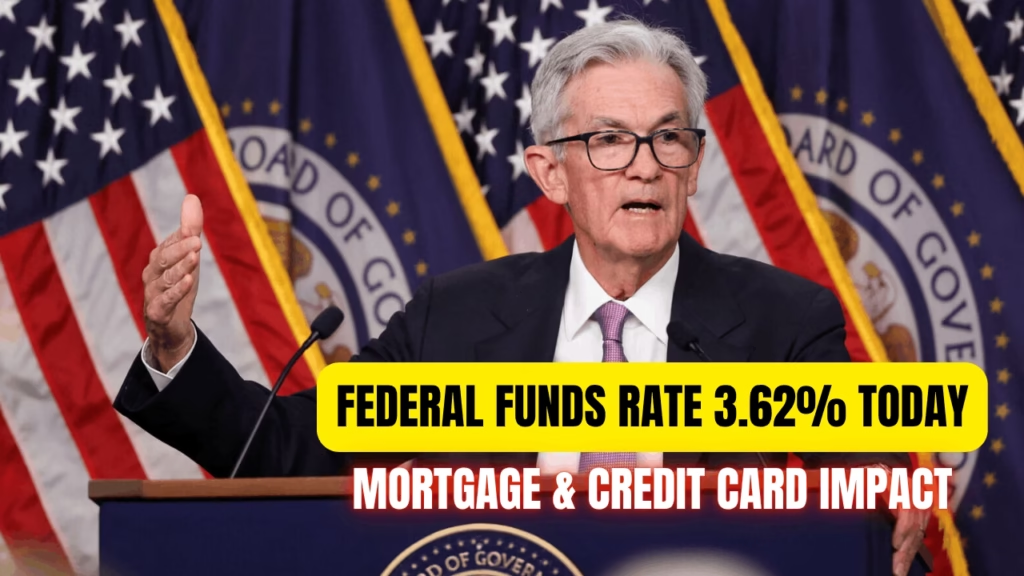
Federal Funds Rate 3.62% Today: The federal funds rate stands at an effective 3.62% today, the midpoint of the Federal Reserve’s target range of 3.50% to 3.75%, where the central bank has now held policy steady for five consecutive meetings. That pause is not just a technical footnote for economists. It is the direct reason the average 30-year mortgage has climbed back above 6.6% this month, why credit card APRs remain stuck near record territory, and why anyone carrying a variable-rate balance is still paying roughly what they paid a year ago. The Federal Open Market Committee’s most recent decision on July 29, 2026 kept rates unchanged in a 9-3 vote, with several officials pushing for a cut that did not happen, and the next opportunity for a change falls on September 16, 2026.
For households, this rate is the invisible hand behind almost every borrowing cost in the economy right now. Mortgage rates, credit card interest, auto loans, home equity lines and even savings account yields all move in response to what the Fed does with this one number, even though the federal funds rate itself is technically just the rate banks charge each other for overnight loans. We’ll be updating this article monthly as new inflation data, jobs reports and FOMC decisions shift the outlook for the rest of 2026 and into 2027. Right now, the practical story is simple: rates are higher for longer than most forecasters expected even a few months ago, and that is reshaping decisions on home buying, refinancing and debt payoff strategy across the country.
Key Highlights: Federal Funds Rate and Borrowing Costs Today
| Item | Current Figure |
|---|---|
| Federal funds target range | 3.50% to 3.75% |
| Effective federal funds rate | 3.62% |
| Last FOMC decision | Held steady on July 29, 2026, fifth consecutive hold |
| FOMC vote | 9 to 3 in favor of holding rates |
| Next FOMC meeting | September 15 to 16, 2026 |
| Prime rate | 6.75% |
| 30-year fixed mortgage rate | Approximately 6.65% to 6.69% depending on lender survey |
| 15-year fixed mortgage rate | Approximately 6.00% to 6.01% |
| Average credit card APR (all accounts) | Approximately 20.9% to 21.1% |
| Average credit card APR (accounts carrying a balance) | Approximately 22.1% to 22.2% |
| Fed’s year-end 2026 rate projection (June dot plot) | 3.6% to 4.1% |
| Inflation (annual CPI) | Approximately 3.7% |
| Core PCE inflation | Approximately 3.3% |
| Unemployment rate | Approximately 4.1% |
Latest Update: Why the Fed Is Holding Rates Steady
The Federal Reserve left its benchmark rate unchanged for the fifth straight meeting on July 29, 2026, keeping the target range at 3.50% to 3.75%, the lowest level the rate has touched since November 2022. The committee’s statement pointed to an economy still expanding at a solid pace, strong productivity growth and steady job gains, but inflation that remains stubbornly above the Fed’s 2% target, partly because of supply shocks in categories like energy tied to ongoing conflict in the Middle East. Three committee members dissented in favor of a quarter-point cut, showing a real split inside the Fed about whether the current stance is too tight given how much unemployment has crept up this year.
What makes this pause different from earlier ones in 2026 is the shift in the Fed’s own outlook. The June 2026 dot plot, the Fed’s quarterly projection of where officials expect rates to land, moved noticeably higher than the March projections. Most officials now expect the federal funds rate to end 2026 somewhere between 3.6% and 4.1%, up from a prior estimate of 3.25% to 3.75%. In plain terms, the people who actually vote on rates now expect fewer cuts this year than they did just a few months ago, and a slower, more cautious path down through 2027 and 2028. Markets had been pricing in two additional quarter-point cuts before the September and December meetings, but that expectation has softened considerably since the July decision and the accompanying projections.
The next real test comes on September 16, 2026, when the Fed will also release fresh Summary of Economic Projections. Between now and then, two data points carry outsized weight: the August jobs report due September 4 and the July Consumer Price Index reading. A hotter-than-expected inflation print or a surprisingly strong jobs number would likely push any rate cut further out, while a cooler reading on either could revive cut expectations and pull mortgage rates back down before the fall home buying season winds down.
Social Security Spousal Benefit Rule Almost Everyone Gets Wrong, and What It Actually Costs
Canada 50% Tariff 2026: Full List of Products That Could See Price Hikes
How the Federal Funds Rate Actually Moves Your Money
The federal funds rate is the interest rate banks charge each other for short-term, typically overnight, loans to meet reserve requirements. The Fed does not set this rate as a single fixed number but rather a target range, currently 3.50% to 3.75%, and uses tools like interest on reserve balances to keep the effective rate, now 3.62%, trading within that band. On its own, this number affects almost nobody directly. Its real power comes from how quickly it ripples through the rest of the financial system.
The clearest link is the prime rate, which nearly all U.S. banks set at exactly three percentage points above the federal funds rate. With the target range at 3.50% to 3.75%, the prime rate today sits at 6.75%. Since most credit cards, many home equity lines of credit and a large share of small business loans are priced as prime plus a margin, changes to the federal funds rate show up on credit card statements within one to two billing cycles. Mortgage rates work differently. They do not track the federal funds rate directly but instead follow the 10-year Treasury yield, which reflects investor expectations for where rates are headed over the life of a 30-year loan, along with inflation expectations and demand for mortgage-backed securities. That is why mortgage rates can move even between FOMC meetings, and why they have actually risen in recent weeks even though the Fed itself has not touched rates since December 2025.
What It Means for Mortgage Rates Right Now
Mortgage rates have climbed to their highest level in more than a year. Freddie Mac’s weekly Primary Mortgage Market Survey put the average 30-year fixed-rate mortgage at 6.69% for the week ending August 6, 2026, up from 6.66% the previous week and higher than the same week last year. Daily rate trackers show a similar picture, with the 30-year fixed hovering between 6.65% and 6.78% depending on the lender and survey method through the first half of August 2026. The 15-year fixed-rate mortgage, popular with borrowers who want to pay off their home faster and accept a higher monthly payment for a lower rate, averaged around 6.00% to 6.01% over the same period.
The reason mortgage rates have risen even while the Fed holds steady comes down to Treasury yields. Investors pushed bond yields higher through late July as they grew less confident the Fed would deliver the rate cuts markets had priced in earlier in the year, and mortgage rates, which track those yields closely, followed. On a $400,000 loan at 6.69%, a borrower is now looking at roughly $2,578 a month in principal and interest alone, before taxes and insurance. That is a meaningful jump from the affordability math many buyers were running just six months ago, and it has cooled refinance activity even though rates remain below the peaks seen in 2023 and 2024.
For homeowners with an existing mortgage rate below 6%, refinancing still generally does not make financial sense at today’s levels. Most mortgage professionals suggest a refinance is worth exploring only when the new rate comes in at least half a percentage point to a full percentage point below your current rate, once closing costs are factored into the break-even calculation. For prospective buyers, the calculus is more about monthly payment capacity than timing the market perfectly, since nobody, including the Fed itself, has a precise read on where rates go from here.
What It Means for Credit Card Interest Rates
Credit card rates are more directly and immediately tied to the federal funds rate than mortgages are, because most cards carry variable APRs pegged to the prime rate. With the prime rate holding at 6.75% throughout the Fed’s pause, credit card rates have been unusually stable in recent months after years of steady increases. The average APR across all credit card accounts stood at roughly 20.94% in the second quarter of 2026, essentially flat compared to the first quarter. For accounts actually carrying a balance and accruing interest, the average climbed slightly to about 22.15%, still below the record highs of 21.76% and 23.37% respectively set in the third quarter of 2024.
Rate survey data for new credit card offers in August 2026 shows the average sitting close to 23.8% to 24.9% depending on the source and card mix included, with penalty APRs for missed payments running as high as 27% and cash advance rates averaging around 24.5%. Because issuers rarely move rates on their own unless the Fed forces the issue, this relative calm is likely to hold as long as the Fed continues to sit on its hands. That also means the reverse is true. If the Fed eventually cuts rates in late 2026 or 2027, cardholders should not expect an immediate windfall, since most issuers pass through Fed rate changes within one to two statement cycles rather than instantly, and even a full percentage point of Fed cuts would only shave about one point off a typical card’s APR.
For anyone carrying a balance today, the math is unforgiving regardless of what the Fed does next. At an average interest rate near 22%, a $5,000 balance paid down with only minimum payments can take years to clear and cost more in interest than the original purchase amount. Financial counselors consistently point to balance transfer cards with a 0% introductory period, now averaging around 13 months for transfers according to recent industry data, or a fixed-rate personal loan, as more effective tools for tackling high-interest debt than waiting for the Fed to eventually cut.
Other Rates Tied to the Federal Funds Rate
Auto loan rates, home equity lines of credit and savings account yields all move with the federal funds rate as well, though on different timelines. Home equity lines of credit, like credit cards, are usually priced directly off the prime rate, so HELOC costs have also held roughly steady through the Fed’s pause. Auto loan rates respond more to a mix of factors including loan term and the borrower’s credit profile, but they generally track the broader direction of the federal funds rate over time. On the savings side, high-yield savings accounts and certificates of deposit have offered some of the most competitive yields in years while the Fed’s rate sits above 3.5%, giving savers a rare opportunity to earn meaningful interest on cash reserves and emergency funds while borrowing costs remain elevated for everyone else.
Official Resources for Tracking the Federal Funds Rate
| Resource | What It’s For | Official Link |
|---|---|---|
| Federal Reserve FOMC statements | Official rate decisions and meeting statements | federalreserve.gov/newsevents/pressreleases |
| FOMC meeting calendar | Dates of upcoming Fed meetings | federalreserve.gov/monetarypolicy/fomccalendars.htm |
| Federal funds effective rate data | Historical and current effective rate data | fred.stlouisfed.org/series/FEDFUNDS |
| Freddie Mac Primary Mortgage Market Survey | Official weekly average mortgage rates | freddiemac.com/pmms |
| Consumer Financial Protection Bureau | Credit card and mortgage consumer guidance | consumerfinance.gov |
Fast-Track Deportation Ruling: Could It Affect Indian Immigrants?
2027 COLA Increase for VA Disability: How Much Could Benefits Rise Under the Latest Projection
FAQs About Federal Funds Rate
What is the federal funds rate today?
The effective federal funds rate is 3.62% today, within the Federal Reserve’s target range of 3.50% to 3.75%, where it has held steady since the Fed’s last cut in December 2025.
Why does the federal funds rate affect my mortgage?
It does not affect mortgages directly. Mortgage rates track the 10-year Treasury yield, which moves based on investor expectations for future Fed policy and inflation, so mortgage rates can rise or fall even when the Fed itself does not change rates at a given meeting.
Why does the federal funds rate affect my credit card more directly?
Most credit cards carry variable APRs set at the prime rate plus a margin, and the prime rate moves in lockstep with the federal funds rate, typically three percentage points above it. That direct link means credit card rates respond to Fed decisions faster than mortgage rates do.
When will the Fed cut rates next?
The next FOMC meeting is scheduled for September 15 to 16, 2026. Whether the Fed cuts depends heavily on the August jobs report and the July inflation data released in the weeks before that meeting.
Is now a good time to refinance my mortgage?
Generally only if your current rate is at least half a percentage point to a full percentage point above today’s average, once closing costs are factored in. With 30-year rates near 6.65% to 6.69%, most homeowners who refinanced in 2020 or 2021 at rates below 4% will not find refinancing worthwhile right now.
Will my credit card rate go down if the Fed cuts rates?
Eventually, yes, but not immediately. Issuers typically adjust variable APRs within one to two billing cycles after a Fed rate change, and the size of the adjustment usually matches the size of the Fed’s move.
People Also Ask
What is the difference between the federal funds rate and the prime rate? The federal funds rate is what banks charge each other for overnight loans and is set by the Federal Reserve. The prime rate is what banks charge their most creditworthy customers and is almost always exactly three percentage points higher than the federal funds rate.
How often does the Fed change interest rates? The Federal Open Market Committee meets eight times a year to review economic data and decide whether to change rates. It does not follow a fixed schedule for changes and can hold rates steady for as many meetings as conditions warrant, as it has done for five consecutive meetings so far in 2026.
Does a high federal funds rate mean a recession is coming? Not necessarily. The Fed raises or holds rates to control inflation, which can slow economic growth, but a high rate alone does not guarantee a recession. Current unemployment near 4.1% and continued job growth suggest the economy is still expanding despite elevated borrowing costs.
How much does the federal funds rate affect my monthly mortgage payment? Indirectly but significantly over time. A move from 6% to 6.69% on a $400,000, 30-year loan adds roughly $260 to $280 to the monthly principal and interest payment, illustrating why even small shifts in mortgage rates matter for affordability.
What should I do with my savings while rates are high? Financial advisors generally recommend taking advantage of high-yield savings accounts and certificates of deposit while the federal funds rate remains elevated, since these products currently offer some of the strongest yields on cash in years.
Conclusion
The federal funds rate at 3.62% today is the quiet force behind a mortgage market stuck above 6.6% and credit card APRs still hovering near 21% to 22%, even though the Fed itself has not moved in eight months. The central bank’s own projections suggest rates will stay higher for longer than expected earlier in 2026, with only a gradual decline penciled in for 2027 and 2028. For borrowers, that means treating today’s rates as the likely baseline for the rest of the year rather than waiting for relief that may not arrive before the September or December FOMC meetings. For savers, the same environment that is punishing for debt is currently rewarding for cash sitting in high-yield accounts. Either way, the September 16 meeting is the next real checkpoint, and incoming jobs and inflation data between now and then will do more to move mortgage and credit card rates than anything the Fed says on a single afternoon.
H-1B FY2027 Cap Reached: What Happens Next for Applicants?
Social Security Payment August 12, 2026: Who Gets Paid Today and When Is Your Next Check?