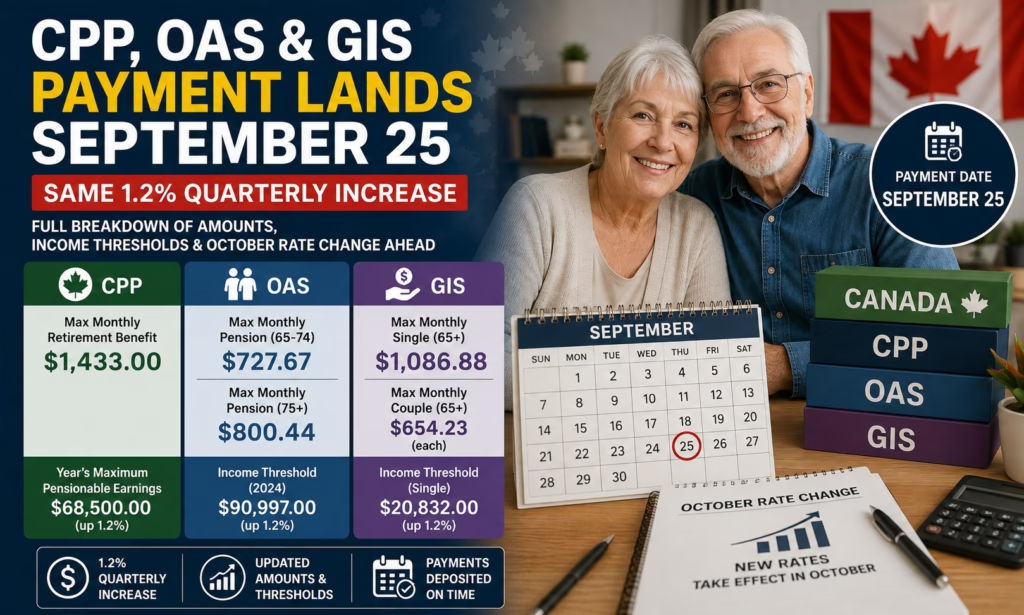
CPP, OAS & GIS September 2026 Payment: Millions of Canadian seniors will see their Canada Pension Plan, Old Age Security, and Guaranteed Income Supplement deposits land on Friday, September 25, 2026, marking the third and final payment of the July-to-September quarter that delivered the largest quarterly OAS increase of the year. The 1.2% adjustment that first appeared in the July 29 payment carries through this deposit unchanged, meaning the maximum OAS pension remains at $751.97 for seniors aged 65 to 74 and $827.17 for those 75 and older. We’ll be updating this article monthly as Service Canada confirms new rate-card figures and payment dates heading into the next quarter.
What makes this particular payment worth understanding closely is what comes right after it. The Government of Canada has already confirmed a 1.4% increase for the October-to-December 2026 quarter, an even larger adjustment than the one currently in effect, which means the October 28 deposit will carry noticeably higher amounts than this month’s payment.
For seniors managing a fixed monthly budget, knowing that September represents the last payment at the current rate, rather than a new or changed amount, matters just as much as knowing the dollar figures themselves. Here is the complete breakdown of this month’s CPP, OAS, and GIS payment, exactly how the 1.2% increase was calculated, and what to expect once the higher October rates take effect.
CPP OAS GIS Payment Date and Quarterly Context
Service Canada pays CPP, OAS, and GIS on the same date each month, and September 25, 2026 is that date this month. This deposit reflects the same July-to-September 2026 quarterly rates that first appeared in the July 29 payment and continued through the August 27 deposit, since OAS and GIS are adjusted quarterly rather than monthly. CPP, by contrast, is adjusted only once per year in January, meaning the CPP portion of this deposit is identical to every CPP payment issued since January 2026.
CPP, OAS & GIS September 2026 Key Highlights
| Item | Detail |
|---|---|
| September 2026 payment date | Friday, September 25, 2026 |
| Current quarterly OAS adjustment | 1.2% increase, effective July to September 2026 |
| Next scheduled OAS adjustment | 1.4% increase, effective October to December 2026 |
| Maximum OAS, ages 65-74 | $751.97 per month |
| Maximum OAS, ages 75+ | $827.17 per month |
| Maximum GIS, single/widowed/divorced | $1,123.17 per month |
| Maximum GIS, spouse receives full OAS | $676.09 per month |
| Maximum CPP retirement pension (new, age 65) | $1,507.65 per month |
| Average new CPP retirement pension (age 65) | $925.35 per month |
| Annual CPP indexation | 2.0%, applied January 2026, holds until January 2027 |
| Next payment date | October 28, 2026 |
| Remaining 2026 payment dates | October 28, November 26, December 22 |
How the 1.2% OAS Increase Was Calculated?
OAS and GIS amounts adjust every quarter in January, April, July, and October based on changes in the Consumer Price Index. The 1.2% increase applied for July through September 2026 was the largest of the three quarterly adjustments so far this year, following a comparatively modest 0.3% increase in January and just a 0.1% adjustment in April. That 1.2% bump pushed the maximum OAS pension from $743.05 to $751.97 for seniors aged 65 to 74, and from $817.36 to $827.17 for those 75 and older, an increase that has now applied unchanged across all three payments in this quarter, including this month’s September 25 deposit.
Because GIS is calculated as a supplement layered on top of OAS for low-income recipients, it received the identical 1.2% adjustment for the same quarter. The maximum GIS for a single, widowed, or divorced pensioner rose to $1,123.17 per month, up from $1,097.75 the previous year, reflecting both this quarter’s adjustment and the program’s broader annual growth pattern.
CalFresh Payment September 2026: Here’s When Your Food Stamps Will Be Loaded
H-1B Crackdown Employer Warning Now Covers OPT, PERM and J-1 Hiring Practices
Full CPP Payment Amounts for 2026
Unlike OAS and GIS, CPP is adjusted once annually, so the amounts landing in this month’s payment are the same figures that have applied to every CPP deposit since January 2026, following a 2.0% annual increase that holds until the next adjustment in January 2027.
| CPP Benefit Type | Average Amount (New Beneficiaries, January 2026) | Maximum Monthly Amount (2026) |
|---|---|---|
| Retirement pension (age 65) | $925.35 | $1,507.65 |
| Post-retirement benefit (age 65) | $11.93 | $54.69 |
| Disability benefit | $1,210.86 | $1,741.20 |
| Post-retirement disability benefit | $610.46 | $610.46 |
| Survivor’s pension, younger than 65 | $545.71 | $803.54 |
| Survivor’s pension, 65 and older | $334.24 | $904.59 |
| Children of disabled or deceased contributor, under 18 | $307.81 | $307.81 |
Reaching the maximum retirement pension requires contributing at the maximum pensionable earnings level for at least 39 years between ages 18 and 65, which is why the vast majority of retirees receive an amount closer to the average figure than the maximum. Someone who defers CPP from 65 to 70 receives roughly 42 percent more per month for life, though the break-even point where deferral pays off compared to starting at 65 typically falls around age 83 to 84, depending on individual circumstances.
GIS, Allowance, and Allowance for the Survivor Amounts
GIS, the Allowance, and the Allowance for the Survivor are all paid alongside OAS on the same September 25 date, arriving as one combined deposit for anyone who qualifies for more than one of these benefits.
| Benefit Type | Maximum Monthly Amount (July-September 2026) | Annual Income Cut-Off (excluding OAS) |
|---|---|---|
| GIS, single, widowed, or divorced | $1,123.17 | Below $22,800 |
| GIS, spouse does not receive OAS or Allowance | $1,123.17 | Combined income below $30,096 |
| GIS, spouse receives full OAS | $676.09 | Combined income below $30,096 |
| GIS, spouse receives the Allowance | $676.09 | Combined income below $30,096 |
| Allowance (ages 60-64, spouse receives GIS) | $1,428.06 | Combined income below $30,096 |
| Allowance for the Survivor (ages 60-64, widowed) | $1,702.34 | Annual income below $30,312 |
GIS is non-taxable and does not count toward the OAS recovery tax calculation, unlike the OAS pension itself, which is fully taxable. This distinction matters for seniors doing their own tax planning, since a senior receiving both benefits sees one taxable and one tax-free amount combined into a single deposit.
Understanding the OAS Recovery Tax Thresholds
Higher-income seniors repay part of their OAS pension through what is commonly called the recovery tax or clawback. For the 2026 income year, which affects OAS payments issued from July 2027 onward, the repayment range runs from $95,323 to $155,109 in net world income for recipients aged 65 to 74, and up to $161,088 for those 75 and older. Net world income for this calculation includes the OAS pension itself along with all other reportable income on a recipient’s T1 tax return, but specifically excludes GIS, the Allowance, and the Allowance for the Survivor, since those benefits are non-taxable and do not factor into the clawback formula.
Because the recovery tax is calculated using the prior year’s income, what shows up in the current benefit period reflects a recipient’s 2025 tax return rather than their 2026 income. When a recovery tax does apply, it is typically spread across the following 12 monthly OAS payments after the Canada Revenue Agency completes the calculation, rather than collected as a single lump-sum deduction.
Why the October Payment Will Look Different?
The most important thing for CPP, OAS, and GIS recipients to understand heading out of this month’s payment is that October brings a genuinely new rate, not just a continuation of the current one. The Government of Canada has already confirmed a 1.4% increase for the October-to-December 2026 quarter, which is a larger jump than the 1.2% adjustment currently in effect. That October increase is expected to push the maximum monthly OAS pension past $762 for seniors aged 65 to 74 and above $838 for those 75 and over, based on projections built from the confirmed 1.4% rate.
The Government of Canada does note that maximum recovery tax thresholds published between January and September of a given year are treated as estimates and only become final once the October through December figures are confirmed, so seniors doing detailed tax planning around clawback thresholds should treat earlier-year projections as provisional until the final quarterly figures are released.
H-1B Visa Ban Texas Schools: Abbott Wants Exactly Zero Foreign Workers, What Indians Should Know
$450K Student Debt Relief: Here Are The Restrictions Behind The Sweet v. McMahon Settlement
The GIS Annual Recalculation and Why Filing Taxes on Time Matters
Every July, GIS, the Allowance, and the Allowance for the Survivor undergo an annual recalculation based on a recipient’s completed tax return from the previous year, in this case the 2025 return rather than 2024. This recalculation happened alongside the July 2026 quarterly OAS increase, meaning any changes to a senior’s GIS amount tied to their 2025 income would have already appeared by the time this month’s September payment arrives.
Seniors who filed their 2025 tax return late may have seen a temporary suspension of income-tested benefits, since Service Canada requires a completed tax return to calculate GIS, Allowance, and Allowance for the Survivor amounts accurately. Anyone whose income dropped significantly due to retirement or the loss of pension income can ask Service Canada to use an estimate of current-year income instead of the prior year’s figure, which can prevent a temporary income spike from unfairly reducing GIS in the months that follow.
How to Apply for CPP, OAS, and GIS?
- Apply for CPP retirement pension through your My Service Canada Account online, or by submitting a paper application, ideally at least six months before you want payments to begin.
- Apply for OAS in the same way if you were not automatically enrolled, since many seniors receive automatic enrollment notification letters from Service Canada shortly before turning 65.
- If you qualify for GIS, you will typically be automatically enrolled once your OAS application is processed and your most recent tax return is on file, though you can also apply manually using Form ISP-3550 or ISP-3025 if automatic enrollment does not occur.
- File your income tax return every year by the deadline, since GIS, the Allowance, and the Allowance for the Survivor all depend on having a completed tax return on file, and late filing can suspend these income-tested payments.
- Set up direct deposit through your My Service Canada Account to receive payments faster and more reliably than by mailed cheque.
- Review your benefit amounts each time a new quarterly adjustment takes effect, since GIS and the Allowance-related benefits can shift independently of the base OAS rate depending on your recalculated income.
Processing Time for New Applications
CPP retirement pension applications are generally processed within a few weeks when submitted online through My Service Canada Account, though Service Canada recommends applying at least six months in advance of your desired start date to avoid any gap in payments. OAS applications follow a similar timeline, and seniors who are automatically enrolled typically receive a notification letter roughly a month before their first eligible payment. GIS applications submitted manually, rather than through automatic enrollment, can take several weeks to process, particularly if a recipient’s most recent tax return has not yet been filed or processed by the Canada Revenue Agency, since GIS eligibility and payment amounts depend entirely on that income data being available.
Payment Schedule for the Rest of 2026
CPP, OAS, and GIS follow a shared payment calendar for the remainder of the year. After this month’s September 25 deposit, the remaining scheduled dates are October 28, November 26, and December 22, 2026. Deposits arriving by direct deposit typically post on the scheduled date itself, while payments arriving by mailed cheque can take several additional business days to arrive, with Service Canada advising recipients to wait five business days past the scheduled date before reporting a payment as missing.
Official Resources and Status Check Links
| Resource | Purpose | Official Link |
|---|---|---|
| My Service Canada Account | Apply for benefits, check status, set up direct deposit | canada.ca (My Service Canada Account) |
| CPP Retirement Pension Overview | Eligibility rules and application details | canada.ca/en/services/benefits/publicpensions/cpp |
| OAS Pension Overview | Eligibility, amounts, and application information | canada.ca/en/services/benefits/publicpensions/cpp/old-age-security |
| GIS Program Page | Income thresholds and application details | canada.ca (Guaranteed Income Supplement page) |
| Old Age Security Payment Amounts | Official current quarterly rate tables | canada.ca (OAS payment amounts page) |
| Service Canada General Inquiries | Phone support for payment and application questions | 1-800-277-9914 |
| CRA My Account | File taxes and check tax return status affecting GIS | canada.ca (CRA My Account) |
Budgeting Around This Payment Before the October Increase
Financial counselors who work with retirees often point out that the final month of a quarter, like this September payment, is the ideal time to review a household budget before a rate change arrives. Because this deposit carries the same amounts as July and August, seniors have a full three-month track record of exactly what to expect, unlike the first month of a new quarter when a rate adjustment can catch a fixed-income household off guard if they were not tracking the announcement closely.
Anyone with recurring bills, rent payments, or pre-authorized withdrawals tied closely to their deposit date should confirm those dates line up cleanly with September 25, particularly if a payment due date falls close to a weekend, since bank processing times can occasionally shift when funds actually become accessible.
For seniors who also receive provincial supplements alongside their federal CPP, OAS, and GIS payments, this is also a reasonable time to check whether any provincial program has its own separate quarterly or annual adjustment coming later in the fall, since provincial senior benefit programs do not always move in lockstep with the federal OAS and GIS adjustment calendar. Cross-referencing federal payment dates against any provincial deposits can help avoid the common budgeting mistake of assuming all senior benefit income arrives and adjusts on the same schedule.
2027 HSA Contribution Limits Announced: IRS Confirms $4,500 and $9,000 Caps
Social Security Compassionate Allowances List: 14 Conditions Added
FAQs
When is the CPP, OAS, and GIS payment date this month?
This month’s payment lands on Friday, September 25, 2026, following the same shared payment calendar Service Canada uses for all three benefits.
Is this month’s OAS amount different from August?
No. September represents the third and final payment of the July-to-September 2026 quarter, so the amounts remain identical to the July and August deposits before the next quarterly adjustment takes effect in October.
How much will OAS increase in October 2026?
The Government of Canada has confirmed a 1.4% increase for the October-to-December 2026 quarter, which is expected to push the maximum OAS pension past $762 for ages 65 to 74 and above $838 for those 75 and over.
What is the maximum GIS payment right now?
A single, widowed, or divorced pensioner can receive up to $1,123.17 per month in GIS for the current July-to-September 2026 quarter, provided their annual income excluding OAS stays below $22,800.
Does CPP increase every quarter like OAS?
No. CPP is adjusted once per year each January, unlike OAS and GIS, which adjust quarterly based on Consumer Price Index changes.
What happens if I file my taxes late as a GIS recipient?
Late filing can temporarily suspend income-tested benefits including GIS, the Allowance, and the Allowance for the Survivor, since Service Canada requires a completed tax return to calculate these amounts accurately.
Are GIS and the OAS pension taxed the same way?
No. The OAS pension is fully taxable and counts toward the recovery tax calculation, while GIS, the Allowance, and the Allowance for the Survivor are all non-taxable and excluded from that calculation.
How much is the average CPP payment in Canada in 2026?
The average new CPP retirement pension for beneficiaries starting at age 65 in January 2026 was $925.35 per month, considerably lower than the $1,507.65 maximum, since reaching the maximum requires 39 years of maximum contributions.
Can I receive CPP and OAS at the same time?
Yes. CPP and OAS are separate federal programs administered independently, though Service Canada coordinates their payment dates so both typically arrive on the same day for recipients who qualify for both.
What income level disqualifies a senior from GIS entirely?
For the current quarter, a single senior with annual income of $22,800 or more, excluding OAS, does not qualify for GIS, while couples where both partners receive OAS are excluded once combined income reaches $30,096.
Does deferring CPP to age 70 result in more money?
Yes, deferring CPP from 65 to 70 increases the monthly payment by roughly 42 percent for life, though the financial advantage of deferral generally only outweighs starting earlier once a recipient reaches their early to mid-80s.
This month’s CPP, OAS, and GIS payment on September 25 closes out the July-to-September quarter at the same 1.2% increased rate that has applied since July, giving seniors one more month to plan around familiar numbers before the confirmed 1.4% October adjustment takes effect. With the recovery tax thresholds, GIS income cut-offs, and annual tax filing requirements all interacting with these payments in ways that are easy to overlook, seniors receiving any combination of these three benefits should use this stable month to confirm their 2025 tax filing is up to date, review their My Service Canada Account for accuracy, and prepare for the noticeably higher amounts arriving with the October 28 deposit.
Also Read :-
Refundable Tax Credit Eligibility: How SSN and Immigration Status Now Decide Your Refund
New Canada LMIA Rules August 2026: What Employers and Foreign Workers Need to Know
SNAP Payments Dates September 2026: Full EBT Payment Schedule by State, New Rules & Status Check!