SSA Payroll Information Exchange and New SSI Improvement Office: The Social Security Administration has confirmed a major operational shake-up inside the Supplemental Security Income program, and it has nothing to do with new eligibility rules. On July 24, 2026, SSA transmitted its 2026 Annual Report of the Supplemental Security Income Program to President Trump and Congress, and the headline news is the full implementation of the SSA Payroll Information Exchange, a wage-verification system that now runs on a monthly cycle across the country. Commissioner Frank J. Bisignano paired that rollout with the creation of a dedicated SSI Improvement Office, the first office of its kind in the agency’s history, along with an expanded set of fraud-detection tools built around the Access to Financial Institution program.
None of this changes who qualifies for SSI or how much a recipient receives. What it changes is how fast SSA catches errors, how much paperwork recipients have to file on their own, and how quickly the agency flags an improper payment before it snowballs into a debt. For the nearly 7.5 million people who rely on SSI each month, that distinction matters. It also matters for advocates, caregivers, and payroll administrators who now interact with a wage-reporting system that behaves very differently than it did even a year ago. This is not a one-time announcement either. Because SSA tends to issue follow-up guidance, field office memos, and technical corrections in the weeks after a major annual report, we’ll be updating this article monthly as new details, deadlines, or clarifications come out of Baltimore.
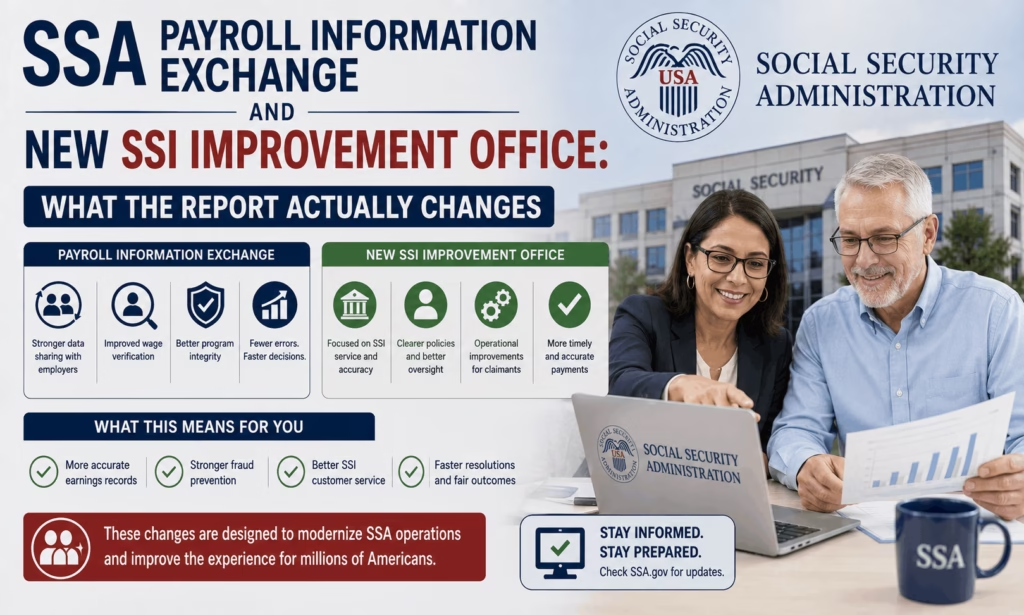
Key Highlights: SSA’s 2026 SSI Improvement Report
| Detail | Information |
|---|---|
| Report name | 2026 Annual Report of the Supplemental Security Income Program |
| Date submitted to Congress | July 24, 2026 |
| Lead official | Commissioner Frank J. Bisignano |
| Core wage tool | Payroll Information Exchange (PIE), full-scale monthly operation since September 2025 |
| New office | SSI Improvement Office, first dedicated SSI office in SSA history |
| Origin of the office | Grew out of the SSI Improvement Team created in September 2025 |
| Recommendations reviewed | More than 170 |
| Fraud-detection tool expanded | Access to Financial Institution (AFI) |
| Program size | Serves more than 7 million aged, blind, and disabled Americans |
| Funding source | General tax revenues, not the Social Security trust funds |
| Eligibility rules changed | No |
| Application process changed | No |
What the SSA Payroll Information Exchange Actually Does
The Payroll Information Exchange, known internally as PIE, is the centerpiece of this year’s report, and it is worth understanding in plain terms. SSI is a needs-based program, which means a recipient’s monthly payment depends directly on how much income they earn. Historically, recipients had to self-report wage changes to SSA, often by phone, mail, or an in-person visit to a field office. Missed reports, delayed reports, or simple math errors led to overpayments that recipients then had to repay, sometimes years later and often at a point where the money was long since spent.
PIE changes that reporting chain. SSA now receives electronic wage data directly from payroll providers on a recurring monthly basis, a system that reached full-scale operation in September 2025 after a phased rollout that began in April of that year. Instead of waiting for a recipient to call in a pay stub change, the agency pulls verified wage figures automatically and updates SSI records against them. According to SSA’s own account of the program, this reduces the time field office staff spend manually verifying income, cuts down on data-entry errors, and lowers the reporting burden placed on recipients and the people authorized to report on their behalf, such as a representative payee.
The practical effect for most current recipients is fewer surprise overpayment notices tied purely to unreported part-time or seasonal work, since the system is now catching those changes closer to real time rather than months later during a redetermination.
SNAP Soda and Candy Ban by State: Full List, Dates, and Rules for 2026
The New SSI Improvement Office, Explained
The second major piece of the July report is administrative rather than technical, but it is arguably the more consequential long-term change. Commissioner Bisignano announced that SSA has, for the first time in the agency’s history, named a dedicated lead executive and stood up a formal SSI Improvement Office. The office traces back to an SSI Improvement Team the commissioner created in September 2025 specifically to find fast, implementable fixes to a program that has long struggled with a heavier administrative burden and a higher improper-payment rate than standard retirement or disability insurance benefits.
That team reviewed more than 170 internal recommendations before narrowing them down to the policy and process changes that made it into this year’s report. Bisignano described the goal in blunt terms, saying the changes are meant to make the program better both for the people who depend on it and for the SSA employees who administer it day to day.
In practice, the SSI Improvement Office now owns responsibility for policy clarity, redetermination scheduling, and the technology rollouts tied to PIE and AFI going forward, rather than those workstreams being split across separate divisions with no single accountable office. Advocates who have tracked SSI administration for years have noted that improper payments in the program run disproportionately high in dollar terms relative to its size, which is part of why this office was created as a standing structure rather than a temporary task force.
Expanded Fraud Detection: The Access to Financial Institution Tool
Alongside PIE, SSA confirmed a broader rollout of its Access to Financial Institution (AFI) tool, which lets the agency verify a recipient’s bank account information directly with financial institutions rather than relying solely on self-reported resource statements. SSI has a strict resource limit, currently set at $2,000 for an individual and $3,000 for a couple, and exceeding that limit even temporarily can trigger a loss of eligibility for that month.
AFI allows SSA to identify excess resources earlier, before an overpayment has a chance to accumulate over several months. A May 2025 report from SSA’s Office of the Inspector General had previously flagged that the agency had not yet completed a full study on expanding AFI use, and this year’s report positions the broader rollout as a direct response to that gap, alongside longstanding technology infrastructure limits the OIG has raised in prior reviews.
The agency also pointed to continued progress on Limited Issue Redeterminations and age-18 Continuing Disability Reviews, both of which are administrative backlogs that have historically delayed accurate benefit decisions for recipients transitioning out of childhood SSI eligibility.
What Has Not Changed: No New Eligibility Rules
It is worth being direct about what this report is not. SSA has been explicit that these changes represent operational modernization, not a policy shift. The 2026 SSI federal benefit rate remains $994 per month for an eligible individual living in their own household with no other countable income, and $1,491 per month for an eligible couple. Income limits, resource limits, and the core definition of disability used to determine SSI eligibility are unchanged. There is no new application form, no new online portal replacing the existing one, and no simplified path to qualifying for benefits tied to this announcement.
What has changed is the machinery behind the scenes, primarily how quickly wage and resource data reaches SSA and how that office is structured to act on it.
SNAP Enrollment Drop 2026: Why 5 Million People Lost Benefits?
IRS Notice 2026-28: New Paid Family Leave Employer Credit Rules
Who This Affects
- Current SSI recipients with any earned income, including part-time, seasonal, or gig work, since PIE now verifies that income monthly rather than waiting on self-reports
- Representative payees managing benefits on behalf of a recipient, who now carry a lighter manual reporting load for wage changes covered by PIE
- Recipients nearing the $2,000 or $3,000 resource limit, who may see faster agency response if a bank balance temporarily exceeds the threshold
- Young adults approaching age 18 who are subject to a Continuing Disability Review as SSA works through that backlog
- Employers and payroll providers, who are now a direct data source in the wage-verification chain rather than a passive party to the process
Official SSA Resources and Links
| Resource | Purpose | Official Link |
|---|---|---|
| SSA Newsroom | Full July 24, 2026 press release | ssa.gov/news/en/press/releases/2026-07-24.html |
| my Social Security account | Login, benefit statements, digital reporting | ssa.gov/myaccount |
| SSI program overview | Eligibility, payment amounts, general rules | ssa.gov/ssi |
| SSI online application | Start or check an application | ssa.gov/apply/ssi |
| Benefit status check | Check current claim or payment status | ssa.gov/myaccount (login required) |
| Report wages online | Wage reporting for SSI recipients | ssa.gov/ssi/wage-reporting |
| SSA Office of the Inspector General | Fraud reports, oversight findings | oig.ssa.gov |
| Find a local SSA field office | In-person appointments | ssa.gov/locator |
FAQs
Does the Payroll Information Exchange mean SSI recipients no longer have to report wages themselves?
No. PIE reduces the manual burden by automatically verifying wage data from payroll providers, but recipients and representative payees are still expected to report income changes, especially from sources PIE does not yet cover, such as cash jobs or certain self-employment income.
Did SSA change SSI income or resource limits in this report?
No. The 2026 report is about administrative and technology improvements. The resource limits remain $2,000 for an individual and $3,000 for a couple, and the federal benefit rate stays at $994 for an individual and $1,491 for a couple.
What is the SSI Improvement Office responsible for?
It oversees policy clarity, redetermination processes, and the technology rollout for tools like PIE and AFI, functioning as the first centralized office dedicated specifically to improving SSI administration in SSA’s history.
When did the Payroll Information Exchange become fully operational?
SSA began receiving wage data through the system on April 7, 2025, and the rollout reached full-scale monthly operation by September 2025.
Will these changes reduce SSI overpayment notices?
SSA states that earlier detection of wage and resource changes should reduce the number of large, delayed overpayment notices, since income data is now verified closer to real time rather than during periodic manual reviews.
People Also Ask
What is the Access to Financial Institution tool used for in SSI? It lets SSA verify a recipient’s bank account balances directly with financial institutions to catch resource-limit violations earlier and prevent overpayments from accumulating over time.
Who is Frank Bisignano and what is his role at SSA? Frank J. Bisignano has led the Social Security Administration as Commissioner since May 2025 and directed the creation of both the SSI Improvement Team and the SSI Improvement Office described in this report.
Is SSI funded by the Social Security trust funds? No. SSI is funded through general tax revenues, separate from the Old-Age and Survivors Insurance and Disability Insurance trust funds that fund standard Social Security benefits.
How many people receive SSI benefits in the United States? SSA’s 2026 report states the program serves more than 7 million aged, blind, and disabled Americans nationwide.
Conclusion
SSA’s July 2026 report is a modernization story, not an eligibility story. The full rollout of the Payroll Information Exchange, the creation of the SSI Improvement Office, and the expanded use of the AFI tool together represent the agency’s most concrete attempt yet to fix the operational problems that have long driven improper payments in the SSI program, without touching who qualifies or how benefits are calculated. For current and prospective recipients, the immediate takeaway is procedural: expect faster wage verification, potentially fewer delayed overpayment notices, and a single accountable office inside SSA now responsible for pushing further SSI-specific fixes. As SSA typically issues follow-up field guidance in the months after an annual report like this, check back here for updates, since this article will be revised as new details emerge.
EB-1 India Visa Bulletin Warning: Category Could Go Unavailable Within Weeks, State Department Says
Canada 50% Tariff 2026: Full List of Products That Could See Price Hikes