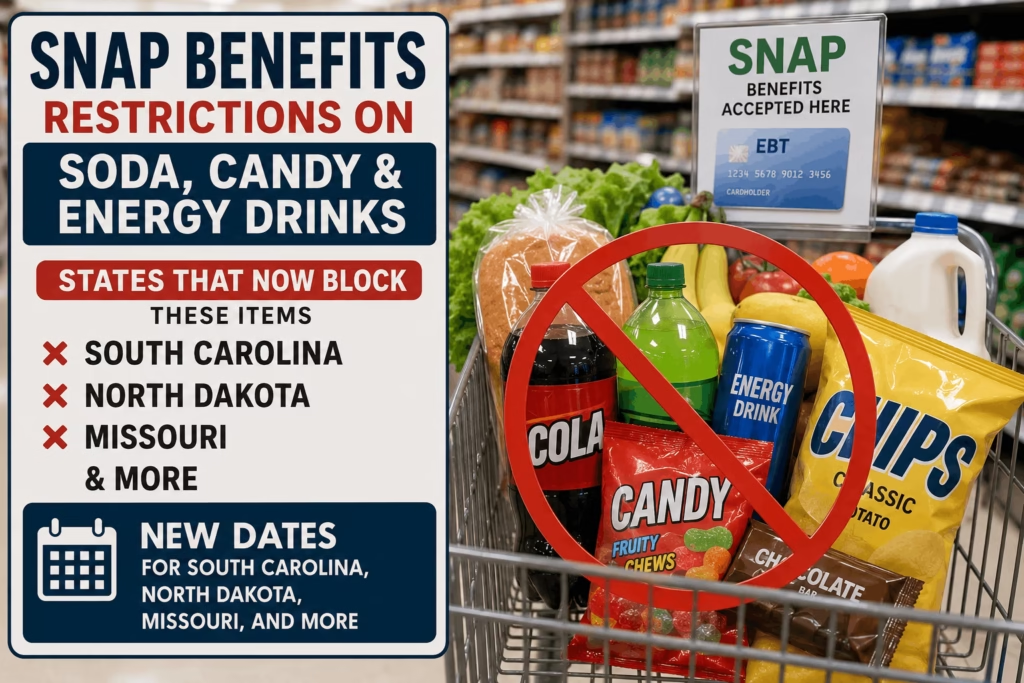
SNAP Soda and Candy Ban by State: South Carolina’s SNAP benefits will stop covering soda, candy, and energy drinks starting August 31, 2026, making it the latest state to roll out a food-stamp purchase restriction under the Make America Healthy Again push. The change follows a wave of similar rules already active in states like Arkansas, Florida, Texas, and Utah, and it arrives just weeks before North Dakota’s own restriction takes effect on September 1.
As of early August 2026, the U.S. Department of Agriculture’s Food and Nutrition Administration has approved SNAP food restriction waivers in 23 states, though a federal court ruling in June blocked five of them from moving forward for now. For the millions of households who rely on SNAP to buy groceries each month, that means the rules genuinely differ depending on where you live, and a restriction that applies in one state may not apply in a neighboring one at all. We’ll be updating this article monthly as more states roll out their SNAP purchase restrictions and as the ongoing court case develops.
What Is Happening With SNAP Purchase Restrictions
The Supplemental Nutrition Assistance Program, still widely known as food stamps, helps more than 40 million low and no-income Americans buy groceries every month through an EBT card loaded with a set benefit amount. Historically, SNAP dollars could be used for almost any food item except alcohol, tobacco, hot prepared meals, and a few other exclusions.
That is changing state by state. Agriculture Secretary Brooke Rollins has said that roughly 20 percent of all SNAP spending goes toward sugary drinks, candy, and salty snacks, and that sugary drinks specifically are the single most common purchase category among SNAP households. Under the Trump administration’s Make America Healthy Again initiative, championed alongside Health and Human Services Secretary Robert F. Kennedy Jr., USDA has been actively encouraging governors to apply for waivers that let their states carve soda and candy out of what SNAP benefits can buy.
These are technically called SNAP food restriction waivers, and each one is state-specific. A state has to apply, get USDA sign-off, and then set its own effective date and its own definition of what counts as a restricted item. That is why the rules look so different from state to state, ranging from a narrow ban on carbonated soft drinks to Iowa’s much broader restriction covering nearly every taxable food item under its state tax code.
Full State-by-State List of SNAP Restrictions
The table below reflects the most current data available as of early August 2026, based on USDA’s Food and Nutrition Administration waiver tracker.
| State | Effective Date | What Is Restricted | Current Status |
|---|---|---|---|
| Arkansas | July 1, 2026 | Soda, low-juice drinks, candy | Active |
| Colorado | Oct 30, 2026 | Soft drinks | Blocked by court ruling |
| Florida | Apr 20, 2026 | Soda, energy drinks, candy, prepared desserts | Active |
| Hawaii | Apr 1, 2027 | Soft drinks | Approved, not yet active |
| Idaho | Feb 15, 2026 | Soda and candy | Active |
| Indiana | Jan 1, 2026 | Soft drinks and candy | Active |
| Iowa | Jan 1, 2026 | Nearly all taxable food items | Blocked by court ruling |
| Kansas | Feb 15, 2027 | Candy and soft drinks | Approved, not yet active |
| Louisiana | Feb 18, 2026 | Soft drinks, energy drinks, candy | Active |
| Missouri | Feb 15, 2027 | Candy, prepared desserts, sweetened beverages | Approved, not yet active |
| Montana | Sep 30, 2026 | High-sugar drinks, energy drinks, candy | Approved, not yet active |
| Nebraska | Jan 1, 2026 | Soda and energy drinks; candy added Nov 1, 2026 | Blocked by court ruling |
| Nevada | Feb 1, 2028 | Candy and sugar-sweetened beverages | Approved, not yet active |
| North Dakota | Sep 1, 2026 | Sweetened beverages, energy drinks, candy | Approved, not yet active |
| Ohio | Oct 1, 2026 | Sugar-sweetened beverages | Approved, not yet active |
| Oklahoma | Feb 15, 2026 | Soft drinks and candy | Active |
| South Carolina | Aug 31, 2026 | Candy, energy drinks, soft drinks, sweetened beverages | Approved, not yet active |
| Tennessee | Jul 31, 2026 | Soda, energy drinks, candy | Blocked by court ruling |
| Texas | Apr 1, 2026 | Sweetened drinks and candy | Active |
| Utah | Jan 1, 2026 | Soft drinks | Active |
| Virginia | Oct 1, 2026 | Sweetened beverages | Approved, not yet active |
| West Virginia | Jan 1, 2026 | Soda | Blocked by court ruling |
| Wyoming | Feb 1, 2027 | Sweetened, carbonated beverages | Approved, not yet active |
If your state is not on this list, USDA has not approved a food restriction waiver there yet. Since new states are added regularly, it is worth bookmarking the official FNA tracker linked in the table further down this page.
South Carolina’s Restriction, Explained
South Carolina’s SNAP soda and candy ban takes effect August 31, 2026 and covers candy, energy drinks, soft drinks, and other sweetened beverages, one of the broader restrictions on the current list. Retailers that accept EBT in the state are expected to update their point-of-sale systems so restricted items are automatically declined when a customer tries to pay with SNAP benefits, though early rollout weeks in other states have sometimes seen checkout systems misflag items. South Carolina SNAP recipients who believe they were charged incorrectly can contact the state’s Department of Social Services, which administers the program locally.
IRS-ICE Data Sharing Ruling: What Immigrants and Green Card Holders Need to Know
Social Security Payment August 12, 2026: Who Gets Paid Today and When Is Your Next Check?
Fast-Track Deportation Ruling: Could It Affect Indian Immigrants?
North Dakota’s September 1 Start Date
North Dakota’s waiver restricts sweetened beverages, energy drinks, and candy starting September 1, 2026. Like most of the newer waivers, the state left day-to-day enforcement details, including how retailers flag restricted items, to its own SNAP administering agency rather than to USDA directly. North Dakota residents who currently receive food assistance should expect their EBT card to simply decline restricted items at checkout once the rule kicks in, rather than requiring any new application or paperwork on the recipient’s part.
Why Missouri’s Restriction Is Not Yet Active
Missouri’s waiver has been approved but is not scheduled to take effect until February 15, 2027, restricting candy, prepared desserts, and certain unhealthy beverages. That is a later date than some early reporting suggested, so Missouri SNAP households do not need to change their shopping habits for these items yet. The gap between approval and implementation is common. States generally need months to update EBT processing systems, coordinate with grocery retailers, and issue public guidance before a restriction actually goes live at the checkout counter.
The Court Ruling That Paused Five States
On June 22, 2026, a federal judge ruled in a case called Aragon v. Rollins that USDA had exceeded its legal authority by approving these restrictions as demonstration projects, since that authority is meant to test the SNAP program’s administrative efficiency rather than reshape what recipients are allowed to eat. The ruling specifically blocked waivers in Colorado, Iowa, Nebraska, Tennessee, and West Virginia. It does not affect the other 18 approved states, which remain active or on schedule regardless of the litigation.
USDA has until August 21, 2026 to file an appeal with the D.C. Circuit Court of Appeals. Secretary Rollins has said the administration intends to keep pursuing the restrictions nationwide, so households in the five paused states should not assume the issue is permanently settled.
Who Is Actually Affected Right Now
As of early August 2026, eight states have restrictions already active at checkout: Arkansas, Florida, Idaho, Indiana, Louisiana, Oklahoma, Texas, and Utah. Ten more states, including South Carolina, North Dakota, Missouri, Hawaii, Montana, Ohio, Virginia, Kansas, Wyoming, and Nevada, have approved waivers with dates still ahead. Five states, Colorado, Iowa, Nebraska, Tennessee, and West Virginia, have waivers that are currently on hold because of the court ruling.
If you are unsure whether a restriction currently applies to your own SNAP benefits, your best move is to check directly with your state’s SNAP office, since implementation details, retailer guidance, and definitions of restricted items vary even among states with similar rules.
ACA Subsidy Cliff 2026: Why Experts Warn of Astronomical Tax Bills?
Official SNAP Resources and Links
| Resource | What It’s For | Official Link |
|---|---|---|
| FNA SNAP Food Restriction Waiver Tracker | Full list of approved states, dates, and restricted items | fna.usda.gov/snap/waivers/foodrestriction |
| SNAP State Directory | Find your local SNAP office, application, and case contact info | fna.usda.gov/snap/state-directory |
| SNAP Applicant and Participant Portal | Apply for benefits or manage an existing case | fna.usda.gov/snap/applicant-participant |
| USDA National SNAP Hotline | Toll-free information line for recipients | 1-800-221-5689 |
| USDA National Hunger Hotline | Help finding food assistance programs | fna.usda.gov/contact-us |
FAQs
Which states currently restrict SNAP purchases of soda and candy?
Eight states have active restrictions as of early August 2026: Arkansas, Florida, Idaho, Indiana, Louisiana, Oklahoma, Texas, and Utah. Several more, including South Carolina and North Dakota, have approved rules set to begin later in 2026.
When does South Carolina’s SNAP restriction start?
South Carolina’s restriction on candy, energy drinks, soft drinks, and sweetened beverages takes effect August 31, 2026.
When does North Dakota’s SNAP restriction start?
North Dakota’s restriction on sweetened beverages, energy drinks, and candy takes effect September 1, 2026.
Is Missouri’s SNAP restriction active yet?
No. Missouri’s waiver has been approved but is not scheduled to take effect until February 15, 2027.
Why did a court block SNAP restrictions in five states?
A federal judge ruled in June 2026 that USDA lacked the legal authority to approve these waivers as demonstration projects, since that authority is meant to test program efficiency rather than change what food benefits can buy. The ruling applies only to Colorado, Iowa, Nebraska, Tennessee, and West Virginia.
Does the court ruling affect every state with an approved waiver?
No. It only applies to the five states named in that specific lawsuit. The other 18 approved states are unaffected and remain on their own schedules.
What exactly counts as restricted under these SNAP waivers?
It depends on the state. Most restrict soda, energy drinks, and candy. A few states also restrict prepared desserts, and Iowa’s waiver, currently blocked, is far broader, covering nearly all taxable food items under state law.
Will my EBT card just stop working for these items automatically?
Yes, in states with active restrictions, point-of-sale systems are set up to decline restricted items automatically when paid for with SNAP benefits. No action is required from recipients, though early weeks of a rollout can sometimes involve retailer errors.
Does this change how much money I get in SNAP benefits?
No. These waivers only change what categories of food and drink can be purchased with SNAP benefits. They do not reduce or increase the dollar amount of anyone’s monthly allotment.
Conclusion
The list of states restricting SNAP purchases of soda, candy, and energy drinks keeps growing, and the rules are far from uniform. South Carolina and North Dakota are the next two states set to roll out restrictions this month, joining eight states where the rules are already in effect, while Missouri, Hawaii, and several others still have months or years to go before their approved waivers actually kick in. At the same time, a federal court has paused the restrictions in five states, and USDA’s decision on whether to appeal that ruling could reshape how this plays out nationally. SNAP recipients are best served by checking their own state’s SNAP office directly rather than assuming a rule from a nearby state applies to them, since dates, definitions, and enforcement details differ from state to state.
IRS Warns of New IRS Phishing Schemes Targeting Tax Professionals
Public Charge Rule Rescinded 2026: New Green Card Eligibility Rules
Federal Funds Rate 3.62% Today: Mortgage and Credit Card Impact