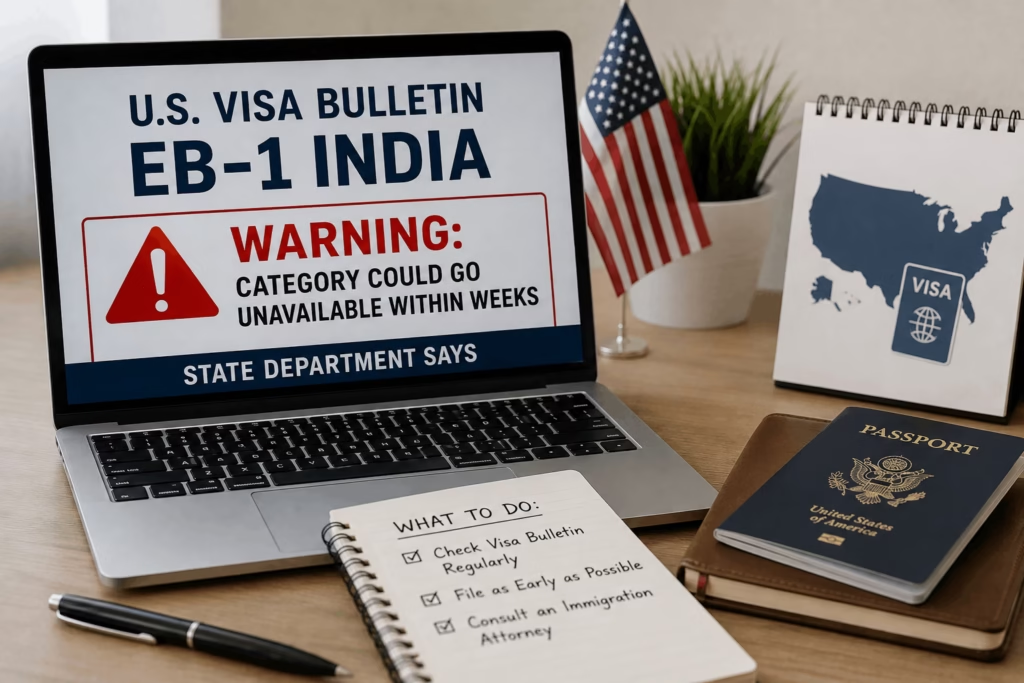
EB-1 India Visa Bulletin Warning: The State Department has issued a rare direct warning inside its own official bulletin: the EB-1 India category, the fastest employment-based green card path for Indian nationals with extraordinary ability, may become completely unavailable before the current fiscal year even ends. The August 2026 Visa Bulletin, released by the Bureau of Consular Affairs, says high demand and heavy use of visa numbers by applicants chargeable to India in the EB-1 category could force the agency to shut the category down entirely in the coming weeks, a move that would freeze green card processing for thousands of pending cases with no advance notice beyond this warning.
The bulletin kept the EB-1 India final action date frozen at October 15, 2022, unchanged for a second straight month after two consecutive retrogressions earlier this year. That freeze, combined with the explicit unavailability warning, is being read by immigration attorneys as one of the strongest signals yet that USCIS and the State Department are running out of room under the fiscal year 2026 annual limit. Indian nationals with EB-1 petitions already filed are now racing to get adjudicated or documentarily qualified before any shutdown takes effect. We will be updating this article monthly as new Visa Bulletin data is released.
What the August 2026 Visa Bulletin Says About EB-1 India
The official language in the August bulletin states that high demand and number use by applicants chargeable to India in the EB-1 category may necessitate making the category unavailable in the coming weeks if India’s pro-rated limit is reached before the fiscal year ends on September 30, 2026. This is not a routine advisory. The State Department typically only issues this kind of direct unavailability warning when annual per-country limits are close to being fully consumed.
For context, EB-1 covers priority workers, meaning individuals with extraordinary ability, outstanding professors and researchers, and multinational executives and managers. It has historically moved faster than other employment-based categories precisely because demand was lower relative to the visa numbers available. The fact that EB-1 India specifically is now facing a potential shutdown marks a significant shift in a category that Indian applicants have often used as an alternative to the far more backlogged EB-2 and EB-3 lines.
EB-2 India Already Unavailable This Month
While EB-1 India is under threat, EB-2 India has already gone unavailable in the August bulletin, marked with a “U” indicating that no further visa numbers can be issued in that category for the remainder of fiscal year 2026. The State Department attributes this to India’s prorated annual limit being reached ahead of schedule due to sustained high demand.
The bulletin does offer a note of cautious optimism for EB-2 India applicants. The Department of State projects that once fiscal year 2027 numbers become available on October 1, 2026, the EB-2 India final action date could return to July 15, 2014 or earlier. Immigration attorneys are quick to stress that this is a projection, not a guarantee, and that continued high demand could force another retrogression shortly after the reset.
Canada 50% Tariff 2026: Full List of Products That Could See Price Hikes
IRS-ICE Data Sharing Ruling: What Immigrants and Green Card Holders Need to Know
Visa Bulletin Key Employment-Based Dates August 2026
| Category | India | China | All Other Countries |
|---|---|---|---|
| EB-1 | October 15, 2022 (warning of possible unavailability) | July 1, 2023 | Current |
| EB-2 | Unavailable | September 1, 2021 | Current, with retrogression warning |
| EB-3 | Advancing slightly | Advancing slightly | Current |
| EB-5 Unreserved | Unavailable | December 1, 2016 | Current |
| Key Development | Date |
|---|---|
| August 2026 Visa Bulletin released | Late July 2026 |
| USCIS confirms Final Action Dates chart applies for employment-based filings | August 2026 |
| Current fiscal year 2026 ends | September 30, 2026 |
| New fiscal year 2027 visa numbers become available | October 1, 2026 |
| Projected EB-2 India reset date | July 15, 2014 or earlier (projected, not guaranteed) |
Why Is EB-1 India Retrogressing Now
Immigration analysts point to a few converging factors behind the current squeeze. Overall employment-based green card demand from India has remained elevated for years due to the country’s large population of skilled workers in the United States, many of whom are stuck in multi-decade backlogs in EB-2 and EB-3. As those categories became harder to access, more applicants who qualify have shifted toward filing EB-1 petitions, since it historically offered a faster route with no or minimal wait for Indian nationals.
That shift in filing behavior appears to be catching up with the category’s annual numerical limit faster than in prior years. Because per-country limits cap what share of total visa numbers any single country can receive in a given category and year, a surge in approved EB-1 India cases can push the country close to its ceiling well before the fiscal year ends, exactly the situation the State Department is now flagging.
What This Means for Pending EB-1 India Green Card Cases
For applicants with an EB-1 India priority date earlier than October 15, 2022, immigration attorneys describe the current period as a race against the calendar. If the category becomes officially unavailable before September 30, any pending adjustment of status application that has not yet been approved could be paused until new numbers become available at the start of fiscal year 2027 on October 1.
Attorneys are advising clients in this situation to push for faster adjudication wherever possible, ensure all supporting documentation is complete and submitted, and avoid unnecessary delays in responding to any Request for Evidence from USCIS, since even a short administrative delay could mean a case misses the window before a potential shutdown.
Should EB-1 India Applicants File Now or Wait
For those who have not yet filed but qualify for EB-1 based on their priority date, immigration lawyers are generally recommending filing as soon as possible rather than waiting. Applications properly filed while a category remains open generally stay validly filed even if the category later becomes unavailable, meaning applicants who file promptly do not automatically lose their place if a retrogression happens shortly afterward. Waiting until the category has already gone unavailable, however, closes the filing window entirely until new numbers open up in the next fiscal year.
Broader Retrogression Warnings Beyond India
The August bulletin’s cautionary language was not limited to India. The State Department also warned that sufficient demand and increased visa number use in the EB-2 category more broadly, not limited to India, may require retrogressing the final action date or making the category unavailable in the coming months to stay within the fiscal year 2026 annual limit. China’s EB-2 and EB-3 categories, along with the Philippines’ EB-3 category, were also flagged as categories where continued high demand could trigger similar action before the fiscal year closes.
This pattern suggests the squeeze on employment-based numbers in 2026 is broader than a single country or category, driven largely by overall demand outpacing the fixed annual visa allocation set by Congress decades ago and never adjusted for today’s applicant volumes.
SNAP Enrollment Drop 2026: Why 5 Million People Lost Benefits?
IRS Notice 2026-28: New Paid Family Leave Employer Credit Rules
Social Security Changes August 2026: SSA Announces Major Update for Retirees and Beneficiaries
What Happens When the New Fiscal Year Begins October 1
Historically, the start of a new fiscal year resets the annual employment-based visa quota, which can lead to renewed forward movement in priority dates across multiple categories. The State Department’s own projections point to this pattern repeating for EB-2 India specifically, with predicted movement back to July 15, 2014 once October arrives.
However, immigration attorneys caution that the amount of movement in October depends heavily on how much unused demand is carried over from the prior year and how the new annual limits for fiscal year 2027 are ultimately allocated. Applicants are being advised to prepare their cases now so they are ready to file the moment the new fiscal year’s numbers become available, rather than waiting to see what October brings before assembling documentation.
FAQs
What does it mean when a visa bulletin category is unavailable?
Unavailable, often shown as “U” in the bulletin, means the State Department cannot issue any more visa numbers in that category for that country for the remainder of the fiscal year because the annual limit has been reached. No new adjustment of status approvals or immigrant visa issuances can occur in that category until new numbers become available at the start of the next fiscal year.
Why is EB-1 India at risk of becoming unavailable?
The State Department says high demand and heavy visa number use by India-chargeable EB-1 applicants may exhaust India’s pro-rated share of the category’s annual limit before the fiscal year ends on September 30, 2026, a situation the agency is monitoring closely.
Is EB-2 India already unavailable in August 2026?
Yes. The August 2026 Visa Bulletin lists EB-2 India as unavailable for the remainder of fiscal year 2026, though the State Department projects the category could return to a final action date around July 15, 2014 once fiscal year 2027 begins on October 1, 2026.
Should I file my EB-1 India case now if my priority date is current?
Most immigration attorneys recommend filing as soon as possible rather than waiting, since cases properly filed while a category remains open generally continue to be processed even if the category later becomes unavailable.
What happens to my pending case if EB-1 India becomes unavailable?
Processing on new approvals in that category would pause until new visa numbers become available at the start of the next fiscal year on October 1. Cases already properly filed remain in the queue rather than being denied outright.
When will the next Visa Bulletin be released?
The Department of State typically releases the Visa Bulletin in the second half of each month for the following month, meaning the September 2026 bulletin, covering the final month of fiscal year 2026, is expected in the coming weeks.
Official Resources
| Resource | Purpose | Official Link |
|---|---|---|
| State Department Visa Bulletin | Official monthly priority date charts | travel.state.gov/visa-bulletin |
| USCIS adjustment of status filing charts | Which chart USCIS is accepting each month | uscis.gov/visabulletininfo |
| USCIS case status check | Track a pending I-485 or petition | egov.uscis.gov/casestatus/landing.do |
| USCIS online account | Manage immigration filings and documents | myaccount.uscis.gov |
| USCIS Form I-485 information | Adjustment of status filing instructions | uscis.gov/i-485 |
Conclusion
The EB-1 India visa bulletin warning inside the August 2026 release is one of the clearest signals yet that employment-based green card demand from India is outpacing the fixed annual limits Congress set decades ago. With EB-2 India already unavailable and EB-1 India now facing the same risk before the fiscal year closes on September 30, applicants and employers have a narrow window to act. Filing promptly, keeping documentation complete, and preparing for the October 1 fiscal year reset are the steps immigration attorneys are recommending right now. This article will be updated monthly as new Visa Bulletin data and USCIS filing guidance are released.
SNAP Soda and Candy Ban by State: Full List, Dates, and Rules for 2026