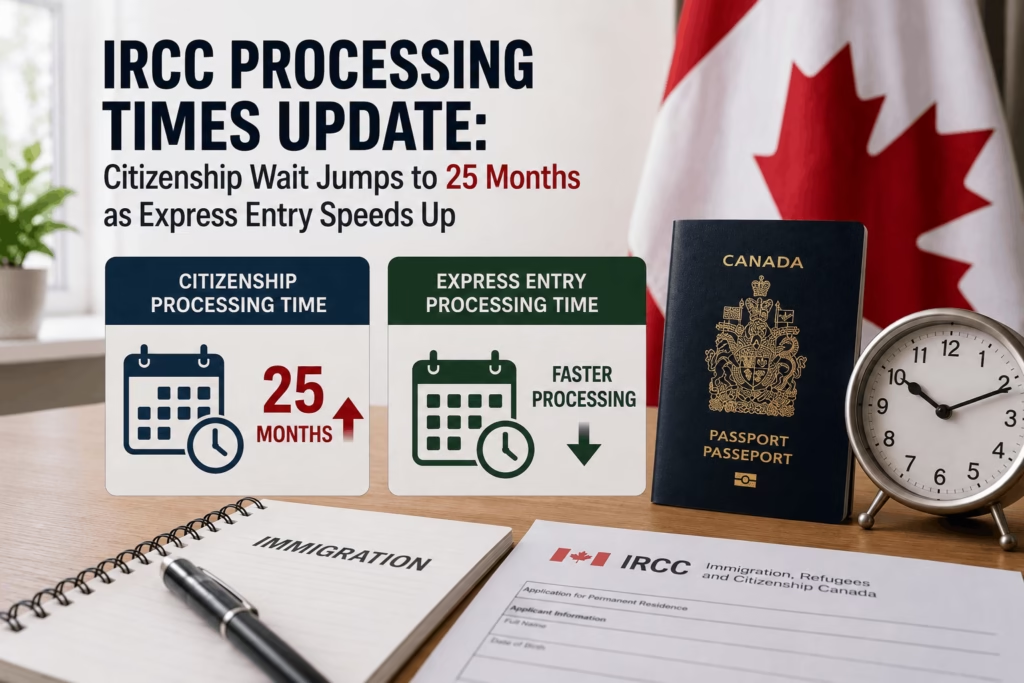
IRCC Processing Times Update: Immigration, Refugees and Citizenship Canada released fresh processing time data this month, and the numbers tell two very different stories depending on which line of the immigration system an applicant is standing in. Citizenship certificate applications, the paperwork used mainly by people confirming citizenship they already hold through descent, has jumped to 25 months, a six month increase in a single reporting cycle. The queue for that category grew by roughly 22,300 people to sit near 121,800 applicants, up from just 50,900 back in March. That means this one category alone has absorbed close to 70,000 new applicants and 22 extra months of wait time in under half a year, driven largely by the wave of citizenship by descent filings tied to the Bill C-3 changes that took effect in December 2025.
On the economic immigration side, the picture looks considerably better. The Federal Skilled Worker Program improved to six months for the first time this year, and its queue shrank by roughly 3,400 people. The Canadian Experience Class held steady at six months while its backlog dropped by about 1,800 applicants, and inland work permit processing fell to 119 days, one of the strongest sustained improvements anywhere in the 2026 data. Not every temporary category is moving in the right direction though. Visitor record extensions spiked to 316 days, up 112 days from the prior update, and work permit processing for applicants in Pakistan surged from roughly 10 weeks to 25 weeks. Because IRCC refreshes monthly categories once a month and weekly categories almost every week, we’ll be updating this article monthly, with interim notes whenever a weekly release shifts the numbers significantly.
IRCC Processing Times Key Highlights
| Category | Latest Processing Time | Change |
|---|---|---|
| Citizenship certificate | 25 months | +6 months |
| Citizenship grant | 12 months | No change |
| New PR card | 41 days | No change |
| PR card renewal | 42 days | +2 days |
| Canadian Experience Class (CEC) | 6 months | No change |
| Federal Skilled Worker Program (FSWP) | 6 months | -1 month |
| Spouse/common-law sponsorship (outside Canada, non-Quebec) | 17 months | No change |
| Parents and Grandparents sponsorship (non-Quebec) | 29 months | -1 month |
| Inland work permit (initial and extension) | 119 days | -3 days |
| Visitor record extension | 316 days | +112 days |
| Work permit, Pakistan | 25 weeks | +15 weeks |
| Study permit, India | 5 weeks | No change |
Citizenship Processing: The Category Driving the Headlines
The single biggest shift in this release involves citizenship certificate processing, which now sits at 25 months, up from 19 months last cycle and just three months back in March. The surge traces back to the expanded citizenship by descent provisions that came into force under Bill C-3 in December 2025, which opened eligibility to a wider group of applicants with Canadian ancestry, including a large number of Americans. IRCC processes applications in the order received, and the intake in this stream has significantly outpaced the staffing allocated to work through it, which is why the backlog has grown so quickly.
Citizenship grant applications, which cover people applying for citizenship for the first time rather than confirming existing citizenship, held steady at 12 months. Renunciation of citizenship dropped to four months, a three month improvement, while a search of citizenship records still takes roughly 17 months.
Permanent Resident Card and Passport Processing Times
PR card processing remains one of the more stable corners of the system. A new PR card currently takes 41 days, unchanged from the prior weekly update and 21 days faster than it was in January. A PR card renewal takes 42 days, a small two day increase.
Canadian passport processing has not shifted meaningfully in recent months. In person applications inside Canada are turning around in about 10 business days, mailed applications inside Canada take roughly 20 business days, and applications mailed from outside the country also run about 20 business days. Urgent, next day pickup and express two to nine day pickup remain available for travellers with proof of imminent travel.
IRS Warns of New IRS Phishing Schemes Targeting Tax Professionals
Public Charge Rule Rescinded 2026: New Green Card Eligibility Rules
Federal Funds Rate 3.62% Today: Mortgage and Credit Card Impact
Family Sponsorship Wait Times
Family sponsorship categories continue to show a wide gap depending on where the applicant is filing from. Spousal and common law sponsorship for applicants living outside Canada currently runs about 17 months for non-Quebec cases and 33 months for Quebec cases. Inland spousal sponsorship, where the sponsored partner is already living in Canada, takes about 27 months outside Quebec and 32 months in Quebec.
Parents and Grandparents sponsorship improved slightly, dropping to 29 months outside Quebec, a one month improvement and the fourth straight monthly decline in that category. The Quebec stream for parents and grandparents fell to 64 months, also down one month.
Permanent Residency Through Economic Programs
This is where the August data offers the most encouraging news for skilled worker applicants. The Federal Skilled Worker Program improved to six months, the fastest it has been all year, while its applicant queue fell by about 3,400 people to roughly 52,400. The Canadian Experience Class held at six months with a shrinking queue of about 59,700 applicants, down 1,800 from the prior update.
Provincial Nominee Program candidates who applied through Express Entry are seeing seven month processing, unchanged from last cycle, while Non-Express Entry PNP applicants face a longer 13 month wait, up one month. Quebec Skilled Worker applications are processing in about 11 months. Categories with persistently long timelines include Quebec Business Class at roughly 75 months, Federal Self-Employed applications and Start Up Visa applications, both listed at more than 10 years due to extremely limited annual admission targets relative to queue size. The Atlantic Immigration Program currently takes about 26 months.
Humanitarian and Compassionate Applications
Humanitarian and Compassionate applications remain the slowest-moving category in the entire system, still listed at more than 10 years for both Quebec and non-Quebec applicants. Protected persons applying for permanent residence from inside Canada, outside Quebec, are seeing roughly 13 month processing, a one month improvement, while the equivalent Quebec stream still runs beyond 120 months. Dependents of protected persons outside Quebec now face roughly 40 months, a two month increase from the prior cycle.
Temporary Resident Processing Times: Visitors, Students, and Workers
Weekly categories moved in several directions at once this update. Visitor visa applications from outside Canada currently average 27 days for applicants in India, 21 days for the United States, 68 days for Nigeria, 48 days for Pakistan, and 16 days for the Philippines. Visitor visa applications filed from inside Canada now take 21 days, down eight days from the prior update.
The standout concern this cycle is the visitor record extension category, which jumped to 316 days, a sharp reversal after months of gradual improvement and now 165 days above where it stood in late January. Super visa processing shows a mixed picture too, with India at 56 days, the United States at 126 days, Nigeria at 43 days, Pakistan at 185 days, and the Philippines climbing 32 days to 100 days.
Study permits filed from outside Canada currently run about five weeks for applicants in India, the United States, and the Philippines, while Nigeria and Pakistan sit at seven weeks. Study permit extensions have improved to 70 days, down 34 days compared to January.
Work permit processing shows the widest country by country spread of any category. Applicants from the United States are seeing roughly three week processing, the Philippines about six weeks, India nine weeks, and Nigeria seven weeks, while Pakistan has surged to 25 weeks, a jump of 15 weeks in a single update. Inland work permit processing, covering both initial applications and extensions filed from within Canada, has fallen to 119 days and remains one of the clearest improvement stories in the entire 2026 dataset. Seasonal Agricultural Worker Program applications currently take about 71 days, up 24 days from the prior cycle, and International Experience Canada work permits sit at seven weeks. Electronic Travel Authorization approvals continue to arrive within minutes for most travellers, with up to 72 hours for applications flagged for extra screening.
ACA Subsidy Cliff 2026: Why Experts Warn of Astronomical Tax Bills?
Why Processing Times Move So Much From One Update to the Next
IRCC calculates published processing times based on how long it actually took to finish 80 percent of applications completed recently in each category, which means these are real outcome based figures rather than fixed targets or guarantees. Application volume, staffing at individual visa offices, seasonal demand, and policy changes all influence how quickly a given stream moves. A single country’s work permit timeline can shift by weeks in one update if that visa office faces a spike in security screening referrals or a temporary staffing gap, which is part of what appears to be happening with Pakistan’s current work permit backlog.
Applicants should also remember that incomplete applications remain one of the most common reasons for delay and refusal across every category, so submitting a fully documented file the first time is still the single most effective way to avoid falling into the slower end of a processing window.
Official IRCC Resources and Links
| Resource | Purpose | Official Link |
|---|---|---|
| Check processing times | Official IRCC tool for every application type | canada.ca/en/immigration-refugees-citizenship/services/application/check-processing-times.html |
| IRCC secure account login | Track an existing application | canada.ca/en/immigration-refugees-citizenship/services/application/account.html |
| Start a new application | Applications for PR, citizenship, visas, and permits | canada.ca/en/immigration-refugees-citizenship/services/application.html |
| Express Entry profile | Create or update an Express Entry profile | canada.ca/en/immigration-refugees-citizenship/services/immigrate-canada/express-entry.html |
| Citizenship application status | Citizenship grant and certificate applications | canada.ca/en/immigration-refugees-citizenship/services/canadian-citizenship.html |
| Canadian passport services | New passports, renewals, and pickup options | canada.ca/en/immigration-refugees-citizenship/services/canadian-passports.html |
| IRCC contact and webform | Escalate an application beyond normal processing time | canada.ca/en/immigration-refugees-citizenship/corporate/contact-ircc.html |
FAQs
Why is citizenship certificate processing taking so much longer than it did earlier this year?
The increase is tied to a large wave of citizenship by descent applications filed after Bill C-3 expanded eligibility in December 2025, particularly from applicants in the United States with Canadian ancestry. The queue has grown much faster than the stream’s processing capacity.
Does a longer processing time mean my application has a problem?
Not necessarily. Published processing times reflect how long it took to complete 80 percent of recently finished applications in that category, so individual files can take longer or shorter depending on complexity, completeness, and whether additional documents or background checks are required.
How often does IRCC update processing times?
Monthly categories such as citizenship, family sponsorship, and permanent residency through economic programs are refreshed once a month. Weekly categories, including visitor visas, study permits, work permits, super visas, and PR cards, are typically refreshed every one to two weeks.
What can I do if my application has gone well beyond the posted processing time?
IRCC generally recommends contacting the department through its webform once your file has exceeded the posted time by roughly 50 percent, or requesting your GCMS notes through an access to information request to see the current status in detail.
Why did the Pakistan work permit processing time increase so sharply in this update?
Sharp single country increases like this typically point to a rise in applications needing extra security screening, a batch of complex cases at that visa office, or a temporary staffing or capacity shift at the office handling those files.
People Also Ask
How long does it take to get permanent residence in Canada in 2026? Express Entry programs such as the Federal Skilled Worker Program and Canadian Experience Class are currently processing in about six months, while Provincial Nominee Program applicants through Express Entry are seeing roughly seven months.
What is the fastest way to immigrate to Canada right now? Express Entry remains the fastest pathway for skilled workers, with most Express Entry permanent residence applications currently completing within six to seven months once an invitation to apply has been issued.
Why do some Canada visa applications take over 10 years? Categories like the Start Up Visa, Federal Self-Employed program, and Humanitarian and Compassionate applications outside Quebec have annual admission targets that are far smaller than their applicant queues, which pushes published processing times past the 10 year mark for the slowest files in line.
Can I check my own IRCC application status online? Yes, applicants can track the status of an existing application through their secure IRCC account, which shows the most recent status update, any outstanding document requests, and estimated next steps for that specific file.
Conclusion
This month’s IRCC processing times update makes clear that Canada’s immigration system is not moving at one uniform speed. Economic immigration streams like the Federal Skilled Worker Program and the Canadian Experience Class are processing faster and clearing backlogs, and inland work permits continue a months long improvement trend. At the same time, citizenship certificate applications, visitor record extensions, and work permits from certain countries are seeing some of the sharpest wait time increases of the year. Anyone with a pending application should check the official IRCC processing times tool directly for their specific category and country, since national averages can shift quickly between updates. As IRCC continues releasing new monthly and weekly figures, this article will be revised to reflect the latest confirmed numbers.
Social Security Payment August 12, 2026: Who Gets Paid Today and When Is Your Next Check?
Fast-Track Deportation Ruling: Could It Affect Indian Immigrants?