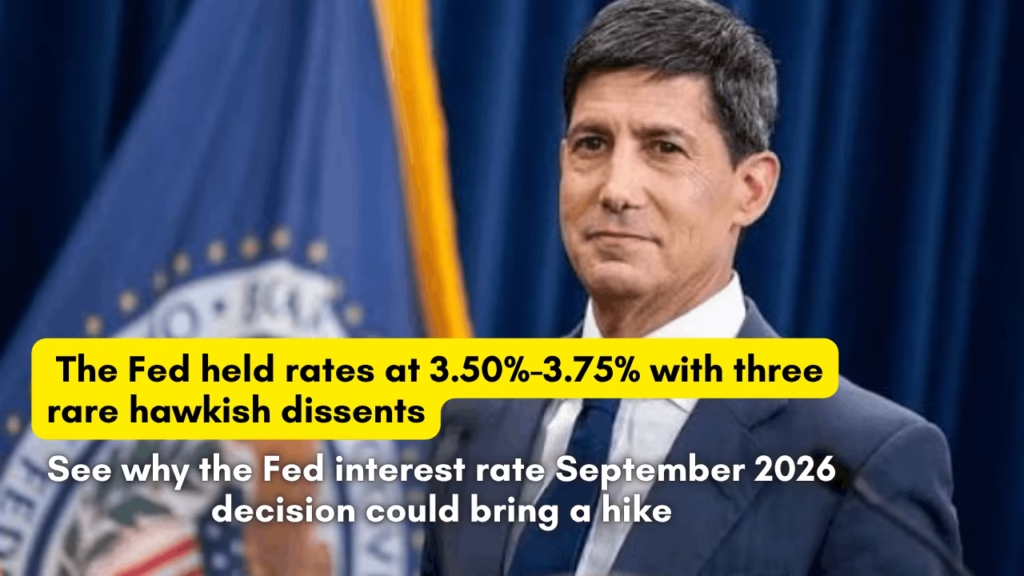
Fed Interest Rate September 2026 : The Federal Reserve held its benchmark interest rate steady at 3.50% to 3.75% on July 29, 2026, but the decision came with an unusual twist that has markets now bracing for a possible Fed interest rate September 2026 hike. Three regional Federal Reserve presidents, Beth Hammack of Cleveland, Neel Kashkari of Minneapolis, and Lorie Logan of Dallas, dissented from the hold and pushed for an immediate quarter-point increase, marking the first time since September 2016 that three Federal Open Market Committee members have dissented with a unified hawkish view.
Fed Chair Kevin Warsh described the internal debate as a “good family fight” during his post-meeting press conference, acknowledging the split while declining to signal where the committee is headed next. Bond markets reacted immediately, with the 10-year Treasury yield climbing to nearly 4.68% and the 30-year yield surging past 5.19%, its highest level in nearly two decades, as investors priced in a real chance of tighter policy ahead. Major Wall Street institutions, including J.P. Morgan Wealth Management, have since shifted their outlook to now expect a 25-basis-point rate hike at the Fed’s next meeting, a notable change from a prior base case of no rate changes at all in 2026. This article breaks down exactly what happened at the July meeting, why the dissents matter, and what to watch for heading into the September decision. We’ll be updating this article monthly as new inflation data and Fed commentary shape the outlook.
What the Fed Actually Decided on July 29, 2026
The Federal Open Market Committee voted 9-3 to hold the federal funds rate in its current target range of 3.50% to 3.75%, where it has sat since being lowered through a series of rate cuts in the second half of 2025. The committee’s official statement was largely unchanged from the previous month, noting that economic activity continues to expand at a solid pace, productivity growth and capital investment remain strong, and job gains have kept pace with the size of the workforce. At the same time, the statement acknowledged that inflation remains elevated relative to the Fed’s 2% target, a condition that has now persisted for more than five years.
Unlike some previous meetings this year, the July decision did not include an updated Summary of Economic Projections or dot plot, since those quarterly forecasts are only released at the March, June, September, and December meetings. That means the September 2026 meeting will be the next opportunity for the public to see individual committee members’ rate projections in detail.
The Historic Three-Way Hawkish Dissent
What set the July meeting apart was not the decision to hold, which matched market expectations, but who dissented and why. Hammack, Kashkari, and Logan all voted against the hold in favor of raising rates by a quarter point immediately, citing concerns that inflation risks were becoming too serious to ignore. According to Fed watchers, this marked the first time in nearly a decade that three FOMC members dissented together with a consistent hawkish position, a signal that a meaningful bloc within the committee now views the current policy stance as too loose given ongoing price pressures.
This shift stands in sharp contrast to earlier in 2026. At the March meeting, the committee held rates on an 11-1 vote, with Governor Stephen Miran dissenting in favor of a rate cut. The April meeting saw four total dissents, reflecting a genuine split over how quickly to ease policy while inflation remained above target. By June, when new Fed Chair Kevin Warsh held his first meeting at the helm, the committee voted a unanimous 12-0 to hold rates steady. The move from unanimous agreement in June to a three-person hawkish revolt in July illustrates just how quickly sentiment on the committee shifted over a single summer.
2027 COLA Increase for VA Disability: How Much Could Benefits Rise Under the Latest Projection
How Markets Reacted to the July Decision
Financial markets responded quickly and negatively to the combination of the hold and the hawkish dissents. The Dow Jones Industrial Average dropped more than 840 points, or roughly 1.6%, shortly after Warsh’s press conference, while the S&P 500 fell about 1% and the Nasdaq Composite slid around 0.9%. In the bond market, the reaction was more complex: the 2-year Treasury yield, which closely tracks near-term Fed policy expectations, actually fell slightly to around 4.24%, while longer-term yields surged. The 10-year yield rose to nearly 4.68%, and the 30-year yield jumped more than 12 basis points to above 5.19%, its highest level in roughly 19 years. This divergence between short and long-term yields suggested traders were less certain about the exact timing of the next move but increasingly worried about the Fed’s ability to keep long-run inflation under control.
According to the CME FedWatch Tool, market-implied odds of a September hike stood at 78.8% on the morning of the July meeting, then eased somewhat to 60.1% immediately following Warsh’s press conference, reflecting the market digesting his deliberately limited forward guidance.
Why September Hike Chances Are Rising Now
Two main forces have pushed major Wall Street strategists toward expecting a rate hike in September rather than continued holds. First, ongoing supply-chain disruptions tied to the conflict involving Iran have kept energy prices elevated, adding fresh inflationary pressure at a time when the Fed was already struggling to bring price growth back to its 2% target. Second, investors have grown increasingly skeptical of the Fed’s inflation-fighting credibility following the July hold, particularly given the unusual show of hawkish dissent from three sitting regional presidents. J.P. Morgan Wealth Management strategists specifically cited both factors in shifting their formal forecast to now include a 25-basis-point hike at the September meeting, a departure from their previous base case of no rate movement at all through the remainder of 2026.
Chair Warsh has also repeatedly emphasized in public remarks that inflation needs to come down further to satisfy the committee’s mandate, telling reporters that “if we get policy right, and we will, the inflation surge of the last five years will be a thing of the past.” While Warsh has been careful not to explicitly commit to a September hike, his consistent framing around price stability as the Fed’s foremost priority has reinforced market expectations that the committee is leaning in a more hawkish direction than it was earlier in the year.
2026 FOMC Meetings: From Dovish Dissents to Hawkish Ones
| Meeting Date | Decision | Dissent Details |
|---|---|---|
| January 27-28, 2026 | Held at 3.50%-3.75% | No significant dissent reported |
| March 17-18, 2026 | Held at 3.50%-3.75% | 11-1 vote; Governor Stephen Miran dissented for a rate cut |
| April 28-29, 2026 | Held at 3.50%-3.75% | 4 total dissents, reflecting a split over the pace of easing |
| June 16-17, 2026 | Held at 3.50%-3.75% | Unanimous 12-0 vote; Chair Warsh’s first meeting |
| July 28-29, 2026 | Held at 3.50%-3.75% | 9-3 vote; three hawkish dissents for a rate hike |
| September 15-16, 2026 | Decision pending | Market-implied hike odds elevated heading in |
What a September Rate Hike Would Mean for Borrowers and Savers
If the Fed does raise rates by a quarter point in September, the practical effects would ripple across several parts of the economy. Variable-rate debt, including many credit cards and home equity lines of credit, would likely see their interest rates tick upward relatively quickly, since these are often tied directly to the prime rate, which moves in step with Fed policy. Mortgage rates, while not directly set by the Fed, are influenced by longer-term Treasury yields, which have already risen meaningfully since the July meeting in anticipation of tighter policy, meaning potential homebuyers may already be feeling some of this pressure even before any formal September hike is announced. On the other side, savers with high-yield savings accounts and certificates of deposit could see modestly better returns if rates move higher, since banks typically adjust deposit rates in response to changes in the federal funds rate, though usually with some lag.
Social Security Spousal Benefit Rule Almost Everyone Gets Wrong, and What It Actually Costs
Canada 50% Tariff 2026: Full List of Products That Could See Price Hikes
When Is the Next Fed Meeting?
The Federal Reserve’s next scheduled policy meeting is September 15-16, 2026, with the interest rate decision set to be announced at 2:00 p.m. Eastern Time on September 16. This meeting is considered especially significant because it includes an updated Summary of Economic Projections, commonly known as the dot plot, giving the public its first detailed look since June at where individual Fed officials expect rates to head over the remainder of 2026 and into 2027. Chair Warsh will hold a press conference following the announcement, as he has after every meeting so far in 2026.
Key Facts About the July 2026 Fed Decision
| Detail | Information |
|---|---|
| Decision date | July 29, 2026 |
| Rate held at | 3.50% to 3.75% |
| Vote count | 9-3 |
| Dissenting members | Beth Hammack, Neel Kashkari, Lorie Logan (all favored a rate hike) |
| Significance of dissent | First 3-member unified hawkish dissent since September 2016 |
| Current effective federal funds rate | Approximately 3.62% |
| Market hike odds after meeting (CME FedWatch) | 60.1% for September |
| Next FOMC meeting | September 15-16, 2026 |
| Next rate decision announcement | September 16, 2026, 2:00 p.m. ET |
Official Resources and Where to Track the Fed’s Next Move
| Resource | Purpose | Link |
|---|---|---|
| Federal Reserve official calendar | Full FOMC meeting schedule and statements | federalreserve.gov/newsevents/calendar.htm |
| FOMC press releases | Official statements from each meeting | federalreserve.gov/newsevents/pressreleases.htm |
| Selected Interest Rates (H.15) | Daily official Treasury and Fed rate data | federalreserve.gov/releases/h15 |
| CME FedWatch Tool | Market-implied probability of Fed rate moves | cmegroup.com (FedWatch Tool) |
| Summary of Economic Projections | Official Fed dot plot and forecasts | federalreserve.gov/monetarypolicy/fomcprojtabl |
OAS Payment Increase August 2026: Confirmed Amounts, Payment Date, and the Annual GIS Reset !
Weekly Jobless Claims Report: 199,000 Filings Signal Labor Market Cooling
Fast-Track Deportation Ruling: Could It Affect Indian Immigrants?
FAQs
What did the Fed decide at its July 2026 meeting?
The Federal Open Market Committee voted 9-3 to hold the federal funds rate at 3.50% to 3.75%, with three regional Fed presidents dissenting in favor of an immediate rate hike.
Why is a Fed interest rate hike expected in September 2026?
Rising energy costs tied to the ongoing Iran conflict, persistent inflation above the Fed’s 2% target, and growing market doubts about the Fed’s inflation-fighting credibility after the July dissents have led major forecasters like J.P. Morgan Wealth Management to now expect a 25-basis-point hike at the September meeting.
When is the next Fed meeting?
September 15-16, 2026, with the rate decision announced at 2:00 p.m. Eastern Time on September 16, alongside an updated Summary of Economic Projections and dot plot.
Who is the current Federal Reserve Chair?
Kevin Warsh, who was appointed by President Trump and held his first press conference as chair on June 17, 2026, after Jerome Powell’s term as chair ended earlier in the year.
How rare was the three-member dissent at the July meeting?
Very rare. It was the first time since September 2016 that three FOMC members dissented together with a unified hawkish position favoring higher rates.
How would a September rate hike affect mortgage rates?
The Fed does not set mortgage rates directly, but mortgage rates are influenced by longer-term Treasury yields, which have already risen since the July meeting in anticipation of tighter policy, meaning some upward pressure on mortgage rates may already be underway.
What is the current federal funds rate?
The target range is 3.50% to 3.75%, with the effective federal funds rate currently sitting at approximately 3.62% within that range.
Does the Fed always signal its next move in advance?
Not under the current leadership. Chair Warsh has said the Fed will observe market reactions directly rather than provide extensive forward guidance, making each meeting’s outcome somewhat less predictable than under some previous Fed chairs.
Conclusion
The Fed’s decision to hold rates at 3.50% to 3.75% in July 2026 was expected, but the rare three-member hawkish dissent from Hammack, Kashkari, and Logan has fundamentally shifted market expectations heading into the September 15-16, 2026 meeting. With energy-driven inflation pressures persisting and major forecasters now penciling in a possible quarter-point hike, borrowers and savers alike should watch the upcoming Summary of Economic Projections closely, since it will offer the clearest signal yet of where the committee, and Chair Warsh specifically, believes policy needs to go next.
Federal Employee RIF Rules 2026: What the New OPM Regulations Actually Change
IRS Releases New Details on the Saver’s Match Program: Up to $1,000 for Your Retirement Account
IRS SSA Advanced Leave Suspension: What Federal Employees Need to Know
Small Personal Loans for Bad Credit USA: Direct Lenders With Same-Day Approval and Funding