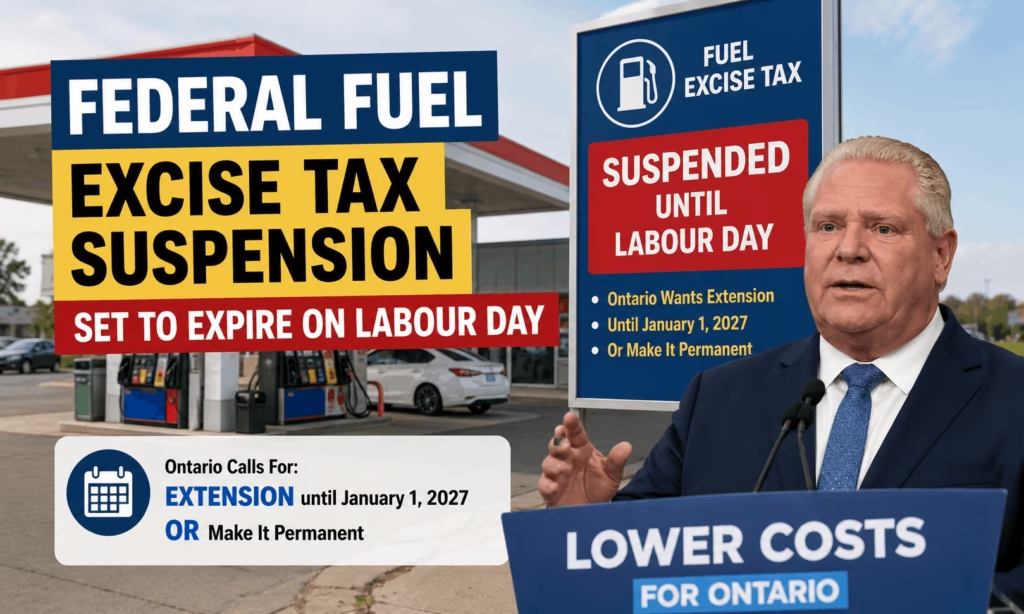
Federal Fuel Excise Tax Suspension: Ontario Premier Doug Ford has thrown down a direct challenge to Prime Minister Mark Carney over gas prices, demanding the federal government extend or permanently cancel the federal fuel excise tax suspension that is due to expire on Labour Day. In a letter sent Friday, August 7, 2026, Ford asked Carney to keep the tax break in place until at least January 1, 2027, arguing that Canadians cannot absorb a sudden jump at the pumps while the cost of living remains a dominant political issue across the country. The request lands just weeks before the suspension’s scheduled end date and puts fresh pressure on the federal government to decide whether the relief measure becomes a permanent fixture or quietly disappears as originally planned.
The federal fuel excise tax suspension has already been saving Canadians 10 cents per litre on regular gasoline and 4 cents per litre on diesel since it took effect on April 20, 2026. Carney introduced the pause in response to oil price shocks tied to the US-Israel war on Iran, framing it as real relief for households and businesses squeezed by volatile energy costs. With the measure set to lapse on September 7, 2026, Ford’s letter has turned what was meant to be a temporary, time-limited response to a global shock into an open political question about whether Ottawa is willing to make it permanent. We’ll be updating this article monthly as the federal government responds and as the Labour Day deadline approaches.
What Is the Federal Fuel Excise Tax Suspension?
The federal excise tax on gasoline and diesel is a longstanding charge collected by the government on every litre of fuel sold in Canada, separate from provincial fuel taxes and separate from the now-cancelled federal consumer carbon price. On April 14, 2026, Prime Minister Mark Carney announced that Canada’s government would temporarily suspend the full amount of that excise tax on gasoline and diesel starting April 20, 2026, running through September 7, 2026, which falls the day after Labour Day. The federal excise tax on aviation fuel was suspended at the same time.
According to the Prime Minister’s Office, the move was designed to reduce operating costs for truckers and businesses in the food, agriculture, housing, construction, and delivery sectors, while also easing costs for everyday drivers filling up at the pump. Global conflict and supply disruptions tied to the Middle East had pushed oil prices higher heading into the spring, and the federal government described the suspension as a direct, immediate way to bring down costs while longer-term energy projects were still being built out.
Key Facts and Dates
| Detail | Information |
|---|---|
| Suspension announced | April 14, 2026 |
| Suspension took effect | April 20, 2026 |
| Scheduled expiry | September 7, 2026 (Labour Day) |
| Savings on gasoline | 10 cents per litre |
| Savings on diesel | 4 cents per litre |
| Also covered | Federal excise tax on aviation fuel |
| Ford’s letter to Carney | August 7, 2026 |
| Ford’s requested extension | Until at least January 1, 2027, or permanent |
| Ontario’s own provincial gas tax cut | Made permanent in 2025, keeping the rate at 9 cents per litre |
Why Doug Ford Wants the Suspension Extended
In his letter to the prime minister, Ford argued that Canadians simply cannot afford higher prices at the pumps right now, and he framed the timing as urgent given that the suspension is set to lapse in a matter of weeks. Ford wrote that if Carney agreed to extend the federal fuel tax holiday until January 1, the federal government could also match Ontario’s own approach by making the suspension permanent altogether, rather than treating it as a temporary bridge measure.
Ford’s position draws directly on Ontario’s own experience with fuel tax relief. The province first cut its provincial gas tax by 5.7 cents per litre and its diesel tax by 5.3 cents per litre back in 2022, a move that was repeatedly extended over the following years before the Ford government made the cut permanent in 2025. That decision effectively harmonized Ontario’s fuel tax rate at 9 cents per litre for both gasoline and diesel, a change the province says saves the average household about 115 dollars a year under the 2026 provincial budget. Ford is essentially asking Ottawa to follow the same playbook it used provincially, treat the relief as permanent policy rather than letting it expire on schedule.
USCIS Restored Power To Deny Without RFE: Here Is What Policy Alert PA-2026-05 Actually Changes
IEEPA Tariff Refund Process: How Businesses Are Claiming Their Share of $166 Billion
50% US Tariffs on Canadian Goods: Full List and What Changes
Political Alignment: Ford and Poilievre Find Rare Common Ground
Ford’s letter also lands at an unusual moment in Canadian conservative politics. Federal Conservative Leader Pierre Poilievre has separately urged the Carney government to cancel what he calls a planned tax hike, pushing Ottawa to suspend the federal fuel excise tax and the GST charged on gasoline and diesel, while also calling for the permanent elimination of the clean fuel standard and the industrial carbon tax. Ford’s request to extend the suspension to January 1, 2027, effectively lines up with Poilievre’s broader campaign on fuel costs, even though the Ontario premier and the federal Conservative leader have had a famously strained relationship over the past several years that has at times split the country’s conservative movement.
That alignment matters politically because it puts pressure on Carney’s Liberal government from two directions at once, a sitting provincial premier making a direct policy request through official government channels, and the federal opposition leader making the same broad argument on the national stage.
How Carney’s Government Has Responded So Far
As of the latest update, the prime minister’s office has not committed to extending or cancelling the suspension. In an emailed response to questions about Ford’s letter, Carney’s press secretary John Fragos did not directly address whether the government would extend the fuel tax pause. Instead, Fragos said the government will continue to pursue measures with the provinces that advance Canada’s growth and competitiveness agenda, lower costs and the sources of them, and respond to the challenging global economic environment the country currently faces.
Fragos pointed to other cost-of-living measures the federal government has already rolled out as evidence of its broader approach, including the Canada Groceries and Essentials Benefit, the earlier cancellation of the consumer carbon tax, and recent reductions to housing-related costs. The response suggests Ottawa sees the fuel excise suspension as one piece of a wider affordability strategy rather than a standalone commitment it is prepared to extend indefinitely without further review.
What Happens If the Suspension Is Not Extended
If Carney’s government allows the suspension to lapse on schedule, the federal excise tax on gasoline and diesel would resume at its previous rate starting September 8, 2026, effectively adding back the 10 cents per litre on gasoline and 4 cents per litre on diesel that drivers and businesses have been saving since April. For a household filling a typical 50 litre tank weekly, that reversal would add roughly 5 dollars back to every fill-up on gasoline alone, a change that would be immediately visible at the pump the day after Labour Day.
Businesses in trucking, food distribution, agriculture, construction, and delivery services, the sectors the federal government specifically cited when announcing the suspension, would also see fuel costs rise again, a factor that could feed into broader price pressures on groceries and other goods that rely on trucked transportation across the country.
Borrower Defense Student Loans: How to Apply for a Full Discharge?
IRS Business Tax Account New Features Give Small Businesses More Ways to Skip the Phone Line
SSA Payroll Information Exchange and New SSI Improvement Office: What the Report Actually Changes
Official Government Resources
| Resource | Purpose | Link |
|---|---|---|
| Prime Minister of Canada, Official Announcements | Original April 2026 fuel excise tax suspension announcement | https://www.pm.gc.ca/en/news/news-releases |
| Canada Revenue Agency, Excise Taxes and Duties | Federal excise tax rates and current status | https://www.canada.ca/en/revenue-agency/services/tax/excise-taxes-duties.html |
| Ontario Ministry of Finance | Provincial gas tax rate information | https://www.ontario.ca/page/gas-tax |
| Natural Resources Canada, Fuel Prices | Current average fuel prices by region | https://www.nrcan.gc.ca/energy/fuel-prices/18664 |
FAQs
What is the federal fuel excise tax suspension?
It is a temporary pause on the federal excise tax charged on gasoline, diesel, and aviation fuel across Canada, introduced by Prime Minister Mark Carney’s government starting April 20, 2026, and originally scheduled to end on Labour Day, September 7, 2026.
How much money does the fuel tax suspension actually save drivers?
The suspension removes 10 cents per litre from the price of regular gasoline and 4 cents per litre from diesel, savings that apply automatically at the pump without any application or claim process required from individual drivers.
Why is Doug Ford asking Carney to extend the gas tax suspension?
Ford argues Canadians cannot afford higher prices at the pump right now and wants the suspension extended to at least January 1, 2027, or made permanent altogether, pointing to Ontario’s own decision to permanently cut its provincial gas tax as a model for the federal government to follow.
When does the current federal fuel excise tax suspension expire?
The suspension is currently scheduled to expire on September 7, 2026, the day after Labour Day, unless the federal government announces an extension before that date.
Has Prime Minister Carney agreed to extend the suspension?
Not yet. As of the most recent update, Carney’s office has not confirmed whether it will extend the suspension, with a spokesperson saying only that the government will continue pursuing measures to lower costs for Canadians without directly committing to an extension.
Does this affect the price of diesel for truckers and businesses?
Yes. The suspension applies to diesel as well as gasoline, and the federal government specifically cited truckers and businesses in food, agriculture, housing, construction, and delivery sectors as beneficiaries of the reduced operating costs.
Is this the same as the carbon tax that was cancelled earlier?
No. The federal fuel excise tax is a separate, longstanding charge from the consumer carbon price, which Carney’s government eliminated through an order-in-council effective April 1, 2025. The excise tax suspension is a distinct, temporary measure introduced more than a year later in response to global oil price pressures.
Conclusion
The clock is now running on one of the more closely watched cost-of-living decisions facing Ottawa this fall. Doug Ford’s letter has turned a temporary, crisis-driven tax pause into a test of whether the Carney government is willing to make gas tax relief a lasting policy rather than a short-term response to a geopolitical shock that has since eased. With Labour Day just weeks away and both a provincial premier and the federal opposition leader pushing in the same direction, the pressure on the federal government to clarify its plans is only going to grow. Whether Carney extends the suspension, lets it expire, or lands somewhere in between will shape fuel prices for millions of Canadian households and businesses heading into the fall. We’ll be updating this article monthly as the federal government finalizes its decision and as the September 7 deadline draws closer.
New $20,000 Visa Bond Program: What It Means for Travelers Entering the U.S.
VA Health and Benefits App: Every Feature You Can Use From Your Phone