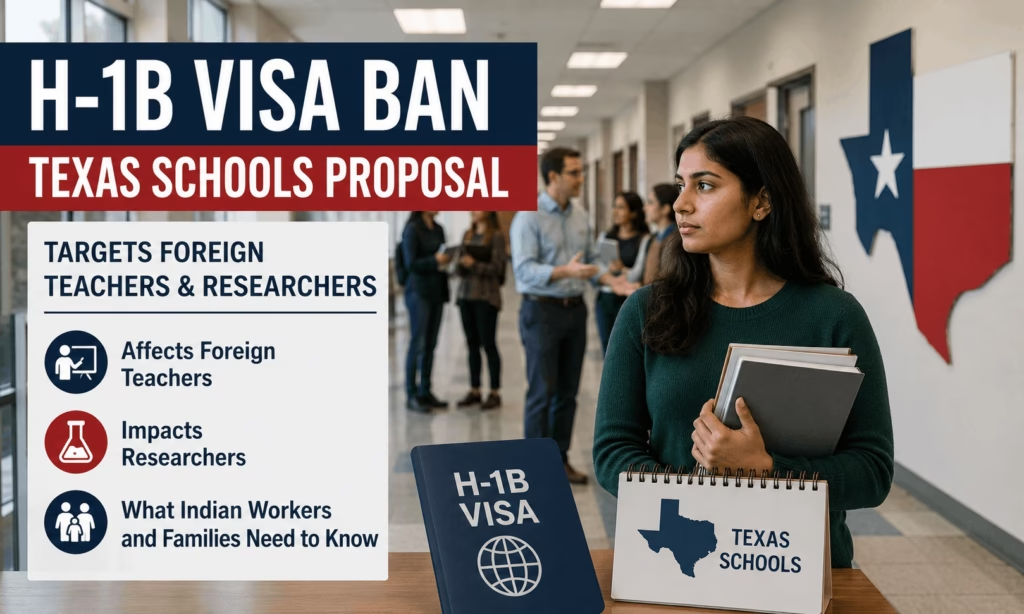
H-1B Visa Ban Texas Schools: Texas Governor Greg Abbott has proposed a sweeping H-1B visa ban Texas schools plan that would stop public school districts from hiring any teacher or staff member on the federal work visa, escalating a fight over foreign labor that has been building in the state since January. Abbott said on Tuesday that he wants legislation ensuring exactly zero Texas public school employees are in the state on H-1B visas, tying the proposal to a broader push against what he calls foreign influence in classrooms. For the large Indian community working in Texas school districts, universities and hospital systems, the announcement raises immediate questions about job security and future visa sponsorship in the state.
The proposal came during a campaign stop on August 18, 2026, and builds directly on an executive freeze Abbott ordered in January that already blocks Texas state agencies and public universities from filing new H-1B petitions without special permission. Since India accounts for the largest share of H-1B visa holders nationwide, any state level restriction carries outsized weight for Indian professionals, especially those working as teachers, researchers, doctors and engineers inside Texas public institutions. We’ll be updating this article monthly as the legislation moves through the Texas Legislature and as more districts respond to the governor’s directive.
What Abbott Announced This Week
Speaking at a campaign event, Abbott laid out plans to ask state lawmakers for legislation that would prohibit Texas public schools from sponsoring H-1B visas altogether. He framed the move as an extension of his earlier order affecting universities and state agencies, telling reporters that exactly zero Texas public school employees should be here on H-1B visas. Abbott linked the proposal to a wider set of measures aimed at limiting foreign influence in classrooms, including a plan to bar public schools from accepting gifts, money or property from foreign governments or foreign linked organizations.
He specifically cited Austin Independent School District’s acceptance of funding from Qatar to support Arabic language instruction, as well as school districts that had partnered with programs affiliated with the Chinese government, as examples of the kind of foreign involvement he wants to restrict. The governor said the minds of Texas students should be shaped by policies approved by state lawmakers rather than by outside influences tied to foreign funding or foreign staffing arrangements.
How This Builds on the January H-1B Freeze
Abbott’s school specific proposal did not appear out of nowhere. In January 2026, his office directed all Texas state agencies controlled by gubernatorial appointees, along with every public university system, to immediately halt new H-1B visa petitions. That freeze remains in effect through the end of the next legislative session on May 31, 2027, and agencies can only file new petitions with written approval from the Texas Workforce Commission.
The January order followed months of scrutiny into Texas A&M University’s use of the visa program, after the conservative outlet The Dallas Express filed public records requests and a complaint with the Texas attorney general over the university’s H-1B related spending. Records later showed Texas A&M spent more than 3.25 million dollars since 2020 on H-1B fees and processing costs, compared with about 1.1 million dollars spent by the University of Texas at Dallas over a similar period. That reporting, combined with a national push from the Trump administration to tighten H-1B rules, set the stage for Abbott’s broader crackdown.
Importantly, the January freeze applied only to state agencies and public universities, not to K-12 school districts. Abbott’s new proposal closes that gap by asking lawmakers to extend the restriction specifically to public schools, which would require legislative action since the governor cannot unilaterally ban hiring practices at independently governed school districts the way he can direct state agencies.
Green Card Rule Changes: New Public Charge Test to Assess Age, Health, Family Status and Finances
Colorado TABOR Refund and PTC Rebate 2026: Who Qualifies and How Much You Can Get
Key Facts and Dates
| Detail | Information |
|---|---|
| New proposal announced | August 18, 2026, during a campaign stop |
| Governor’s stated goal | Exactly zero Texas public school employees on H-1B visas |
| Legal mechanism | Proposed legislation for the Texas Legislature to consider |
| Related order already in effect | January 27, 2026 freeze on new H-1B petitions at state agencies and public universities |
| Freeze duration | Through May 31, 2027, the end of the next legislative session |
| Oversight body | Texas Workforce Commission must approve any exceptions |
| Total H-1B holders in Texas | More than 41,000 in fiscal year 2025, according to federal data |
| Top education sector sponsor | Dallas ISD, with 230 H-1B visa holders as of federal filings |
| Other major sponsors | UT Southwestern Medical Center, Texas A&M flagship campus, UT MD Anderson Cancer Center, UT Austin |
| Additional proposal | Ban on public schools accepting foreign gifts, money or property |
Why Texas School Districts Use H-1B Visas
H-1B visas allow employers to hire foreign professionals for specialty occupations that typically require at least a bachelor’s degree. In the education sector, that most often means researchers, professors and physicians at university medical centers, but K-12 school districts also use the program in a narrower way, primarily to fill critical teacher shortages in areas such as bilingual education, special education, mathematics and science, where qualified domestic candidates can be difficult to recruit in sufficient numbers.
Federal data cited by Texas news outlets shows Dallas Independent School District employs more H-1B visa holders than any other education related employer in the state, and it draws heavily on the program to staff bilingual classrooms serving the district’s large population of English language learners. Districts that support Abbott’s earlier push have argued the numbers involved are small relative to their total workforce, generally around one percent or less of overall staff, but critics of the program argue that even modest numbers of visa dependent hires can crowd out opportunities for domestic teachers if recruitment efforts are not genuine.
The Impact on Indian Teachers, Researchers and Doctors
India has consistently represented the largest single source country for H-1B visa approvals nationwide, accounting for roughly seventy percent of new H-1B petitions in recent fiscal years according to United States Citizenship and Immigration Services data. That concentration means Indian nationals make up a substantial share of the foreign workforce inside Texas school districts, university research labs and academic medical centers, particularly in specialized roles such as science and math instruction, clinical research and physician staffing at teaching hospitals.
For Indian professionals already working in Texas under H-1B status at a public university or state agency, the January freeze does not revoke existing visas, but it does block their employer from filing new petitions, including extensions or amendments, without Texas Workforce Commission approval. That creates real uncertainty for anyone approaching a visa renewal date or hoping to change roles within the same institution. If lawmakers extend Abbott’s proposed ban to K-12 schools, Indian teachers currently working in bilingual or specialty programs at Texas districts could eventually face non-renewal of their sponsorship once the legislation takes effect, even if their current visa remains valid until its original expiration date.
Indian graduate students and postdoctoral researchers hoping to transition into H-1B sponsored positions at Texas public universities after completing their studies are also directly affected, since university systems are covered under the existing freeze. Prospective applicants are being advised to confirm directly with their department or sponsoring institution whether Texas Workforce Commission approval has been secured before assuming a position will convert to H-1B sponsorship as originally planned.
What the Legislation Would Need to Pass
Because Texas school districts are independently governed local entities rather than direct arms of state government, Abbott cannot extend his executive freeze to K-12 schools through an order alone. His proposal requires the Texas Legislature to pass a new law specifically prohibiting school districts from sponsoring H-1B visas, along with the companion measure barring schools from accepting foreign gifts or funding. The Texas Legislature does not meet in regular session every year, meeting instead in the years matching odd numbered calendar years, which means any such legislation would likely need to advance during the next regular session or through a special session called by the governor.
Abbott’s announcement effectively previews legislative priorities he intends to push once lawmakers reconvene, giving school districts, advocacy groups and affected employees a window to respond before any bill is formally introduced, debated and voted on. Education policy groups have said they expect hearings on the proposal to draw significant attention given how directly it would affect bilingual education staffing in large urban districts.
Reaction From Education and Policy Experts
Policy analysts who track higher education and workforce trends have cautioned that H-1B employees, while a small percentage of overall Texas payrolls, often fill highly specialized positions that are genuinely difficult to source domestically, particularly in fields like advanced mathematics, certain engineering disciplines and specialized medicine. Experts interviewed by Texas news outlets warned that renewed scrutiny of the program could have a chilling effect on the state’s research and academic reputation, especially at institutions that have built strong programs partly by recruiting international talent.
Supporters of Abbott’s approach argue the opposite, saying state government must lead by example by prioritizing Texas based workers for taxpayer funded positions, and that the H-1B program at the federal level has not done enough to verify employers are making good faith efforts to recruit domestic candidates before turning to foreign labor. That debate mirrors a national argument playing out under the Trump administration, which has pursued its own proclamation restricting entry for certain nonimmigrant workers and has raised fees associated with new H-1B petitions as part of a broader effort to tighten the program.
Social Security Phone Claims New Process in 2026: What Changed and New Process Explained
Canada Pension Plan Payment August 27th, 2026: Who Will Receive CPP Benefits and How Much?
How This Fits Into the National H-1B Debate
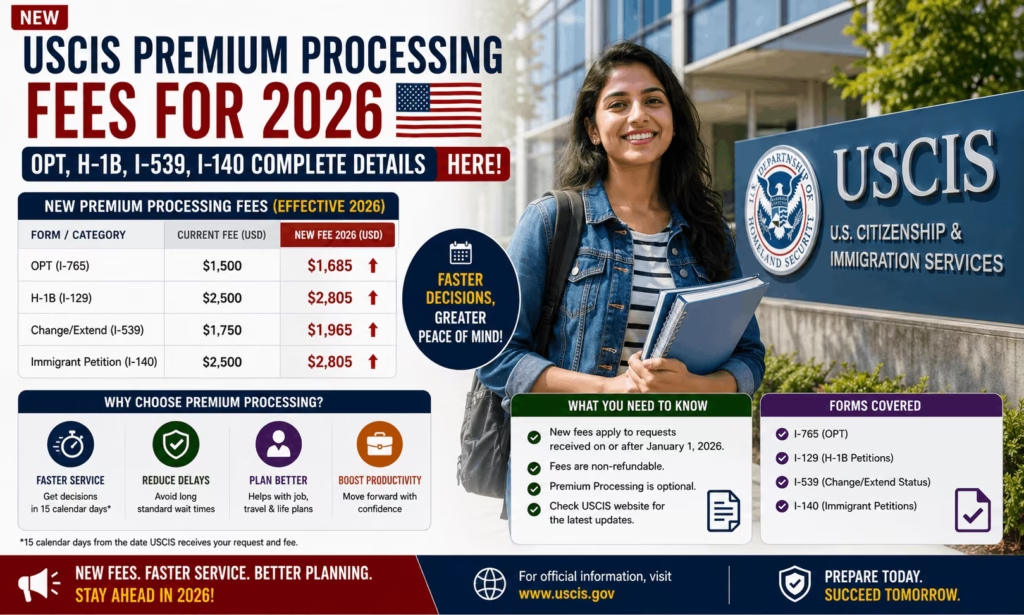
Abbott’s Texas specific push is unfolding against the backdrop of significant federal changes to the H-1B program under the Trump administration. Earlier this year, the administration introduced a substantial new fee structure for certain H-1B petitions, and USCIS premium processing costs have also risen for several visa categories, changes that have already made sponsorship more expensive for universities and school districts across the country, not just in Texas. Abbott has directly cited the federal government’s own crackdown as validation for the state’s separate action, arguing that Texas is stepping in because Washington has not sufficiently limited who can enter the country under the H-1B program.
Other states have watched the Texas approach closely, since a successful legislative ban on H-1B sponsorship for public schools could become a model that Republican controlled legislatures in other states choose to replicate. Immigration attorneys note that any such state level restriction would likely face legal scrutiny over whether states can regulate a federally administered visa program in this way, since H-1B eligibility, petitions and approvals are governed entirely by federal immigration law rather than state statute.
What Affected Employees Can Do Right Now
Indian and other foreign national employees currently working under H-1B status at Texas public universities, state agencies or school districts are encouraged to take a few concrete steps while the legislative process unfolds. Confirming the exact expiration date of a current visa and any planned extension timeline with human resources is an important first step, since existing approved petitions are not affected by either the January freeze or the new school proposal. Employees should also ask their sponsoring department whether any pending amendments, such as a change in job duties or worksite, would require a new filing that could now need Texas Workforce Commission sign off.
For those hoping to secure new H-1B sponsorship at a Texas public institution in the coming months, confirming in writing whether the hiring department has already obtained or plans to seek the required state approval can prevent last minute surprises. Employees who believe they may be affected by any future school district specific legislation should also monitor announcements from their district’s human resources office, since implementation details, including whether existing school employees would be grandfathered in, have not yet been finalized by lawmakers.
How This Connects to Texas A&M and the Paxton Investigation
The scrutiny that led to Abbott’s original January freeze traces back to a separate but related controversy involving Texas Attorney General Ken Paxton’s office, which has been examining H-1B sponsorship practices among smaller Texas based staffing and consulting firms accused of running so called ghost office operations. Investigators have alleged that some firms listed office addresses that showed little or no evidence of actual business activity, raising questions about whether certain H-1B petitions filed on behalf of those companies met the federal requirement of a genuine, specialty occupation job offer. While that investigation is separate from the university and school district freeze, both efforts reflect the same underlying political pressure in Texas to tighten oversight of the H-1B program at every level, from small private staffing agencies up to major public university systems.
Texas A&M University System, which drew the earliest scrutiny after the Dallas Express public records dispute, has already discontinued sponsoring new H-1B petitions that would require it to pay the federal government’s steep 100,000 dollar fee introduced earlier this year, according to a university spokesperson. That fee, part of a broader Trump administration effort to make H-1B sponsorship more costly for employers, has independently pushed some Texas institutions toward the same outcome Abbott is now seeking through state policy, even before any new legislation is passed.
What This Means for the Indian Student Pipeline to Texas
Beyond current H-1B employees, Abbott’s proposal carries longer term implications for the pipeline of Indian students who come to Texas universities on F-1 student visas with the expectation of eventually transitioning to H-1B sponsored employment through Optional Practical Training. Texas has long been one of the top destination states for Indian graduate students in fields like computer science, engineering and public health, drawn partly by strong research programs at institutions such as UT Austin and Texas A&M. If the freeze on university H-1B sponsorship remains in place through the 2027 legislative session, or if lawmakers extend similar restrictions further, prospective Indian students weighing offers from Texas graduate programs may need to factor in greater uncertainty about post graduation employment pathways compared to states without similar restrictions.
Career services offices at several Texas universities have already fielded questions from international students, particularly those in their final year of study, about whether current sponsorship practices will hold through their Optional Practical Training window. University administrators have generally advised students that existing programs and previously approved sponsorships are not affected retroactively, but that any new hire requiring a fresh H-1B petition after graduation would need Texas Workforce Commission approval under the current freeze, adding an extra administrative step that does not exist in most other states.
Trump Accounts Dell $250 Grant: Check State & ZIP Code Eligibility
Official Resources for Tracking This Policy
| Resource | Purpose | Official Link |
|---|---|---|
| Office of the Texas Governor | Official statements and executive orders from Governor Abbott | gov.texas.gov |
| Texas Workforce Commission | Approval process for H-1B petition exceptions under the freeze | twc.texas.gov |
| USCIS H-1B Program page | Federal rules, forms and eligibility for the H-1B visa | uscis.gov/working-in-the-united-states/h-1b-specialty-occupations |
| USCIS Case Status Online | Track a pending H-1B petition | egov.uscis.gov/casestatus/landing.do |
| Texas Legislature Online | Track proposed bills once formally introduced | capitol.texas.gov |
| US Department of Labor | Labor condition applications and prevailing wage data for H-1B roles | dol.gov/agencies/eta |
FAQs
What did Governor Abbott say about H-1B visas in Texas schools?
Abbott said he wants legislation ensuring exactly zero Texas public school employees are in the state on H-1B visas, announcing the proposal during a campaign stop on August 18, 2026, as part of a broader plan targeting foreign influence in classrooms.
Does the H-1B freeze already apply to Texas public schools?
Not yet. The freeze Abbott ordered in January 2026 currently applies only to state agencies controlled by gubernatorial appointees and public universities, not K-12 school districts. Extending it to schools requires new legislation from the Texas Legislature.
How many H-1B visa holders work in Texas?
Federal data shows more than 41,000 H-1B visa recipients were reported in Texas during fiscal year 2025, spanning universities, hospital systems, school districts and private employers.
Which Texas school district employs the most H-1B visa holders?
Dallas Independent School District has the largest number among education related employers, with 230 H-1B visa holders reported in federal filings, largely supporting bilingual education programs.
Why does this matter for Indian H-1B holders specifically?
India accounts for roughly seventy percent of H-1B visa approvals nationwide, so any state level restriction on the program disproportionately affects Indian teachers, researchers, doctors and engineers working inside Texas public institutions.
Can existing H-1B visa holders in Texas lose their status immediately?
No. Current approved visas remain valid through their existing expiration dates. The freeze and proposed ban affect new petitions, renewals and amendments filed by covered institutions going forward, not visas that are already in effect.
Conclusion
Governor Abbott’s push for an H-1B visa ban Texas schools plan marks a significant escalation from his earlier freeze on state agencies and universities, and it puts K-12 districts squarely in the middle of a national debate over foreign labor and immigration policy. For Indian professionals working in Texas classrooms, research labs and hospitals, the coming months will be defined by uncertainty as lawmakers decide whether to turn Abbott’s campaign trail proposal into binding law. Anyone currently sponsored under the program, or hoping to be, should stay in close contact with their employer’s human resources office and track the legislation as it moves through the Texas Legislature.
Trump Halts 50 Percent Tariffs Canada: What the Last Minute Deal With Ottawa Means
2027 Social Security COLA: 3.6% Estimate Beats Medicare Hike
2027 HSA Contribution Limits Announced: IRS Confirms $4,500 and $9,000 Caps