Empire State Child Credit 2026: New York has just rolled out the largest change to its child tax benefit in state history, and the timing could not matter more for families feeling the pinch of rent, groceries and childcare bills. The Empire State Child Credit, a refundable tax benefit paid out to eligible households regardless of how much tax they owe, has jumped from a maximum of $330 per child to as much as $1,000 per child under age four for the current filing season. Governor Kathy Hochul’s administration confirmed the expansion in late January, calling it a direct response to the rising cost of raising young children across the state, from Buffalo to Brooklyn.
For a working parent with a toddler and a school-age child, this is not a small adjustment. It is money that shows up as a bigger refund check or direct deposit, with no requirement to have earned a single dollar of income during the year. Families with zero income can still file a New York State tax return and receive the full credit as cash back. The state says the reform will roughly double the average benefit per family, from about $472 to $943, and extend eligibility to households that previously earned too much or too little to qualify for meaningful help. We’ll be updating this article monthly as the New York State Department of Taxation and Finance releases new guidance, refund timelines and income-threshold adjustments.
What Is The Empire State Child Credit
The Empire State Child Credit is a refundable New York State tax credit for families raising children under 17. Refundable means the credit is not limited to wiping out your tax bill. If the credit is worth more than what you owe, the state pays you the difference directly, either as a larger refund or as an outright payment if you had no tax liability at all. This structure puts it in the same family as the federal Earned Income Tax Credit, which is designed to lift working households above the poverty line rather than simply reward high earners with a tax break.
Until this year, the credit was calculated using a formula tied to the pre-2018 federal child tax credit, and it rarely exceeded $330 per child for most families. The 2025 tax year overhaul breaks that link. New York has decoupled its credit from the outdated federal formula and replaced it with a flat, age-based structure that is far easier for parents to understand and calculate on their own.
Why New York Expanded The Child Tax Credit Now
Lawmakers in Albany have pointed to childcare costs, which have climbed faster than wages in most counties, as the driving force behind the change. Advocacy groups, including anti-poverty organizations that track child well-being statewide, had spent years pushing for a credit that reaches the lowest-income families, who often received little to nothing under the old formula because it was pegged to tax liability rather than need.
The expansion was folded into the state budget passed in 2025 and took effect for tax year 2025, the return most New Yorkers are filing between January and April 2026. State officials describe it as a central piece of Governor Hochul’s affordability agenda, alongside inflation refund checks and expanded STAR property tax relief, all aimed at putting cash back into household budgets without requiring families to navigate complicated applications outside of their normal tax filing.
Oregon Kicker Tax Credit 2026: How To Claim Your Share Of The $1.41 Billion Surplus
California Climate Credit 2026: Payment Timing Just Changed, Here Is What to Expect on Your Bill
Empire State Child Credit Amount: How Much Can You Get
The credit amount depends entirely on a child’s age as of December 31 of the tax year.
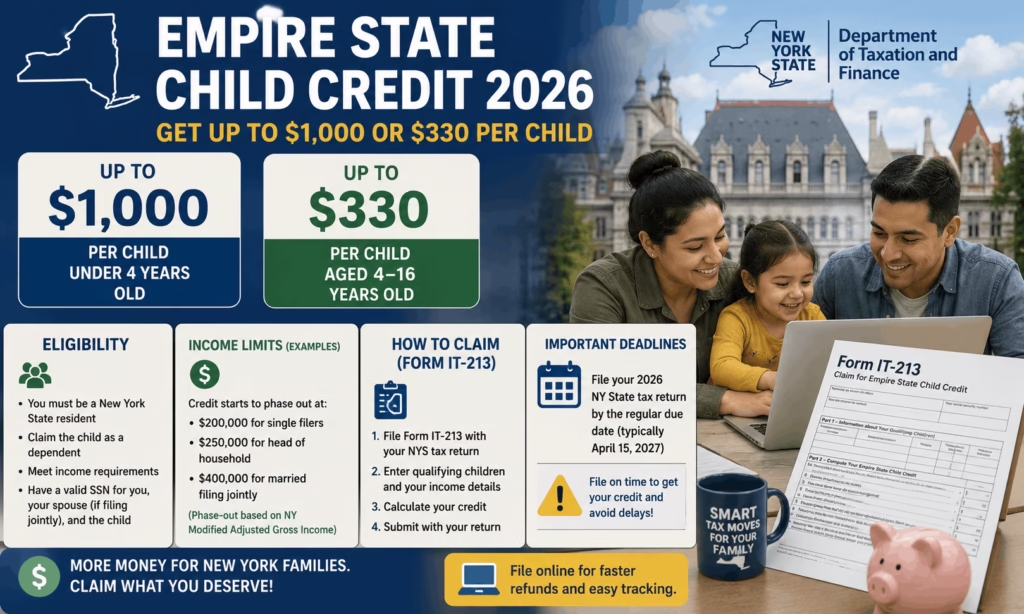
- Up to $1,000 for each qualifying child who was under age four on December 31, 2025
- Up to $330 for each qualifying child aged four through sixteen on December 31, 2025
Looking ahead, the state has already confirmed the next step of the phase-in. For tax year 2026, the return families will file in early 2027, the amount for children aged four through sixteen rises again, to as much as $500 per child, while the under-four amount holds steady at $1,000. That means the full expansion will not be complete until the 2027 filing season, so families with older children should expect one more increase before the credit reaches its final planned value.
There is no cap on the number of children a household can claim, so a family with three qualifying children under four could theoretically receive up to $3,000 through this credit alone, before counting any other state or federal benefits.
Empire State Child Credit Income Limits And Phase-Out Rules
One of the most significant parts of this reform is what New York removed rather than what it added. Previously, families with very low or no income often received a reduced credit or none at all, because the old formula was tied to a percentage of federal tax liability. The new structure eliminates that penalty for the poorest households. Families with no income, or income under roughly $4,000, do not owe state tax and can now claim the full credit as a straightforward cash refund.
For everyone else, the credit phases out gradually at higher income levels rather than cutting off abruptly.
- Married filing jointly: phase-out begins at $110,000 in federal adjusted gross income
- Single, head of household or qualifying surviving spouse: phase-out begins at $75,000
- Married filing separately: phase-out begins at $55,000
For every $1,000 of income above the relevant threshold, the credit is reduced by $16.50 per qualifying child. This gradual reduction means many middle-income families who were previously shut out under the old rules will still see some benefit, even if it is smaller than the maximum.
Who Qualifies For The Empire State Child Credit
To claim the credit, a taxpayer generally must meet all of the following conditions.
- Be a full-year resident of New York State for the tax year
- Have at least one qualifying child who was under 17 years old as of December 31 of the tax year
- File a New York State income tax return, even if no federal return is required
- Provide a valid Social Security Number or Individual Taxpayer Identification Number for themselves and for each child claimed
A qualifying child is generally the taxpayer’s son, daughter, stepchild, foster child, sibling, stepsibling, half-sibling, or a descendant of any of them, such as a grandchild or a sibling’s child. The child must have lived with the taxpayer for more than half the year, must not have provided more than half of their own financial support, and must be claimed as a dependent on the taxpayer’s federal return. A child with an ITIN must be considered a US resident for federal tax purposes to qualify.
Importantly, receiving the Empire State Child Credit does not count as income and will not reduce or affect eligibility for other public benefits, including Medicaid, SNAP, Supplemental Security Income, cash assistance or housing assistance. The state has also confirmed that if a family saves their refund, it will not count against asset limits for benefit programs for up to twelve months.
How To Claim The Empire State Child Credit
Unlike many benefit programs, there is no separate application. The credit is claimed entirely through the annual state tax filing process.
- File a New York State personal income tax return for the relevant tax year, even if the filer has little or no income and would not otherwise be required to file
- Complete and attach Form IT-213, Claim for Empire State Child Credit
- Provide a valid Social Security Number or ITIN for the taxpayer and every child being claimed
- Submit the return electronically or by mail before the filing deadline
- If eligible for a refund, choose direct deposit for the fastest payment
Free filing help is available through New York’s network of Volunteer Income Tax Assistance sites and the NYC Free Tax Prep program for families who qualify, so filers do not need to pay a preparer to claim this credit.
$450K Student Debt Relief: Here Are The Restrictions Behind The Sweet v. McMahon Settlement
Chapter 33 VA Benefits Housing Allowance: How Much Can You Get Per Month
Social Security Changes August 2026: SSA Announces Major Update for Retirees and Beneficiaries
Key Highlight
| Detail | Information |
|---|---|
| Program name | Empire State Child Credit (ESCC) |
| Applies to | Tax Year 2025 return, filed in the 2026 filing season |
| Maximum for children under 4 | Up to $1,000 per child |
| Maximum for children aged 4 to 16 | Up to $330 per child (tax year 2025); rising to $500 for tax year 2026 |
| Filing season opened | January 26, 2026 |
| Filing deadline | April 15, 2026 |
| Income phase-out start (married filing jointly) | $110,000 federal AGI |
| Income phase-out start (single/head of household) | $75,000 federal AGI |
| Income phase-out start (married filing separately) | $55,000 federal AGI |
| Reduction rate above threshold | $16.50 per $1,000 of income over the limit, per child |
| Required form | Form IT-213 |
| Refundable | Yes, paid as cash back if it exceeds tax owed |
| Impact on other benefits | None; does not affect Medicaid, SNAP, SSI, cash or housing assistance |
Official Resources And Useful Links
| Resource | Purpose | Link |
|---|---|---|
| NY Department of Taxation and Finance | Official credit details and updates | tax.ny.gov |
| Empire State Child Credit overview (OTDA) | Program eligibility and benefit summary | otda.ny.gov/programs/empire-state-child-credit |
| Form IT-213 and instructions | Claim form to attach to your state return | tax.ny.gov/pit/file |
| File a New York State return online | State e-filing portal | on.ny.gov (State e-file services) |
| NYC Free Tax Prep | Free filing help for eligible NYC residents | access.nyc.gov |
| Quick eligibility check | Short link shared by the state | on.ny.gov/childcredit |
Empire State Child Credit Compared To The Federal Child Tax Credit
Families often confuse this state credit with the federal Child Tax Credit, which is a separate benefit worth up to $2,200 per child under the current federal rules. New Yorkers can claim both. The federal credit is claimed on the federal Form 1040 with Schedule 8812, while the Empire State Child Credit is claimed separately on the state return with Form IT-213. Together, a family with a young child could realistically see well over $3,000 in combined federal and state child-related tax credits in a single filing season, before factoring in the Earned Income Tax Credit, which New York also supplements at 30 percent of the federal amount.
What Happens If You Miss The Deadline
Families who do not file by April 15 are not automatically shut out. New York generally allows taxpayers to file a return and claim refundable credits like the ESCC for up to three years after the original due date without penalty, provided no tax is owed. Filing late will delay the refund but will not usually forfeit it, though anyone concerned about their specific situation should confirm directly with the Department of Taxation and Finance or a free tax preparer.
FAQs
What is the Empire State Child Credit for 2026?
It is a New York State refundable tax credit worth up to $1,000 for each qualifying child under age four and up to $330 for each qualifying child aged four through sixteen, claimed on the tax year 2025 return filed during the 2026 season.
Who qualifies for the $1,000 child credit in New York?
Full-year New York residents with at least one qualifying child under 17, a valid Social Security Number or ITIN for themselves and each child, and income under the applicable phase-out threshold generally qualify.
Do I need income to receive the Empire State Child Credit?
No. Families with no income or very low income can still file a New York State return and receive the full credit as a cash refund.
How do I apply for the Empire State Child Credit?
There is no separate application. File a New York State income tax return and attach Form IT-213, Claim for Empire State Child Credit.
Will this credit affect my SNAP or Medicaid benefits?
No. New York has confirmed that receiving the Empire State Child Credit does not count as income and does not affect Medicaid, SNAP, SSI, cash assistance or housing assistance eligibility.
What is the income limit for the Empire State Child Credit?
The credit begins phasing out at $110,000 for married couples filing jointly, $75,000 for single filers and heads of household, and $55,000 for married couples filing separately.
Is the Empire State Child Credit the same as the federal Child Tax Credit?
No. They are separate credits. Families can claim both the federal Child Tax Credit on their federal return and the Empire State Child Credit on their New York State return in the same year.
Will the credit amount increase again next year?
Yes. For tax year 2026, filed in 2027, the amount for children aged four through sixteen rises to up to $500 per child, while the under-four amount remains at $1,000.
Conclusion
The expansion of the Empire State Child Credit marks the most significant change to how New York supports families with young children in the credit’s history. By removing the old income penalty for the poorest households and raising the maximum benefit for children under four to $1,000, the state has aimed the reform squarely at the years when childcare costs hit hardest. Filing is simple, requires no separate application beyond the annual tax return and Form IT-213, and does not put other public benefits at risk. With one more scheduled increase already confirmed for the 2026 tax year, families should keep their filing records ready and check the official Department of Taxation and Finance page each season for updated thresholds and deadlines.
Canada 50% Tariff 2026: Full List of Products That Could See Price Hikes