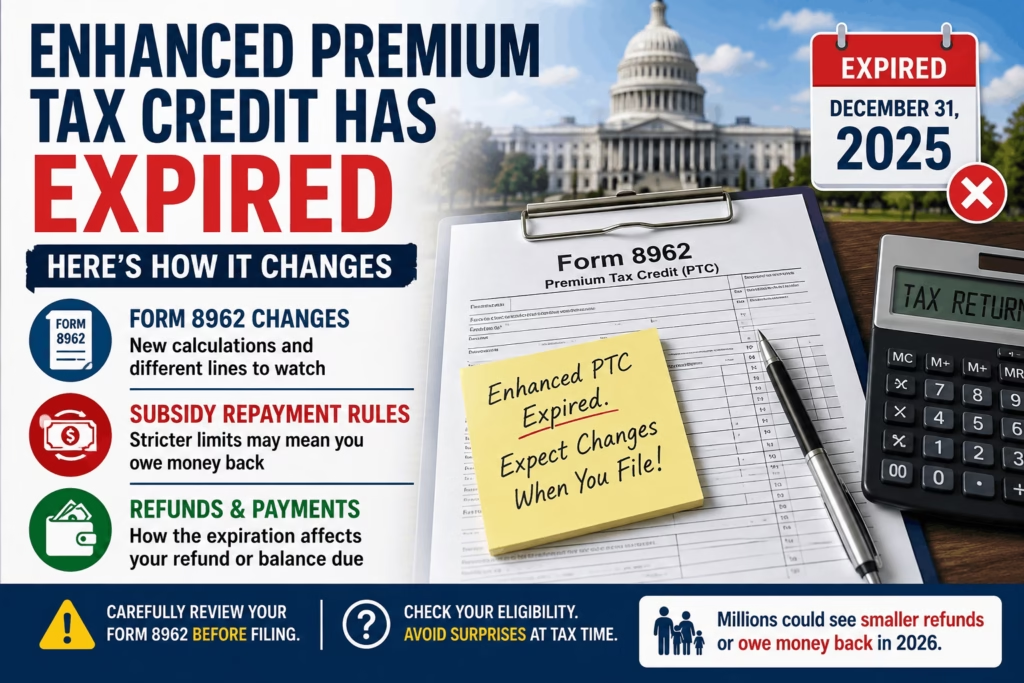
Premium Tax Credit Expiration: Millions of Americans who bought health coverage through the ACA marketplace are about to feel the premium tax credit expiration in a place they were not expecting: their tax return. The enhanced premium tax credit, which capped what marketplace enrollees paid toward their health insurance since 2021, lapsed on December 31, 2025, after Congress failed to extend it before the deadline. That single missed deadline is now reshaping how tax software calculates refunds, how Form 8962 gets filled out, and how much some households may suddenly owe the IRS if their income changed during the year. We’ll be updating this article monthly as Congress, the IRS, and the healthcare marketplace release new guidance, so bookmark this page if you receive marketplace coverage.
For most of the last five years, marketplace enrollees rarely worried about a tax bill tied to their health coverage. The premium tax credit expiration changes that calculus in two distinct ways: it shrinks the subsidy itself for people who still qualify, and it brings back a hard income cutoff that removes eligibility entirely for households earning more than 400% of the federal poverty level. According to the Congressional Budget Office, average gross benchmark premiums are projected to climb roughly 4.3% in 2026 largely because healthier enrollees are expected to leave the marketplace risk pool, and separate KFF modeling found that out-of-pocket premium payments for subsidized enrollees could rise by more than 75% on average. For someone filing a 2026 tax return in early 2027, or reconciling any advance payments received during 2026, this is not an abstract policy debate. It directly changes the number on line 26 or line 29 of Form 8962.
What Actually Expired, in Plain Terms
The premium tax credit itself is not gone. It has existed since 2014 and remains permanent law. What expired is the enhancement Congress added through the American Rescue Plan Act in 2021 and later extended through the Inflation Reduction Act. That enhancement did two things: it removed the 400% FPL income ceiling so higher earners could qualify, and it lowered the percentage of income every eligible household was expected to contribute toward a benchmark silver plan.
With the enhancement gone, the ACA marketplace subsidy structure reverts to its original, pre-2021 design. That means the income ceiling at 400% of the federal poverty level is back, and applicable percentage tables that determine required premium contributions have shifted upward across every income bracket. Analysts frequently describe this as the return of the subsidy cliff, where a household earning even one dollar over the 400% threshold loses the entire credit rather than seeing it phase out gradually.
Premium Tax Credit Expiration Dates and Highlights
| Item | Detail |
|---|---|
| Enhanced premium tax credit expiration | December 31, 2025 |
| 400% FPL income cap | Reinstated starting with 2026 coverage |
| House vote on 3-year extension bill | Passed 230-196 on January 8, 2026 |
| Senate action on extension | Pending; requires 60 votes to advance |
| 2026 Open Enrollment window (most states) | November 1, 2025 to January 15, 2026 |
| Projected 2026 uninsured increase (CBO) | 2.2 million people |
| Average premium payment increase (KFF estimate) | Over 75% for subsidized enrollees |
| Relevant tax form for reconciliation | IRS Form 8962, Premium Tax Credit |
| Relevant marketplace statement | Form 1095-A, Health Insurance Marketplace Statement |
My Safe Florida Home Grant Program 2026: Current Status, $10,000 Funding, and How to Apply
Colorado TABOR Refund and PTC Rebate 2026: Who Qualifies and How Much You Can Get
USCIS E-Filing Mandate: New DHS Rule Gives Agency Power To Retire Paper Immigration Forms
Denaturalization Cases Surge As DOJ Files Record 25 Complaints In Just Two Weeks
Why This Matters at Tax Filing Time
Every year, anyone who received advance payments of the premium tax credit toward their marketplace premium has to reconcile that advance amount against their actual income when they file. This reconciliation happens on Form 8962, using the numbers reported on Form 1095-A from the marketplace. If your income ends up lower than what you estimated, you may get an additional credit added to your refund. If your income ends up higher than estimated, you may have to repay some or all of the advance credit you already received.
The premium tax credit expiration affects this reconciliation in three concrete ways.
First, the repayment limitation caps that protected lower and middle income households from large repayment amounts were part of the enhanced structure. As those caps revert, taxpayers whose income came in higher than projected could face steeper repayment amounts than they experienced in recent tax years.
Second, anyone whose household income lands above 400% of the federal poverty level for the year no longer qualifies for any premium tax credit at all, even if their marketplace plan quoted a subsidized price when they enrolled. If a household received advance payments throughout the year based on an income estimate under the cap, but a bonus, freelance income, or capital gain pushes them over 400% FPL by year end, they could be required to repay the full amount of advance credit received, since the reinstated cliff does not offer partial protection the way the enhanced rules did.
Third, tax preparation software and IRS instructions for Form 8962 are being updated to reflect the new applicable percentage tables, so early filers should confirm they are using the most current version of the form rather than a cached prior-year version.
Who Feels the Biggest Impact
Not every marketplace enrollee is affected equally. According to modeling cited by health policy researchers, households whose income sits just above the 400% FPL line face the steepest jump because they move from receiving a substantial subsidy to receiving none at all. A family of four near that threshold could see their monthly premium responsibility rise by several hundred dollars, while households well above 600% of FPL, who were only recently eligible because of the enhancement, may lose access to any credit whatsoever.
Lower-income households between 100% and 400% FPL generally retain some level of premium tax credit, since that eligibility band predates the enhancement, but they will still see their required contribution percentage increase compared to the past several years, meaning a smaller net credit and a higher monthly premium even while remaining eligible.
Self-employed workers, gig economy earners, and small business owners are frequently highlighted in congressional testimony as a group facing disproportionate impact, since they typically rely on marketplace coverage rather than employer-sponsored plans and often have income that fluctuates month to month, making it harder to estimate accurately for advance credit purposes.
Chapter 33 VA Benefits Housing Allowance: How Much Can You Get Per Month
State Farm Dividend: Who Qualifies to Receive Part of the $5 Billion Payout
H-1B Visa Ban Texas Schools: Abbott Wants Exactly Zero Foreign Workers, What Indians Should Know
Trump Halts 50 Percent Tariffs Canada: What the Last Minute Deal With Ottawa Means
Green Card Rule Changes: New Public Charge Test to Assess Age, Health, Family Status and Finances
The Congressional Fight Still Shaping the Outcome
The premium tax credit expiration has not ended the political debate. On January 8, 2026, the House of Representatives passed a bill to reinstate a three-year extension of the enhanced credit by a vote of 230-196, with a small number of Republicans crossing party lines to support it. That bill moved to the Senate, where it needs 60 votes to overcome procedural hurdles, and Senate negotiators have floated alternative proposals, including shorter extensions, income caps around 600% of FPL, minimum premium contribution requirements, and additional program integrity provisions aimed at reducing improper enrollments.
Because this legislative process remains unresolved, taxpayers filing returns that touch tax year 2026 should treat the current reverted rules as the baseline, while watching for any retroactive legislative fix that Congress could still apply later in the year. Retroactive tax law changes have happened before with marketplace subsidies, most notably when the American Rescue Plan Act temporarily waived repayment obligations for the 2020 tax year after some returns had already been filed. If a similar retroactive change occurs for 2026, the IRS would typically issue updated guidance on how affected taxpayers should respond, which is one more reason to keep an eye on official updates before assuming this year’s filing rules are locked in.
Practical Steps for Marketplace Enrollees Before You File
Anyone currently enrolled in a marketplace plan can take a few concrete steps to avoid a surprise repayment when they file. Reporting income changes to the marketplace as soon as they happen, rather than waiting until open enrollment, keeps advance credit calculations closer to your actual year-end income. Reviewing your Form 1095-A carefully when it arrives in January, and comparing the monthly premium amounts and advance credit amounts against your own records, catches marketplace reporting errors before they become a filing headache. Using the official marketplace calculators or speaking with a tax professional before year-end, especially if you expect a raise, bonus, or new freelance income, helps you decide whether to reduce your advance credit voluntarily during the year rather than repaying a lump sum later. Households near the 400% FPL cliff in particular may want to run projections mid-year, since crossing that line even slightly can eliminate the entire credit for the year.
Official Resources and Links
| Resource | Purpose | Link |
|---|---|---|
| HealthCare.gov | Enrollment, plan shopping, reporting income changes | https://www.healthcare.gov |
| HealthCare.gov account login | Check your application status and update income | https://www.healthcare.gov/login |
| IRS Form 8962 and Instructions | Reconcile advance credit with your actual credit amount | https://www.irs.gov/forms-pubs/about-form-8962 |
| IRS Premium Tax Credit overview | General eligibility and calculation rules | https://www.irs.gov/affordable-care-act/individuals-and-families/the-premium-tax-credit-the-basics |
| KFF Health Insurance Marketplace Calculator | Estimate your 2026 premium and credit amount | https://www.kff.org/interactive/subsidy-calculator |
| Congress.gov bill tracker | Track the Senate status of extension legislation | https://www.congress.gov |
FAQs
Has the premium tax credit expired completely?
No. The base premium tax credit created in 2014 remains permanent law. What expired on December 31, 2025 is the temporary enhancement from 2021 that removed the income cap and lowered required contribution percentages. Marketplace enrollees between 100% and 400% of the federal poverty level can still qualify for a credit, just a smaller one than in recent years.
Will I have to repay my premium tax credit when I file my 2026 return?
It depends on whether your actual household income for the year matches what you estimated when you enrolled. If your income came in higher than your estimate, especially if it pushed you above 400% of the federal poverty level, you may need to repay some or all of the advance credit. If your income came in lower, you may be owed an additional credit as part of your refund.
What is the 400% FPL subsidy cliff?
It is the income threshold above which a household becomes completely ineligible for any premium tax credit, with no partial phase-out. Because the enhancement that eliminated this cliff has expired, it is back in effect for 2026 coverage, meaning even a small amount of extra income above the line can eliminate the entire credit.
Do I need Form 8962 even if I did not use advance payments?
If you enrolled in a marketplace plan and want to claim any premium tax credit on your return, or if you received any advance payments during the year, you generally need to file Form 8962 along with your return. Skipping it when required can delay processing of your refund.
Is Congress going to extend the enhanced premium tax credit again?
As of this update, the House has passed a three-year extension bill, but it remains pending in the Senate, where it needs 60 votes to advance. The outcome is not guaranteed, and several competing proposals with different income caps and durations are still being negotiated.
How much more will I pay for marketplace coverage in 2026?
Estimates vary by income, family size, and state, but multiple analyses project that subsidized enrollees could see their out-of-pocket premium payments rise by an average of more than 75%, with the sharpest increases concentrated among households near or above the reinstated 400% FPL cutoff.
People Also Ask
What happens if I don’t file Form 8962? The IRS can delay or reject your return’s processing of any premium tax credit claim, and you could also lose eligibility for advance credit payments in future years until the reconciliation is completed.
Can I still get a premium tax credit if I make over 400% of the poverty level? Under the reverted rules now in effect, no. The temporary provision that allowed credits above that income level expired at the end of 2025, so households above 400% FPL are currently not eligible unless Congress passes new legislation.
Why did my health insurance premium go up in 2026? Premiums rose for several overlapping reasons, including the expiration of enhanced subsidies, insurers pricing in an expectation that healthier enrollees will leave the marketplace, and standard year-over-year medical cost inflation built into insurer rate filings.
Is the premium tax credit the same as a subsidy? Yes, these terms are generally used interchangeably. The premium tax credit is the formal name for the subsidy that lowers the cost of a marketplace health insurance plan, whether it is applied in advance to reduce monthly premiums or claimed later as a credit on your tax return.
What income counts toward premium tax credit eligibility? Eligibility is based on Modified Adjusted Gross Income, or MAGI, for your household, which includes wages, self-employment income, and several other income sources, compared against the federal poverty level for your household size.
Conclusion
The premium tax credit expiration is not just a headline about health insurance costs. It is a filing season change that will show up directly on tax returns touching 2026 coverage, through a reinstated income cliff, tighter repayment limitation rules, and updated Form 8962 calculations. Whether you already have marketplace coverage or are weighing your options during open enrollment, the safest approach is to track your income closely throughout the year, update your marketplace account promptly when it changes, and check official IRS and HealthCare.gov guidance before you file, since congressional action on an extension bill could still change these rules. This article will keep tracking the Senate’s next steps, the IRS’s updated Form 8962 instructions, and marketplace guidance as they are released, with a fresh update published every month.
Georgia Flat Income Tax Rate Cut to 4.99%: What the New Law Actually Means for Your Paycheck
Employment Insurance (EI) 2026 Rule Changes: What Every Canadian Worker Needs to Know
Empire State Child Credit 2026: $1,000 Per Child Under 4, Full Eligibility & Payment Guide
Oregon Kicker Tax Credit 2026: How To Claim Your Share Of The $1.41 Billion Surplus
California Climate Credit 2026: Payment Timing Just Changed, Here Is What to Expect on Your Bill