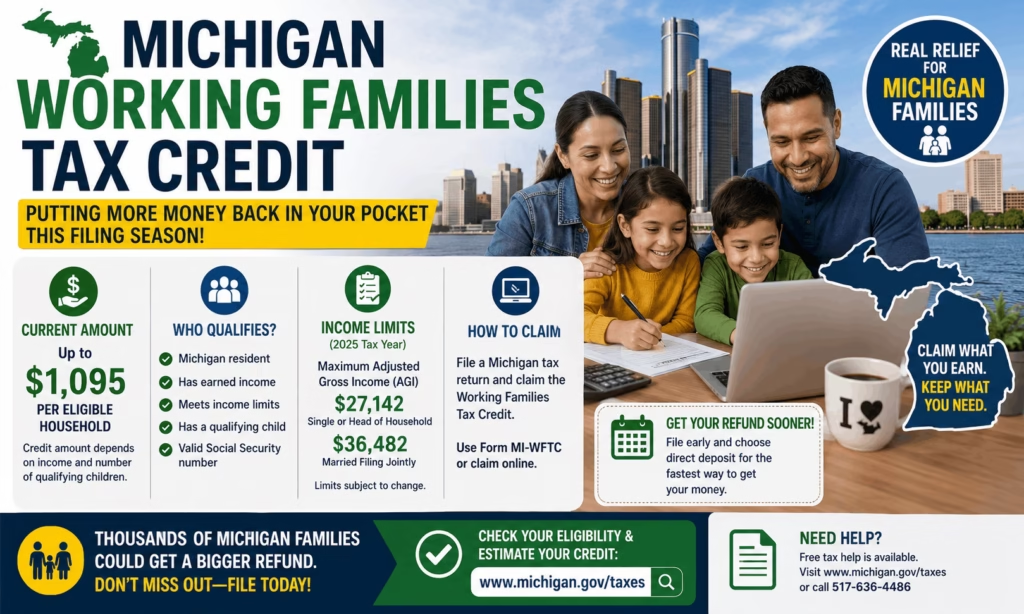
Michigan Working Families Tax Credit: Michigan households filing their state tax return this year are seeing one of the largest income boosts available through state policy, with the Michigan Working Families Tax Credit now pushing combined federal and state refunds to an average of nearly $3,900 per eligible family. The Michigan Department of Treasury confirmed that roughly 665,000 households received the credit this past filing season, and officials expect that number to hold steady or grow as the 2026 filing season continues, since the credit remains automatic for anyone who already qualifies for the federal Earned Income Tax Credit. We’ll be updating this article monthly, so check back for the latest refund figures, income thresholds, and any legislative changes to the credit.
For a working parent juggling rent, groceries, and childcare costs, a few thousand extra dollars at tax time is not a minor line item, it is often the single biggest financial event of the year. The Michigan Working Families Tax Credit, formally known as the Michigan Earned Income Tax Credit for Working Families, is built entirely on top of the federal EITC, meaning any household that qualifies federally automatically qualifies for the state match without filing a separate application. Since the credit was quintupled from 6% to 30% of the federal EITC under Public Act 4 of 2023, state officials say it has become the largest tax break for working families in Michigan history, and it continues to be a central piece of the state’s affordability agenda heading into the current filing season.
What the Michigan Working Families Tax Credit Actually Is
The Michigan Working Families Tax Credit is the state’s matching version of the federal Earned Income Tax Credit. Rather than requiring a separate application, eligibility flows directly from the federal EITC, if a taxpayer qualifies for and claims the federal credit on their federal return, the Michigan Department of Treasury automatically calculates and applies the state match when that person files their Michigan MI-1040 return.
The credit is refundable, meaning eligible taxpayers can receive money back even if they owe no state income tax at all. This design makes it one of the more powerful anti-poverty tools available at the state level, since it puts cash directly into the hands of working households rather than only reducing a tax bill that may already be low or zero.
Key Facts and Latest Filing Season Highlights
| Detail | Information |
|---|---|
| Program name | Michigan Working Families Tax Credit (Michigan EITC) |
| Administered by | Michigan Department of Treasury |
| Current state match rate | 30% of the federal Earned Income Tax Credit |
| Original match rate before expansion | 6% of the federal EITC |
| Law that expanded the credit | Public Act 4 of 2023 (Lowering MI Costs Plan) |
| Retroactive to | Tax year 2022 |
| Households receiving the credit (2025 filing season) | Approximately 665,000 |
| Average state EITC issued | $890 per household |
| Average combined federal and state credit | Nearly $3,900 per household |
| Federal EITC range for 2025 tax year | $649 to $8,046 depending on income and family size |
| Separate application required | No, automatic once federal EITC is claimed |
| 2026 individual income tax filing season | Began January 2026 |
Premium Tax Credit Expiration Hits Millions of Taxpayers as Filing Season Rules Change
My Safe Florida Home Grant Program 2026: Current Status, $10,000 Funding, and How to Apply
How the 30 Percent Match Actually Works
Understanding the math behind the Michigan Working Families Tax Credit helps explain why the dollar amounts vary so widely from household to household. The federal EITC amount depends on a taxpayer’s income, filing status, and number of qualifying children claimed as dependents. Once that federal amount is determined, Michigan applies its 30% match on top.
For example, a family that qualifies for a $3,000 federal EITC would receive an additional $900 from the state of Michigan, bringing their combined credit to $3,900. Under the old 6% rate that existed before the 2023 expansion, that same family would have received only $180 from the state, a difference of $720 in their pocket purely because of the rate change.
Because the credit is proportional to the federal EITC, larger families with more qualifying children generally see larger combined refunds, while workers without children still qualify for a smaller version of the credit if they meet the federal EITC’s separate rules for childless filers.
Who Is Eligible for the Michigan Working Families Tax Credit
Eligibility for the Michigan credit is entirely tied to federal EITC eligibility, so there is no separate income test or application process at the state level. To qualify, a taxpayer generally must have earned income during the tax year, have investment income below the federal EITC threshold, hold a valid Social Security number, have been a U.S. citizen or resident alien for the entire year, and not file Form 2555 for foreign earned income.
Income limits for the federal EITC, and therefore for the Michigan match, adjust annually and depend on filing status and the number of qualifying children. Workers without qualifying children can still receive a smaller credit if their income and investment income fall under the relevant limits. Anyone who does not qualify for the federal EITC automatically does not qualify for the Michigan Working Families Tax Credit, since the state credit has no independent eligibility pathway.
Filing a federal income tax return is required to claim the credit, even for taxpayers who owe no tax or would not otherwise be required to file. Skipping the federal return, even when no tax is technically due, means missing out on both the federal EITC and the Michigan match entirely.
How to Claim the Credit This Filing Season
Claiming the Michigan Working Families Tax Credit does not require any extra paperwork beyond a standard tax filing. The process begins with filing a federal income tax return and claiming the federal EITC, which requires reporting earned income, filing status, and any qualifying children. Michigan taxpayers then file their state MI-1040 return, where the state match is automatically calculated based on the federal EITC amount already claimed.
Taxpayers do not need to fill out a separate Michigan EITC form or submit additional documentation specifically for the state credit. The Michigan Department of Treasury pulls the federal EITC figure directly from the filed federal return and applies the 30% match when processing the state return. Choosing electronic filing and direct deposit is the fastest way to receive both the federal refund and the Michigan credit, since the vast majority of Michigan taxpayers, more than 91% in recent filing seasons, already file electronically.
Free filing assistance is widely available for eligible households. Individuals with low to moderate income, disabilities, or who are 60 years of age or older may qualify for free tax preparation help from IRS-certified volunteers through Volunteer Income Tax Assistance and Tax Counseling for the Elderly programs operating across the state.
Colorado TABOR Refund and PTC Rebate 2026: Who Qualifies and How Much You Can Get
USCIS E-Filing Mandate: New DHS Rule Gives Agency Power To Retire Paper Immigration Forms
Denaturalization Cases Surge As DOJ Files Record 25 Complaints In Just Two Weeks
Why the 2023 Expansion Still Matters for 2026 Filers
The current 30% match rate traces back to Public Act 4 of 2023, part of what state lawmakers called the Lowering MI Costs Plan. Before that law, Michigan’s EITC match had sat at just 6% since 2012, after being cut down from a higher rate during an earlier round of budget constraints. The 2023 law restored and significantly expanded the credit, quintupling the match rate and making the increase retroactive to the 2022 tax year.
Because the expansion applied retroactively, Michigan taxpayers who filed 2022 returns before the law took effect on February 13, 2024 initially received only the original 6% credit. The Department of Treasury subsequently issued supplemental paper checks covering the remaining 24 percentage points to affected households, a process that delivered nearly 300,000 checks worth more than $219 million in the months that followed. While that catch-up process has long since concluded, it explains why some Michigan households may recall receiving two separate payments tied to the same tax year, and it set the foundation for the 30% rate that continues to apply to every filing season since, including the current one.
The Real Financial Impact on Michigan Families
State officials and independent advocacy groups have consistently framed the Working Families Tax Credit as the largest tax break for working families in Michigan’s history. In the most recent completed filing season, approximately 665,000 households received the credit, with an average state EITC of $890 combined with an average federal EITC of $2,966, for a total average credit of nearly $3,900 per household.
Advocacy organizations tracking the credit’s impact note that it reaches roughly half of all children in Michigan, since the credit’s structure favors working families with dependents. Research on the EITC more broadly has found that children in households receiving the credit tend to see long-term benefits, including higher rates of high school and college completion and higher earnings in early adulthood, reinforcing the credit’s role as both an immediate financial support and a longer-term investment in family stability.
Local economic impact estimates place the credit’s contribution at more than $550 million flowing into Michigan communities and small businesses annually, as families use the additional funds for essentials like child care, groceries, car repairs, and household appliances rather than discretionary spending.
What Changed Heading Into the Current Filing Season
Michigan’s fiscal year 2026 and 2027 state budgets, finalized through bipartisan negotiations between Governor Gretchen Whitmer and the legislature, continued funding the Working Families Tax Credit at its expanded 30% rate rather than scaling it back. Budget documents from the governor’s office describe the credit as continuing to deliver an average combined refund approaching $3,900 to roughly 665,000 families, alongside other affordability measures such as the phased elimination of the state’s retirement tax and, separately, changes to how tips, overtime pay, and Social Security income are taxed under recent state and federal law changes.
Because Michigan’s EITC eligibility and amount are pegged directly to the federal EITC, any future adjustments to federal EITC income thresholds, phase-in rates, or the credit amount itself would automatically flow through to the Michigan calculation as well, since the state does not maintain an independent set of income brackets.
Common Mistakes That Cause Filers to Miss the Credit
Tax preparers and community organizations report a handful of recurring reasons eligible Michigan households fail to claim the credit they are owed. Not filing a federal return at all, often because a person mistakenly believes they are not required to file since they owe no tax, is the most common reason households leave money on the table. Filing a federal return but failing to claim the EITC, particularly among workers without qualifying children who may not realize they still qualify for a smaller credit, is another frequent gap. Using an outdated address on file with the Treasury Department can delay any supplemental payments or correspondence related to the credit. Finally, some taxpayers assume they need to submit a separate Michigan-specific EITC application, which is not the case and can lead to confusion or unnecessary delays if they search for a form that does not exist.
Official Resources and Links
| Resource | Purpose | Link |
|---|---|---|
| Michigan Treasury EITC page | Full program details and eligibility rules | https://www.michigan.gov/taxes/iit/tax-guidance/credits-exemptions/eitc |
| Michigan e-file portal | File your state return online | https://www.mifastfile.org |
| IRS EITC eligibility assistant | Check if you qualify for the federal EITC | https://www.irs.gov/credits-deductions/individuals/earned-income-tax-credit |
| Update your Michigan Treasury address | Keep your mailing address current for refunds | https://www.michigan.gov/taxes/questions/iit/accordion/general/change-address |
| Michigan free tax help locator | Find free filing assistance near you | https://www.michigan.gov/mdhhs |
| IRS Free File | File your federal return for free if eligible | https://www.irs.gov/filing/free-file-do-your-federal-taxes-for-free |
Chapter 33 VA Benefits Housing Allowance: How Much Can You Get Per Month
FAQs About Michigan Working Families Tax Credit 2026
How much is the Michigan Working Families Tax Credit worth?
The Michigan credit equals 30% of whatever federal Earned Income Tax Credit a household qualifies for. Combined with the federal credit, eligible households received an average of nearly $3,900 in the most recent completed filing season, though individual amounts vary based on income and number of qualifying children.
Do I need to apply separately for the Michigan Working Families Tax Credit?
No. The credit is automatically calculated by the Michigan Department of Treasury once you claim the federal Earned Income Tax Credit on your federal return and file your Michigan MI-1040 state return. There is no separate state application.
Who qualifies for the Michigan EITC?
Anyone who qualifies for the federal Earned Income Tax Credit automatically qualifies for the Michigan match. This generally requires earned income, investment income below the federal limit, a valid Social Security number, and full-year U.S. citizen or resident alien status.
What is the current Michigan EITC match rate?
The current rate is 30% of the federal EITC, up from 6% before the 2023 expansion under Public Act 4. This rate has remained in place through the current filing season and is funded in the state’s most recent budgets.
Can I get the Michigan Working Families Tax Credit if I have no children?
Yes, workers without qualifying children can still receive a smaller version of the federal EITC, and therefore a smaller Michigan match, if they meet the federal EITC’s separate income and age requirements for childless filers.
When will I receive my Michigan Working Families Tax Credit refund?
The state match is included as part of your regular state tax refund rather than issued as a separate payment, so it typically arrives on the same timeline as your standard Michigan income tax refund after your return is processed.
People Also Ask
Is the Michigan Earned Income Tax Credit the same as the Working Families Tax Credit? Yes, these are two names for the same program. The Michigan Department of Treasury and state officials use both terms interchangeably to refer to the state’s 30% match of the federal EITC.
What is the income limit for the Earned Income Tax Credit? Income limits vary by filing status and number of qualifying children and are adjusted annually by the IRS, with the federal credit itself ranging from a few hundred dollars up to over eight thousand dollars depending on family size and income level.
How do I know if I qualify for the EITC? The IRS provides an online EITC Assistant tool that walks taxpayers through a short questionnaire covering income, filing status, and dependents to determine federal eligibility, which also determines Michigan state eligibility automatically.
Why did my Michigan EITC check come separately from my tax refund? Separate supplemental checks were issued only to taxpayers affected by the retroactive 2023 expansion of the credit for the 2022 tax year, covering the difference between the old 6% rate and the new 30% rate. Current filing seasons include the full 30% match directly within the standard refund.
Does claiming the EITC delay my tax refund? Yes, under federal law the IRS cannot issue refunds that include the EITC before mid-February, regardless of when the return was filed, which can affect the timing of the associated Michigan state credit as well since it depends on the federal calculation.
Conclusion
The Michigan Working Families Tax Credit continues to stand out as one of the most substantial pieces of state-level financial relief available to working households, with combined federal and state refunds now averaging close to $3,900 for roughly 665,000 Michigan families each filing season. Because the credit is entirely automatic once a household claims the federal EITC, the most important step for any eligible Michigander is simply making sure they file a federal return, even with no tax owed, and claim the federal credit correctly so the state match follows through without any extra paperwork. As state budget decisions and any future federal EITC adjustments continue to shape the credit’s value, this article will be updated every month with the latest figures, thresholds, and program details.
Trump Halts 50 Percent Tariffs Canada: What the Last Minute Deal With Ottawa Means
Green Card Rule Changes: New Public Charge Test to Assess Age, Health, Family Status and Finances
Georgia Flat Income Tax Rate Cut to 4.99%: What the New Law Actually Means for Your Paycheck