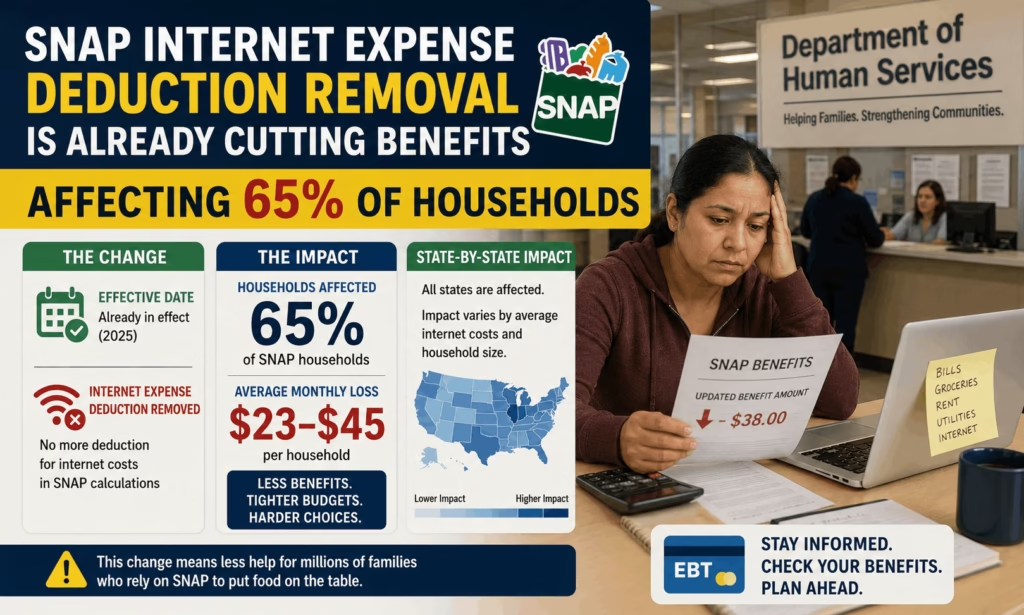
The SNAP internet expense deduction removal is not a future proposal anymore. It has already taken effect, and it is quietly shrinking food assistance checks for roughly 65 percent of SNAP households nationwide, an estimated 13 million families, by about $10 a month each. The change comes from Section 10104 of the One Big Beautiful Bill Act, or OBBBA, the sweeping federal budget law President Trump signed on July 4, 2025. It strips home internet costs out of the Standard Utility Allowance calculation that states use to figure a household’s shelter expenses, which in turn determines how much SNAP benefit that household receives. The Food and Nutrition Service, now renamed the Food and Nutrition Administration, told every state agency in an August 15, 2025 memo to leave internet out of their fiscal year 2026 utility allowance values, and the federal effective date landed October 1, 2025, the start of federal fiscal year 2026.
The dollar figure sounds small in isolation, but the Center on Budget and Policy Priorities calculates it adds up to roughly $11 billion in cumulative SNAP cuts over the next decade, out of $186 billion in total SNAP reductions under the same law. What makes this particular change unusual is how it reverses a policy that barely had time to take hold. The U.S. Department of Agriculture had only formally recognized internet as a basic utility expense in a final rule published November 18, 2024, following years of review, and that rule did not even fully take effect nationwide before OBBBA reversed it less than a year later. We’ll be updating this article monthly as USDA finalizes further guidance and as more states confirm their fiscal year 2026 and 2027 utility allowance figures.
What the Excess Shelter Deduction and Utility Allowance Actually Do
To understand why cutting internet out of a utility calculation lowers a food benefit, it helps to understand how SNAP math works. When a state calculates a household’s SNAP benefit, it starts with gross income and subtracts a series of allowed deductions to reach net income, which is what the benefit formula is actually based on. One of the largest deductions available is the excess shelter deduction, which covers rent, mortgage costs, and utility expenses that exceed half of a household’s income after other deductions. Because actual utility bills fluctuate and are hard to verify individually, most states use a Standard Utility Allowance, a flat, state-set dollar figure that stands in for a household’s real utility costs rather than requiring line-by-line receipts.
In fiscal year 2023, 14.5 million SNAP households, or about 67.9 percent of all SNAP households, claimed the excess shelter deduction, according to Food Research and Action Center analysis of USDA data. Any increase in a household’s countable utility costs raises that deduction and lowers net income, which increases the SNAP benefit. Any decrease does the opposite. Removing internet from the calculation shrinks the Standard Utility Allowance in every state that had incorporated it, which raises net income on paper and lowers the resulting benefit, even though the household’s actual internet bill has not changed at all.
Key Highlights: SNAP Internet Expense Deduction Removal
| Category | Detail |
|---|---|
| Governing law | One Big Beautiful Bill Act (OBBBA), Section 10104 |
| Signed into law | July 4, 2025 |
| USDA guidance issued | August 15, 2025 (FNS memo to all state SNAP agencies) |
| Federal effective date | October 1, 2025 (start of FY2026) |
| Households affected | About 65 percent of SNAP households, roughly 13 to 14 million nationally |
| Average monthly benefit reduction | About $10 per household per month |
| 10-year cumulative cut from this provision | Roughly $11 billion |
| Total OBBBA SNAP cuts over 10 years | $186 billion |
| Prior USDA rule this reverses | Nov. 18, 2024 final rule that first added internet as an allowable SUA expense |
| Households exempt | None specifically for this provision; it removes internet for all households using the SUA |
Why This Reversal Happened So Fast
The timeline here is unusually compressed for federal benefits policy, and it is worth laying out because it explains why so many advocates describe this as a whiplash change rather than a gradual phase-in. USDA spent years developing the rule that first added internet to the Standard Utility Allowance, publishing a proposed version back in 2019 and another in 2016 before combining them into the final rule issued November 18, 2024. That rule was framed around a straightforward argument: home internet had become as functionally necessary as electricity or water for work, school, telehealth, and even applying for benefits online, so treating it differently from other utilities in the SNAP formula no longer reflected how low-income households actually live.
Barely eight months after that final rule was published, OBBBA’s Section 10104 explicitly prohibited state agencies from treating internet costs as an allowable shelter expense at all, undoing the change before most states had even finished implementing it. USDA’s August 15, 2025 memo to state agencies did not leave room for state discretion on this point, directing every state to recalculate its fiscal year 2026 Standard Utility Allowance values without internet costs included, regardless of how far along a given state was in adopting the earlier rule.
How the $10 a Month Figure Was Calculated
The widely cited $10 per month estimate traces back to Congressional Budget Office scoring of the provision, cited by Center on Budget and Policy Priorities analysts tracking the law’s SNAP impact. It represents an average across affected households rather than a fixed amount every household will see. Because Standard Utility Allowance values differ significantly from state to state and even by region within some states, the actual reduction for an individual household depends on how large a role the internet allowance played in that state’s specific SUA calculation before the reversal. States that had built a relatively generous internet component into their allowance will see a bigger swing than states that had only just begun incorporating it. Households whose shelter costs were already high enough to hit the maximum excess shelter deduction cap in their state may see little or no change at all, since the deduction was already capped regardless of the exact utility figure feeding into it.
This Change Is Separate From the LIHEAP-SNAP Rule Change
It is easy to confuse the internet deduction removal with a second, related OBBBA provision affecting utility allowances, and the two are frequently discussed together because both hit the same Standard Utility Allowance calculation around the same time. Under prior rules, a household that received even a small Low Income Home Energy Assistance Program payment automatically qualified for a state’s higher Heating and Cooling Standard Utility Allowance, regardless of the size of that LIHEAP payment. OBBBA restricts that automatic qualification to households that include a member age 60 or older or a person with a disability. Younger, non-disabled households that previously relied on a nominal LIHEAP payment to unlock the higher heating and cooling allowance must now document actual heating and cooling costs directly, a separate change Food Research and Action Center estimates will reduce benefits for more than 670,000 households by an average of about $100 a month, a considerably larger per-household hit than the internet removal, though it affects a smaller overall population. Together, both changes are reshaping the same utility allowance figure that determines a household’s excess shelter deduction, which is why total benefit reductions for some households will reflect more than just the internet piece.
State-by-State Implementation Differences
Every state was required to comply with the October 1, 2025 federal deadline, but states have documented and communicated the change differently. New York’s Office of Temporary and Disability Assistance issued a formal notice to all SNAP recipients ahead of the October 1, 2025 changeover, publishing updated Standard Utility Allowance figures for New York City, Nassau and Suffolk counties, and the rest of the state, alongside the standard deduction and maximum allotment updates that take effect the same date each year. Illinois’s Department of Human Services updated its own utility allowance policy guidance to reflect the new LIHEAP qualification rules alongside the internet removal. Michigan advocates have specifically flagged both the internet removal and the LIHEAP-linked heating and cooling change as related cuts households should prepare for together, since caseworkers in several states are processing both adjustments in the same benefit recalculation cycle.
Because Standard Utility Allowance methodology and update timing vary by state, and because states retain some flexibility in how they structure their specific SUA tiers, the practical size of the internet-related reduction genuinely differs by location even though the underlying federal rule applies uniformly everywhere.
What SNAP Households Can Do
There is no appeal process specifically for the internet removal itself, since it is a change to federal law rather than a state administrative decision, meaning a household cannot contest the policy through the normal fair hearing process the way it could contest an individual case error. What households can do is confirm their current benefit calculation reflects accurate, current shelter and utility information, since a state using outdated income or household size data could be compounding an unrelated error on top of the SUA change. Households experiencing a benefit decrease should request a clear explanation of the calculation from their caseworker, specifically asking whether the reduction stems from the internet removal, the LIHEAP-linked heating and cooling change, an income change, or a combination of factors, since multiple provisions can affect the same benefit amount simultaneously. For households with an elderly or disabled member, confirming that status is properly documented in the case file matters more than ever, since that status is now the deciding factor in whether the LIHEAP-linked heating and cooling exemption still applies.
Households can also request a copy of their state’s current Standard Utility Allowance worksheet or notice, which most states are required to make available on request even outside the standard annual mailing cycle. Comparing the prior year’s SUA figure against the current one can clarify exactly how much of a benefit change is attributable to the internet removal specifically versus other factors like the annual cost-of-living adjustment to maximum allotments, which moves independently of the utility allowance and can sometimes partially offset or obscure the size of the internet-related reduction on a benefit statement.
California Climate Credit 2026: Payment Timing Just Changed, Here Is What to Expect on Your Bill
What Advocates and Policy Groups Are Saying
The reaction from anti-hunger and poverty law organizations has been consistently critical of both the substance and the speed of the reversal. Center on Budget and Policy Priorities analysts have pointed out that the timing effectively wasted years of USDA rulemaking work, since the agency had only just finished implementing the original internet-inclusion rule when Congress overrode it through the budget reconciliation process rather than a standard regulatory process. Food Research and Action Center has framed the change as part of a broader pattern within OBBBA’s SNAP provisions, arguing that treating internet access as separate from other basic utilities no longer reflects how low-income households manage work, school, telehealth appointments, and even SNAP case management itself, much of which now happens online through state benefit portals. Supporters of the broader law have generally framed the SNAP provisions collectively as reducing federal spending and tightening program integrity rather than commenting on the internet deduction specifically as an isolated policy question, since it was one of dozens of SNAP changes bundled into the same reconciliation bill.
Official Resources and Links
| Resource | What It’s For | Official Link |
|---|---|---|
| USDA Standard Utility Allowance page | Federal SUA rules and state-by-state overview | fna.usda.gov/snap/eligibility/deduction/standard-utility-allowances |
| USDA SNAP eligibility overview | General SNAP income and deduction rules | fna.usda.gov/snap |
| Find your state SNAP agency | State-specific applications, notices, and case status | fns-prod.azureedge.us/state-directory |
| USDA SNAP fiscal year data | Annual participation and cost summaries | fna.usda.gov/resource-files/snap-annualsummary |
| National SNAP hotline | General SNAP information and application help | 1-800-221-5689 |
FAQs
When did the SNAP internet expense deduction removal take effect?
The provision, part of Section 10104 of the One Big Beautiful Bill Act, took effect October 1, 2025, the start of federal fiscal year 2026, after USDA directed all state SNAP agencies in an August 15, 2025 memo to exclude internet costs from their fiscal year 2026 utility allowance calculations.
How much will my SNAP benefit go down because of the internet deduction removal?
The commonly cited figure is an average reduction of about $10 a month, based on Congressional Budget Office scoring, but the actual amount depends on your state’s specific Standard Utility Allowance structure and whether your household was already at your state’s maximum excess shelter deduction cap.
Does this affect every SNAP household?
It affects households that use the Standard Utility Allowance and previously had internet costs factored into that allowance, an estimated 65 percent of SNAP households nationally. Households that document actual utility expenses rather than using the standard allowance, or whose shelter costs already exceed their state’s deduction cap, may see little or no change.
Can I still deduct my actual internet bill if I document it separately?
No. The federal law prohibits treating internet connection service fees as an allowable shelter expense at all, whether through the Standard Utility Allowance or through documentation of actual costs, so there is no workaround available at the household level.
Is the internet deduction removal the same as the LIHEAP heating and cooling change?
No, they are separate provisions in the same law. The internet removal affects the utility allowance calculation for all SNAP households using it. The LIHEAP-linked change specifically restricts automatic qualification for the higher heating and cooling allowance to households with an elderly or disabled member, and is expected to cut benefits for a smaller number of households but by a larger average amount, roughly $100 a month.
Why did USDA reverse the internet rule so quickly after adding it?
USDA’s original rule adding internet as a recognized utility expense was finalized November 18, 2024, following years of regulatory review. OBBBA, signed into law July 4, 2025, superseded that rule through new federal statute before most states had fully implemented it, requiring USDA to direct states to exclude internet from their calculations starting with fiscal year 2026.
Will my SNAP benefit ever go back up if this rule changes again?
Any future change would require new legislation or a new USDA rulemaking process, similar to how the original 2024 rule was developed. As of the most recent guidance, no such reversal is currently planned, and the exclusion applies for the foreseeable future under current law.
How do I know if my state’s Standard Utility Allowance changed because of this rule?
Most states issue an annual notice to SNAP recipients around the fiscal year change each October, showing updated Standard Utility Allowance figures and standard deduction amounts. Checking that notice, or contacting your state SNAP agency directly, will show your state’s current allowance values compared to the prior year.
People Also Ask
What is the Standard Utility Allowance for SNAP? It is a flat, state-set dollar amount that represents typical low-income household utility costs, used in place of requiring individual households to document every actual utility bill when calculating the excess shelter deduction that lowers net income for SNAP benefit purposes.
Why did SNAP stop counting internet as a utility? Congress removed internet connection fees from the list of allowable shelter expenses under Section 10104 of the One Big Beautiful Bill Act, reversing a 2024 USDA rule that had added internet as a recognized utility cost, as part of a broader package of SNAP spending reductions in the law.
How much money is being cut from SNAP overall? The Congressional Budget Office estimates the One Big Beautiful Bill Act reduces federal SNAP spending by $186 billion over ten years, making it the largest cut to food assistance in the program’s history, with the internet deduction removal contributing an estimated $11 billion of that total.
Does losing the internet deduction mean I lose SNAP entirely? No. The change lowers the calculated benefit amount for affected households by reducing a deduction, but it does not by itself remove anyone from SNAP eligibility. A household would need to fail an income, resource, or work requirement test separately to lose eligibility entirely.
Conclusion
The SNAP internet expense deduction removal is already in effect and already showing up in reduced benefit amounts for millions of households nationwide, even though the average $10 monthly reduction may not be immediately obvious on a benefit statement. Understanding that this change stems from a specific federal law provision, rather than a state error or a temporary technical glitch, matters for anyone trying to figure out why their SNAP amount shifted since last fall. Combined with the related LIHEAP-linked heating and cooling change, households are seeing compounding reductions to the same utility allowance figure that has powered the excess shelter deduction for decades. This article will be updated monthly as USDA issues further guidance and as states finalize fiscal year 2027 utility allowance figures.
$450K Student Debt Relief: Here Are The Restrictions Behind The Sweet v. McMahon Settlement
Chapter 33 VA Benefits Housing Allowance: How Much Can You Get Per Month
Social Security Changes August 2026: SSA Announces Major Update for Retirees and Beneficiaries