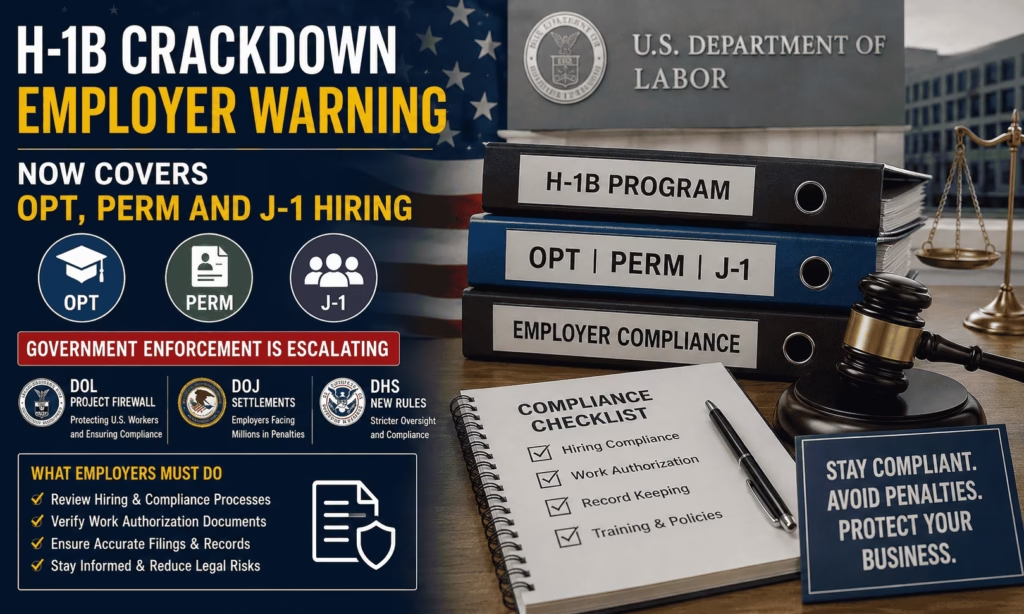
H-1B crackdown employer warning: The federal government’s enforcement push against visa-related hiring abuse has moved well beyond H-1B petitions this year, with the Department of Labor, the Department of Justice, and the Department of Homeland Security now actively flagging employer practices tied to OPT, PERM, and J-1 programs as well. In the most recent development, Newsweek reported that the Trump administration launched a fresh probe into alleged H-1B recruitment networks, with the Labor Department’s list of disqualified employers now naming four companies, GowraTech LLC, Renotek Group LLC, Seeloz Inc., and Sherwood at Mount Dora Inc., doing business as Sherwood Academy. We’ll be updating this article monthly as new enforcement actions, settlements, and regulatory changes are announced across each of these visa categories.
For employers who sponsor foreign workers through any of these pathways, this is no longer a story about a single visa category getting more expensive or harder to obtain. It is a coordinated, multi-agency compliance effort spanning the entire employment-based immigration pipeline, from the F-1 student who transitions onto Optional Practical Training, to the PERM labor certification process that underpins most employment-based green cards, to the J-1 exchange visitor placed at a host organization. Here is a complete breakdown of what has changed across each program, which enforcement actions have already produced real financial penalties, and what employers using any of these visa categories need to do to stay compliant.
What Triggered This Wider Crackdown
The expansion did not happen overnight. Since late 2025, the Department of Labor has run Project Firewall, an enforcement initiative Morgan Lewis and other employment law firms describe as focused on protecting the wages and job opportunities of American workers, with direct implications for immigration compliance, wage and hour law, and in some cases criminal referrals. That initiative laid the groundwork for a much larger action announced in July 2026, when Labor Department Inspector General Anthony D’Esposito told Fox Business that his office had opened its first major H-1B and PERM visa fraud investigation, describing it as tied to alleged human trafficking, kickback schemes, and labor broker misconduct, with dozens of subpoenas already issued.
At the same time, the Department of Justice has been pursuing its own track. In April 2026, the department announced a $313,420 settlement with Compunnel Software Group Inc., a New Jersey-based professional services company, after finding that some of its recruiters had posted job advertisements excluding U.S. citizens and permanent residents while favoring workers on H-1B and other temporary visas. That settlement included $58,000 in back pay and $255,420 in civil penalties, along with a requirement to retrain recruiters and strengthen compliance measures. The same month, the department reached a separate settlement with LanceSoft Inc., a Virginia-based IT services provider, over similar allegations involving job advertisements that excluded qualified American applicants.
H-1B Crackdown Employer Warning Key Highlights
| Program or Action | Development | Status |
|---|---|---|
| DOL Project Firewall | Enforcement initiative targeting wage, hour, and immigration compliance tied to H-1B hiring | Active since late 2025 |
| DOL Inspector General H-1B/PERM fraud probe | First major joint fraud investigation, dozens of subpoenas issued, human trafficking allegations | Announced July 2026, ongoing |
| DOL disqualified employer list | GowraTech LLC, Renotek Group LLC, Seeloz Inc., Sherwood at Mount Dora Inc. (Sherwood Academy) | Currently disqualified from H-1B sponsorship |
| DOJ settlement: Compunnel Software Group Inc. | $313,420 total, including $58,000 back pay and $255,420 civil penalty | Settled April 2026 |
| DOJ settlement: LanceSoft Inc. | Settlement over job ads excluding U.S. citizens and permanent residents | Settled April 2026 |
| DHS third-party placement rule | New restrictions targeting H-1B workers placed at client work sites through IT consulting and outsourcing firms | Proposed, expected 2026 |
| DOL PERM overhaul | Proposed update to 2004 recruitment framework, tighter layoff and non-discrimination rules | Regulatory agenda, timeline pending |
| DOS J-1 program rule changes | Broader authority to end exchange visitor status, new definitions for unauthorized employment | Proposed July 30, 2026; comments open until September 28, 2026 |
| $100,000 H-1B proclamation fee | Vacated by federal court June 8, 2026, then stayed pending appeal on June 12, 2026 | Currently still being collected pending appeal |
H-1B Enforcement: From Wage Complaints to Recruitment Network Investigations
The most visible piece of this crackdown remains H-1B enforcement, and it has escalated considerably through the summer of 2026. Beyond the Labor Department’s fraud probe, Newsweek reported that federal officials have stepped up scrutiny of H-1B recruitment networks specifically, examining how staffing firms and IT consulting companies source and place workers across client sites. The same reporting confirmed the current Labor Department disqualification list includes GowraTech LLC, Renotek Group LLC, Seeloz Inc., and Sherwood Academy, meaning these companies are currently barred from hiring under the H-1B program.
A separate regulatory proposal, described by Newsweek as likely to draw the most attention from the technology and consulting sectors, would tighten rules around third-party placement, the practice of an H-1B worker being formally employed by one company while performing work at a different company’s job site. This arrangement has been common in IT staffing and outsourcing for decades, and the new Department of Homeland Security language signals further restrictions may be coming on top of oversight already expanded under the Biden-era H-1B modernization rule, which gave USCIS authority to conduct worksite inspections.
2027 Social Security COLA Estimate Falls to 3.4%: How Much Could Your Check Increase?
OPT and STEM OPT: Employer Obligations Under Increased Scrutiny
Optional Practical Training has drawn less direct enforcement action compared to H-1B, but it sits directly in the crosshairs of the broader regulatory agenda released by DHS, DOL, and the Department of State earlier in 2026. According to that agenda, a final rule is expected to end automatic extensions of certain Employment Authorization Documents, a change that would directly affect F-1 students transitioning from OPT into H-1B status or awaiting a cap-gap extension.
Employers hiring OPT and STEM OPT participants should be aware that STEM OPT specifically already carries strict compliance requirements, including mandatory E-Verify enrollment and a signed Form I-983 Training Plan outlining specific learning objectives, with required evaluations at the 12-month mark and again at the end of the STEM extension period. Given the current enforcement climate, employers using OPT hires should treat these existing requirements as an active compliance obligation rather than a paperwork formality, since worksite inspections tied to STEM OPT compliance have occurred in past enforcement cycles and could resume under the current environment.
PERM Labor Certification: A Major Overhaul Is Coming
The PERM process, which most employers must complete before sponsoring a foreign worker for an employment-based green card, is facing its most significant proposed overhaul in over two decades. According to reporting on the administration’s regulatory agenda, the Department of Labor is expected to propose updates to the existing PERM recruitment framework, which was introduced in 2004 and, according to the department, no longer reflects modern hiring practices and technological changes.
The proposal is expected to update minimum standards for testing the U.S. labor market before a PERM application can proceed, tighten rules connected to layoffs of American workers occurring around the same time as a PERM filing, and strengthen compliance requirements tied to non-discrimination in recruitment and hiring. Employers currently in the middle of a PERM process, or planning to start one, should watch this proposal closely, since the recruitment steps required to demonstrate no qualified U.S. worker was available for the position could change meaningfully once a final rule is published.
J-1 Exchange Visitor Program: New State Department Authority
The J-1 program has followed a slightly different track, with the Department of State proposing regulatory changes rather than launching direct enforcement actions. On July 30, 2026, the department published a Notice of Proposed Rulemaking in the Federal Register that would give it broader and clearer authority to end a participant’s exchange visitor status, while also updating rules around program extensions, reinstatements, and sponsor responsibilities.
The proposal introduces formal definitions for terms including unauthorized employment and valid program status, which officials say are intended to reduce confusion and promote more consistent enforcement across the wide range of organizations that sponsor J-1 programs. It would also allow the State Department to terminate a J-1 program immediately if DHS or DOS revokes or cancels a participant’s visa, a change from current rules under which J-1 status does not automatically end when a visa is revoked. Grounds for revocation under the proposal specifically include unauthorized employment, directly tying this rule change to employer hiring practices for J-1 workers, interns, trainees, and exchange visitors placed at host organizations. Public comments on this proposal remain open until September 28, 2026.
How Employers Should Respond: A Compliance Checklist
- Audit current job postings across every hiring channel to confirm none exclude or disadvantage U.S. citizens or lawful permanent residents, since this exact practice triggered the Compunnel and LanceSoft settlements.
- Review third-party placement arrangements for any H-1B workers currently placed at client sites, and prepare documentation showing genuine oversight of wages, worksite conditions, and job duties, given the proposed DHS restrictions specifically targeting this arrangement.
- Confirm STEM OPT compliance requirements are fully documented, including current Form I-983 Training Plans, E-Verify enrollment status, and completed 12-month evaluations for every STEM OPT employee.
- Begin preparing for potential PERM recruitment changes by reviewing current recruitment documentation practices against the existing 2004 framework, so your organization is positioned to adapt quickly once a final rule is published.
- If your organization sponsors J-1 exchange visitors, review current termination and unauthorized employment policies against the proposed State Department definitions, and consider submitting comments before the September 28, 2026 deadline if the changes would affect your program.
- Consult immigration counsel before responding to any Department of Labor subpoena or inquiry connected to the ongoing H-1B and PERM fraud investigation, given the human trafficking and labor broker allegations tied to that probe.
CRS Score Distribution 2026: 5 Trends Shaping the Next Express Entry Draw
New Canada LMIA Rules August 2026: What Employers and Foreign Workers Need to Know
Processing Time and Investigation Timelines
There is no single processing time that applies across this crackdown, since each agency is operating on its own investigative and rulemaking timeline. The Labor Department’s fraud probe, which began issuing subpoenas around July 2026, does not have a publicly announced conclusion date, and investigations of this scope have historically taken many months to over a year to reach settlements or debarment decisions, based on the pattern seen with the Compunnel and LanceSoft cases, both of which were resolved roughly a year after the underlying conduct was first identified.
Regulatory changes follow a separate and generally slower track. The State Department’s J-1 proposal remains in a public comment period through September 28, 2026, after which the agency must review submitted comments before finalizing any rule, a process that commonly takes several months to over a year depending on comment volume and complexity. The PERM overhaul and the H-1B third-party placement rule referenced in the DHS, DOL, and DOS regulatory agenda do not yet have confirmed publication dates, meaning employers should treat current requirements as still in effect until a final rule is officially published in the Federal Register.
Payment and Penalty Exposure for Employers
Unlike a standard visa filing fee schedule, the financial exposure in this crackdown comes from penalties, back pay, and civil fines tied to enforcement actions rather than routine government fees. The Compunnel settlement alone totaled $313,420, split between $58,000 in back pay owed to affected workers and $255,420 in civil penalties. Companies placed on the Labor Department’s disqualification list lose the ability to sponsor H-1B workers entirely, which carries its own significant indirect cost for businesses that depend on that talent pipeline. Employers found in violation during the ongoing fraud investigation could face a combination of back wage orders, civil fines, and debarment from future program participation, based on the penalty structure the Labor Department has applied in past H-1B enforcement cases.
Official Government Resources and Compliance Links
| Resource | Purpose | Official Link |
|---|---|---|
| DOL H-1B Disclosure Data Center | Check current disqualified and debarred H-1B employers | dol.gov/agencies/eta/foreign-labor/performance |
| DOJ Immigrant and Employee Rights Section | File a complaint or review discrimination-related guidance | justice.gov/ier |
| USCIS H-1B Program Overview | Official H-1B eligibility and filing information | uscis.gov/h-1b |
| DOL PERM Program Page | Current PERM labor certification requirements | dol.gov/agencies/eta/foreign-labor/programs/permanent |
| Federal Register J-1 Proposed Rule | Full text and comment submission for the J-1 rule change | federalregister.gov |
| E-Verify | Employer verification system, including STEM OPT compliance requirements | e-verify.gov |
| USCIS STEM OPT Extension Information | Official STEM OPT rules and Form I-983 requirements | uscis.gov/opt |
| DOL Wage and Hour Division | Report wage violations connected to visa-sponsored employment | dol.gov/agencies/whd |
The Human Trafficking Angle Behind the PERM Fraud Probe
One detail that sets the Labor Department’s current investigation apart from earlier H-1B enforcement cycles is the explicit connection to human trafficking allegations. Inspector General D’Esposito’s description of the probe as covering kickback schemes and labor broker misconduct alongside standard visa fraud signals a more serious legal framing than a typical wage and hour dispute. Labor broker misconduct in this context generally refers to intermediary staffing arrangements where a worker is charged fees, has wages withheld, or is placed in a position of dependency on a broker or employer in ways that cross from a labor violation into a trafficking concern under federal law.
This distinction matters for employers because human trafficking allegations carry potential criminal exposure in addition to the civil penalties, back pay, and debarment consequences already associated with H-1B and PERM violations. Companies that rely on third-party staffing arrangements or subcontracted recruitment pipelines should treat this specific angle of the investigation as a signal to review not just their own direct hiring practices, but also the practices of any staffing partners, recruiters, or labor brokers they work with, since liability in a trafficking-adjacent investigation can extend across a hiring chain rather than stopping at the direct employer.
How the Agencies Are Coordinating
A notable feature of this year’s enforcement expansion is how closely the Department of Labor, Department of Justice, Department of Homeland Security, and Equal Employment Opportunity Commission appear to be coordinating rather than operating in isolation. Bloomberg Law’s reporting on the renewed $100,000 fee proposal specifically describes an administration-wide enforcement crackdown, noting that the Justice Department, Labor Department, and EEOC have each launched separate initiatives examining potential abuses connected to the H-1B program. Congress has added its own layer of pressure, with multiple members introducing bills aimed at halting the program entirely or blocking specific categories of employers from sponsoring workers, alongside criticism from state elected officials.
This kind of cross-agency alignment tends to produce faster and more consequential enforcement outcomes than a single agency acting alone, since a Labor Department wage finding can feed directly into a Justice Department discrimination case, which can in turn trigger a Homeland Security worksite review. Employers navigating this landscape should not assume that resolving an issue with one agency closes out exposure with another, since the current pattern suggests findings are increasingly being shared and acted upon across departments rather than staying siloed.
FAQs
What is Project Firewall and how does it affect employers?
Project Firewall is a Department of Labor enforcement initiative focused on protecting American workers’ wages and job opportunities, with direct implications for H-1B compliance, wage and hour law, and in some cases criminal referrals for employers found violating program requirements.
Which companies are currently disqualified from H-1B sponsorship?
As of the most recent Labor Department update reported by Newsweek, the disqualified employer list includes GowraTech LLC, Renotek Group LLC, Seeloz Inc., and Sherwood at Mount Dora Inc., doing business as Sherwood Academy.
Does the crackdown affect OPT and STEM OPT hiring too?
Yes. While enforcement activity has focused most heavily on H-1B and PERM so far, the broader DHS, DOL, and DOS regulatory agenda includes plans to end automatic extensions for certain Employment Authorization Documents, which would directly affect OPT-to-H-1B transitions.
What changes are coming to the PERM process?
The Department of Labor is expected to propose an overhaul of the PERM recruitment framework, which has not been substantially updated since 2004, including tighter labor market testing standards and stronger non-discrimination requirements.
How does this affect J-1 exchange visitor sponsors?
The State Department has proposed new rules giving it broader authority to terminate a J-1 participant’s status, including for unauthorized employment, with the public comment period open until September 28, 2026.
Can an employer still be penalized if it excludes U.S. workers from job postings?
Yes. The Department of Justice has already reached settlements with multiple companies over job postings that excluded U.S. citizens and permanent residents in favor of visa holders, resulting in combined penalties and back pay well over $300,000 in one case alone.
Is the $100,000 H-1B fee currently in effect?
The fee’s legal status remains unsettled. A federal judge vacated it on June 8, 2026, but the same court stayed that ruling on June 12, 2026 pending appeal, meaning USCIS is currently still collecting the fee for qualifying consular-processed petitions.
People Also Ask
Why is the Trump administration expanding enforcement beyond H-1B?
Officials describe the goal as closing gaps across the entire employment-based visa pipeline, since OPT, PERM, and J-1 pathways often feed directly into or alongside H-1B sponsorship, meaning enforcement limited to H-1B alone would leave related hiring practices unexamined.
What happens if my company is placed on the H-1B disqualification list?
A disqualified employer generally cannot sponsor new H-1B workers for a defined debarment period, which can create significant workforce and business continuity challenges for companies that rely heavily on visa-sponsored talent.
Are staffing and IT consulting firms specifically targeted?
Yes. Reporting indicates the proposed third-party placement restrictions and much of the recruitment network investigation activity is focused on staffing agencies and IT consulting or outsourcing firms that place H-1B workers at client sites.
How can an employer respond to a DOL subpoena related to this investigation?
Employers who receive a subpoena connected to the ongoing H-1B and PERM fraud probe should consult experienced immigration and employment counsel immediately, given the serious nature of the human trafficking and labor broker allegations tied to the investigation.
Conclusion
What started as scattered H-1B enforcement actions has become a coordinated, multi-agency effort touching nearly every major employment-based visa category, from OPT and STEM OPT through PERM and now J-1 exchange visitor programs. Employers who assumed this crackdown was limited to H-1B petitions and lottery registrations should reassess that assumption given the disqualification list, the active fraud investigation, and the proposed rule changes now moving through DHS, DOL, and the State Department simultaneously. The practical response for any organization sponsoring foreign workers under these programs is the same regardless of category: audit current recruitment and compliance documentation now, correct any practices that could be read as excluding qualified U.S. workers, and stay current with each agency’s regulatory agenda rather than waiting for a final rule or an enforcement notice to arrive.
Indian Student Applications to US Colleges Fall 15% Amid Visa Uncertainty: What the New Data Shows