
SSA Ticket to Work Program: The Social Security Administration has renewed its public push this month to get more disability beneficiaries into the workforce, and the Ticket to Work Program is at the center of that effort. On August 13, 2026, the SSA published a fresh blog explainer urging Supplemental Security Income and Social Security Disability Insurance recipients to use the program’s free employment services rather than navigate a return to work alone. The timing matters: with the 2026 cost-of-living adjustment raising monthly payments by 2.8%, and updated income thresholds now in effect, thousands of beneficiaries are re-evaluating whether working part-time or full-time is finally worth the risk to their benefits.
For years, the biggest reason disabled Americans avoided taking a job was fear, fear that one paycheck would trigger a benefit cutoff or an unexpected medical review. The SSA Ticket to Work Program, a free and voluntary initiative created under the Ticket to Work and Work Incentives Improvement Act of 1999, was built specifically to remove that fear. It connects eligible SSDI and SSI recipients aged 18 through 64 with Employment Networks (ENs) and state Vocational Rehabilitation (VR) agencies that provide career counseling, resume help, job placement, and ongoing coaching all at no cost to the beneficiary. We’ll be updating this article monthly as SSA releases new income limits, program data, and policy changes.
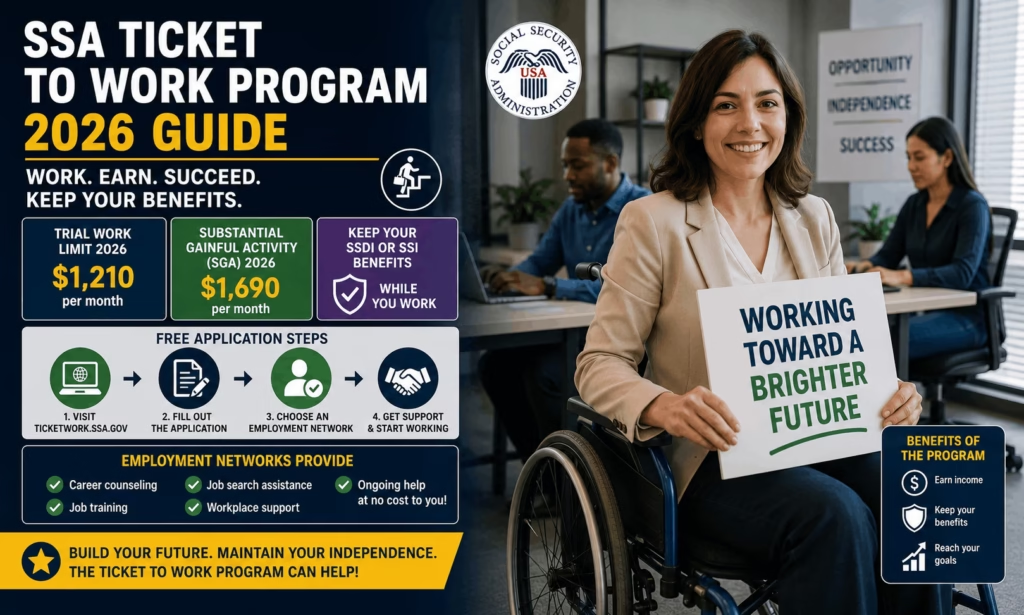
Latest Update: What Changed for the SSA Ticket to Work Program 2026
Before getting into eligibility and application steps, here is what is actually new this year. Social Security recalculates several dollar thresholds every January based on national wage growth, and 2026 brought meaningful increases across the board.
| Category | 2026 Figure | What It Means |
|---|---|---|
| Cost-of-Living Adjustment (COLA) | 2.8% increase | Applies to nearly 71 million Social Security beneficiaries and 7.5 million SSI recipients |
| Trial Work Period (TWP) threshold | $1,210/month | Earning above this counts as one of your 9 trial work months |
| Substantial Gainful Activity (SGA) — non-blind | $1,690/month | Earning above this after your TWP can end SSDI eligibility |
| Substantial Gainful Activity (SGA) — blind | $2,830/month | Higher threshold specifically for statutorily blind beneficiaries |
| Taxable maximum earnings | $184,500 | Ceiling on wages subject to Social Security tax |
| Earnings limit (under Full Retirement Age) | $24,480/year | Applies to retirement beneficiaries who work before FRA |
| Extended Period of Eligibility (EPE) | 36 months | Window after the TWP where benefits can restart if income drops |
| SSA blog explainer published | August 13, 2026 | SSA reaffirmed program benefits and encouraged sign-ups |
These numbers directly shape how much a beneficiary can safely earn without disrupting their monthly check, which is why understanding the Ticket to Work income limits 2026 is the first step before enrolling.
What Is the SSA Ticket to Work Program?
The Ticket to Work Program is a federal initiative run by the Social Security Administration that supports career development for people receiving disability benefits. It is not a job itself — it is a support system that pairs beneficiaries with an “employment team” of counselors, trainers, and job coaches who help them find and keep a job while protecting the safety net they already rely on.
The program grew out of the Ticket to Work and Work Incentives Improvement Act of 1999 (Public Law 106-170), which Congress passed to expand employment opportunities for SSDI and SSI recipients. Final regulations took effect in 2002, and the program has operated continuously since, now covering all 50 states and 10 U.S. territories.
A key operational change beneficiaries should know: SSA no longer mails a physical paper ticket. Eligibility today is determined automatically by your benefit status, not by holding a printed document. If you meet the criteria below, you already have access to the program — you simply need to connect with a provider to activate it.
Canada Pension Plan Payment September 2026: Who Will Receive CPP Benefits and How Much?
OAS Payment Increase September 2026: Confirmed Amounts, Payment Date, and the Annual GIS Reset !
Who Is Eligible for the Ticket to Work Program?
Eligibility is straightforward and does not require a separate application to “qualify” — SSA determines it based on your existing benefit record. You are eligible if you meet all of the following:
- You are between 18 and 64 years old
- You currently receive SSDI under Title II of the Social Security Act, SSI under Title XVI, or both
- Your disability status has not been formally deemed to have medically improved to the point of ineligibility
If you meet these conditions, your Employment Network or state Vocational Rehabilitation agency will verify your eligibility when you sign up — you do not need to prove anything to Social Security directly beforehand. You can also confirm your status yourself by calling the Ticket to Work Help Line.
Why the Program Exists: The Core Protections
The single biggest draw of the Ticket to Work Program is the set of work incentives it activates once you’re enrolled. These protections are what make testing employment realistic instead of risky.
Trial Work Period (TWP)
During your Trial Work Period, you can work and earn any amount for at least nine months and still receive your full SSDI payment. In 2026, a month only counts toward your nine if you earn more than $1,210. Earn less, and that month doesn’t get used up — giving you flexibility to ease into work gradually.
Extended Period of Eligibility (EPE)
After your TWP ends, you enter a 36-month Extended Period of Eligibility. During this window, you’ll receive your SSDI benefit for any month your earnings fall below the SGA level ($1,690 for most beneficiaries, $2,830 if you are blind), and benefits pause only for months you earn above it. If your income drops again within the EPE, benefits can restart without a new application.
Continued Medicare or Medicaid Coverage
One of the most underappreciated parts of the program is extended health coverage. Many beneficiaries can keep Medicare or Medicaid for several years after cash benefits stop, which removes one of the largest financial fears tied to returning to work — losing medical insurance.
Protection from Continuing Disability Reviews
As long as you are enrolled in the Ticket Program and making timely progress toward your employment goals, SSA will pause scheduled medical Continuing Disability Reviews (CDRs). This means pursuing work does not put your existing benefit approval at risk of a fresh medical re-evaluation.
How the Ticket to Work Program Works, Step by Step
Once you decide to participate, the process is designed to be simple and entirely free.
| Step | What Happens |
|---|---|
| 1. Confirm eligibility | Check your age and benefit type, or call the Help Line to verify |
| 2. Choose a provider | Select an Employment Network or your state Vocational Rehabilitation agency using the Find Help tool |
| 3. Build an employment plan | Work with your provider on goals, resume building, and skill development |
| 4. Assign your ticket | Formally connect your Ticket to the chosen provider |
| 5. Begin receiving services | Job coaching, training, placement help, and benefits counseling begin |
| 6. Report earnings | Keep records and report wages to SSA regularly |
| 7. Track progress | Provider monitors “timely progress” to keep CDR protection active |
2027 Social Security COLA Estimate Falls to 3.4%: How Much Could Your Check Increase?
How to Apply for the Ticket to Work Program?
There is no separate paper application to “apply” for the ticket itself — eligibility is automatic based on your SSDI/SSI status. What you actually apply for is a service provider. Here’s the practical path:
- Visit the official Find Help tool to search Employment Networks and VR agencies near you by ZIP code and service type.
- Call the Ticket to Work Help Line at 1-866-968-7842 (TTY 1-866-833-2967), Monday through Friday, 8 a.m. to 8 p.m. ET, for personalized guidance.
- Attend a free WISE webinar (Work Incentives Seminar Event) to understand how the program interacts with your specific benefit.
- Sign an Individualized Plan for Employment (IPE) with your chosen provider before services formally begin.
- Text the word “TICKET” to 1-571-489-5292 to opt into SMS updates from the program.
Processing Time
There is no lengthy “approval” wait the way there is for a disability claim. Since eligibility is automatic, the real timeline depends on how quickly you connect with a provider and complete an employment plan — typically a matter of days to a few weeks, depending on provider availability in your area. Benefits counseling sessions and the WISE webinars are usually available on a rolling or scheduled basis with little to no wait.
Payment Schedule and How Employment Networks Get Paid
Beneficiaries themselves never pay to join the program — it is entirely free. Instead, Employment Networks are compensated by Social Security on an outcome basis. ENs receive payments when a beneficiary reaches specific milestones or outcomes tied to sustained work and reduced reliance on benefits, not simply for enrolling someone. This funding structure is designed to keep providers focused on actual job placement and retention rather than paperwork volume.
Employment Networks vs. Vocational Rehabilitation Agencies
Beneficiaries generally choose between two types of service providers, and understanding the difference helps you pick the right fit.
| Feature | Employment Network (EN) | Vocational Rehabilitation (VR) Agency |
|---|---|---|
| Type | Private or public organization approved by SSA | State government agency |
| Cost to beneficiary | Free | Free |
| Funding model | Outcome-based payments from SSA | State and federal VR funding |
| Best for | Ongoing job coaching and long-term support | Intensive, time-limited rehabilitation services |
| Flexibility | Beneficiary can switch ENs by reassigning ticket | Typically works within a structured VR case plan |
SSDI vs. SSI: How Ticket to Work Rules Differ
Because SSDI and SSI are funded and calculated differently, the work incentives that apply to each program are not identical, and mixing them up is one of the most common sources of confusion among beneficiaries.
| Rule | SSDI | SSI |
|---|---|---|
| Based on | Work history and prior earnings (Title II) | Financial need (Title XVI) |
| Trial Work Period applies | Yes — 9 months, unlimited earnings | No — SSI uses a different earned-income exclusion formula |
| Substantial Gainful Activity limit | Applies after TWP ends | Does not directly apply the same way |
| Income counting | All-or-nothing after SGA threshold is exceeded | Gradual reduction — roughly $1 reduction for every $2 earned above the exclusion |
| Health coverage tied to benefit | Medicare | Medicaid |
This is exactly why a benefits counseling session matters before you increase your work hours. A Community Work Incentives Coordinator, available free through many Employment Networks and independent Work Incentives Planning and Assistance (WIPA) projects, can calculate precisely how your specific combination of SSDI, SSI, Medicare, or Medicaid will respond to a given paycheck — something a generic online calculator cannot reliably do.
Who Benefits Most From the Program
While the Ticket to Work Program is open to any eligible beneficiary, certain groups tend to see the clearest advantage from enrolling:
- Beneficiaries unsure how work affects benefits — the program pairs you with a counselor who can model outcomes before you commit to more hours.
- People re-entering the workforce after years off — resume building, interview coaching, and job matching services address skill gaps directly.
- Beneficiaries worried about a medical review — enrolling and making timely progress pauses scheduled Continuing Disability Reviews, which removes a major source of anxiety around returning to work.
- Younger beneficiaries early in adulthood — starting at 18 gives more runway to build a career trajectory while young.
- Beneficiaries in rural or underserved areas — many Employment Networks now offer remote and virtual coaching, closing a gap that used to limit access to in-person VR offices only.
CRS Score Distribution 2026: 5 Trends Shaping the Next Express Entry Draw
New Canada LMIA Rules August 2026: What Employers and Foreign Workers Need to Know
Program Reach and Scale
The Ticket to Work Program is not a small pilot — it operates as a permanent, nationwide infrastructure. It is available in all 50 states and 10 U.S. territories, and Social Security has approved an open-ended, unlimited number of Employment Networks, meaning the provider network keeps expanding rather than operating with a capped slot system. SSA distributes program news and updates through the Ticket Connection, a quarterly e-newsletter aimed at Employment Networks and state VR agencies, which also gives beneficiaries a way to track new provider types and service offerings as they roll out.
With roughly 71 million Americans receiving Social Security benefits and 7.5 million receiving SSI as of the 2026 COLA update, the pool of people technically eligible for Ticket to Work services is enormous — yet participation remains a fraction of that number, which is part of why SSA has ramped up direct outreach, including the August 2026 blog post and ongoing WISE webinar promotion.
Tips Before You Start
- Get a benefits counseling session first. It’s free and prevents surprises once your paycheck arrives.
- Keep a simple earnings log. Track hours, gross pay, and pay dates from day one — this makes SSA wage reporting far easier.
- Ask your provider directly about “timely progress” requirements. These vary slightly by provider and benefit type.
- Don’t wait for a perfect job to start. Many beneficiaries begin with part-time or trial roles specifically to use the Trial Work Period as a low-risk testing ground.
- Re-check the fact sheets every year. Because TWP, SGA, and COLA figures adjust annually, a rule that applied last year may already be outdated.
Official SSA Ticket to Work Resources
Always verify information and manage your ticket through official government channels rather than third-party sites claiming to process applications for a fee.
| Resource | Purpose | Official Link |
|---|---|---|
| Ticket to Work homepage | Program overview and news | choosework.ssa.gov |
| Find Help tool | Search Employment Networks and VR agencies | choosework.ssa.gov/findhelp |
| my Social Security account (login) | Manage benefits, check statements, update info | ssa.gov/myaccount |
| WISE webinars (registration) | Free work incentives seminars | choosework.ssa.gov/wise |
| Fact sheets library | TWP, EPE, Medicare/Medicaid rules | choosework.ssa.gov/library/fact-sheets |
| SSA COLA and benefit updates | Current-year payment and limit changes | ssa.gov/news/en/cola |
| Ticket to Work Help Line | Phone support | 1-866-968-7842 / TTY 1-866-833-2967 |
| Program email support | Direct SSA contact | TicketToWork@ssa.gov |
Common Mistakes Beneficiaries Make
Many people either avoid the program out of fear or misuse it in ways that create confusion later. A few patterns show up repeatedly among beneficiaries who run into trouble:
- Not reporting earnings promptly. Delayed wage reporting is one of the most common causes of overpayment notices.
- Assuming any income stops benefits immediately. In reality, the Trial Work Period allows unlimited earnings for nine months.
- Skipping benefits counseling. A Community Work Incentives Coordinator (CWIC) can map out exactly how your specific benefit will change with your specific income — skipping this step often leads to surprises.
- Letting a ticket sit unassigned indefinitely. While there’s no penalty for not using the program, an unassigned ticket also means you’re not receiving CDR protection or active job support.
FAQs About
Is the SSA Ticket to Work Program really free?
Yes. It costs nothing to enroll, and there are no fees at any stage. Employment Networks are compensated directly by Social Security through outcome-based payments, not by charging beneficiaries.
Will working affect my SSDI or SSI benefits right away?
Not immediately in most cases. Your Trial Work Period allows you to earn any amount for at least nine months while keeping your full SSDI benefit. SSI has its own separate income-counting rules, which a benefits counselor can walk you through.
Do I need a physical ticket to participate?
No. SSA stopped mailing paper tickets. Eligibility is based on your benefit record, and you can activate services simply by contacting an Employment Network or VR agency.
Can I switch Employment Networks after signing up?
Yes. You can take back your ticket and reassign it to a different Employment Network if your current provider isn’t meeting your needs, though you’ll need to formally transfer it rather than working with two at once.
What happens to my Medicare or Medicaid if I start earning more?
Many beneficiaries keep Medicare or Medicaid coverage for an extended period even after cash benefits stop, thanks to continued Medicare/Medicaid work incentive provisions. The exact duration depends on your benefit type and state.
How do I know if I’m making “timely progress” in the program?
Your Employment Network or VR counselor tracks specific milestones tied to your employment plan. As long as you’re actively engaged — attending appointments, applying for jobs, completing training steps — you generally maintain your Continuing Disability Review protection.
Can I use the Ticket to Work Program if I’m already working part-time?
Yes. The program is open to beneficiaries who want to increase their existing work hours or change careers, not only those starting from zero.
Conclusion
The SSA Ticket to Work Program remains one of the most practical, underused tools available to disability beneficiaries who want to test the workforce without gambling their financial safety net. With the 2026 income thresholds now raised — a $1,210 trial work limit and a $1,690 substantial gainful activity ceiling — beneficiaries have more room than ever to earn while keeping their benefits and health coverage intact. The August 2026 SSA blog reminder signals that the agency wants more eligible Americans to actually use these protections rather than let them sit unclaimed. If you receive SSDI or SSI and have been on the fence about working, the first real step is a free call to the Ticket to Work Help Line or a visit to the Find Help tool — not a leap into the unknown, but a guided, protected path back to earning a paycheck.
Indian Student Applications to US Colleges Fall 15% Amid Visa Uncertainty: What the New Data Shows