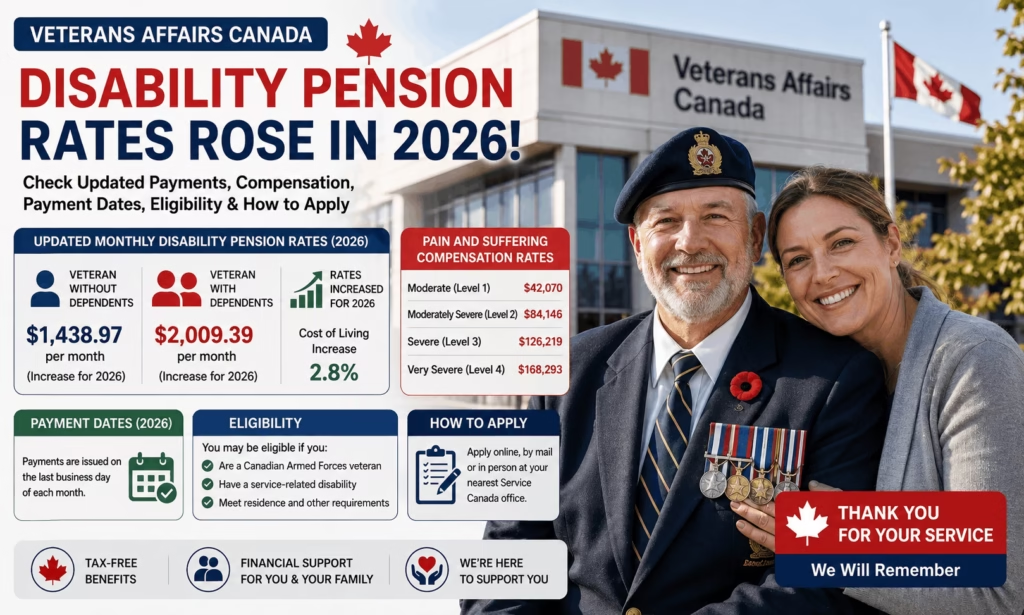
Veterans Affairs Canada Disability Pension payments have gone up again this year, and thousands of Canadian Armed Forces veterans, RCMP members and survivors are now seeing the updated amount land in their bank accounts. Effective January 1, 2026, VAC applied a 2.0 percent cost of living adjustment to every Disability Pension rate under Schedule I and Section 75 of the Pension Act, pushing the top monthly rate for a single Class 1 veteran to $3,513.48 and the Pain and Suffering Compensation maximum to $1,419.82 a month for a veteran with a fully accepted 100 percent disability. For veterans who have relied on this benefit for years, and for newer applicants who are only now learning how the system works, the update changes both the numbers on the deposit slip and, in some cases, the amount owed retroactively once a claim is finally approved. We’ll be updating this article monthly as Veterans Affairs Canada confirms new rates, payment dates and program changes.
The increase did not happen in isolation. It followed a year in which Veterans Affairs Canada continued working through a backlog of first applications and reassessments that has grown steadily since 2015, even as the department reported hiring more adjudicators and simplifying decisions for certain recognized medical conditions. For a veteran filing today, the practical questions are rarely about policy history. They are about how much the disability pension actually pays in 2026, whether the older Pension Act pension or the newer Pain and Suffering Compensation applies to their situation, when the next payment date falls, and how long a first application realistically takes from submission to decision. This article answers each of those questions using the official rate tables and program pages published directly by Veterans Affairs Canada, along with the links veterans need to check their file, apply online, or track a payment.
Key Highlights: Veterans Affairs Canada Disability Pension 2026
| Detail | Information |
|---|---|
| Program name | Disability Pension (Pension Act) and Pain and Suffering Compensation (Veterans Well-being Act) |
| Administered by | Veterans Affairs Canada (VAC) |
| 2026 rate adjustment | 2.0 percent increase effective January 1, 2026 |
| Top monthly rate (Class 1, single veteran) | $3,513.48 |
| Lowest monthly rate (Class 20, single veteran) | $175.67 |
| Maximum Pain and Suffering Compensation | $1,419.82 per month or $461,956.71 as a lump sum |
| Application review target | 80 percent of first applications decided within 16 weeks |
| Tax status | Fully tax free, not reported as income |
| Application method | My VAC Account online or mailed paper form |
| Toll free support line | 1-866-522-2122 |
What Is the Veterans Affairs Canada Disability Pension
The Disability Pension is a monthly, tax free payment made under the Pension Act to Canadian Armed Forces veterans, current or former RCMP members, and certain Second World War or Korean War veterans, including Merchant Navy veterans, who live with a health condition connected to their service. It is one of two main paths VAC uses to compensate service related illness and injury. The older Pension Act stream, which most people mean when they say disability pension, pays a monthly amount for life based on a class system running from Class 1, the most severe, down to Class 20. The newer stream, introduced for injuries and illnesses arising after April 2006, is called Pain and Suffering Compensation and can be taken as either a monthly payment for life or a one time lump sum.
Both streams exist alongside a wider basket of financial supports, including the Income Replacement Benefit, Additional Pain and Suffering Compensation, the Caregiver Recognition Benefit, the Critical Injury Benefit and several allowances tied to specific needs such as attendance care or clothing wear. Veterans do not usually have to choose a single benefit in isolation. A veteran with a severe service related condition may be receiving a Disability Pension for an older injury while also collecting Pain and Suffering Compensation for a more recently accepted condition, plus an allowance for a related need such as attendance care at home.
Service Canada Benefit Payments September 2026 Dates, Amounts and Who Qualifies
Canada FMCSP Study Permit: 2,970 Spots Now Open for French-Speaking Students From 33 Countries
Veterans Affairs Canada Disability Pension Rates 2026
Veterans Affairs Canada adjusts Disability Pension rates every January 1 in line with the Consumer Price Index, as required under Section 75 of the Pension Act. The 2026 increase came in at 2.0 percent, applied on top of the 2025 rates. The class system determines how much a veteran receives, with additional monthly amounts payable for a spouse or common law partner and for each dependent child.
| Class | Monthly rate (single veteran) | Additional for spouse | Additional for one child | Additional for second child | Additional for each other child |
|---|---|---|---|---|---|
| Class 1 | $3,513.48 | $878.37 | $456.75 | $333.78 | $263.51 |
| Class 5 | $2,810.78 | $702.70 | $365.40 | $267.03 | $210.81 |
| Class 10 | $1,932.41 | $483.10 | $251.21 | $183.58 | $144.93 |
| Class 15 | $1,054.04 | $263.51 | $137.03 | $100.13 | $79.05 |
| Class 20 | $175.67 | $43.92 | $22.84 | $16.69 | $13.18 |
These are sample classes taken from the official schedule. Veterans Affairs Canada assesses each file individually, and the precise class awarded depends on the medical entitlement decision and the assessed extent of disability, so two veterans with a similar diagnosis can still receive different monthly amounts depending on how their specific condition and its impact on daily function were evaluated. Veterans who want the complete class by class breakdown, including every class between 1 and 20, can view the full rate table published by Veterans Affairs Canada.
Pain and Suffering Compensation Rates 2026
For conditions accepted under the Veterans Well-being Act rather than the older Pension Act, Veterans Affairs Canada pays Pain and Suffering Compensation. Veterans choose whether to receive this as a monthly amount for life or as a single lump sum, and the amount scales directly with the assessed extent of disability, expressed as a percentage.
| Extent of disability | Monthly benefit | Lump sum amount |
|---|---|---|
| 5 percent | $70.99 | $23,097.84 |
| 20 percent | $283.96 | $92,391.34 |
| 40 percent | $567.93 | $184,782.68 |
| 60 percent | $851.89 | $277,174.03 |
| 80 percent | $1,135.86 | $369,565.37 |
| 100 percent | $1,419.82 | $461,956.71 |
Veterans who qualify for a severe and permanent barrier to reintegration into civilian life may also receive Additional Pain and Suffering Compensation, paid in three grades. Grade 1 pays $1,851.93 a month, Grade 2 pays $1,234.62 a month, and Grade 3 pays $617.31 a month. This additional payment recognizes the ongoing economic loss that comes with a severe disability rather than only the pain and suffering itself.
Other Financial Supports Linked to the Disability Pension
Veterans receiving a Disability Pension or Pain and Suffering Compensation are often also eligible for related supports, and understanding these can make a meaningful difference to a household budget.
The Attendance Allowance provides a monthly payment when a veteran’s health needs require daily personal care, with rates ranging from $2,324.88 at Grade 1 down to $372.11 at Grade 5. The Clothing Allowance helps offset wear and tear on clothing caused by a disability, or the cost of specially made clothing, and pays between $263.46 and $29.21 a month depending on grade. The Exceptional Incapacity Allowance, for veterans whose combined disabilities create hardship beyond what standard rates reflect, pays from $1,859.93 down to $620.00 a month across five grades.
Veterans transitioning through rehabilitation may also receive the Income Replacement Benefit, which guarantees at least 90 percent of gross pre release military salary, working out to a minimum pre tax income of $60,002.64 a year. Family caregivers of veterans with the most severe needs can receive the Caregiver Recognition Benefit, currently $1,264.25 a month and indexed annually. For the most catastrophic service related injuries, the Critical Injury Benefit pays a one time, tax free lump sum of $92,175.45, and in the event a Canadian Armed Forces member dies while still serving, the Death Benefit pays $461,956.71 to a surviving spouse, common law partner or dependent children.
Social Security Payment September 2026: Five Confirmed Dates You Need to Know
Who Is Eligible for the Disability Pension
Eligibility for the Veterans Affairs Canada Disability Pension rests on three core requirements. First, the applicant must be a Canadian Armed Forces veteran, a current or former member of the Royal Canadian Mounted Police, or fall into certain recognized categories of Second World War, Korean War, or Merchant Navy veterans. Second, there must be a diagnosed medical condition. Third, and often the most contested part of a claim, there must be a credible link between that condition and military or police service, whether the condition arose directly during service, was aggravated by service, or developed as a consequence of another already accepted service related condition.
Veterans do not need to have been injured in combat to qualify. Conditions such as hearing loss from prolonged noise exposure, musculoskeletal injuries from physical training, and mental health conditions including post traumatic stress disorder and depression linked to service are among the most commonly accepted claims. Veterans Affairs Canada uses published Entitlement Eligibility Guidelines for many conditions, which set out the medical and scientific basis for recognizing a link to service, and these guidelines can speed up a decision when a veteran’s file clearly matches the recognized pattern.
How to Apply for the Veterans Affairs Canada Disability Pension
Applying starts with choosing between the online and paper route, and Veterans Affairs Canada strongly encourages using the online option wherever possible because it is faster to submit and easier to track.
Veterans who register for My VAC Account can complete a guided web form that walks through each part of the application, including the diagnosis, the connection to service, and supporting documentation. Still serving Canadian Armed Forces members are encouraged to set up My VAC Account well before release, since VAC uses the account both to receive the application and to automatically request health records from Canadian Forces Health Services, removing the need for the applicant to chase down those records themselves. Veterans who prefer not to apply online can download the paper application form and mail the completed package directly to Veterans Affairs Canada, PO Box 6000, Matane, QC G4W 0E4.
Whichever method is used, a complete application package generally needs a current medical diagnosis, medical or service health records showing the condition, proof of identity, and a direct deposit request form so payments can be set up immediately once approved. Veterans who are unsure how to complete any part of the form can get free help from a Veterans Affairs Canada staff member by calling 1-866-522-2122, from a Bureau of Pensions Advocate, or from veteran support organizations such as the Royal Canadian Legion and The War Amps of Canada, both of which assist with applications at no cost.
Processing Time for Disability Pension Applications
Veterans Affairs Canada has set a formal service standard for disability benefit decisions: 80 percent of first applications and reassessments should be decided within 16 weeks, while departmental reviews are targeted at 12 weeks. Whether an individual file meets that standard depends heavily on how complete the application is at the time of submission and how quickly medical records can be obtained.
Applications with straightforward, well documented conditions that match an existing Entitlement Eligibility Guideline tend to move faster, sometimes well within the 16 week target. Files involving multiple conditions, conflicting medical evidence, or missing documentation take longer, since a decision maker will place the file on hold and notify the applicant if information is missing rather than issuing a decision on an incomplete record. Veterans facing serious financial hardship, terminal illness or advanced age can ask VAC about priority handling of their file, and in many cases doing so shortens the wait considerably. Importantly, once a claim is approved, Veterans Affairs Canada pays retroactively to the effective date, which is usually the date of application or the date the condition first arose, so a veteran who waited several months for a decision does not lose that period of entitlement.
Payment Schedule: Disability Pension Payment Dates 2026
Veterans Affairs Canada disability benefits are paid monthly, generally landing near the end of the month, with slightly different dates for Canadian Armed Forces veterans compared with RCMP members. Based on the official VAC payment calendar, disability pension payments for the remainder of 2026 fall on the following dates for RCMP recipients, with CAF veteran payments typically arriving one business day later in the same week.
| Month | RCMP disability pension payment date |
|---|---|
| September 2026 | September 28 |
| October 2026 | October 29 |
| November 2026 | November 27 |
| December 2026 | December 23 |
Veterans who use direct deposit generally receive their payment on the scheduled date without delay, while those still waiting on a mailed cheque should expect a few extra days for delivery. If a scheduled payment does not appear within three to five business days of the listed date, Veterans Affairs Canada recommends contacting the department directly rather than assuming an error, since bank processing times and statutory holidays can occasionally shift when funds actually clear.
IRCC Tightens Citizenship by Descent: What the New 1,095-Day Presence Test Rules Mean for Applicants
SSI Address Change Service Enhancements: SSA’s New Fast-Track Process Explained
Checking Your Application Status and Reassessments
Once an application is submitted, the fastest way to track progress is through My VAC Account, which shows the current stage of the file, from initial review, to health record collection, to assignment with a decision maker. Veterans who do not have online access can call the toll free line for a status update.
If a veteran’s condition worsens after a decision has already been made, they can request a reassessment rather than filing a brand new claim. A reassessment requires new medical evidence showing the change in condition, and if VAC confirms the condition has worsened, the class or extent of disability rating is adjusted upward, unless the veteran is already receiving the maximum rate available. Veterans who disagree with a decision, whether it is a denial of entitlement or a class assessment they feel is too low, have the right to request a Departmental Review, and beyond that, an appeal to the independent Veterans Review and Appeal Board, which operates separately from Veterans Affairs Canada and reports directly to Parliament through the Minister of Veterans Affairs.
Official Veterans Affairs Canada Resources
| Resource | Link |
|---|---|
| Official Disability Pension rates page | https://veterans.gc.ca/en/about-vac/resources/rates |
| My VAC Account login and registration | https://veterans.gc.ca/en/contact-us/my-vac-account |
| Disability benefits overview | https://veterans.gc.ca/en/financial-programs-and-services/compensation-illness-or-injury/disability-benefits |
| Application forms | https://veterans.gc.ca/en/about-vac/resources/forms |
| How to appeal a decision | https://veterans.gc.ca/en/veterans-rights/how-appeal |
| Contact Veterans Affairs Canada | https://veterans.gc.ca/en/contact-us |
| Toll free helpline | 1-866-522-2122 |
FAQs
How much is the Veterans Affairs Canada Disability Pension in 2026?
Monthly amounts range from $175.67 for a Class 20 rating up to $3,513.48 for a Class 1 rating for a single veteran, following the 2.0 percent increase applied on January 1, 2026. Additional amounts are paid for a spouse or common law partner and for each dependent child.
Is the Disability Pension taxable?
No. The Disability Pension, along with Pain and Suffering Compensation and most other VAC disability benefits, is fully tax free and does not need to be reported as income on a tax return.
How long does it take to process a VAC disability pension application?
Veterans Affairs Canada aims to decide 80 percent of first applications within 16 weeks. Straightforward, well documented claims can be decided faster, while complex files with multiple conditions or missing records often take longer.
What is the difference between the Disability Pension and Pain and Suffering Compensation?
The Disability Pension is paid under the older Pension Act as a lifetime monthly amount based on a class system. Pain and Suffering Compensation is paid under the newer Veterans Well-being Act and can be taken either monthly or as a lump sum, calculated as a percentage of the maximum rate.
Can I apply for the Disability Pension online?
Yes. Veterans who register for My VAC Account can complete and submit a guided online application, which is generally faster than the paper form and allows the veteran to track the status of the file in real time.
What happens if my condition gets worse after approval?
Veterans can request a reassessment by contacting Veterans Affairs Canada or visiting a local office. New medical evidence showing the condition has worsened can lead to an upward adjustment of the disability class or rating, unless the veteran is already at the maximum rate.
When are disability pension payments deposited each month?
Payments are generally deposited near the end of each month, with RCMP recipients and Canadian Armed Forces veterans sometimes receiving deposits on slightly different dates in the same week. Direct deposit is the fastest and most reliable way to receive payment on schedule.
Can survivors receive the Disability Pension?
Yes. Survivors of veterans who were receiving or entitled to a Disability Pension may qualify for a Survivor’s Pension, calculated using a separate rate schedule published alongside the veteran rates.
Conclusion
The Veterans Affairs Canada Disability Pension remains one of the most important sources of financial support for Canadian veterans and RCMP members living with a service related condition, and the 2026 rate increase means both new and long standing recipients are seeing a modestly higher monthly deposit this year. For veterans who have not yet applied, the process is more manageable than it may first appear, particularly through My VAC Account, and the department’s published service standards give a realistic sense of how long a decision should take. For those already receiving payments, keeping track of the payment calendar, understanding how reassessments work, and knowing where to turn if a condition changes or a decision feels wrong can make a real difference over the life of the benefit. As Veterans Affairs Canada continues to update rates, processing targets and payment schedules through the rest of 2026, this article will be revised to reflect the latest confirmed figures.
SSA Strategic Plan FY2026-2030: New Goals, Wait Times & Service Targets
SSA Ticket to Work Program: How Disability Beneficiaries Can Return to Work Without Losing Benefits
SSDI Payment Dates September 2026: Who Gets Paid and When?
Japan Visa Renewal Fee Increase 2026: New Charges From October Explained