Service Canada Benefit Payments September 2026: Millions of Canadians who rely on federally administered benefits are heading into a September that brings a small but genuinely new development alongside the usual monthly deposits. Service Canada benefit payments September 2026 include the regular Canada Pension Plan and Old Age Security deposits landing on the same day as always, the Canada Disability Benefit arriving on its own separate mid-month date, and, for the first time, a confirmed one-time $150 top-up payment tied to new regulations that took legal effect on September 1. We’ll be updating this article monthly as Service Canada confirms new payment dates and any changes to benefit amounts.
Understanding which programs fall under Service Canada rather than the Canada Revenue Agency matters more than it might seem, because the two departments run entirely separate payment calendars, and mixing them up is one of the most common sources of confusion for anyone tracking multiple benefits at once. Service Canada, operating under Employment and Social Development Canada, is responsible for the Canada Pension Plan in all its forms, Old Age Security and the Guaranteed Income Supplement, the Canada Disability Benefit, and Employment Insurance. The Canada Revenue Agency, by contrast, handles the Canada Child Benefit, the GST and HST credit, and several provincial tax-based supplements. This guide covers every Service Canada program on its own terms, including the one benefit that does not follow a fixed calendar date at all.
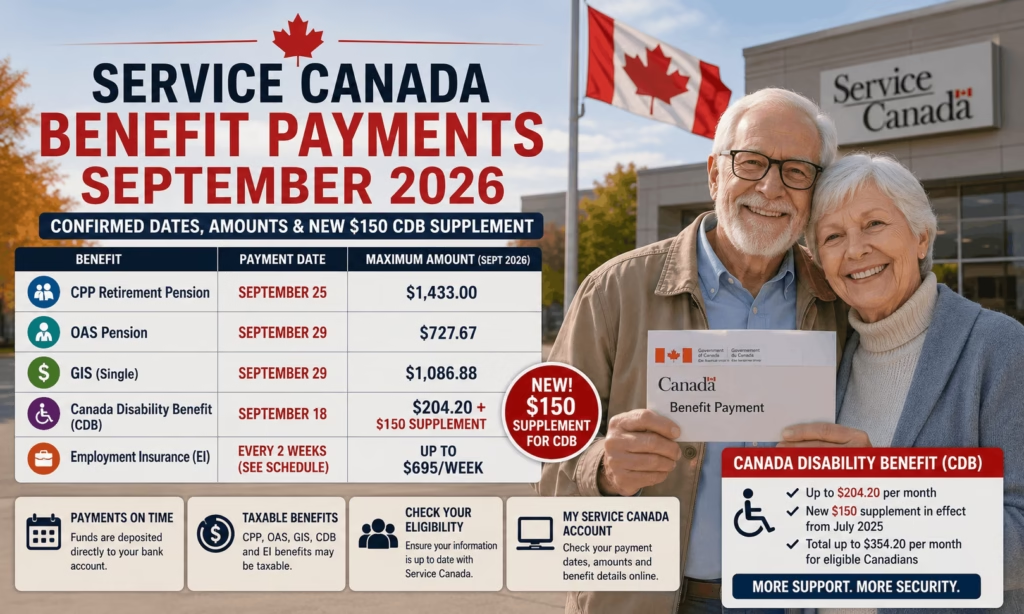
Service Canada Benefit Payments Key Highlights
| Program | September 2026 Payment Date | Current Monthly Maximum |
|---|---|---|
| Canada Pension Plan (retirement, disability, survivor, children’s) | September 25 | Up to $1,507.65 for a new retirement pension at 65 |
| Old Age Security | September 25 | $751.97 (ages 65 to 74), $827.17 (ages 75 and up) |
| Guaranteed Income Supplement | September 25 | Up to $1,123.17 for a single pensioner |
| Canada Disability Benefit | September 17 | $204.20, plus a new one-time $150 supplement |
| Employment Insurance | No fixed date; paid biweekly per individual claim | Up to $729 per week |
Source: Service Canada’s official 2026 benefits payment calendar and the Canada Disability Benefit Regulations amendments published in the Canada Gazette, Part II, July 1, 2026.
The Two-Paragraph Version: What’s Actually New This Month
If you only read one part of this guide, read this. Most Service Canada programs are simply continuing their existing 2026 schedule in September with no rate change, since Old Age Security and the Guaranteed Income Supplement only adjust quarterly, and September is the final month of the current July-to-September quarter at the confirmed 1.2 percent rate. The Canada Pension Plan and OAS both pay on Friday, September 25, 2026, the standard shared date Service Canada uses every month for these two programs together.
What is genuinely new this month sits with the Canada Disability Benefit. New regulations amending the Canada Disability Benefit Regulations were published in the Canada Gazette on July 1, 2026, and took legal effect on September 1, authorizing a one-time supplemental payment of 150 dollars for every current recipient who received at least one regular CDB payment before September 2026. This supplement, intended to help offset the cost of obtaining the Disability Tax Credit certificate that the program requires as a gateway document, arrives automatically, without a separate application, alongside the regular monthly CDB deposit scheduled for September 17.
Indian Student Applications to US Colleges Fall 15% Amid Visa Uncertainty: What the New Data Shows
Canada Pension Plan: September Payment Explained
The Canada Pension Plan pays retirement, disability, survivor, and children’s benefits on the same shared date every month, and September 2026 follows that pattern with a deposit on Friday, September 25. Unlike Old Age Security, CPP amounts depend entirely on an individual’s own contribution history rather than a flat rate set for everyone.
A new CPP retirement pension starting at age 65 in 2026 pays an average of roughly 925 dollars a month, with a maximum of 1,507.65 dollars for contributors who paid the maximum amount throughout their working years. Workers who began contributing under the CPP enhancement introduced starting in 2019, and specifically the second enhancement phase that began in 2024, will see somewhat higher eventual payouts as those enhanced contributions accumulate over their careers. CPP retirement, disability, and survivor benefits are all considered taxable income and must be reported annually, though tax is not automatically withheld unless a recipient specifically requests voluntary deductions through Service Canada.
Old Age Security and the Guaranteed Income Supplement
OAS and GIS share the same September 25 payment date as CPP, and both are reviewed quarterly, in January, April, July, and October, based on movements in the Consumer Price Index rather than adjusting every single month the way some other indexed benefits do. The 1.2 percent increase that took effect in July for the July-to-September quarter carries forward unchanged into this month’s payment, since September is the final deposit of that quarterly cycle.
The maximum monthly OAS pension currently stands at 751.97 dollars for seniors aged 65 to 74 and 827.17 dollars for those 75 and older, the higher figure reflecting the permanent 10 percent enhancement introduced for that older age group back in July 2022. GIS, a non-taxable supplement layered on top of OAS for low-income seniors, currently maxes out at 1,123.17 dollars a month for a single, widowed, or divorced pensioner, provided their annual income excluding OAS stays under roughly 22,800 dollars. Both GIS and OAS eligibility calculations shifted this cycle to use a recipient’s completed 2025 tax return rather than 2024, which means seniors who filed their 2025 return late may have experienced a temporary suspension of income-tested amounts until the return was processed.
Looking ahead, Service Canada has already confirmed a larger 1.4 percent increase for the October-to-December 2026 quarter, which is expected to push the maximum OAS pension for the youngest eligible group past 762 dollars and above 838 dollars for those 75 and older once the new rate takes effect with the October payment.
Canada Disability Benefit: New September Supplement Explained
The Canada Disability Benefit follows its own separate schedule from CPP and OAS, paid on the third Thursday of each month rather than the shared end-of-month date, which puts the September 2026 CDB deposit on September 17. The maximum monthly amount for the current 2026-27 benefit year is 204.20 dollars, reflecting a 2.1 percent inflation adjustment applied in July that raised the annual entitlement ceiling from the original 2,400 dollars to 2,450.40 dollars spread across twelve monthly payments. Because the benefit is legally structured so its maximum can never decrease even if inflation turns negative, this figure represents a floor going into the rest of the benefit year.
The genuinely new development is the one-time supplemental payment. Regulations amending the Canada Disability Benefit Regulations were published in the Canada Gazette, Part II, on July 1, 2026, authorizing a fixed 150 dollar lump sum for every recipient who received at least one regular CDB payment before September 2026. The changes took legal effect on September 1, and eligible recipients do not need to file a separate application, since the supplemental amount is issued automatically to existing recipients. The government has framed the payment as targeted relief for the cost of obtaining a Disability Tax Credit certificate, the mandatory qualifying document every CDB applicant must hold before receiving regular monthly payments.
CDB income thresholds also rose with the July indexation. Single recipients can now earn up to 23,483 dollars in other income before their benefit begins reducing, up from 23,000 dollars, while the threshold for couples rose from 32,500 dollars to 33,182.50 dollars. A working income exemption additionally allows single recipients to earn up to 10,210 dollars in employment income, and couples up to 14,294 dollars, before that income affects the benefit calculation at all.
Employment Insurance: Why There Is No Fixed September Date
Employment Insurance is the one Service Canada program that genuinely does not fit into a fixed monthly calendar, and understanding why prevents a great deal of unnecessary confusion. Unlike CPP, OAS, or the CDB, which pay every eligible recipient on the same shared date, EI runs on an individual biweekly cycle tied to each claimant’s own application date. After an initial one-week waiting period, a claimant submits a report every two weeks confirming continued eligibility, and Service Canada issues payment within about two business days of that report by direct deposit, or five to seven business days by mailed cheque.
For 2026, the maximum insurable earnings ceiling is 68,900 dollars, and EI regular benefits pay 55 percent of a claimant’s average insurable weekly earnings up to that ceiling, producing a maximum weekly benefit of 729 dollars for anyone earning at or above the cap. A claimant earning less than the maximum receives 55 percent of their own average, so someone with average insurable earnings of 40,000 dollars a year would receive roughly 424 dollars a week rather than the maximum figure. Regular EI benefits can run anywhere from 14 to 45 weeks depending on the unemployment rate in a claimant’s economic region and the number of insurable hours accumulated over the prior 52 weeks.
A temporary set of tariff relief measures, including a waived one-week waiting period for some claimants, remains in effect through October 2026, which means some new applicants filing before that date may see their first payment arrive faster than the standard 28-day processing window that normally applies from a complete application to first deposit. Because the schedule is individual rather than shared, there is no single “EI payment date” for September the way there is for CPP or OAS, and any calendar claiming otherwise should be treated with caution.
Comparing Service Canada’s Programs
| Feature | CPP | OAS and GIS | CDB | EI |
|---|---|---|---|---|
| Based on | Individual contribution history | Age and years of Canadian residence | Age 18 to 64, low income, DTC certificate holder | Recent insurable employment and job loss |
| Payment frequency | Monthly, fixed shared date | Monthly, fixed shared date | Monthly, fixed separate date | Biweekly, individual cycle |
| September 2026 date | September 25 | September 25 | September 17 | Varies by claim |
| Taxable | Yes | Yes | No | Yes |
| Rate adjustment cycle | Annual, January | Quarterly | Annual, July | Set annually via MIE |
How to Apply for Service Canada Benefits?
- Create or log into your My Service Canada Account, the online portal used to apply for and track CPP, OAS, EI, and the CDB.
- For CPP, confirm your contribution history and decide your intended start age, since taking CPP earlier than 65 permanently reduces the monthly amount while deferring past 65 increases it.
- For OAS, applications can sometimes be automatic based on existing government records, but many seniors still need to apply directly, particularly if they have lived outside Canada for extended periods.
- For the Canada Disability Benefit, secure a valid Disability Tax Credit certificate first, since CDB eligibility requires holding an approved DTC before a CDB application can be processed.
- For EI, apply as soon as possible after your job ends, since delaying an application can result in a loss of benefits, and gather your Record of Employment from your employer to avoid processing delays.
- Set up direct deposit through your My Service Canada Account for any of these programs to ensure payments arrive on schedule rather than being delayed by mailed cheques.
- Submit required biweekly reports promptly if collecting EI, since a missed report will pause that payment cycle until the report is filed.
Processing Time: How Long Do Service Canada Benefits Take?
Processing time varies considerably across these four programs. CPP retirement applications submitted with complete documentation are typically processed within a matter of weeks, though applying several months before your intended start date is generally recommended. CPP disability claims take longer because they require a medical review confirming the disability is both severe and prolonged, with payments beginning four months after that determination is made. OAS applications generally process within a similar window to CPP retirement claims, though first-time applicants without an existing Service Canada file may see a slightly longer wait.
The Canada Disability Benefit has processed a substantial volume of claims since applications opened in June 2025, with more than 330,000 client decisions completed and over 218,000 clients receiving payments as of the most recent government reporting. Eligible applicants can receive back payments for up to 24 months from the date Service Canada receives a complete application, though not for any month before the program’s June 2025 launch. Employment Insurance targets roughly 28 days from a complete application to first payment, a timeline that includes the standard one-week waiting period, though the current tariff relief measures have temporarily waived that waiting period for some claimants through October 2026.
SSI Address Change Service Enhancements: SSA’s New Fast-Track Process Explained
IRCC Tightens Citizenship by Descent: What the New 1,095-Day Presence Test Rules Mean for Applicants
What to Do If Your Payment Is Late
Service Canada advises waiting 5 to 10 business days after a scheduled payment date before assuming something has gone wrong, since bank processing and mailed cheques can add delay even after a payment has been issued on time.
- Check your bank account directly, since a scheduled deposit sometimes posts later in the day than expected.
- Confirm your direct deposit banking details are current through your My Service Canada Account, since outdated information is one of the most common causes of a missing payment.
- For EI specifically, confirm your biweekly report was actually submitted, since a missed report will pause payment for that entire cycle until the report is filed.
- Wait the recommended 5 to 10 business day window before contacting Service Canada about a payment that has not arrived.
- Call the national Service Canada line if the payment still has not appeared after that window, or visit a local Service Canada office for in-person help.
Recipients who still receive a mailed cheque rather than direct deposit should expect longer delays as a matter of course, and switching to direct deposit through My Service Canada Account remains the most reliable way to avoid this issue going forward.
SSA Ticket to Work Program: How Disability Beneficiaries Can Return to Work Without Losing Benefits
SSA Strategic Plan FY2026-2030: New Goals, Wait Times & Service Targets
Service Canada Payment Schedule 2026
| Item | September 2026 Detail |
|---|---|
| CPP payment date | September 25 |
| OAS and GIS payment date | September 25 |
| CDB payment date | September 17 |
| CDB one-time supplement | 150 dollars, effective September 1, automatic for existing recipients |
| EI payment timing | Biweekly, roughly 2 business days after each report by direct deposit |
| Current OAS quarterly rate | 1.2 percent, unchanged from July, next adjustment October at 1.4 percent |
Official Service Canada Resources
| Resource | Purpose | Official Link |
|---|---|---|
| My Service Canada Account | Apply, track, and manage CPP, OAS, EI, and CDB | canada.ca, My Service Canada Account login |
| Official benefits payment calendar | View confirmed dates for every federal program | canada.ca, Benefits payment dates page |
| Apply for CPP retirement pension | Start a new CPP application | canada.ca, Apply for CPP page |
| Apply for the Canada Disability Benefit | Start a new CDB application | canada.ca, Canada Disability Benefit application page |
| Apply for Employment Insurance | Start a new EI claim | canada.ca, Apply for EI benefits page |
| Service Canada national phone line | Speak with a representative | 1-800-206-7218 |
Indian Student Applications to US Colleges Fall 15% Amid Visa Uncertainty: What the New Data Shows
FAQs
When is the Service Canada payment date for September 2026?
It depends on the program. CPP and OAS both pay September 25, the Canada Disability Benefit pays September 17, and Employment Insurance has no fixed date since it runs on an individual biweekly cycle tied to each claimant’s own reporting schedule.
What is the new $150 CDB payment in September 2026?
It is a one-time supplemental payment authorized by regulations that took legal effect September 1, 2026, intended to help offset the cost of obtaining a Disability Tax Credit certificate. It goes automatically to every recipient who received at least one regular CDB payment before September 2026, with no separate application required.
Is OAS increasing in September 2026?
No. September is the third and final payment of the current July-to-September quarter at the confirmed 1.2 percent increase. The next adjustment, a larger 1.4 percent increase, is already confirmed for October.
Why doesn’t EI have a fixed payment date like CPP and OAS?
EI runs on an individual biweekly cycle rather than a shared monthly calendar because each claimant’s payment timing depends on when their specific claim started and when they submit their biweekly report, not on a single date that applies to everyone.
What is the maximum EI payment in 2026?
The maximum weekly EI benefit is 729 dollars, based on 2026’s maximum insurable earnings ceiling of 68,900 dollars and the standard 55 percent benefit rate.
Do I need to apply separately for the CDB supplemental payment?
No. The 150 dollar supplement is issued automatically to eligible existing recipients alongside their regular September CDB deposit, with no separate application process.
Which programs does Service Canada administer versus the Canada Revenue Agency?
Service Canada, under Employment and Social Development Canada, handles CPP, OAS, GIS, the Canada Disability Benefit, and Employment Insurance. The Canada Revenue Agency separately administers the Canada Child Benefit, the GST and HST credit, and several provincial tax-based supplements.
Conclusion
September 2026 keeps most Service Canada programs on their familiar rhythm, CPP and OAS landing together on September 25 and the CDB arriving on its own September 17 date, but this month carries one development that is genuinely new: a confirmed one-time 150 dollar CDB supplement, authorized through regulations that took legal effect September 1, arriving automatically for existing recipients without any separate application. For anyone tracking multiple federal benefits at once, the most useful habit is remembering that Service Canada’s calendar is not one single date but several running in parallel, with Employment Insurance standing apart entirely as the one program with no shared date at all. Keeping direct deposit information current through My Service Canada Account remains the simplest way to avoid unnecessary delays across every program on this list. This article will be updated monthly as Service Canada confirms new payment dates and any changes to benefit amounts.
TPS Somalia Termination: Work Permits No Longer Valid After August 14 Deadline
Meta Safety Changes on Instagram and Facebook: What Teens and Parents Need to Know Right Now
H-1B Crackdown Employer Warning Now Covers OPT, PERM and J-1 Hiring Practices
Japan Visa Renewal Fee Increase 2026: New Charges From October Explained