Canada FMCSP Study Permit: A fresh round of one of Canada’s most overlooked permanent residence pathways has just opened, and it carries a detail that separates it from almost every other study permit route into the country: graduates do not need a job offer, a competitive Express Entry score, or a post-graduation work permit gamble to secure permanent residence. Immigration, Refugees and Citizenship Canada opened its third annual intake under the Francophone Minority Communities Student Pilot on August 26, accepting up to 2,970 new study permit applications from eligible French-speaking applicants across 33 countries, running through August 25, 2027. We’ll be updating this article monthly as new intake and processing data becomes available.
The program, generally shortened to the FMCSP, is not new. It first launched on August 26, 2024, with a modest opening cap of 2,300 applications aimed at French speakers from regions where study permit refusal rates have historically run far higher than the national average. What changed this year is the legal framework underpinning it. Immigration Minister Lena Metlege Diab signed an updated public policy on June 25, 2026, that replaced the prior September 2025 version, locked in a second consecutive year at the higher 2,970-application cap, and extended the pilot’s study permit intake window by a full year, out to August 25, 2027. A companion policy governing the permanent residence and open work permit side of the pilot was signed the same day and now runs until November 30, 2032, giving the program a long runway that few other immigration pilots in Canada currently have.
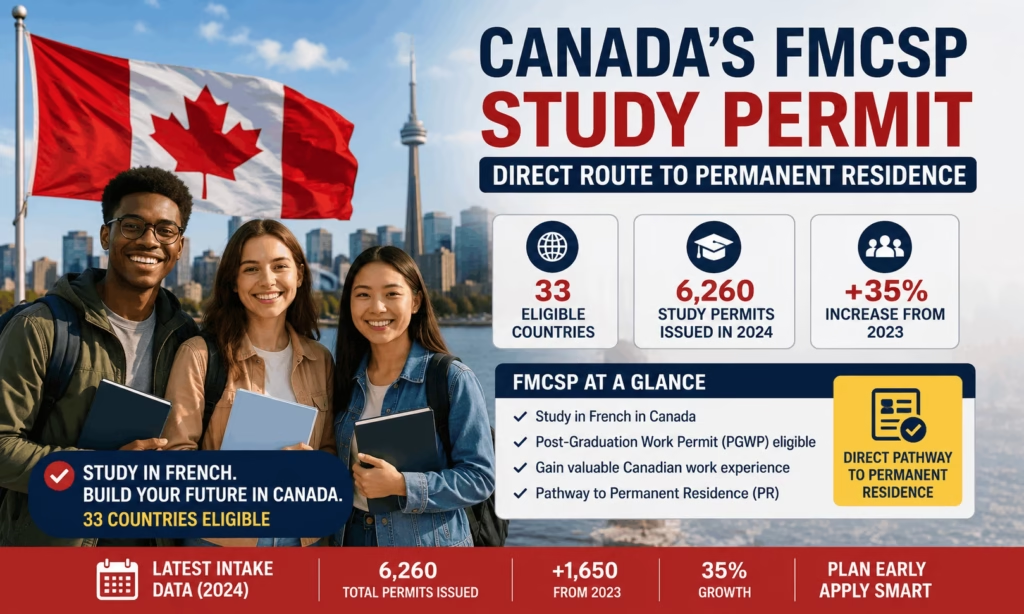
Canada FMCSP Study Permit Key Highlights
| Detail | Current Figure |
|---|---|
| Current intake window | August 26, 2026 to August 25, 2027 |
| Application cap this intake year | 2,970 study permit applications |
| Original launch date | August 26, 2024 |
| Original first-year cap | 2,300 applications |
| Number of eligible countries | 33, across Africa, the Middle East, and the Americas |
| Number of participating institutions | 17 designated learning institutions outside Quebec |
| Minimum French proficiency required | NCLC Level 5 in all four abilities |
| Study permit application fee | 150 CAD |
| PR policy expiry | November 30, 2032 |
| PR application component opens | Winter 2027 |
Source: Immigration, Refugees and Citizenship Canada’s updated public policy for the Francophone Minority Communities Student Pilot, signed June 25, 2026, and the companion permanent residence public policy signed the same date.
What Is the FMCSP and Why Does It Matter Right Now?
The Francophone Minority Communities Student Pilot exists to solve two problems Ottawa identified at once. First, French-speaking prospective students from parts of Africa, the Middle East, and the Americas have historically faced study permit refusal rates far above the global average, in some regions above 60 percent, largely tied to how visa officers assess an applicant’s likelihood of leaving Canada at the end of their studies. Second, French-speaking minority communities outside Quebec have struggled to maintain their population share, a concern formally written into Canada’s modernized Official Languages Act.
The FMCSP study permit answers both problems in a single design. Applicants from the eligible country list are exempted from having to demonstrate that they intend to leave Canada once their studies end, a requirement that trips up a large share of conventional study permit applications from these same regions. In exchange, applicants commit to a full-time program of at least two years, taught primarily in French, at one of the 17 participating institutions located outside Quebec, all with the explicit goal of settling and integrating into a Francophone minority community once they graduate.
SSA Ticket to Work Program: How Disability Beneficiaries Can Return to Work Without Losing Benefits
SSA Strategic Plan FY2026-2030: New Goals, Wait Times & Service Targets
How the Study-to-Permanent-Residence Pathway Actually Works?
Understanding the FMCSP means understanding that it is not simply a study permit with better odds of approval. It is a structured pipeline with three connected stages.
The first stage is the FMCSP study permit itself, applied for from outside Canada before the applicant ever enters the country. This is a hard rule: unlike many other student pathways, an applicant who is already in Canada on a regular study permit cannot switch into the FMCSP. The application must be the applicant’s entry point into the country.
The second stage is completion of the academic program. The credential must be a degree or diploma earned through at least two years of full-time study, with more than half of instruction delivered in French, at a designated learning institution that held valid FMCSP signatory status both when the study permit was issued and when the applicant graduates.
The third stage is the direct permanent residence application, filed under a dedicated FMCSP public policy rather than through Express Entry or a Provincial Nominee Program. There is no Comprehensive Ranking System score to compete for, no job offer requirement, and no reliance on employer sponsorship. IRCC has stated that the permanent residence application component of the pilot is scheduled to open in winter 2027, which lines up with when the first cohort admitted in 2024 will have completed a full two-year program.
Who Is Eligible: The 33-Country List and Language Requirement
Eligibility under the FMCSP rests on citizenship, language ability, and enrollment at a qualifying institution, and each criterion is specific.
Applicants must hold citizenship in one of the 33 countries that were members of l’Organisation internationale de la Francophonie, drawn from world regions where study permit refusal rates have historically run highest. The list spans 28 African nations, including Senegal, Cameroon, Morocco, Côte d’Ivoire, and Burkina Faso, two Middle Eastern countries, Egypt and Lebanon, and three countries in the Americas, Haiti, Dominica, and Saint Lucia.
Every applicant must also submit results from an approved French-language test showing a minimum score of NCLC Level 5, the Niveaux de compétence linguistique canadiens scale, across all four language abilities: speaking, listening, reading, and writing. Test results must be less than two years old at the time of application. This threshold is notably lower than the NCLC 7 typically required in Express Entry’s French-language category draws, which is part of what makes the FMCSP more accessible to a broader range of applicants than the mainstream French-stream immigration route.
Financial Requirements Under the FMCSP
Financial proof under the pilot works differently from a standard study permit application. Applicants must show two things: enough funds to cover their first year of tuition and travel costs, and separately, financial resources equal to at least 75 percent of the Low Income Cut Off for the municipality where their institution’s main campus is located. This LICO-based figure adjusts every September 1 in line with other study permit financial requirements, and IRCC confirmed in a November 2025 program delivery update that FMCSP financial thresholds rise on the same schedule as the general international student financial requirement.
Annual Intake Caps Since the Pilot Launched
The FMCSP has run on a fixed annual cap since day one, and understanding the trend helps applicants gauge how much room exists in any given intake year.
| Intake Year | Period | Application Cap |
|---|---|---|
| Year 1 | August 26, 2024 to August 25, 2025 | 2,300 |
| Year 2 | August 26, 2025 to August 25, 2026 | 2,970 |
| Year 3 | August 26, 2026 to August 25, 2027 | 2,970 |
Applications submitted after a given year’s cap is reached are not processed. IRCC returns them to the applicant along with a refund of the processing fee, which makes early submission a meaningful strategic factor for anyone planning to apply once the current window opened on August 26.
Participating Institutions and the Attestation Letter Exemption
The pilot currently works with 17 designated learning institutions across Ontario, New Brunswick, Manitoba, Alberta, Saskatchewan, Prince Edward Island, British Columbia, and Nova Scotia. Each institution must have a signed Memorandum of Understanding with IRCC confirming its participation, and the letter of acceptance an applicant submits must explicitly confirm that the program qualifies under the FMCSP, runs at least two years full time, and is delivered primarily in French.
One of the more practically significant advantages of the pilot is that FMCSP applicants do not need a Provincial or Territorial Attestation Letter, commonly called a PAL or TAL, when they apply for their study permit. Most other international students applying to Canadian institutions have needed this letter since the national study permit intake cap took effect, and sourcing one has become a genuine bottleneck at many institutions. FMCSP applicants skip that step entirely, though IRCC’s March 2026 briefing to the House of Commons immigration committee confirmed that FMCSP participants still count toward Canada’s overall 2026 study permit issuance target, so the exemption is procedural rather than a way around the national numbers.
SSI Address Change Service Enhancements: SSA’s New Fast-Track Process Explained
IRCC Tightens Citizenship by Descent: What the New 1,095-Day Presence Test Rules Mean for Applicants
From Graduation to Permanent Residence: What the Companion PR Policy Covers
The permanent residence side of the FMCSP is governed by its own public policy, separate from the study permit rules but designed to work with them directly. To qualify, a graduate must have completed all requirements of a full-time program of at least two years, taught primarily in French, at a DLI that held valid FMCSP signatory status at the time the original study permit was issued. The applicant must be residing in Canada outside Quebec, hold valid temporary resident status or have applied for restoration of status, and intend to settle in a province or territory other than Quebec.
No job offer is required at any point in the PR process, and the application can include a spouse, common-law partner, and dependent children, all of whom are eligible for their own temporary resident facilitation under the same policy framework. Graduates who submit a PR application under the FMCSP can simultaneously apply for a dedicated open work permit valid for up to three years, allowing them to work for any employer in any occupation anywhere in Canada outside Quebec while their permanent residence application is being processed. This work permit operates under its own legal authority within the FMCSP’s regulatory exemptions, distinct from a standard Post-Graduation Work Permit.
How the FMCSP Compares to the Conventional PGWP-to-PR Route?
Most international students in Canada follow a familiar sequence: study permit, then Post-Graduation Work Permit, then an attempt to qualify for permanent residence through the Canadian Experience Class inside Express Entry. That route depends heavily on accumulating Canadian work experience and then competing against a large applicant pool for an invitation to apply, with CEC cutoff scores remaining highly competitive through 2026.
| Feature | FMCSP Route | Conventional PGWP to PR Route |
|---|---|---|
| Job offer required for PR | Not required | Typically not required, but helps CRS score |
| French proficiency threshold | NCLC 5 | NCLC 7 for French-category Express Entry draws |
| Post-graduation work authorization | Dedicated FMCSP open work permit, up to 3 years | Standard PGWP, length tied to program duration |
| Provincial attestation letter | Not required | Required for most programs under the national cap |
| PR application pathway | Direct FMCSP public policy application | Canadian Experience Class or Provincial Nominee Program |
| Competition for a spot | No CRS score competition | Competitive CRS cutoffs in Express Entry draws |
For eligible candidates, that combination, a lower language bar, no job offer requirement, and no ranking-system competition, makes the FMCSP one of the more accessible permanent residence routes currently available in Canada’s immigration system.
How to Apply: Step-by-Step FMCSP Process?
- Confirm citizenship eligibility against the 33-country list and secure French-language test results at NCLC Level 5 or higher, dated within the last two years.
- Apply to and receive a letter of acceptance from one of the 17 participating designated learning institutions, confirming the program is at least two years full time, taught primarily in French, and FMCSP-eligible.
- Submit the study permit application online through the applicant’s IRCC secure account before entering Canada, selecting the option confirming exemption from the provincial attestation letter requirement.
- Upload French language test results in the designated Proof of Language Test Results field, along with financial documentation covering tuition, travel, and the required 75 percent LICO threshold.
- Pay the 150 CAD study permit application fee and complete biometrics collection where required.
- Wait for IRCC to request letter of acceptance verification from the designated learning institution; if the institution does not respond by the deadline, the application is returned along with a fee refund.
- Once approved, travel to Canada and present the port of entry letter of introduction to a border services officer, who issues the study permit on arrival.
- After completing the full program, apply directly for permanent residence under the FMCSP’s dedicated PR public policy once that component opens in winter 2027, optionally alongside the FMCSP-specific open work permit.
Indian Student Applications to US Colleges Fall 15% Amid Visa Uncertainty: What the New Data Shows
Processing Time: What to Expect?
IRCC has not published FMCSP-specific processing time data separate from general study permit timelines, largely because the pilot’s first cohort, admitted in 2024, will only complete their two-year programs starting in 2026, meaning meaningful FMCSP-specific PR processing data has not yet accumulated. For the study permit stage itself, applicants can reference IRCC’s general processing times tool, which reports the window within which 80 percent of recent applicants received a decision, though FMCSP applications may move somewhat differently given the exemption from attestation letter verification, a step that adds time to many standard applications.
FMCSP Study Permit and PR Fee Schedule
| Item | Current Amount |
|---|---|
| Study permit application fee | 150 CAD |
| Biometrics fee | 85 CAD, where applicable |
| French language test | Varies by test provider (TEF Canada, TCF Canada, or equivalent approved test) |
| Open work permit fee (post-PR application) | Standard IRCC work permit fee schedule applies |
| Refund policy | Full processing fee refunded if application is returned for exceeding the annual cap or unverified letter of acceptance |
Always confirm the live fee schedule on the official IRCC website before submitting payment, since fees are reviewed periodically.
Official IRCC Resources
| Resource | What It’s For | Official Link |
|---|---|---|
| FMCSP program overview | Eligibility criteria and program details | canada.ca, Francophone Minority Communities Student Pilot page |
| FMCSP application portal | Submit the study permit application online | canada.ca, FMC Student Pilot apply page |
| IRCC secure account login | Track application, upload documents, biometrics status | IRCC secure account, linked from canada.ca |
| FMCSP path to PR page | Details on the permanent residence component | canada.ca, FMC Student Pilot path to PR page |
| IRCC processing times tool | Check current wait times by application type | canada.ca, Check processing times |
| List of participating institutions | Confirm which DLIs currently hold FMCSP signatory status | canada.ca, FMCSP participating institutions list |
FAQs
What is the Canada FMCSP study permit and who qualifies?
The Francophone Minority Communities Student Pilot is a study permit and permanent residence pathway for French-speaking applicants who are citizens of one of 33 eligible countries across Africa, the Middle East, and the Americas, who meet a minimum NCLC Level 5 French proficiency requirement and gain admission to a full-time, at least two-year French-language program at one of 17 participating institutions outside Quebec.
How many applications does the FMCSP accept each year?
The current intake year, running from August 26, 2026, to August 25, 2027, has a cap of 2,970 study permit applications, the same level as the previous intake year, up from an original first-year cap of 2,300 in 2024.
Do FMCSP applicants need a provincial attestation letter?
No. FMCSP applicants are specifically exempt from the Provincial or Territorial Attestation Letter requirement that applies to most other international study permit applicants under Canada’s national intake cap.
Can someone already studying in Canada switch to the FMCSP?
No. The FMCSP study permit application must be submitted from outside Canada before the applicant enters the country. Anyone already holding a regular Canadian study permit cannot switch into the pilot.
When can FMCSP graduates apply for permanent residence?
IRCC has stated the permanent residence application component of the FMCSP is scheduled to open in winter 2027, timed to when the first cohort of students admitted in 2024 will have completed their required two-year programs.
Does the FMCSP require a job offer for permanent residence?
No. Unlike many Provincial Nominee Programs and employer-driven pathways, the FMCSP’s permanent residence policy does not require a job offer at any stage.
What happens if the FMCSP application cap is reached before the intake year ends?
IRCC stops accepting new applications once the annual cap is met and returns any additional applications received, along with a refund of the processing fee, to the applicant.
Conclusion
The Canada FMCSP study permit has quietly become one of the more accessible study-to-permanent-residence pipelines in the country’s immigration system, and the June 2026 policy update strengthens that position considerably by locking in a second year at the higher 2,970-application cap and extending the program’s PR framework out to 2032. For French-speaking applicants from the 33 eligible countries who are prepared to commit to a full two-year program at a participating institution outside Quebec, the pilot offers a rare combination: a lower language threshold than Express Entry’s French-category draws, no job offer requirement, no Provincial Attestation Letter, and no competition against a ranking system score. The trade-off is a firm structural rule, the application must come from outside Canada, and a real numerical ceiling that returns applications once the annual cap is reached. For anyone weighing this route, the smartest first step is confirming current eligibility and DLI signatory status directly on IRCC’s official page before applying. This article will be updated monthly as new intake, processing, and permanent residence data becomes available.
TPS Somalia Termination: Work Permits No Longer Valid After August 14 Deadline
Meta Safety Changes on Instagram and Facebook: What Teens and Parents Need to Know Right Now
H-1B Crackdown Employer Warning Now Covers OPT, PERM and J-1 Hiring Practices
Japan Visa Renewal Fee Increase 2026: New Charges From October Explained