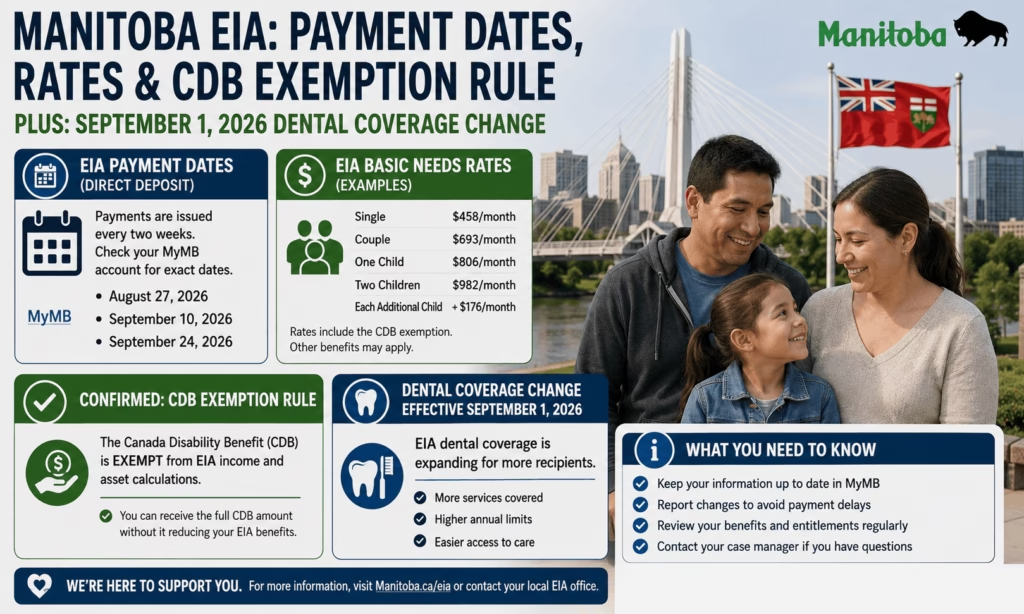
Manitoba EIA Payment and CDB Exemption: Manitobans relying on Employment and Income Assistance are navigating two very different kinds of change this year, one reassuring, one requiring action before a hard deadline. On the reassuring side, the Manitoba government has confirmed that the federal Canada Disability Benefit will not reduce a recipient’s EIA entitlement, joining Ontario, British Columbia, Saskatchewan, and Newfoundland and Labrador in explicitly protecting this new federal payment from provincial clawback. That confirmation matters enormously for the thousands of Manitobans who qualify for both programs, since it means the CDB functions as genuine additional income rather than a dollar-for-dollar reduction in provincial support.
The harder deadline sits on the calendar for September 1, 2026. Starting that date, EIA will stop covering routine dental care for most recipients, shifting to emergency-only coverage unless a recipient has separately enrolled in the federal Canadian Dental Care Plan. For a program that serves tens of thousands of low-income Manitobans monthly, this transition, layered on top of the province’s ongoing shift of disability recipients into a separate Manitoba Disability Income Support Program, makes 2026 one of the more consequential years for EIA policy in recent memory. We’ll be updating this article monthly as Manitoba confirms further EIA rate and policy changes.
Latest Update: Key Manitoba EIA Changes for 2026
Here is the complete, current snapshot of what’s changing and what’s confirmed protected for EIA recipients this year.
| Detail | Information |
|---|---|
| CDB clawback status in Manitoba | Confirmed exempt, does not reduce EIA entitlement |
| Provinces with confirmed CDB non-clawback | Manitoba, Ontario, British Columbia, Saskatchewan, Newfoundland and Labrador |
| Dental coverage change effective | September 1, 2026 |
| What EIA dental covers after September 1 | Emergency dental work only |
| Alternative for routine dental | Canadian Dental Care Plan (separate federal application required) |
| Earnings exemption (updated August 2025) | First $500 of monthly net earnings fully exempt |
| Additional earnings exemption | 30% of earnings above $500 also exempt |
| Liquid asset exemption | $4,000 per person, up to $16,000 per family |
| Monthly EIA + federal benefit range (general) | Roughly $923 to $3,826, depending on family situation |
| Disability category transition | Moved to Manitoba Disability Income Support Program (formerly EIA Disability) |
| CDB federal supplemental payment | $150 lump sum, effective September 1, 2026, automatic for eligible recipients |
What Is Manitoba EIA and Who Qualifies?
Manitoba Employment and Income Assistance (EIA) is the province’s core income-support program for residents who cannot cover their basic needs and shelter costs through other financial resources. It is administered by Manitoba’s Ministry of Families and functions as the province’s welfare program of last resort for people without other means of support, whether that’s due to job loss, a temporary inability to work, or being a single parent without adequate income.
To qualify, the total cost of an applicant’s or family’s basic monthly needs and shelter must exceed their total available financial resources, meaning both income and assets are factored into the assessment. EIA calculates a household’s needs based on family size, the ages of family members, and how household members are related to one another, along with any ongoing medical care costs. The program currently operates two main active categories: general assistance for single people, couples, and families without a qualifying disability, and a separate stream for single parents. A third historical category, EIA for persons with disabilities, has been transitioning to the newer Manitoba Disability Income Support Program, which pays higher benefits than the original EIA disability stream.
Florida Minimum Wage Reaches $15/Hour: The Final Step of a Six-Year Countdown Arrives September 30
USCIS Ukraine TPS EAD Extension: Work Permits Automatically Extended Through October 19, 2026
TPS Terminations 2026: Complete Tracker for Somalia, Ethiopia, South Sudan, Syria, Haiti, and Yemen
September 2026 Refund Payments: All the Real Deposits You Could Actually Get This Month
The CDB Exemption Rule: Why It Matters for Manitoba Recipients
This is the single most important protection for EIA recipients who also qualify for the federal Canada Disability Benefit, and it’s worth understanding exactly what it means in practice. The Canada Disability Benefit is a relatively new federal monthly payment for low-income, working-age Canadians who hold an approved Disability Tax Credit certificate. Because it’s a federal income benefit, many EIA recipients initially worried it would simply be treated as income and deducted dollar-for-dollar from their provincial assistance, effectively canceling out the value of the new federal payment.
Manitoba has explicitly ruled that out. The province has confirmed its Employment and Income Assistance program will not claw back the CDB for the disabled-person component, meaning a recipient’s CDB payment is not counted as income that reduces their monthly EIA entitlement. Manitoba’s approach mirrors the exemption policy adopted by Ontario’s ODSP, British Columbia’s PWD program, Saskatchewan’s SAID, and Newfoundland and Labrador’s disability programs, all of which have committed to the same non-clawback treatment. Alberta’s AISH program, by contrast, has been notably slower to confirm the same exemption, making Manitoba’s early, clear stance on this issue a genuine point of comparative advantage for residents.
A New $150 Federal Supplement Lands the Same Month
Adding another layer to this year’s changes, the federal government confirmed on July 1, 2026 that amendments to the Canada Disability Benefit Regulations will take legal effect on September 1, 2026, enabling a one-time $150 supplemental payment for CDB recipients. This supplement, published in the Canada Gazette, is paid automatically as a lump sum with no separate application required, and it’s specifically intended to help offset the out-of-pocket cost some recipients face when a medical practitioner charges a fee to complete Disability Tax Credit certification paperwork. For Manitoba EIA recipients who also receive the CDB, this $150 arrives on top of their regular payments and, consistent with the broader exemption rule, is not treated as income that reduces EIA benefits.
The September 1, 2026 Dental Coverage Change: What EIA Recipients Need to Know
While the CDB news is reassuring, this is the change EIA recipients genuinely need to act on before the deadline arrives. Manitoba has confirmed that starting September 1, 2026, EIA will only pay for emergency dental work, a significant reduction from the routine dental coverage the program previously provided. Recipients who want to maintain access to non-emergency dental care need to separately apply for the federal Canadian Dental Care Plan (CDCP).
A few important transition details apply here. For anyone who was already receiving EIA before April 1, 2026, nothing changes about their dental coverage until September 1, meaning any appointment booked before that date can still be covered the way it always has been. Anyone who starts receiving EIA after April 1, 2026, however, is expected to pay for routine dental care themselves unless the situation qualifies as a genuine emergency. Recipients who already have dental coverage through private insurance do not need to apply for the CDCP, since the transition is specifically aimed at those relying on EIA as their only source of dental coverage.
Manitoba EIA Earnings Exemption: How Working Affects Your Payment
One of the more consumer-friendly updates to Manitoba’s EIA program is its earnings exemption structure, updated in August 2025, which is specifically designed to make sure taking on paid work always results in more total income rather than an equivalent clawback. Under the current rules, the first $500 of net monthly earnings is fully exempt from any EIA deduction, and Manitoba goes a step further by also exempting 30% of any earnings above that $500 threshold. Only the remaining portion beyond both exemptions gets deducted from a recipient’s monthly benefit.
For example, a recipient who earns $600 in a given month keeps the entire first $500 with no reduction to their EIA payment. Of the remaining $100, 30%, or $30, is also exempt, leaving only $70 subject to deduction from that month’s EIA benefit. This structure means working part-time or picking up occasional shifts consistently increases a recipient’s total monthly income rather than simply substituting for provincial assistance dollar-for-dollar.
80% to 100% VA Disability: Why the Final Jump Is the Hardest One Veterans Face
H-1B Spouse Work Permit at Risk: How Trump’s Latest Move Could Cut Family Incomes in Half
EIA Payment Amounts: What Recipients Actually Receive
Monthly EIA amounts vary considerably depending on family composition, disability status, and whether federal benefits are combined into the total. When provincial EIA and Rent Assist payments are combined with federal benefits like the GST/HST credit and the Canada Child Benefit, monthly totals generally range from roughly $923 to $3,826 for households without dependent children, and can run higher, up to approximately $4,222 in some configurations, for larger families or households receiving additional federal supports. Rates are formally reviewed and updated annually each July.
| Recipient Type | Estimated Combined Monthly Range (Provincial + Federal) |
|---|---|
| Single person, general assistance | Lower end of the range, roughly $900s to low $1,000s |
| Family with dependent children | Mid-range, benefiting from Canada Child Benefit stacking |
| Larger families with multiple federal benefits combined | Higher end, up to approximately $4,222 |
| Manitobans age 55+, additional quarterly benefit | $161.80 quarterly (single) / $173.90 per person (couple) |
What Income and Assets Count Against EIA Eligibility
Understanding what actually affects an EIA application matters just as much as knowing the payment amounts. Income sources that count toward a household’s financial resources include wages, child or spousal support payments, pensions, dividend and interest income, and inheritances. A specific, meaningful list of income sources is explicitly excluded from this calculation: the Canada Child Benefit, tax credit refunds, RDSP withdrawals, foster home maintenance payments, and gifts up to $100 per person for general recipients, or up to $500 for recipients with a disability designation.
On the asset side, EIA exempts liquid assets, meaning cash and bank account balances, up to $4,000 per person, to a maximum of $16,000 per family. A recipient’s primary residence, vehicles, and other essential property are also generally excluded from the asset calculation, though EIA staff make case-by-case determinations for anything not clearly covered by these standard exemptions.
How to Apply for Manitoba EIA?
For Manitobans considering an application, the process runs through several practical stages.
- Confirm your basic eligibility by comparing your household’s basic needs and shelter costs against your available income and assets.
- Contact your local EIA office or apply through the Manitoba government’s online EIA portal to begin the application process.
- Complete required documentation, including proof of income, assets, identification, and shelter costs for every household member.
- Submit a monthly Income Declaration Statement once approved, reporting any earnings along with pay stubs so EIA staff can calculate your adjusted monthly payment.
- Apply separately for Rent Assist if renting in the private market, since EIA recipients automatically qualify for the maximum Rent Assist benefit, calculated at 77% of median market rent, adjusted every July.
- Apply for the Canadian Dental Care Plan before September 1, 2026, if you want to maintain routine, non-emergency dental coverage going forward.
Processing Time for Manitoba EIA Applications
EIA processing timelines vary based on case complexity and how quickly required documentation is submitted, but applicants working through a straightforward case with complete documentation generally see decisions move faster than those requiring additional medical or financial verification. Recipients applying for the Manitoba Disability Income Support Program specifically should expect a more detailed review process, since that program has its own separate medical assessment requirements distinct from the general EIA disability designation that preceded it.
Manitoba EIA Payment Schedule
EIA payments follow a consistent monthly pattern: direct deposits and mailed cheques are issued in advance of the benefit month they cover, generally landing around the third-to-last business day of each month. Recipients using direct deposit receive their payment on the scheduled date, while those receiving a mailed cheque should expect it to arrive a few days later. Because payments fund the following month’s benefits, a payment issued in late August, for example, is technically covering September’s EIA entitlement.
FAQs
Does the Canada Disability Benefit reduce my Manitoba EIA payment?
No. Manitoba has confirmed that its Employment and Income Assistance program does not claw back or reduce EIA entitlements based on CDB payments, meaning the CDB is treated as additional income on top of your existing EIA benefit rather than a replacement for it.
What happens to my EIA dental coverage after September 1, 2026?
Starting September 1, 2026, EIA will only cover emergency dental work. To maintain routine, non-emergency dental care, you need to separately apply for the federal Canadian Dental Care Plan before that date.
Do I need to apply for the Canadian Dental Care Plan if I already have private dental insurance?
No. Recipients with existing dental coverage through private insurance do not need to apply for the CDCP, since the September 2026 transition specifically targets recipients who rely on EIA as their only source of dental coverage.
How much can I earn while on Manitoba EIA before my benefits are reduced?
The first $500 of your net monthly earnings is fully exempt from any EIA deduction, and 30% of any earnings above that $500 threshold is also exempt. Only the remaining amount beyond both exemptions reduces your monthly EIA payment.
Is the EIA disability category still available in Manitoba?
The original EIA for Persons with Disabilities category has been converting to the Manitoba Disability Income Support Program, which pays higher benefits and includes its own annual earnings exemption of $12,000 for recipients enrolled in that program specifically.
What is the new $150 Canada Disability Benefit payment in September 2026?
It is a one-time federal supplemental payment confirmed for September 1, 2026, paid automatically as a lump sum to eligible CDB recipients, with no separate application required, and it is not counted against Manitoba EIA entitlements.
How much can I have in savings and still qualify for EIA?
EIA exempts liquid assets, such as cash and bank balances, up to $4,000 per person, to a maximum of $16,000 per family. Amounts above these thresholds can affect your eligibility.
When are Manitoba EIA payments deposited each month?
Payments are generally issued around the third-to-last business day of each month, in advance of the benefit month they cover, with direct deposit recipients receiving funds first and mailed cheques arriving a few days later.
How Manitoba’s CDB Exemption Compares Across Canada
Manitoba’s decision doesn’t exist in isolation, and understanding where it sits relative to other provinces helps explain why this exemption matters so much to advocacy groups tracking the CDB’s rollout nationally. Ontario’s ODSP, British Columbia’s PWD program, Saskatchewan’s SAID, and Newfoundland and Labrador’s disability assistance programs have all made the same commitment as Manitoba, ensuring the federal Canada Disability Benefit adds to, rather than replaces, provincial support. The Atlantic provinces beyond Newfoundland and Labrador, including Nova Scotia’s Employment Support and Income Assistance, New Brunswick’s Social Development program, and PEI’s Social Assistance, have generally aligned with the same non-clawback intent, though specific policy details are worth confirming directly with each province’s social services department since implementation language can vary.
Alberta stands out as the notable holdout. Its AISH program has been slower than Manitoba and most other provinces to formally confirm a non-clawback policy for the CDB, leaving some Alberta recipients with less certainty about how the federal payment will interact with their existing provincial benefits. For Manitobans, this comparative context underscores why the province’s early and explicit confirmation carries real weight, it removes a significant source of financial uncertainty for residents who qualify for both the CDB and EIA at a time when many other jurisdictions are still finalizing their own approach.
Rent Assist: The Companion Benefit Most EIA Recipients Already Have
Housing costs represent one of the largest line items in any EIA recipient’s monthly budget, which is why understanding the Rent Assist program matters alongside the core EIA payment itself. Rent Assist is a Manitoba benefit that helps cover housing costs for low-income residents, and EIA recipients who rent in the private market automatically qualify for the maximum available benefit, calculated at 77% of median market rent and adjusted every July to reflect current rental market conditions. The program also extends to cover utility costs, including heat, electricity, and water, when those costs aren’t already bundled into a recipient’s rent.
Importantly, Rent Assist isn’t limited strictly to EIA recipients. Manitobans who are not receiving EIA can still apply for Rent Assist separately if their net annual income falls below $28,096 for individuals, or $32,432 for those aged 55 and older, a detail that surprises many low-income Manitobans who assume the housing benefit is exclusively tied to broader income assistance enrollment.
Official Resources for Manitoba EIA and CDB
Always confirm your specific eligibility and payment details directly through these official government channels.
| Resource | Purpose | Official Link |
|---|---|---|
| Manitoba Employment and Income Assistance | Program overview, eligibility, and application information | gov.mb.ca/fs/eia |
| Manitoba EIA online application and login | Apply for benefits and manage your case | gov.mb.ca/fs/eia (online services) |
| Manitoba Supports for Persons with Disabilities | Details on the disability income program replacing EIA Disability | gov.mb.ca/fs/manitobasupports |
| Canada Disability Benefit overview | Federal eligibility rules and payment details | canada.ca (Canada Disability Benefit) |
| Canadian Dental Care Plan | Apply for continued dental coverage after September 2026 | canada.ca (Canadian Dental Care Plan) |
| Manitoba Rent Assist | Housing benefit information for EIA and non-EIA applicants | gov.mb.ca/fs/eia/rentassist.html |
| Contact EIA | General inquiries and document submission | gov.mb.ca/fs/contacting-eia.html |
Conclusion
Manitoba’s EIA program is delivering genuinely good news alongside a deadline that demands attention this year. The province’s confirmed decision not to claw back the Canada Disability Benefit protects a meaningful new income source for recipients who qualify for both programs, putting Manitoba alongside a growing group of provinces committed to letting the federal benefit actually improve financial outcomes rather than simply offsetting provincial support. At the same time, the shift to emergency-only EIA dental coverage on September 1, 2026 is a real, practical change that requires recipients to take action, specifically applying for the Canadian Dental Care Plan, well before the deadline arrives. Between the earnings exemption structure that rewards work, the ongoing transition to the Manitoba Disability Income Support Program, and these two September changes landing simultaneously, EIA recipients have more reason than usual to stay closely engaged with official updates through the rest of 2026.
$150 Canada Disability Benefit Top-Up: What the New September 2026 Payment Means for You