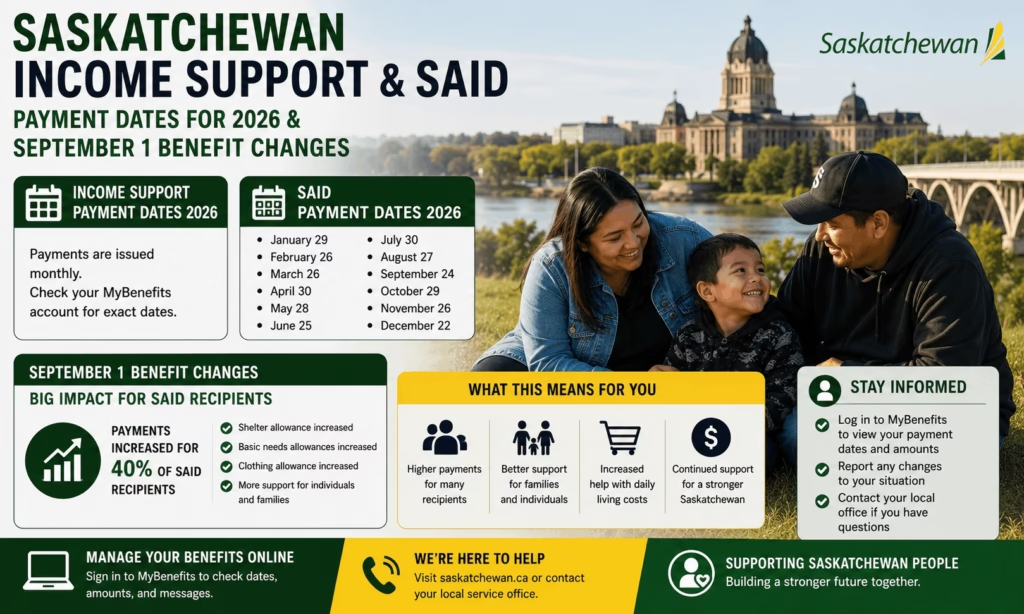
Saskatchewan Income Support and SAID Payment Schedule: Roughly 7,200 Saskatchewan families and individuals are about to see a bigger deposit hit their account. The provincial government confirmed on July 9, 2026 that restructured benefits under the Saskatchewan Assured Income for Disability (SAID) program take effect September 1, 2026, and Social Services Minister Terry Jenson says 40% of SAID clients will see an increase in their monthly benefits as a direct result. For a program that serves more than 18,000 Saskatchewan residents with significant and enduring disabilities, that’s a meaningful, immediate financial change landing at the start of the fall benefit cycle.
This latest round follows an earlier simplification announced back in February 2026, when the province first moved to consolidate 30 narrow, niche SAID benefits into five broader categories. Between the February restructuring, the April 1 rollout of related eligibility changes, and now the September 1 payment increases, SAID has gone through more structural change in a single year than in most of the program’s recent history. For anyone receiving Saskatchewan Income Support (SIS) or SAID, or planning to apply for either, understanding exactly when payments land and how these reforms affect monthly amounts is essential heading into the fall. We’ll be updating this article monthly as Saskatchewan confirms further SIS and SAID payment and policy changes.
Latest Update: What’s Changing for SIS and SAID in 2026
| Detail | Information |
|---|---|
| SAID benefit restructuring effective | September 1, 2026 |
| SAID clients seeing an increase | Approximately 40%, roughly 7,200 families and individuals |
| Earlier SAID simplification effective | April 1, 2026 (30 niche benefits into 5 broader categories) |
| SAID liquid asset limit (new applicants) | Raised from $1,500 to $2,000, plus $500 per additional household member |
| SIS basic benefit increase (effective May 1, 2026) | +2%, to $375 (non-Northern) / $445 (Northern) |
| SIS monthly incidental income exemption | Doubled from $100 to $200 |
| SIS households served | Approximately 20,000 across Saskatchewan |
| SAID clients served | More than 18,000 provincewide |
| Canada Disability Benefit treatment under SAID | Fully exempt from income calculation |
| Typical payment timing | 2–3 business days before month-end (direct deposit) |
Saskatchewan Income Support vs. SAID: What’s the Difference?
Before breaking down payment dates, it helps to understand how these two programs actually differ, since they’re often confused despite serving distinctly different populations.
| Feature | Saskatchewan Income Support (SIS) | Saskatchewan Assured Income for Disability (SAID) |
|---|---|---|
| Who it serves | Individuals and families with low or no income | People with significant and enduring disabilities |
| Maximum monthly benefit | Capped, based on family size and location | No set maximum; varies by individual need |
| Core benefit components | Adult basic benefit, shelter benefit | Living income, disability income, shelter, with additional needs-based benefits |
| Replaced program(s) | Saskatchewan Assistance Program and Transitional Employment Allowance (merged August 2021) | Standalone program with ongoing structural reforms in 2026 |
| Employment expectation | Recipients expected to work toward self-sufficiency where possible | Program recognizes disability as a long-term, often permanent barrier to full employment |
| 2026 households served | Approximately 20,000 | More than 18,000 |
SSA Ticket to Work Program: How Disability Beneficiaries Can Return to Work Without Losing Benefits
SSA Strategic Plan FY2026-2030: New Goals, Wait Times & Service Targets
SSI Address Change Service Enhancements: SSA’s New Fast-Track Process Explained
IRS Confirms Payments of Up to $8,231: Who Qualifies for the EITC in 2026
Why SAID Is Getting Its Biggest Overhaul in Years
To understand the scale of what’s happening this year, it’s worth looking at how this reform unfolded in stages rather than as a single announcement. The Ministry of Social Services first signaled changes back in February 2026, when Minister Jenson explained the reasoning bluntly: SAID had become too complicated. “This complexity makes it difficult for clients to know what they are eligible for, and limits ministry flexibility to adapt to individual circumstances,” Jenson said at the time, describing a system where clients often didn’t know what support they actually qualified for.
That February announcement introduced the first wave of changes, effective April 1, 2026: consolidating 30 highly specific, niche benefits into five broader categories, including a new Employment and Training Benefit, an Emergency Benefit for unforeseen health and safety needs, and a Household and Safety category. The province also discontinued the Respite Benefit entirely, since data showed almost no clients were using it, and renamed the Clothing Benefit to the Incontinent Supplies Benefit to better reflect its actual use. Alongside these structural changes, the ministry raised the liquid asset limit for new SAID applicants from $1,500 to $2,000 per household, plus an additional $500 for each household member beyond the first.
What’s New on September 1, 2026: The Payment Increase Wave
The April changes were about structure. The September 1, 2026 changes are about money, and this is where the real financial impact lands for thousands of recipients. According to the province’s July 9 announcement, the second phase specifically expands and restructures the Living Income Benefit, merges several existing benefits directly into that core payment, and elevates the two lowest-paid Community of Residence Benefit tiers by folding them into the higher-paid tiers. The ministry also removed additional benefits it determined were rarely used or already available through other provincial ministries and programs.
The headline result: 40% of SAID clients will see their overall benefit increase, while the ministry has stated the remaining clients will see no reduction in their current benefit levels. That distinction matters. Disability advocacy organizations, including Inclusion Saskatchewan, responded publicly to the reforms, acknowledging the simplification goal while noting that concerns raised by the disability community following the February announcement were consistent with feedback they’d heard about the program long before these specific changes were introduced. The ministry has committed to directly contacting the roughly 100 clients initially flagged as potentially seeing a benefit reduction under the new flat-rate system, confirming their current benefit levels will be maintained rather than reduced.
Saskatchewan Income Support (SIS) Payment Dates for 2026
SIS payments follow a consistent monthly pattern, landing near the end of the month prior to the actual benefit month they cover. Direct deposit recipients typically see funds land 2 to 3 business days before month-end, generally somewhere between the 26th and 30th depending on how the calendar falls, while recipients receiving a mailed cheque should expect it a few days earlier in the mail cycle, with an additional 5 to 10 business days for actual delivery.
| Benefit Month | Typical Direct Deposit Timing |
|---|---|
| July 2026 | Late June 2026 |
| August 2026 | Late July 2026 |
| September 2026 | Late August 2026 |
| October 2026 | Late September 2026 |
| November 2026 | Late October 2026 |
| December 2026 | Late November 2026 |
SAID follows the same general end-of-month payment pattern as SIS, though amounts vary considerably more given the program’s individualized, needs-based benefit structure with no fixed monthly maximum.
IRCC Tightens Citizenship by Descent: What the New 1,095-Day Presence Test Rules Mean for Applicants
September 2026 Refund Payments: All the Real Deposits You Could Actually Get This Month
Current SIS and SAID Benefit Amounts
Understanding actual payment amounts requires separating the two programs, since their benefit structures work quite differently.
Saskatchewan Income Support provides a basic benefit plus a separate shelter benefit, with amounts varying by household size, location, and whether a household is in a Northern or non-Northern community. Following the 2% increase effective May 1, 2026, the basic benefit rose to $375 for non-Northern households and $445 for Northern households, with shelter rates increasing by $15 to $22 per month depending on household composition. Combined, SIS households can receive anywhere from roughly $375 to over $1,640 monthly depending on family size and shelter costs.
Saskatchewan Assured Income for Disability does not operate on a single maximum benefit structure. Instead, SAID combines a living income component, a disability income component, and a shelter benefit, with additional benefits layered on based on an individual’s documented needs. Because SAID is explicitly designed around individualized support rather than a flat monthly cap, two SAID recipients with different circumstances can receive substantially different total monthly amounts even within the same broad benefit category.
How Working Affects Your SIS or SAID Payment
Both programs allow recipients to earn some income without losing their full benefit, though the specific exemption thresholds differ. Under SIS, the monthly incidental income exemption doubled from $100 to $200, meaning recipients can now earn up to $200 monthly without any reduction to their benefit. Income earned above that threshold is generally deducted from the SIS payment at a dollar-for-dollar rate. SAID’s income exemption structure operates separately and is assessed individually based on a client’s specific benefit tier and household circumstances, which is part of why speaking directly with a caseworker remains the most reliable way to understand exactly how a specific job or income change will affect an individual SAID payment.
Both programs share one important, explicitly confirmed exemption: the federal Canada Disability Benefit is exempt from income calculations under SAID, meaning CDB payments do not reduce a recipient’s provincial disability benefit. This exemption is written directly into the program’s regulations rather than left as informal policy guidance.
How to Apply for SIS or SAID: Step-by-Step
For Saskatchewan residents applying to either program, the process runs through a similar general sequence, though documentation requirements differ based on which program fits your situation.
- Determine which program fits your circumstances. SIS is generally the starting point for low-income individuals and families; SAID is specifically for people with significant, enduring disabilities who have exhausted other financial resources.
- Gather required documentation, including identification, proof of income, housing costs, and, for SAID applicants, medical documentation supporting a significant and enduring disability.
- Submit your application through the Ministry of Social Services, either online, by phone, or in person at a local office.
- Complete an intake assessment, during which a caseworker reviews your income, assets, and household composition against program eligibility rules.
- Set up direct deposit to receive payments faster and avoid delays associated with mailed cheques.
- Report income and household changes promptly, since both programs require ongoing reporting to keep benefit amounts accurate.
TPS Terminations 2026: Complete Tracker for Somalia, Ethiopia, South Sudan, Syria, Haiti, and Yemen
USCIS Ukraine TPS EAD Extension: Work Permits Automatically Extended Through October 19, 2026
BC PNP Entrepreneur Immigration Draw Invites 16 Business Candidates in Latest Round
Processing Time for SIS and SAID Applications
Processing timelines vary based on program and case complexity. SIS applications generally move faster given the program’s more standardized benefit structure, while SAID applications typically require additional time for medical documentation review, given the program’s more individualized, needs-based assessment process. Applicants transitioning into the newly restructured SAID benefit categories following the September 1, 2026 changes should expect ministry staff to reassess existing files as part of the broader rollout, though the province has stated this reassessment process is designed to avoid unnecessary delays or benefit disruptions for current clients.
SIS and SAID Payment Schedule Summary
Both programs issue payments monthly, in advance of the benefit month they cover, following the end-of-month direct deposit and mailing pattern described above. Recipients experiencing a delayed or missing payment should contact their local Social Services office directly rather than assuming a payment was simply late, since incorrect banking information or an incomplete monthly reporting requirement are common causes of payment delays for both programs.
FAQs
When do Saskatchewan Income Support payments arrive each month?
SIS direct deposit payments typically land 2 to 3 business days before the end of the month, generally between the 26th and 30th depending on how the calendar falls that month. Mailed cheques are sent slightly earlier but can take 5 to 10 additional business days to arrive.
What changed for SAID recipients on September 1, 2026?
Effective September 1, 2026, Saskatchewan restructured and expanded the Living Income Benefit under SAID, merging several existing benefits into it and elevating lower Community of Residence Benefit tiers. The province confirmed 40% of SAID clients will see an increase in their overall monthly benefit as a result.
Is the Canada Disability Benefit counted as income under SAID?
No. The Canada Disability Benefit is explicitly exempt from income calculations under SAID, meaning it does not reduce a recipient’s provincial disability benefit amount.
What is the difference between SIS and SAID in Saskatchewan?
SIS serves low-income individuals and families generally, with a capped benefit structure based on family size and location. SAID serves people with significant and enduring disabilities, with an individualized benefit structure and no fixed monthly maximum.
How much can I earn while receiving SIS without losing my benefit?
The SIS monthly incidental income exemption is $200 as of the May 1, 2026 increase, meaning you can earn up to that amount without any reduction to your monthly SIS payment.
What is the new liquid asset limit for SAID applicants?
As of April 1, 2026, new SAID applicants can have up to $2,000 in liquid assets per household, plus an additional $500 for each household member beyond the first, up from the previous $1,500 limit.
Will any SAID recipients see their benefits reduced under the new changes?
The Ministry of Social Services has stated that clients will see an increase or no change to their overall benefits under the September 2026 restructuring. Approximately 100 clients initially flagged as potentially affected by the flat-rate system changes are being individually contacted to confirm their current benefit levels are maintained.
How many benefit categories does SAID now have after the simplification?
The April 1, 2026 changes consolidated 30 previously separate, niche SAID benefits into five broader categories, designed to make the program easier for clients to understand and navigate.
Basic Eligibility Requirements for Each Program
Understanding whether you qualify for SIS or SAID starts with a few core requirements, though both programs conduct individualized assessments beyond these baseline criteria.
For Saskatchewan Income Support, applicants generally need to be Saskatchewan residents aged 18 or older, demonstrate low or no income, and show they’ve made reasonable efforts to support themselves through other available means, such as actively seeking employment, pursuing available child support, or accessing other financial resources before turning to provincial assistance. Personal assets and one vehicle per household are generally exempt from the eligibility calculation, though a second or recreational vehicle with equity exceeding $5,000 must typically be converted to cash within 180 days of application.
For SAID, eligibility centers on documenting a significant and enduring disability that substantially restricts a person’s ability to function independently or participate in the workforce, combined with having exhausted other reasonable financial resources. SAID remains explicitly framed as a last-resort income support program, meaning applicants are generally expected to have already pursued other available income sources, including federal disability benefits like the Canada Pension Plan disability benefit, before SAID becomes the primary support.
H-1B Spouse Work Permit at Risk: How Trump’s Latest Move Could Cut Family Incomes in Half
80% to 100% VA Disability: Why the Final Jump Is the Hardest One Veterans Face
FY2027 Government Shutdown Risk: Congress Races the September 30 Funding Cliff
How the Disability Community Has Responded to the Reforms
The pace and scope of SAID’s 2026 changes haven’t gone unnoticed by advocacy organizations working directly with the province’s disability community. Inclusion Saskatchewan, one of the more vocal advocacy groups tracking the reforms, issued a public response following the February announcement acknowledging the ministry’s stated goal of simplification while also noting that the concerns raised by SAID recipients during that period reflected feedback the organization had already been hearing about the program’s complexity for a long time. The organization’s July 10 follow-up statement, issued after the September changes were announced, recognized the expanded Living Income Benefit and tier consolidation as a genuine step toward the simplified, more navigable program the community had been requesting, particularly for individuals with intellectual disabilities who often face the steepest barriers navigating complex, niche benefit categories.
That said, the transition hasn’t been entirely without friction. Some recipients speaking to media during the province’s broader income assistance overhaul in recent years have expressed a preference for aspects of older program structures, particularly around direct payment mechanisms for rent and utilities that helped prevent housing instability among higher-needs clients. The Ministry of Social Services has responded to some of this feedback by allowing direct payments for rent and utilities on behalf of certain high-needs clients considered at risk of homelessness, a policy adjustment that predates the 2026 SAID reforms but remains relevant context for understanding how the province has historically responded to recipient and advocate concerns about program design.
Official Resources for Saskatchewan Income Support and SAID
Always verify current payment dates, benefit amounts, and application status directly through these official Government of Saskatchewan channels.
| Resource | Purpose | Official Link |
|---|---|---|
| Saskatchewan Income Support (SIS) | Program overview, eligibility, and application information | saskatchewan.ca/income-support |
| Saskatchewan Assured Income for Disability (SAID) | Program overview and the 2026 benefit restructuring details | saskatchewan.ca (SAID program page) |
| Ministry of Social Services online client portal | Manage your case and check payment status | saskatchewan.ca (Social Services client login) |
| SAID and SIS news releases | Official government announcements on program changes | saskatchewan.ca/government/news-and-media |
| Canada Disability Benefit overview | Federal eligibility rules and payment details | canada.ca (Canada Disability Benefit) |
| Contact Ministry of Social Services | General inquiries and application support | saskatchewan.ca (Social Services contact page) |
Conclusion
The Saskatchewan Income Support and SAID payment landscape heading into the fall of 2026 reflects one of the more active reform periods either program has seen in years. SIS recipients are working with modestly higher basic benefits and a doubled income exemption following the May increase, while SAID clients are navigating a genuine structural overhaul that started with February’s simplification announcement and lands, financially, on September 1 with higher payments for 40% of the program’s more than 18,000 recipients. For anyone currently receiving either benefit, or considering applying, the practical takeaway is straightforward: confirm your specific payment amount and category directly through the Ministry of Social Services rather than relying on general averages, since both programs, SAID in particular, are built around individualized assessments that a general guide like this one can outline but never fully replace.
Florida Minimum Wage Reaches $15/Hour: The Final Step of a Six-Year Countdown Arrives September 30
IRS Seize Bank Accounts, Vehicles and Property From Taxpayers Who Ignore This Final Notice
Manitoba EIA Payment and CDB Exemption: What Changes and What Stays Protected in 2026