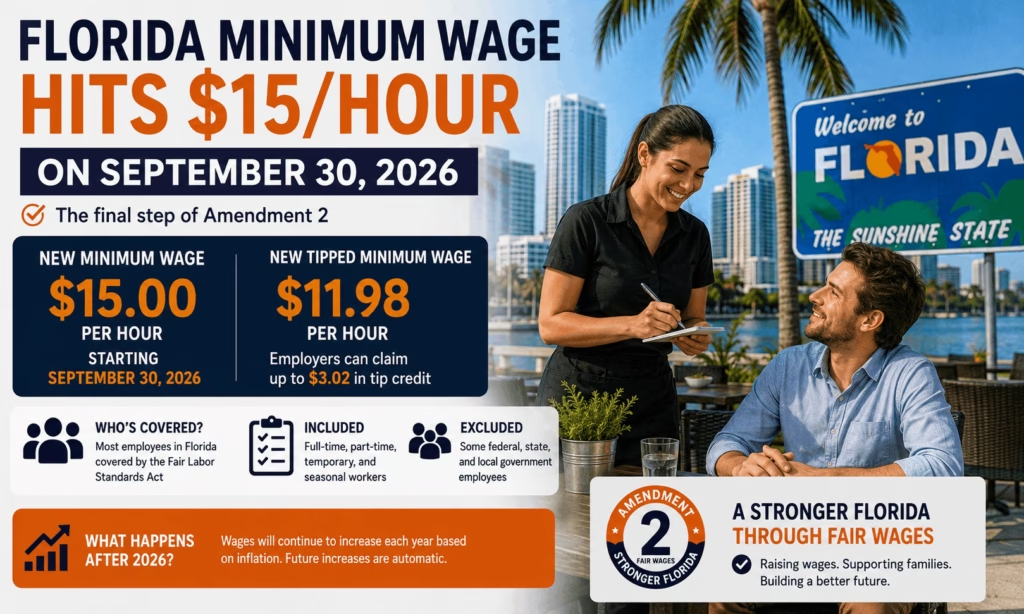
Florida Minimum Wage Reaches $15/Hour: Six years after Florida voters wrote it into the state constitution, the countdown ends this month. On September 30, 2026, Florida’s minimum wage climbs from $14.00 to $15.00 an hour, the final scheduled increase under Amendment 2 and the moment Florida officially joins the small group of states that have hit the $15 threshold through a legislated, dollar-by-dollar path rather than an inflation formula alone. For an estimated 2.5 million Florida workers, roughly a quarter of the state’s entire workforce, this is the raise they’ve been counting toward since Election Day 2020.
The significance goes beyond a single dollar amount. Florida became the eighth state, and the first in the American South, to approve a $15 minimum wage when 60.8% of voters passed the constitutional amendment in November 2020. That single ballot measure locked in six consecutive years of automatic dollar increases, each landing on September 30, with zero need for the state legislature to act. Now, as the final increase arrives, Florida transitions into a new phase entirely, one where future wage increases will be tied to inflation instead of a fixed schedule, changing how business owners and workers alike should plan for 2027 and beyond. We’ll be updating this article monthly as new Florida wage compliance guidance is confirmed.
Latest Update: What Changes on September 30, 2026
Here is the complete breakdown of Florida’s final Amendment 2 increase and what it means in practice.
| Detail | Information |
|---|---|
| New standard minimum wage | $15.00 per hour |
| Effective date | September 30, 2026 |
| Previous rate (since September 30, 2025) | $14.00 per hour |
| New tipped employee direct wage | $11.98 per hour |
| Previous tipped direct wage | $10.98 per hour |
| Fixed tip credit | $3.02 per hour (unchanged) |
| Governing law | Florida Constitution, Article X, Section 24 (Amendment 2) |
| Amendment approved by voters | November 3, 2020, with 60.8% support |
| Federal minimum wage for comparison | $7.25 per hour, unchanged since 2009 |
| Workers estimated to benefit | Approximately 2.5 million (about 25% of Florida’s workforce) |
| What happens after 2026 | Annual adjustments tied to the Consumer Price Index |
| Administering agency | Florida Department of Commerce |
The Six-Year Path to $15: How Florida Got?
Florida’s journey to a $15 minimum wage was never a single legislative vote. It was a constitutional amendment with a built-in, self-executing schedule, meaning no governor, no legislature, and no future election could slow it down once voters approved it. The full sequence played out exactly as written into the constitution:
| Effective Date | Minimum Wage |
|---|---|
| September 30, 2021 | $10.00 |
| September 30, 2022 | $11.00 |
| September 30, 2023 | $12.00 |
| September 30, 2024 | $13.00 |
| September 30, 2025 | $14.00 |
| September 30, 2026 | $15.00 (final scheduled increase) |
Each step happened automatically, without requiring fresh legislation, a pattern that made Florida’s wage increases some of the most predictable in the country for both employers and workers, even as the political debate around the underlying policy continued year after year.
USCIS Ukraine TPS EAD Extension: Work Permits Automatically Extended Through October 19, 2026
TPS Terminations 2026: Complete Tracker for Somalia, Ethiopia, South Sudan, Syria, Haiti, and Yemen
September 2026 Refund Payments: All the Real Deposits You Could Actually Get This Month
What This Means for Tipped Workers in Florida?
Restaurant, bar, and hospitality workers make up one of the largest groups directly affected by this final increase, and Florida’s tip credit system means their math works a little differently than a standard hourly employee’s. Under the new $15.00 rate, employers can continue applying a fixed tip credit of $3.02 per hour, a number that has not changed throughout the entire six-year phase-in. That means the required direct cash wage for tipped employees rises to $11.98 per hour starting September 30, 2026, up from $10.98.
The critical rule employers and workers both need to understand: the tip credit is fixed, but the total compensation requirement isn’t. If a tipped employee’s direct wage plus tips doesn’t add up to the full $15.00 minimum wage in any given workweek, the employer is legally required to make up the difference. Tipped employees also cannot be required to share tips with managers, cooks, or other staff who don’t customarily and regularly receive tips themselves.
Who Is Covered Under Florida’s $15 Minimum Wage?
Florida’s minimum wage law applies broadly, but a few important distinctions determine exactly who falls under the new $15.00 rate versus other pay structures.
- Most Florida employees covered under the federal Fair Labor Standards Act are entitled to the state’s $15.00 rate, since Florida’s constitutional minimum exceeds the federal floor of $7.25.
- National employers operating in multiple states must still pay the Florida rate for any hours worked within Florida, even if their standard company-wide rate is lower.
- Tipped employees who regularly receive more than $30 per month in tips fall under the separate tip-credit structure described above, rather than receiving the full $15.00 as a direct wage.
- Florida does not have a separate lower minimum wage for young or student workers. All employees, regardless of age, are entitled to the full state minimum wage.
- Commission-based employees must still average out to at least $15.00 per hour for all hours worked; if commissions fall short, the employer must cover the gap.
- Salaried employees classified as exempt must meet specific federal salary and duties tests. Job title alone does not create an exemption, meaning misclassified salaried workers who don’t actually meet those tests remain entitled to minimum wage and overtime protections.
What Happens After 2026: The Shift to Inflation-Based Increases?
This is the detail most searched by both workers and employers trying to plan ahead, and it’s the most significant structural change tied to this final increase. Once Florida’s minimum wage reaches $15.00 on September 30, 2026, Amendment 2’s fixed dollar-per-year schedule officially ends. Beginning in 2027, all future increases will be calculated based on the Consumer Price Index, a formula the Florida Department of Commerce will calculate and announce annually rather than a pre-set dollar amount written into the constitution.
This shift puts Florida in line with a growing number of states, including Minnesota, Oregon, Maine, and Connecticut, that already adjust their minimum wage annually based on inflation data rather than legislative action. In practical terms, this means the size of Florida’s 2027 increase, and every year after, will depend on how much consumer prices rise over the preceding 12-month period, rather than a fixed $1.00 jump the way workers have experienced since 2021.
How Florida Compares to Other States Reaching $15 in 2026?
Florida is not alone in crossing the $15 threshold this year, though its path to get there looked different from most of its peers. Several other states, including Arizona, Colorado, Hawaii, Maine, Missouri, and Nebraska, crossed the $15 mark for the first time in 2026 through their own separate inflation-indexed formulas, while Florida’s increase completes a fixed schedule that was locked in six years ago. According to the Economic Policy Institute, the full wave of 2026 minimum wage increases nationwide, including Florida’s, will directly benefit roughly 8.3 million workers and add approximately $5 billion in aggregate wage gains across the country this year alone. With this increase, Florida joins states like Washington, California, and Massachusetts among those with a $15-or-higher minimum wage, marking the first time in U.S. history that more workers nationwide live in a state with a $15-plus minimum wage than in a state still anchored to the $7.25 federal floor.
Service Canada Benefit Payments September 2026 Dates, Amounts and Who Qualifies
Canada FMCSP Study Permit: 2,970 Spots Now Open for French-Speaking Students From 33 Countries
How to Confirm Compliance: What Florida Employers Need to Do?
For business owners across the state, this increase carries real compliance obligations, not just a payroll adjustment. Employers should treat the following as a practical checklist heading into the effective date.
- Update payroll systems to reflect the new $15.00 standard rate and $11.98 tipped direct wage before the September 30, 2026 effective date, not on it.
- Replace minimum wage compliance posters in every physical Florida location, since state law requires employers to display the current minimum wage rate where employees can see it.
- Audit tipped employee pay records to confirm that direct wages plus tips consistently reach the full $15.00 requirement for every workweek, not just on average across a pay period.
- Review salaried exempt classifications to confirm employees genuinely meet both the salary and duties tests required for exemption from minimum wage and overtime rules.
- Communicate the change to affected staff ahead of the effective date to avoid confusion around paycheck amounts in the first pay period after September 30.
Processing Time: When Does the New Rate Actually Take Effect?
There is no phase-in or grace period for this increase. The new $15.00 minimum wage, and the corresponding $11.98 tipped direct wage, take effect precisely on September 30, 2026, and apply to all hours worked on or after that date. Employers who continue running payroll at the old $14.00 rate past this date, even unintentionally, risk fines, back wage liability, and a compliance headache that grows more expensive the longer it goes uncorrected.
What This Means for Worker Pay and Paycheck Schedules?
This wage increase does not change how or when employees are paid, only the rate itself. Workers should expect to see the new $15.00 rate reflected starting with the first full pay period that includes hours worked on or after September 30, 2026. Employees who don’t see the updated rate reflected in their paycheck within that window should first raise the issue directly with their employer’s payroll or HR department, since Florida does not maintain a dedicated state wage enforcement agency, meaning unresolved wage disputes are generally handled through the U.S. Department of Labor or private legal action.
80% to 100% VA Disability: Why the Final Jump Is the Hardest One Veterans Face
H-1B Spouse Work Permit at Risk: How Trump’s Latest Move Could Cut Family Incomes in Half
FAQs About Florida Minimum Wage Reaches $15/Hour
What is Florida’s minimum wage as of September 30, 2026?
Florida’s minimum wage rises to $15.00 per hour on September 30, 2026, marking the final scheduled increase under the state’s Amendment 2, which voters approved in 2020.
What is Florida’s tipped minimum wage after this increase?
The direct cash wage for tipped employees increases to $11.98 per hour, using the fixed $3.02 tip credit against the new $15.00 standard minimum wage. Tips plus direct wage must still total at least $15.00 per hour.
Is this the last scheduled increase under Florida’s Amendment 2?
Yes. This is the final fixed dollar-per-year increase written into the constitutional amendment. Starting in 2027, Florida’s minimum wage will adjust annually based on the Consumer Price Index rather than a pre-set schedule.
How many workers benefit from Florida reaching $15/hour?
The Florida Policy Institute estimates approximately 2.5 million workers, roughly a quarter of the state’s entire workforce, are affected by the state’s minimum wage increases under Amendment 2.
Does Florida have a lower minimum wage for teenagers or student workers?
No. Florida does not maintain a separate, lower minimum wage for young or student workers. All employees, regardless of age, are entitled to the full $15.00 state minimum wage.
How does Florida’s $15 minimum wage compare to the federal minimum wage?
Florida’s new $15.00 rate is more than double the federal minimum wage of $7.25 per hour, which has remained unchanged since July 2009, the longest period in U.S. history without a federal minimum wage increase.
What happens if my employer doesn’t update my pay to $15/hour after September 30?
Employers who fail to update payroll to the new rate are liable for back wages and potential fines. Since Florida doesn’t have its own dedicated wage enforcement agency, unresolved disputes are typically handled through the U.S. Department of Labor.
Will Florida’s minimum wage keep increasing after it hits $15?
Yes, but differently. Starting in 2027, increases will be calculated annually based on inflation data from the Consumer Price Index rather than the fixed dollar amounts used from 2021 through 2026.
The 2020 Vote That Set This All in Motion
Understanding this week’s milestone means understanding the ballot fight that created it. Amendment 2 appeared on Florida’s November 2020 general election ballot as a citizen-initiated constitutional amendment, spearheaded by prominent Orlando attorney John Morgan and backed by the national, union-driven Fight for $15 campaign. At the time, Florida’s minimum wage stood at $8.56 an hour, and the amendment proposed raising it first to $10.00 in September 2021, then by one dollar annually until reaching $15.00 in 2026.
The measure needed 60% voter approval to amend Florida’s constitution, a notably high bar. It cleared that threshold narrowly, with 60.8% support, making Florida the eighth state in the country, and the first in the American South, to commit to a $15 minimum wage. The Florida Chamber of Commerce and other business groups opposed the amendment at the time, warning it would strain small businesses already struggling through the pandemic. Six years later, with the final increase now arriving, that debate over the policy’s real-world economic impact continues, even as the schedule itself played out exactly as written.
The Economic Debate: What Research Shows So Far
As Florida’s minimum wage climbed from $8.56 to $15.00 over six years, the increase became something of a real-world test case for a debate that has played out in state legislatures nationwide for over a decade. Worker advocacy groups, including the Florida Policy Institute, have argued throughout the phase-in that the increases have moved individuals and smaller families closer to a genuine living wage without the widespread job losses that opponents originally predicted. Business groups, meanwhile, have continued to flag concerns about margin pressure in labor-intensive industries like tourism, hospitality, and food service, sectors that make up an outsized share of Florida’s economy compared to many other states.
Worth noting: even at the new $15.00 rate, some worker organizing efforts in Florida have pushed for more. Tourism workers represented by certain hospitality unions in Central Florida have requested wages closer to $18 to $20 an hour during contract negotiations in recent years, citing the gap between the state minimum and the actual cost of housing, food, and transportation in high-tourism metro areas like Orlando and Miami. That tension, between a state-mandated wage floor and the real cost of living in Florida’s most expensive regions, is likely to remain part of the conversation even after this final Amendment 2 increase takes effect.
Local Minimum Wage Rules: What Florida Cities and Counties Can (and Can’t) Do
A common point of confusion for both workers and multi-location employers is whether individual Florida cities or counties can set their own, higher minimum wage on top of the state’s $15.00 rate. Unlike states such as California or Washington, where cities like Seattle and San Francisco maintain minimum wages well above their state floor, Florida law generally preempts local governments from establishing their own minimum wage ordinances that differ from the statewide rate. This means, with narrow historical exceptions tied to certain government contracts, most Florida workers and employers deal with a single, uniform $15.00 minimum wage statewide rather than a patchwork of city-by-city rates common in some other large states. This uniformity is part of why Florida’s minimum wage story, unlike wage stories in states with significant local variation, comes down to one single statewide number and one single effective date each year.
Official Resources for Florida Minimum Wage Compliance
Always verify current rates and compliance requirements directly through official Florida and federal government channels.
| Resource | Purpose | Official Link |
|---|---|---|
| Florida Department of Commerce | Official state minimum wage rates and annual determinations | commerce.florida.gov |
| Florida minimum wage compliance poster | Required workplace posting for employers | floridajobs.org (minimum wage poster page) |
| U.S. Department of Labor Wage and Hour Division | Federal wage law enforcement and complaint filing | dol.gov/agencies/whd |
| Florida Constitution, Article X, Section 24 | Full legal text of Amendment 2 | flsenate.gov (Florida Constitution) |
| Florida minimum wage complaint filing | Where to report unpaid or incorrect wages | dol.gov/agencies/whd/contact/complaints |
| Economic Policy Institute minimum wage tracker | National minimum wage data and impact estimates | epi.org (minimum wage tracker) |
Conclusion
Florida’s minimum wage reaching $15 an hour on September 30, 2026 closes out one of the most closely watched, and longest-running, wage policy stories in the state’s recent history, a six-year march written directly into the constitution by voters rather than left to the legislature’s discretion. For the roughly 2.5 million workers this increase touches, it’s the final step of a raise they’ve watched arrive one dollar at a time since 2021. For employers, the real work now shifts from tracking a known, fixed schedule to preparing for a less predictable future, one where each year’s increase depends on inflation data rather than a number already written down years in advance. Whatever comes next for Florida’s minimum wage, this September marks the end of a specific chapter that began with a ballot box decision back in 2020 and is finally, fully realized.