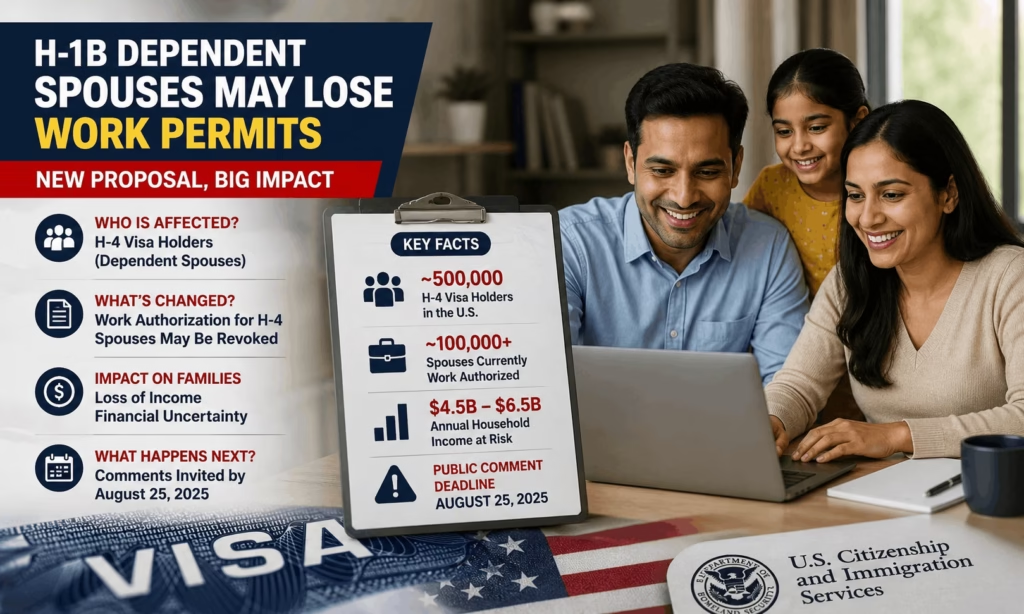
H-1B Spouse Work Permit at Risk: Thousands of dual-income immigrant households across the technology and healthcare sectors are bracing for a major financial shock after the Department of Homeland Security confirmed a new plan targeting the H-1B spouse work permit program. On August 29, 2026, a notice of proposed rulemaking, listed under regulatory identifier RIN 1615-AD14, was formally added to the federal government’s long-term regulatory agenda, signaling that the administration intends to eliminate employment authorization eligibility for spouses of H-1B visa holders who currently hold H-4 visas. While no exact rollout date has been announced, the filing marks the clearest signal yet that the H-4 EAD program, first created under the Obama administration in 2015, is heading toward elimination.
For families who rely on two incomes, the timing could not be worse. Many H-1B households have structured mortgages, childcare costs, and long-term savings plans around the assumption that a spouse’s income would continue for years while the primary visa holder waits out an employment-based green card backlog that, for applicants born in India, can stretch well beyond a decade. If the rule is finalized as proposed, that second paycheck could disappear almost overnight for tens of thousands of families, forcing sudden and painful adjustments to household budgets. We’ll be updating this article monthly as DHS releases further details on the rulemaking timeline and any legal challenges that follow.
What Changed?
| Detail | Information |
|---|---|
| Proposal name | Removal of certain H-4 spouses from EAD eligibility |
| Regulatory ID | RIN 1615-AD14 |
| Announced | August 29, 2026 |
| Issuing agency | Department of Homeland Security (DHS) |
| Program affected | H-4 Employment Authorization Document (H-4 EAD) |
| Original rule created | 2015, under the Obama administration |
| Who currently qualifies | H-4 spouses whose H-1B partner has an approved I-140 or an H-1B extension beyond six years |
| Estimated current H-4 EAD holders | Estimated in the tens of thousands, historically over 100,000 at peak |
| Stage of the process | Early rulemaking; no formal proposed rule text released yet |
| Target implementation date | Not yet announced |
| Likely legal challenges | High, based on prior 2018-2020 attempts to end the program |
Understanding the H-4 EAD Program Before the Proposed Rollback
To understand why this proposal matters so much, it helps to look at what the H-4 work permit actually does. The H-1B visa is a nonimmigrant work visa for skilled professionals in fields like technology, engineering, healthcare, and finance, typically valid for three years and extendable up to six. Spouses and unmarried children under 21 who accompany the H-1B worker are classified under the H-4 dependent visa category. On their own, H-4 holders cannot legally work in the United States.
That changed with the 2015 rule, which allowed a specific subset of H-4 spouses, those whose H-1B partner already had an approved employment-based immigrant petition (Form I-140) or had received an H-1B extension beyond the standard six-year limit while a green card case was pending, to apply for an Employment Authorization Document. Once approved, an H-4 EAD functions much like any other work permit: the holder can work for virtually any employer, in virtually any field, without needing separate visa sponsorship.
The policy was designed with a specific purpose in mind. Employment-based green card wait times for applicants born in countries like India and China can run into decades because of per-country visa caps. The H-4 EAD gave spouses, most of whom are highly educated and many of whom left established careers back home, a legal path to keep working while the family waited out the backlog.
USCIS Ukraine TPS EAD Extension: Work Permits Automatically Extended Through October 19, 2026
TPS Terminations 2026: Complete Tracker for Somalia, Ethiopia, South Sudan, Syria, Haiti, and Yemen
September 2026 Refund Payments: All the Real Deposits You Could Actually Get This Month
Why the Trump Administration Wants to End It Now
The current proposal is not the first attempt to unwind the program. The first Trump administration tried to rescind H-4 EAD between 2017 and 2020, citing the “Buy American, Hire American” executive order and arguing that H-4 spouses were competing directly with qualified American workers for jobs across technology, finance, healthcare, and consulting. That earlier effort stalled amid legal challenges, advocacy pressure from major employers, and a change in administration before a final rule was ever published.
This time, the proposal arrives as part of a much broader campaign against the H-1B system as a whole. The administration has already introduced a steep new $100,000 filing fee tied to certain H-1B sponsorships, moved to eliminate the standard 60-day grace period that lets laid-off H-1B workers search for new sponsorship before falling out of status, and is now targeting spousal work authorization as a third front. Officials frame the combined push as closing what they describe as loopholes that let foreign workers and their families compete against Americans in the labor market. Critics, including major immigration advocacy groups, argue the changes will drive skilled workers and their families toward countries with friendlier immigration systems, such as Canada, which has no per-country green card cap and has seen a documented rise in former U.S.-based skilled workers relocating north in recent years.
How Big Is the Financial Impact on Families
For a typical dual-income H-1B household, the H-4 EAD often represents thirty to fifty percent of total family earnings, sometimes more in cases where the H-4 spouse works in a well-paying technical or medical field. Losing that income does not just mean tighter monthly budgets. It can directly affect:
- Mortgage qualification and refinancing, since many lenders calculate loan eligibility based on combined household income
- Childcare and school costs, particularly in high cost-of-living metro areas with large H-1B populations like the San Francisco Bay Area, Seattle, and the New York-New Jersey corridor
- Retirement and 401(k) contributions, which often assume two incomes contributing simultaneously
- Green card processing costs, since many families use the second income to cover attorney fees and filing costs tied to the primary visa holder’s permanent residency case
- Health insurance coverage, in cases where the spouse’s employer-sponsored plan currently covers the family
Beyond the financial mechanics, many H-4 spouses describe the EAD as something closer to a matter of personal identity and independence rather than simply a paycheck. Many arrived in the U.S. with advanced degrees and established careers of their own, only to spend years unable to legally work while waiting for the visa system to catch up. Losing that authorization again would mean returning to full financial dependence on a spouse’s single income and immigration status.
Who Is Currently Eligible for an H-4 EAD
Even before this proposal, H-4 EAD eligibility has always been narrower than many people assume. Under the existing rule, an H-4 spouse generally qualifies only if one of the following applies to their H-1B partner:
- The H-1B spouse has an approved I-140 immigrant petition (the key step in the employment-based green card process), even if the actual green card is still years away due to backlog
- The H-1B spouse has received a visa extension beyond the standard six-year limit, which itself typically requires either an approved or long-pending I-140 or a pending labor certification
Spouses of workers who recently won the H-1B lottery and have not yet reached these milestones are not currently eligible for an H-4 EAD, regardless of how long the family has lived in the U.S. This narrower eligibility window is one reason estimates of current H-4 EAD holders vary, ranging from the tens of thousands today to historical highs of over 100,000 approvals at the program’s peak, the vast majority going to spouses of Indian H-1B holders.
Service Canada Benefit Payments September 2026 Dates, Amounts and Who Qualifies
Canada FMCSP Study Permit: 2,970 Spots Now Open for French-Speaking Students From 33 Countries
What Happens If the Rule Is Finalized
DHS has not yet released the full text of a formal proposed rule, and officials have not clarified several critical details, including whether existing H-4 EAD holders would be allowed to keep working until their current permit expires, whether there would be a wind-down period, or whether the rule would apply only to new applicants going forward. Historically, similar policy reversals attempted during the first Trump term were challenged in federal court by advocacy organizations, and litigation significantly slowed the process before an administration change ultimately shelved the effort entirely.
Given that history, most immigration attorneys expect this attempt to also face legal challenges once a formal rule is published, meaning the actual timeline for elimination could stretch well beyond a year even after the proposal becomes official. In the meantime, current H-4 EAD holders and renewal applicants should not assume immediate changes, since the notice added to the regulatory agenda is an early procedural step, not a finalized policy.
What H-1B and H-4 Families Should Do Right Now
Immigration attorneys generally recommend that affected families take a few practical steps while the situation develops rather than waiting until a final rule is published:
- Check your current H-4 EAD expiration date and file for renewal as early as the rules allow, since existing automatic extension protections for some EAD categories have already been narrowed by DHS for applications filed after certain 2026 cutoff dates.
- Review your household budget assuming a scenario where the second income disappears, so any transition is less disruptive if the rule eventually takes effect.
- Consult an immigration attorney about your specific I-140 and visa extension status, since eligibility rules are highly fact-specific and small details can affect timing.
- Monitor the official regulatory docket for RIN 1615-AD14 rather than relying on secondhand summaries, since the formal proposed rule text, once published, will include the real implementation details.
- Explore alternate visa categories, such as a spouse applying for their own H-1B, O-1, or other independent work visa, where eligible, to reduce dependence on the H-4 EAD pathway entirely.
H-1B Filing Fee and Grace Period Changes: The Bigger Picture
The H-4 EAD proposal is not happening in isolation. It arrives alongside other recent changes that collectively make the H-1B pathway more expensive and less forgiving. The newly introduced six-figure filing fee for certain H-1B petitions has already led some smaller employers and startups to scale back or eliminate sponsorship altogether, since the added cost can be difficult to justify for early-stage companies. Separately, the elimination of the standard grace period after job loss means H-1B workers who are laid off now have a much shorter window to secure new sponsorship before falling out of legal status, a change that indirectly increases pressure on families who may have been counting on the spouse’s H-4 EAD income to bridge a gap during a job search.
Taken together, these three changes, the filing fee increase, the shortened grace period, and the proposed H-4 EAD rollback, represent one of the most significant tightening cycles for the H-1B program since the visa category was created, and immigration policy analysts expect additional proposals to follow as the regulatory agenda continues to develop through the rest of 2026.
Conclusion
The proposed rollback of the H-1B spouse work permit program is still in its earliest procedural stage, but the direction of travel is unmistakable. For the tens of thousands of families currently relying on H-4 EAD income, and the many more who were counting on eventually qualifying once their I-140 clears, the uncertainty alone is already forcing difficult financial planning conversations. Whether the rule survives the same legal and political obstacles that sank the first attempt between 2017 and 2020 remains to be seen, but families affected by the policy should treat this moment as a signal to prepare rather than wait. Staying current on renewal deadlines, consulting an immigration attorney about individual eligibility, and building a household budget that does not assume permanent dual income are the most practical steps available while the rulemaking process plays out over the coming months.
IRCC Tightens Citizenship by Descent: What the New 1,095-Day Presence Test Rules Mean for Applicants
SSI Address Change Service Enhancements: SSA’s New Fast-Track Process Explained
Official Resources and Useful Links
| Resource | What It’s For |
|---|---|
| USCIS official website | H-4 EAD eligibility rules and form instructions |
| USCIS Form I-765 page | Application form for employment authorization |
| USCIS case status online | Check pending H-4 EAD or I-140 application status |
| Federal Register regulatory docket | Track the formal RIN 1615-AD14 proposed rule once published |
| DHS regulatory agenda (Unified Agenda) | See the current status of the H-4 EAD proposal |
| Department of State visa bulletin | Track employment-based green card priority dates and backlog movement |
FAQs
Can H-4 visa holders still work in 2026?
Yes, for now. Only H-4 spouses who already hold an approved I-140 or whose H-1B partner has extended beyond six years can currently apply for an H-4 EAD, and existing rules remain in place until a final rule is published and takes effect.
Will H-4 EAD be eliminated under Trump? .
The Department of Homeland Security has added a proposal to end H-4 EAD eligibility to its regulatory agenda as of August 2026, but no formal rule has been published yet, and any final elimination would likely take well over a year to implement given expected legal challenges
How long does H-4 EAD processing take?
Processing times for H-4 EAD applications have historically ranged from a few weeks to several months depending on USCIS workload, though recent policy changes narrowing automatic extensions have made timely renewal filing more important than ever.
Who qualifies for an H-1B spouse work permit?
An H-4 spouse generally qualifies only if their H-1B partner has an approved employment-based immigrant petition (I-140) or has received an H-1B extension beyond the standard six-year limit while a green card case is pending.
What happens to my H-4 EAD if the rule changes?
DHS has not clarified whether current H-4 EAD holders would be allowed to keep working until their existing permit expires or whether the change would apply immediately, so affected workers should monitor official updates closely.
How many H-1B spouses currently have work permits?
Estimates vary, but historically more than 100,000 H-4 EADs have been approved at the program’s peak, with the majority going to spouses of H-1B holders born in India.
Can H-1B spouses apply for their own work visa instead?
Yes, in some cases. Spouses with qualifying skills or job offers may be able to pursue their own H-1B, O-1, or other independent employment-based visa rather than relying solely on H-4 EAD eligibility.
Why is the Trump administration targeting H-4 EAD again?
Officials argue the program allows H-4 spouses to compete directly with American workers across professional fields, and the current proposal follows a similar attempt made during the first Trump term between 2017 and 2020 that was ultimately not finalized.
SSA Strategic Plan FY2026-2030: New Goals, Wait Times & Service Targets
SSA Ticket to Work Program: How Disability Beneficiaries Can Return to Work Without Losing Benefits
SSDI Payment Dates September 2026: Who Gets Paid and When?
Japan Visa Renewal Fee Increase 2026: New Charges From October Explained