USCIS Ukraine TPS EAD Extension: U.S. Citizenship and Immigration Services gave thousands of Ukrainian workers a moment of relief on August 14, 2026, announcing that certain expired Temporary Protected Status work permits will remain automatically valid through October 19, 2026. The notice specifically targets Ukrainian TPS beneficiaries who filed a timely re-registration and Employment Authorization Document renewal before the March 18, 2025 deadline but are still waiting on a decision, a backlog that had left many with a facially expired card and no clear proof of continued work authorization.
But that announcement is only half the story, and it’s the smaller half. Just days after USCIS issued its EAD guidance, a separate legal mechanism quietly triggered in the background: because the Department of Homeland Security let the statutory 60-day review deadline for Ukraine’s TPS designation pass without publishing a formal decision, federal law itself now extends Ukraine’s entire TPS designation for an additional six months, pushing the real expiration date to April 19, 2027. Nobody announced this. No press release marked the moment. It happened automatically, by operation of law, and most Ukrainian TPS holders don’t yet know about it. We’ll be updating this article monthly as DHS and USCIS release further Ukraine TPS guidance.
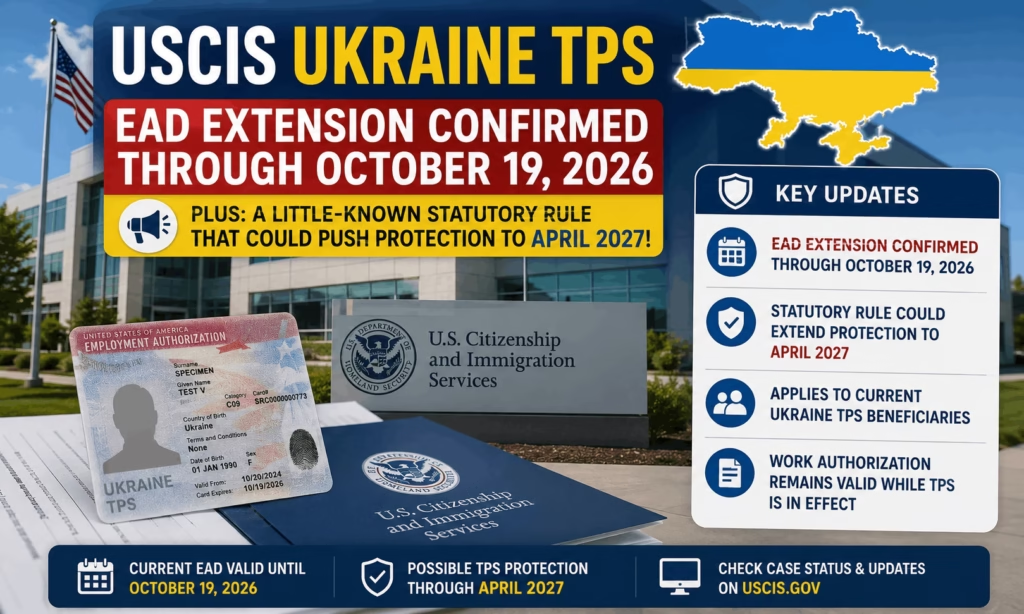
Latest Update: What’s Confirmed About Ukraine TPS Right Now
| Detail | Information |
|---|---|
| USCIS EAD extension announcement | August 14, 2026 |
| EAD automatic extension covers | Ukraine TPS beneficiaries with a pending renewal filed by March 18, 2025 |
| EAD valid through (per USCIS notice) | October 19, 2026 |
| Eligible EAD category codes | A-12 or C-19 |
| Eligible expired “Card Expires” dates | April 19, 2025, or October 19, 2023 |
| Ukraine’s current TPS designation was set to end | October 19, 2026 |
| Statutory 60-day review deadline missed by DHS | August 20, 2026 |
| Automatic statutory extension triggered under | 8 U.S.C. § 1254a(b)(3)(C) |
| New legal TPS expiration date (by operation of law) | April 19, 2027 |
| Approximate Ukrainian TPS population | Roughly 103,700 (last confirmed re-registration cycle) |
| Governing eligibility cutoff | Continuous U.S. residence since August 16, 2023 |
What USCIS Actually Announced on August 14?
The August 14 notice was narrowly targeted at solving an immediate, practical problem. Thousands of Ukrainian TPS holders had filed a timely re-registration and EAD renewal application during the official window between January 17 and March 18, 2025, but USCIS had not yet issued them a new physical card. That left many beneficiaries holding a work permit that looked expired on its face, creating real risk during Form I-9 reverification or E-Verify checks at their jobs.
To close that gap, USCIS is mailing and electronically distributing individualized Notices of Action confirming that qualifying expired EADs, those carrying category code A-12 or C-19 with a “Card Expires” date of April 19, 2025 or October 19, 2023, remain valid through October 19, 2026. For Form I-9 purposes, an affected employee can present the expired physical card together with this USCIS notice as a valid combination of documents. Employers are instructed to enter October 19, 2026 in the applicable expiration date fields and note the extension in the Additional Information section, and to use the same date for E-Verify cases.
TPS Terminations 2026: Complete Tracker for Somalia, Ethiopia, South Sudan, Syria, Haiti, and Yemen
September 2026 Refund Payments: All the Real Deposits You Could Actually Get This Month
Service Canada Benefit Payments September 2026 Dates, Amounts and Who Qualifies
Canada FMCSP Study Permit: 2,970 Spots Now Open for French-Speaking Students From 33 Countries
A Six-Month Extension No One Announced
Here is where this story moves well beyond a routine EAD notice. Under the Immigration and Nationality Act, the Secretary of Homeland Security is required to review a TPS-designated country’s conditions and publish a decision, whether to extend, redesignate, or terminate, at least 60 days before that country’s current designation expires. For Ukraine, with an October 19, 2026 expiration date, that review deadline fell on August 20, 2026.
DHS let that deadline pass without publishing any formal determination in the Federal Register. Under federal statute, specifically 8 U.S.C. § 1254a(b)(3)(C), missing that deadline is not a neutral outcome. The law states plainly that if the Secretary does not make a timely determination, “the period of designation of the foreign state is extended for an additional period of 6 months.” That is not a discretionary courtesy DHS can choose to apply or ignore. It is a self-executing statutory mandate, triggered automatically by the calendar date itself, regardless of whether the agency wants it to happen or issues any public statement about it.
The practical result: Ukraine’s TPS designation, which was scheduled to end October 19, 2026, has already been legally extended to April 19, 2027, whether or not USCIS or DHS has said so publicly yet.
Why This Matters More Than a Typical Extension?
A statutory extension carries more legal weight than an ordinary discretionary one, and that distinction matters for anyone trying to predict what happens next. A companion provision, 8 U.S.C. § 1254a(b)(3)(B), specifically restricts how a future termination decision can be applied: any termination the Secretary later announces can only take effect at the end of the current designation period. In practical terms, that means even if DHS eventually decides to end Ukraine’s TPS designation, the earliest it could legally take effect is April 19, 2027, not October 19, 2026. Attempting to shorten or retroactively cancel a statutory extension that has already been triggered would run contrary to how the provision is written.
This also intersects with the broader legal landscape shaped by the Supreme Court’s June 25, 2026 ruling in Mullin v. Doe, which sharply limited judicial review of a Homeland Security Secretary’s substantive country-conditions decisions. That ruling does not touch this situation the same way, because the six-month extension here isn’t a substantive discretionary call about Ukraine’s conditions. It is a clear statutory trigger tied to a missed deadline, an area where courts generally retain the ability to review whether the agency followed the law as written.
What Ukrainian TPS Beneficiaries Should Know Right Now?
Do You Need to Re-Register for the Extra Six Months?
No, not at this time. The automatic statutory extension applies as a blanket protection to all TPS beneficiaries who remain eligible under Ukraine’s current designation. Current TPS holders do not need to file a new Form I-821 simply to benefit from the six-month extension, since the protection triggers automatically for anyone who already holds valid status.
Will DHS Publish Anything Official About This?
Eventually, yes. DHS is expected to publish a retroactive notice in the Federal Register formally documenting the six-month extension, along with instructions for beneficiaries, employers, and state agencies. The statute does not set a firm deadline for when that notice must appear, so it could come at any point before the April 19, 2027 extension itself expires. It is common practice for DHS to publish this kind of clarifying notice after the fact rather than in advance.
What Does This Mean for Work Permits Specifically?
This is the most unsettled piece of the puzzle right now. Legally, the automatic six-month statutory extension of the underlying TPS designation should also extend the validity date of TPS-based work permits beyond the October 19, 2026 date USCIS referenced in its August 14 notice. Whether USCIS will actually formalize April 19, 2027 as the new EAD expiration date, and how it will communicate that to beneficiaries and employers, remains to be seen. Two realistic paths exist: DHS could publish a blanket EAD extension covering all beneficiaries directly in its Federal Register notice, or it could require a standard re-registration process with new Form I-765 filings if it ultimately decides to formally extend Ukraine’s designation for a full 12 to 18 months rather than relying on the automatic six-month period alone.
How to Apply or Confirm Your Ukraine TPS Status?
For Ukrainian nationals navigating this evolving situation, here is the practical path forward depending on your circumstances.
- Check your eligibility first. TPS remains limited to Ukrainian nationals who have continuously resided in the United States since on or before August 16, 2023. Individuals who arrived after that date are not eligible under the current designation.
- Confirm your EAD category code. Only cards marked A-12 or C-19 with a “Card Expires” date of April 19, 2025 or October 19, 2023 qualify for the automatic extension referenced in the August 14 notice.
- Watch your mail and myUSCIS account for the individualized Notice of Action confirming your specific extension, and keep it together with your expired physical card.
- If you missed the March 18, 2025 re-registration deadline, you may still be able to file a late re-registration by showing good cause and submitting a letter of explanation, which USCIS can accept at its discretion.
- If you filed an initial TPS application that is still pending, continue monitoring your case; an approval issued during this period should reflect the new statutory end date.
- Present the correct combination of documents to your employer, an expired EAD plus the USCIS extension notice, for Form I-9 or E-Verify purposes through at least October 19, 2026.
IRCC Tightens Citizenship by Descent: What the New 1,095-Day Presence Test Rules Mean for Applicants
SSI Address Change Service Enhancements: SSA’s New Fast-Track Process Explained
Processing Time for Pending Ukraine TPS Applications
USCIS has not published a specific accelerated processing timeline tied to this extension. Beneficiaries with a pending re-registration or EAD renewal filed during the January–March 2025 window should expect continued processing delays consistent with the broader backlog that prompted the August 14 automatic extension notice in the first place. Initial (first-time) TPS applicants filing a late application should be aware that, given current processing delays, USCIS may not adjudicate their case before the designation’s current legal end date, though an eventual approval would still be considered valid retroactively from the filing date.
What This Means for Public Benefits and Documentation?
A pending or approved TPS application can support eligibility for certain public benefits and REAL ID-compliant driver’s licenses or identification cards in many states. Beneficiaries applying for these benefits during this extension period should be prepared to show either a TPS Employment Authorization Document with category code A-12 or C-19, or a copy of their Form I-797 Notice of Action for a current Form I-821 application, as proof of their status.
Ukraine Isn’t Alone: Sudan and El Salvador Face the Same Squeeze
Ukraine’s situation did not happen in isolation. On the same day it issued the Ukraine notice, USCIS also extended certain Sudan TPS-based EADs through October 19, 2026, using an identical mechanism for beneficiaries with pending renewal applications. Sudan’s TPS designation shares Ukraine’s October 19, 2026 expiration date, meaning both countries are subject to the same statutory 60-day review deadline and the same potential for an automatic six-month extension if DHS does not act in time.
El Salvador presents a related but distinct complication. Employment authorization for TPS beneficiaries from El Salvador, Ukraine, and Sudan with pending EAD renewals was previously set to expire on July 22, 2026, under a separate policy interpretation tied to the One Big Beautiful Bill Act, the tax-and-spending legislation passed in July 2025 that imposed a one-year cap on TPS-based EAD validity. That work-permit cap operates independently of the underlying TPS designation itself, which means even a country with an actively extended TPS designation can still see its beneficiaries’ work permits capped at one year under this separate statutory provision. A federal court in Massachusetts declined to block that one-year cap policy in a ruling issued August 5, 2026, meaning the cap continues to apply even as the designation-level extension plays out for Ukraine.
What Employers Need to Know About Reverification?
For businesses employing Ukrainian TPS holders, the practical compliance steps matter just as much as the underlying legal theory. Employers should treat the August 14 USCIS notice as the current operative guidance for Form I-9 purposes, entering October 19, 2026 as the expiration date and retaining a copy of the individualized USCIS notice alongside the employee’s I-9 record. Because the statutory six-month extension has not yet been formally translated into updated USCIS guidance, employers should avoid extending that date on their own initiative to April 19, 2027 without official confirmation, and instead continue monitoring USCIS’s TPS Ukraine webpage and any forthcoming Federal Register notice for updated instructions. HR and compliance teams handling multiple TPS-designated employees should also cross-check whether affected workers fall under the separate one-year EAD cap tied to the 2025 tax legislation, since that cap can affect work authorization timelines independently of the designation extension discussed here.
Ukraine TPS Timeline: How the Designation Has Evolved
| Date | Development |
|---|---|
| March 2022 | Ukraine first designated for TPS following Russia’s invasion |
| August 2023 | TPS extended and redesignated through April 19, 2025 |
| January 17, 2025 | TPS extended 18 months, through October 19, 2026 |
| January–March 2025 | 60-day re-registration window for existing beneficiaries |
| August 14, 2026 | USCIS announces automatic EAD extension through October 19, 2026 |
| August 20, 2026 | Statutory 60-day review deadline passes without a DHS decision |
| Result | Automatic 6-month statutory extension triggered, pushing TPS to April 19, 2027 |
Social Security Payment September 2026: Five Confirmed Dates You Need to Know
FAQs About USCIS Ukraine TPS EAD Extension Automatically Through Oct 19, 2026
Is Ukraine’s TPS designation ending on October 19, 2026?
Not according to current federal law. While USCIS’s August 14, 2026 notice referenced October 19, 2026 as the current designation end date, a separate statutory provision automatically extended Ukraine’s TPS designation for six additional months to April 19, 2027, after DHS missed its required 60-day review deadline.
Do I need to re-register to get the automatic six-month extension?
No. The automatic extension applies as a blanket protection to all current TPS beneficiaries who remain eligible under Ukraine’s existing designation, without requiring a new Form I-821 filing at this time.
What documents do I need to show my employer if my Ukraine TPS EAD looks expired?
Present your expired EAD, marked A-12 or C-19 with a Card Expires date of April 19, 2025 or October 19, 2023, together with the USCIS Notice of Action confirming the extension, as a valid combination for Form I-9 purposes through October 19, 2026.
Will my work permit automatically extend to April 19, 2027 too?
This remains unconfirmed by USCIS as of this update. Legally, the statutory extension of the TPS designation should extend work authorization validity as well, but USCIS has not yet issued formal guidance confirming April 19, 2027 as the new EAD expiration date.
Can DHS still terminate Ukraine’s TPS designation?
Yes, DHS retains authority to terminate the designation, but any termination decision can only take legal effect at the end of the current designation period, meaning no earlier than April 19, 2027, under the statutory extension already triggered.
What if I missed the March 18, 2025 re-registration deadline?
You may still be able to file a late re-registration application by demonstrating good cause for the delay and submitting a letter of explanation, which USCIS can accept and approve at its discretion.
Who is eligible for Ukraine TPS in the first place?
Eligibility is limited to Ukrainian nationals, and individuals with no nationality who last habitually resided in Ukraine, who have continuously resided in the United States since on or before August 16, 2023. Individuals who arrived after that date do not qualify under the current designation.
Where can I check the official status of Ukraine’s TPS designation?
The official USCIS Temporary Protected Status webpage for Ukraine is the most current source, and it is updated as DHS publishes new Federal Register notices or guidance related to the designation.
Official Resources for Ukraine TPS Beneficiaries
Always confirm your specific status and documentation requirements directly through official government channels.
| Resource | Purpose | Official Link |
|---|---|---|
| USCIS Temporary Protected Status: Ukraine | Official country-specific TPS status and updates | uscis.gov/humanitarian/temporary-protected-status/temporary-protected-status-designated-country-ukraine |
| myUSCIS online account (login) | View case status, notices, and pending applications | my.uscis.gov |
| Form I-821 | Application for Temporary Protected Status | uscis.gov/i-821 |
| Form I-765 | Application for Employment Authorization | uscis.gov/i-765 |
| E-Verify TPS guidance | Employer verification instructions | e-verify.gov |
| Federal Register | Official TPS designation and extension notices | federalregister.gov |
| USCIS Contact Center | General phone and online support | uscis.gov/contactcenter |
Conclusion
The USCIS Ukraine TPS EAD extension announced on August 14, 2026 solved an immediate paperwork problem for thousands of workers stuck with expired-looking cards. But the more consequential development happened almost invisibly less than a week later, when a missed federal deadline triggered a statutory extension of Ukraine’s entire TPS designation to April 19, 2027, whether or not the government has formally announced it yet. For Ukrainian TPS holders, employers, and immigration attorneys tracking this case, the practical takeaway is to treat October 19, 2026 as an outdated reference point rather than the real deadline, while continuing to watch for the official Federal Register notice that will eventually confirm exactly how DHS plans to handle both the designation and the underlying work permits through this extended window.
SSA Strategic Plan FY2026-2030: New Goals, Wait Times & Service Targets
SSA Ticket to Work Program: How Disability Beneficiaries Can Return to Work Without Losing Benefits
SSDI Payment Dates September 2026: Who Gets Paid and When?
Japan Visa Renewal Fee Increase 2026: New Charges From October Explained